

Choosing The Best Multivitamin For Men In The UK
Finding the best multivitamin for men isn't about grabbing a one-size-fits-all pill off the shelf. It’s about finding a formula that genuinely fills your personal nutritional gaps with high-quality, bioavailable ingredients. The right choice will always line up with your age, diet, and specific health goals, making it a strategic investment in your well-being, not just another supplement.
What Defines The Best Multivitamin For Men

Walking down the supplement aisle can feel overwhelming. With endless brands all promising more energy, sharper focus, and better performance, it’s no wonder so many men just grab the first bottle they see. But if you're serious about your health, the search for the best multivitamin deserves a more thoughtful approach.
The reality is, a standard "one-a-day" tablet often gives you a broad but shallow spread of nutrients. This might tick the most basic boxes, but it’s unlikely to deliver targeted support where you actually need it. Your nutritional needs are unique, and they change quite a bit as you go through life.
Beyond The Basics: A Personalised Approach
A truly effective multivitamin goes way beyond generic formulas. It’s built around delivering specific nutrients in forms your body can actually absorb and put to use—a concept known as bioavailability. This is the critical difference between a supplement that works and one that’s little more than a placebo.
Think about the different ways you can approach supplementation:
| Strategy | Primary Benefit | Who It's For |
|---|---|---|
| All-in-One Daily | Convenience and simplicity. | The busy professional who wants to cover basic nutritional gaps with minimal fuss. |
| Targeted Stacks | Customisation and potency. | The health-conscious man looking to hit specific goals like athletic performance or longevity. |
| Performance Blends | High-impact energy support. | The dedicated athlete or gym-goer needing an extra boost for training and recovery. |
This distinction is key because your lifestyle dictates your needs. An office worker doesn't have the same nutrient demands as a marathon runner, and a guy in his 20s has different priorities than a man in his 50s.
The goal of supplementation isn't just to avoid deficiency; it's to optimise your health. A personalised strategy ensures you're supplying your body with the precise tools it needs to function at its peak, day in and day out.
The UK supplement market reflects this growing demand for more tailored solutions. Valued at roughly USD 2.90 billion in 2024, the industry is set to grow significantly, with multivitamins leading the charge. This signals a clear shift towards proactive health management, where people are looking for more than just basic coverage. You can learn more about these market trends and what they mean for consumers.
Ultimately, identifying the best multivitamin for you means looking past the marketing claims on the bottle. It’s about understanding what your body needs and finding a product or strategy that meets those demands with precision and quality.
Key Nutrients Men Need At Different Life Stages

A man’s nutritional needs aren’t set in stone; they change and evolve as the decades pass. The nutrients that fuel peak performance in your twenties are worlds away from those needed to protect your long-term health in your forties and beyond.
Getting your head around these shifts is the first step in finding a multivitamin that’s genuinely right for you, one that aligns with where you are in life right now. Think of it like maintaining a car: when it’s brand new, you’re all about high-octane fuel for performance. As the mileage climbs, you start paying more attention to protective oils and engine care to keep it running smoothly for the long haul. Your supplement strategy should follow the same logic.
Under 40: Fuelling Performance And Vitality
For men in their 20s and 30s, life is often running at full throttle. You’re building a career, maybe a family, and pushing your physical limits. Nutritional priorities are geared towards energy production, muscle function, and hormonal health. A good multivitamin acts as a solid support system for this high-demand phase.
The non-negotiables for this group usually include:
- B Vitamins: This family of eight essential vitamins (including B12, B6, and Folate) are the spark plugs for your metabolism. They’re absolutely vital for converting the food you eat into usable energy, fuelling everything from tough workouts to long days at your desk.
- Magnesium: Often running low due to stress and physical activity, magnesium is a master mineral involved in over 300 biochemical reactions. It’s critical for muscle contraction and relaxation, nerve function, and sleep quality.
- Zinc: This mineral is a true cornerstone of men’s health. It’s a key player in testosterone production, supports a robust immune system, and is essential for fertility.
A multivitamin for a man under 40 should be built to sustain high energy output and shore up the foundations of muscle growth and hormonal balance. It’s less about long-term prevention and more about immediate performance optimisation.
This stage is all about maximising your potential. Your body is resilient, but modern life can easily create nutritional gaps. A well-formulated supplement can help fill them, ensuring you’ve got the resources to perform at your best.
Over 40: Proactive Support For Long-Term Health
Once men hit their 40s and beyond, the focus naturally shifts from peak performance to proactive health maintenance. Hormonal changes are kicking in, metabolism might start to slow down, and the risk of age-related health issues starts to creep up. The best multivitamin for this age group anticipates these changes and provides targeted support for longevity and cognitive performance.
The conversation turns to protecting key systems:
- Vitamin D: Absolutely essential for absorbing calcium, Vitamin D is fundamental for maintaining bone density and warding off osteoporosis later in life. It also plays a massive role in immune function and even mood regulation.
- Vitamin K2: This vitamin works hand-in-hand with Vitamin D. It helps direct calcium to your bones where it belongs, and importantly, away from your arteries. This double-act is vital for supporting both skeletal strength and cardiovascular health.
- Selenium: A powerful antioxidant, selenium helps protect your cells from damage and is particularly important for prostate health. It also supports thyroid function, which is the master regulator of your metabolism.
The need for certain nutrients, like Vitamin D, is especially relevant here in the UK. National guidance has highlighted widespread low levels, prompting the NHS to recommend that everyone consider a daily 10 microgram (400 IU) supplement during the autumn and winter months.
This specific advice is a big reason why any decent men’s multivitamin in the UK will include a solid dose. For a deeper dive into this topic, our guide on supplements for men over 40 offers more detailed strategies for supporting long-term wellness. Choosing the right nutrients at this stage is a powerful investment in your future health.
To make this easier to digest, here’s a quick-glance table comparing the nutrient priorities for each age group.
Nutrient Priorities For Men By Age
| Nutrient | Why It's Important For Men Under 40 | Why It's Important For Men Over 40 |
|---|---|---|
| B Vitamins | Powers energy metabolism for an active, high-demand lifestyle and supports cognitive function during career-building years. | Still important for energy, but also supports nerve function and helps manage homocysteine levels for heart health. |
| Magnesium | Crucial for muscle recovery after workouts, managing stress, and supporting over 300 enzymatic reactions needed for peak performance. | Helps maintain normal muscle function, supports blood pressure regulation, and can aid in sleep quality. |
| Zinc | A cornerstone for testosterone production, immune defence, and supporting fertility and reproductive health. | Continues to support immune function and testosterone, but also plays a key role in prostate health. |
| Vitamin D | Supports immune function and mood, which are key for handling the pressures of daily life and physical training. | Essential for calcium absorption to maintain bone density and prevent age-related decline. Crucial for immune health. |
| Vitamin K2 | Plays a supporting role in bone health, laying the groundwork for later life. | Works with Vitamin D to direct calcium to bones and away from arteries, directly supporting both skeletal and cardiovascular health. |
| Selenium | Acts as an antioxidant, protecting cells from the stress of a fast-paced lifestyle. | A powerful antioxidant specifically linked to protecting prostate health and supporting thyroid function as metabolism changes. |
This table shows how the focus shifts. It’s not that B Vitamins suddenly become unimportant after 40, but rather that nutrients like Vitamin K2 and Selenium take on a new level of priority for proactive, long-term health.
How To Read A Supplement Label Like An Expert
Choosing the right multivitamin isn't just about the nutrients listed on the front of the bottle; it's about the quality and form of those ingredients. The supplement label is your road map to a product's true value, but you need to know what to look for beyond the flashy claims. Learning to decode these labels is the single most important skill you can develop to make sure your investment is actually doing you some good.
Let's be honest, many labels are confusing, and some are even designed to be misleading. But by focusing on a few key details, you can quickly separate the high-quality formulas from the duds and get exactly what you're paying for.
Understanding Bioavailability: The Form Is Everything
The word bioavailability might sound a bit technical, but the idea is simple: it’s the amount of a nutrient your body can actually absorb and put to use. This is where many budget multivitamins cut corners. They use cheaper, less absorbable forms of vitamins and minerals to keep costs down, but it means you're not getting the benefits.
Magnesium is a classic example. You could see two labels, both listing 400 mg of magnesium, but one is vastly superior.
- Magnesium Oxide: This form is cheap and doesn't take up much space in a capsule, but its bioavailability is shockingly low. Some studies suggest as little as 4% gets absorbed. The rest is often just flushed from your system, which is why it can sometimes cause gut health issues.
- Magnesium Glycinate: This form is "chelated," which means the magnesium is bound to an amino acid (in this case, glycine). This simple change makes it much easier for your body to recognise and absorb, giving you far better results without the digestive issues.
This same principle applies to most nutrients. Keep an eye out for methylated B vitamins (like methylcobalamin for B12) and chelated minerals (like zinc picolinate or glycinate). These are usually signs of a premium, effective formula.
Identifying Common Red Flags On The Label
Once you get the hang of bioavailability, you'll start spotting red flags all over the place. Good supplements are transparent and precise, while lower-quality products often hide behind vague language and a long list of unnecessary additives.
1. Proprietary Blends
This is a major warning sign. A "proprietary blend" or "complex" is a smokescreen. It lists a group of ingredients with a single total dosage, which means you have no idea how much of each one you're actually getting. It’s a common trick to hide the fact that you're getting clinically meaningless doses of the expensive stuff and a whole lot of cheap filler.
2. Fillers, Binders, and Artificial Colours
Always scan the "Other Ingredients" list at the bottom. Things like magnesium stearate, titanium dioxide, and artificial colours (e.g., FD&C Red No. 40) add zero health benefits. While some binders are needed to press a tablet, a long list of chemical-sounding names is often a sign of a cheaper manufacturing process.
3. Ineffective Dosages and Vague Percentages
Pay close attention to the "% NRV" (Nutrient Reference Value) column. This tells you what percentage of your recommended daily intake the supplement provides for each nutrient. To get the full picture on this, our guide explaining what the Nutrient Reference Value means is a great resource.
A common tactic is to sprinkle in a tiny amount of a trending ingredient, like CoQ10 or ashwagandha, just so they can put it on the front of the bottle. If the dose is miles below the scientifically studied amount, it's not going to do anything for you. Always question why an ingredient is there and if the dose is actually meaningful.
Being a savvy buyer means reading past the marketing on the front and getting to the facts on the back. Developing this expert eye will help you find a men's multivitamin that truly delivers.
Comparing Different Multivitamin Strategies
Choosing the best multivitamin for men isn't just about grabbing a bottle off the shelf; it's about picking a strategy that actually fits your life. There's more than one way to build a solid supplement routine, and the right approach for you will be a sweet spot between convenience, cost, and your personal health goals.
Figuring out the difference between these strategies is crucial if you want a plan you can stick with—one that delivers real results. Let's break down the three most common ways guys approach this: the simple all-in-one, the precise targeted stack, and the high-octane performance blend. Each has its own strengths and is built for a different kind of man.
The All-in-One Daily
This is the classic, no-fuss approach to supplementation. An all-in-one daily multivitamin packs a broad spectrum of essential vitamins and minerals into a single, convenient pill or two. Its main appeal is simplicity. You take it once a day and get on with your life.
This strategy is perfect for men who are just dipping their toes into the world of supplements or simply have a jam-packed schedule. It’s a great way to cover your basic nutritional bases and patch up common dietary gaps without the headache of juggling multiple bottles. But, its greatest strength is also its main weakness—the one-size-fits-all formula means the doses might not be perfectly dialled in for your specific needs, age, or activity level.
Ideal User: The busy professional or supplement beginner who wants a simple, set-and-forget way to ensure foundational nutrient coverage without overthinking their daily routine.
The Targeted Stack
This is a more advanced and personalised strategy. A targeted stack usually starts with a solid foundational multivitamin, but then you add specific, individual supplements to zero in on particular health goals. This is where you can get really precise with your regimen.
For example, you might add a high-potency omega-3 for heart and brain health alongside your daily multi, or throw in some ashwagandha to help manage stress. Others might add extra magnesium to improve sleep quality and speed up muscle recovery. This method gives you maximum customisation, letting you build a routine that's perfectly tuned to your body's demands.
Of course, while this approach delivers superior personalisation and potency, it does require a bit more effort and knowledge on your part. It also tends to be more expensive than a simple all-in-one, as you're buying several different products.
Ideal User: The health-conscious man with specific goals (like boosting cognitive performance or supporting joint health) who is willing to invest the time and money to create a highly personalised supplement plan.
The Performance Blend
Performance blends are specialised formulas designed for men who really push their bodies. These products are often more than just a multivitamin; they're hybrid formulas that combine essential vitamins and minerals with performance-focused ingredients like amino acids, antioxidants, and herbal extracts.
You'll often find these packed with high doses of B vitamins to fuel energy metabolism, along with antioxidants like Vitamin C and E to fight the oxidative stress that comes from intense exercise. While they're excellent for supporting athletic training and recovery, these blends might not provide the same broad, long-term health support as a traditional multivitamin. They are built for a specific purpose—fuelling physical performance—and might be light on certain nutrients important for your overall wellness.
Ideal User: The dedicated athlete, regular gym-goer, or anyone engaged in intense physical activity who needs a robust formula to support energy production, muscle function, and rapid recovery.
This decision-tree flowchart breaks down how to evaluate any supplement, helping you check the ingredient form, spot fillers, and verify the dose.
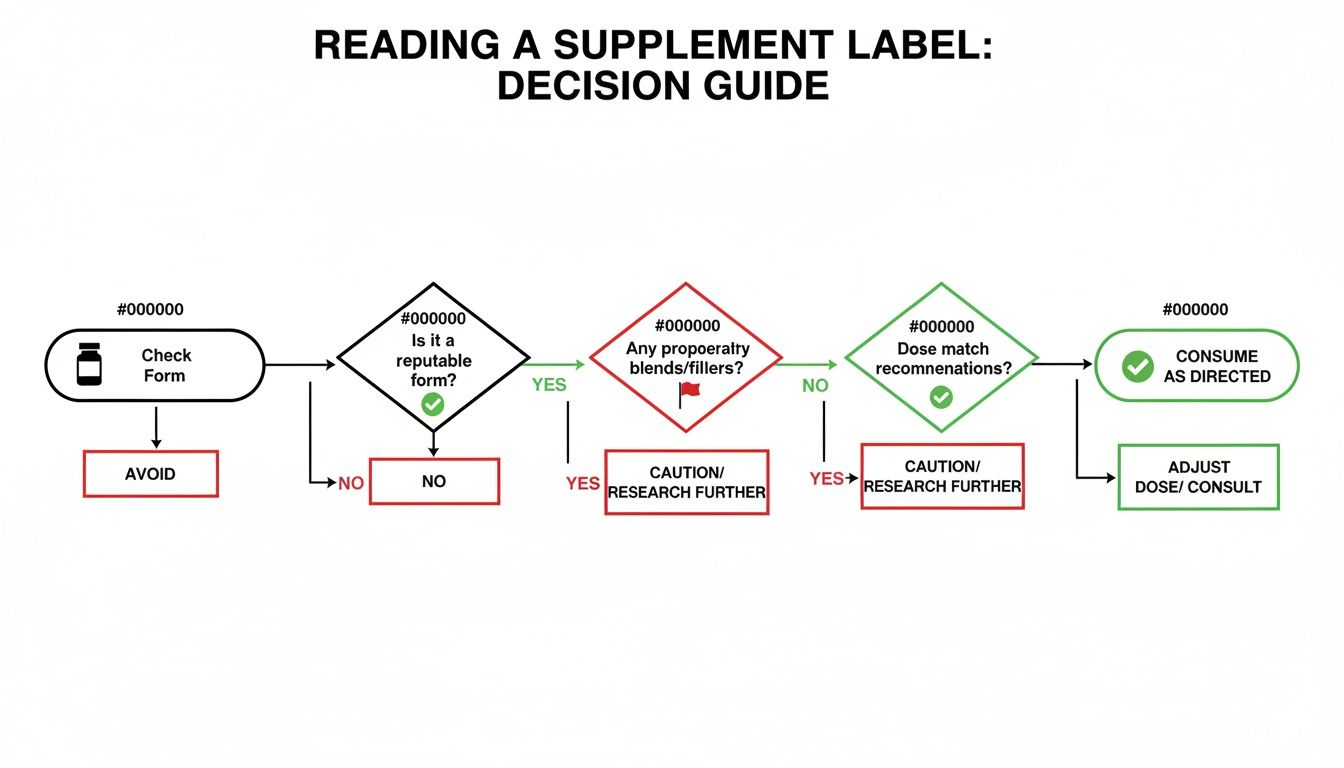
Ultimately, this flow reinforces a key idea: the quality of the ingredients and their dosages are what determine a supplement's real value, no matter which strategy you go for.
Choosing Your Strategy
Making the right choice really comes down to a bit of self-awareness. Think about your lifestyle, your budget, and how much time you're genuinely willing to put into your supplement routine. There is no single "best" strategy—only the one that works best for you.
To help lay it all out, the table below gives a side-by-side comparison of these three popular approaches.
Multivitamin Strategy Comparison
| Approach | Best For | Potential Drawbacks | Typical User |
|---|---|---|---|
| All-in-One Daily | Convenience and covering basic nutritional needs with minimal effort. | Generic, one-size-fits-all dosing that may not be optimal for specific health goals. | The man who is just starting with supplements or prioritises simplicity above all else. |
| Targeted Stack | Maximum personalisation and potent, goal-oriented support for specific health concerns. | Higher cost, requires more research, and involves taking multiple pills daily. | The man who is knowledgeable about supplements and wants to build a tailored plan for his unique needs. |
| Performance Blend | Supporting high-intensity physical activity, energy production, and muscle recovery. | May lack broad foundational nutrients for long-term health and can be overly specialised. | The athlete or fitness enthusiast whose primary goal is to enhance physical performance and recovery. |
By weighing up your own priorities against these options, you can confidently pick a multivitamin strategy that fits your life and helps you move closer to your health objectives.
Building Your Personal Supplement Plan

Alright, you now know how to tell the good stuff from the marketing fluff and can read a supplement label like a pro. Let's put that knowledge to work and build a plan that's actually designed for you. Finding the best multivitamin for men isn't about grabbing the first bottle you see; it's about a smart process of looking at your diet, figuring out what you want to achieve, and creating a routine you can stick with.
Don't worry, this doesn't have to be complicated. With a clear framework, you can go from feeling unsure to being confident that your choices are directly fuelling your health goals.
Step 1: Assess Your Current Diet
Before adding anything, you need to get real about what you’re already eating. Are your meals packed with a variety of fruits and vegetables, or are you surviving on quick, processed options? Try keeping a food diary for a week—it can be a seriously eye-opening exercise.
This isn't about judging yourself; it's about spotting the gaps. If oily fish never makes it onto your plate, an omega-3 supplement should probably be on your radar. If you're on a plant-based diet, B12 and iron are likely non-negotiables. The aim is to establish a realistic baseline, not to strive for perfection. For a truly data-driven approach, a vitamin deficiency test in the UK can give you the hard facts on what your body is actually missing.
Step 2: Define Your Primary Health Goals
Next, you need to get specific. A vague goal like "be healthier" is impossible to track and easy to abandon. Instead, think about what you actually want to feel or achieve.
Are you trying to:
- Boost energy levels so you're not flagging by 3 pm?
- Improve muscle recovery after hitting the gym hard?
- Sharpen your focus and manage daily stress?
- Support your long-term heart health as you get older?
Your main objective will be your compass. If energy is the top priority, a formula loaded with B vitamins and CoQ10 is a logical choice. If stress is the bigger issue, you might lean towards a stack that includes adaptogens like ashwagandha.
A supplement plan without a clear goal is like a ship without a rudder. By defining your destination first, you ensure every choice you make is moving you in the right direction.
Step 3: Align Your Plan With Your Lifestyle
Finally, any plan you make has to be sustainable. There's no point in designing a complex, expensive routine that you can't stick to for more than a week. Be honest about your budget and how many pills you're realistically going to take each day.
If simplicity is your game, a solid all-in-one daily multivitamin is a fantastic starting point. But if you’re laser-focused on specific outcomes and don't mind a more detailed regimen, a targeted stack will serve you much better. For a deeper dive into creating a routine that slots seamlessly into your life, check out our guide on building a personalised nutrition plan.
Real-World Examples: Putting It All Together
Let's see how this plays out in the real world. Here are two examples showing how a man's age, diet, and goals create two very different—but equally effective—supplement stacks.
Scenario 1: Mark, 32, Focused on Fitness and Energy
- Goal: Maximize gym performance, recover faster, and stay energised for a demanding job.
- Diet: Pretty healthy, but leans heavily on protein shakes and bars for convenience.
- Strategy: A performance-focused targeted stack.
Mark's Personal Plan:
- Foundation: A high-quality multi with methylated B vitamins for energy and chelated zinc and magnesium for recovery.
- Performance: Adds 5g of creatine monohydrate daily to support strength and power.
- Recovery: Takes a separate, higher-dose magnesium glycinate supplement before bed to help his muscles relax and improve his sleep quality.
Scenario 2: David, 55, Prioritising Heart Health and Vitality
- Goal: Proactively support his cardiovascular system, maintain bone density, and keep age-related inflammation in check.
- Diet: Generally balanced, but he admits he could eat more fish and leafy greens.
- Strategy: A longevity-focused targeted stack.
David's Personal Plan:
- Foundation: A comprehensive multivitamin designed for men over 40, with generous amounts of Vitamin D3 and K2.
- Heart Health: Adds a high-potency omega-3 fish oil (1000mg EPA/DHA) to promote healthy circulation and lower inflammation.
- Vitality: Includes Coenzyme Q10 (CoQ10) to support cellular energy production, providing crucial antioxidant protection for his heart.
These scenarios make it clear: the "best" plan is always the one that’s built for the individual. By following these steps, you can create a smart, effective routine that genuinely supports where you are and where you want to go.
Your Multivitamin Questions, Answered
Even when you've done your homework, a few questions are bound to pop up. The world of supplements can feel a bit overwhelming, and those "what ifs" are completely normal. Getting clear, no-nonsense answers is the final piece of the puzzle to feeling confident in your choice.
So, let's cut through the noise and tackle the most common queries men have about multivitamins. The goal here is to clear up any lingering confusion and give you the practical insights you need to make your new routine a success.
Should I Take My Multivitamin Every Single Day?
Absolutely. Consistency is everything if you want to see any real benefits. Think of it less like a quick fix and more like a long-term investment in your health and performance.
Many essential nutrients, particularly water-soluble ones like the B vitamins and Vitamin C, aren't stored in your body for very long. Taking your multi daily ensures you're maintaining a steady supply of these crucial compounds, topping up your levels day in, day out. This is what helps fill those nutritional gaps and contributes to better energy, a stronger immune system, and overall well-being over time. Popping one here and there just won’t cut it.
Can I Get All My Nutrients from Diet Alone?
In a perfect world, a meticulously planned diet would cover all your bases. But for most of us, modern life gets in the way. It's not just about what you eat, but the quality of the food itself. Things like soil depletion, which lowers the nutrient content in fruit and veg, and the prevalence of processed foods mean even a "healthy" diet can have surprising gaps.
On top of that, everyone's needs are different. Your requirements change based on your age, stress levels, and how active you are. An athlete, for instance, burns through minerals like magnesium and zinc far faster than someone with a desk job. A high-quality multivitamin is your nutritional insurance policy, making sure you’re covered on the days when your diet isn't quite up to scratch.
Think of it this way: food should always be the foundation. A multivitamin is simply a practical tool for bridging the gap between what you should eat and what you actually manage to eat, day after day.
What's The Best Time of Day to Take Multivitamins?
Honestly, the best time is whenever you'll actually remember to take it. For most blokes, that means with breakfast. Pairing your supplement with a meal is a smart move, as it helps your body absorb fat-soluble vitamins like A, D, E, and K. It also drastically reduces the chances of an upset stomach.
A couple of finer points to consider:
- Never on an empty stomach. This is a fast track to feeling nauseous, especially with minerals like iron or zinc.
- Watch the coffee. Your morning brew can interfere with the absorption of certain minerals. Try to leave a bit of a gap between your coffee and your multi if you can.
- Consider splitting the dose. If you're taking a more comprehensive formula, you could take half in the morning and half with your evening meal. This helps maintain more stable nutrient levels around the clock.
At the end of the day, the most effective time is the one that slots seamlessly into your daily routine.
Are Expensive Supplements Really Better?
Price isn't a perfect indicator of quality, but with supplements, you generally get what you pay for. That price gap between a cheap supermarket multi and a premium formula usually comes down to the critical factors we’ve already covered.
Ingredient Forms: Cheaper products often use poorly absorbed forms like magnesium oxide or cyanocobalamin (a synthetic B12). Pricier options invest in superior, chelated minerals and methylated B vitamins that your body can actually grab hold of and use.
Dosages: Premium brands formulate with clinically relevant doses designed to make a tangible difference. They're not just "label dressing" with minuscule amounts of dozens of ingredients to look impressive.
Purity and Testing: Reputable companies spend the money on third-party testing to prove their products are free from contaminants and contain exactly what's on the label. That quality control adds to the cost, but it's your guarantee of safety and effectiveness.
So, while the most expensive option isn't automatically the best multivitamin for men, a suspiciously cheap one is almost certainly cutting corners where it counts.
Ready to stop guessing and start building a supplement plan that’s perfectly aligned with your unique biology and goals? The VitzAI AI-powered questionnaire analyses your age, lifestyle, and health objectives to generate a personalised report in minutes. Find out exactly what your body needs to perform at its best.
Take the free VitzAI quiz and get your personalised recommendations today!
This article is for informational purposes only and is not medical advice. Always consult a qualified health professional before starting any new supplement or major lifestyle change.