

Best Omega-3 Supplement: 2026 Buyer’s Guide
Many UK adults consume less than 50 mg of EPA plus DHA per day from food, while the British Dietetic Association uses 450 mg of combined EPA and DHA daily as a rough supplement comparison for one to two portions of oily fish per week. The best omega-3 supplement is therefore not the bottle with the largest fish-oil number, but the one that provides a suitable amount of clearly labelled EPA and DHA for your diet and health context.
That distinction changes how you should shop. A capsule marketed as 1,000 mg of fish oil may contain substantially less than 1,000 mg of the marine omega-3s you are comparing. You'll get a more useful answer by checking the Supplement Facts panel, identifying the source and form, and screening for situations where a high dose could be inappropriate.
| What to compare | Why it matters | Practical question |
|---|---|---|
| EPA plus DHA per serving | These are the long-chain omega-3s most relevant to dietary guidance and clinical research | How much do I receive from the stated daily serving? |
| Source | Fish, krill and algae suit different dietary and sustainability preferences | Does the source fit my diet and values? |
| Molecular form | Triglyceride and ethyl ester products can differ in formulation and how they fit your routine | Is the form clearly disclosed? |
| Purity and testing | Marine oils need responsible quality control | Can the manufacturer show independent testing? |
| Dose and medical context | More isn't automatically better | Am I combining products or taking a high dose? |
Why Most People Choose the Wrong Omega-3 Supplement
The first comparison is dietary, not commercial. UK intake data report that much of the population consumes less than 50 mg of EPA plus DHA per day, while the average US adult obtains approximately 90 mg per day from food, according to the National Institutes of Health omega-3 overview. These figures don't establish a universal supplement target. Recommended daily amounts specifically for EPA and DHA haven't been formally established in the United States.
They do show why some adults start looking at supplements. If you rarely eat oily fish, your food intake may be considerably lower than that of someone who regularly eats sardines, mackerel or salmon. The decision should then begin with the amount of EPA and DHA you need to add, not with the number printed in the largest type on the front of the bottle.
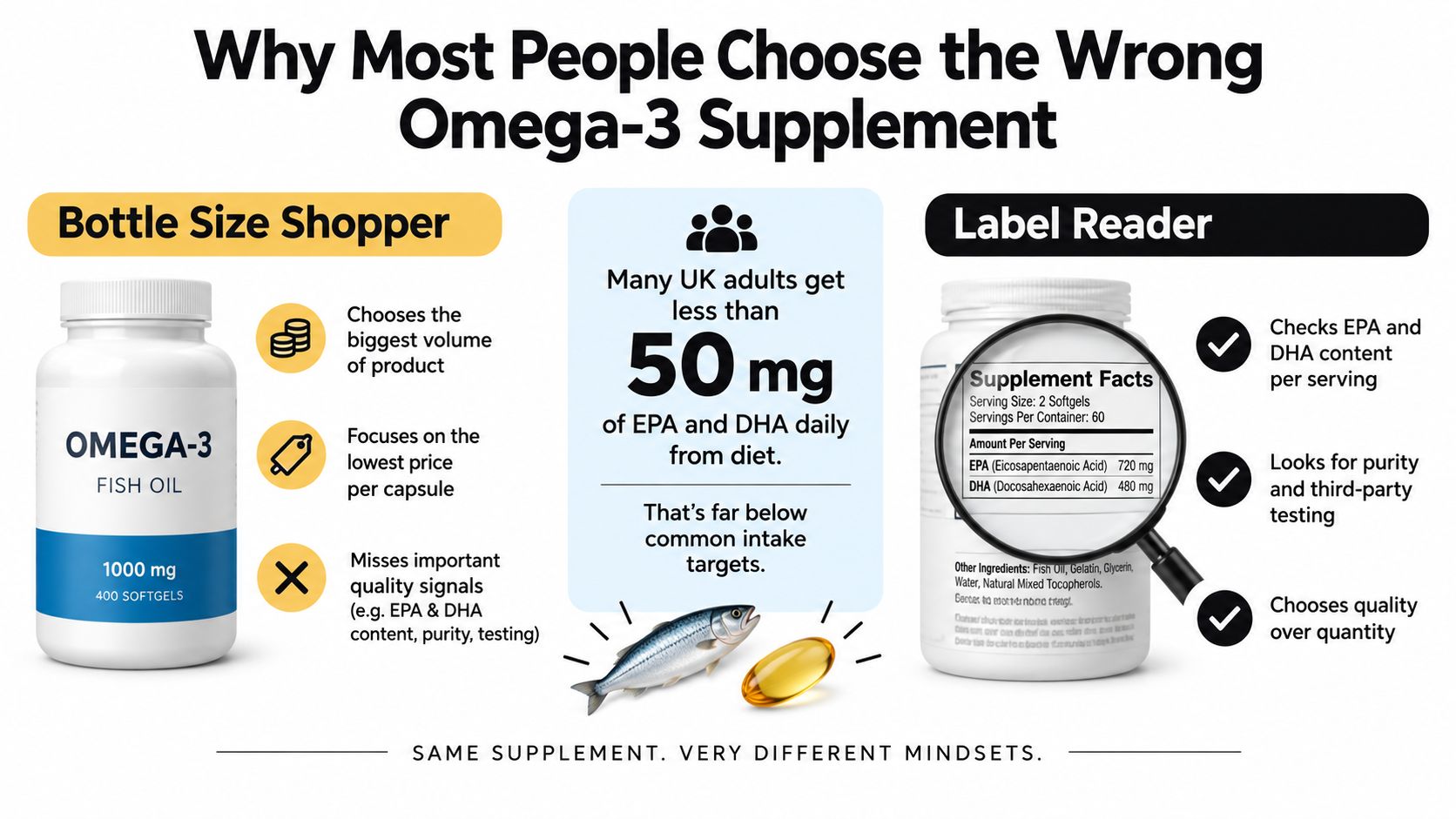
The front-label trap
A “1,000 mg fish oil” capsule describes the total oil weight. It doesn't necessarily describe the amount of EPA and DHA. The rest may include other fatty acids, so two products with the same total fish-oil amount can deliver very different quantities of the compounds you're trying to compare.
Turn the bottle around and look for separate EPA and DHA lines. Add them together. For example, if the panel lists one amount of EPA and another amount of DHA, your comparison figure is their combined total per daily serving. Don't compare one product per capsule with another product per two-capsule serving.
Practical rule: Ignore the biggest number until you've found the combined EPA and DHA amount and the serving size.
Why price per capsule misleads
A cheap capsule isn't necessarily good value if it provides little EPA and DHA. You may need more capsules to reach the same combined amount as a more concentrated product, which changes the actual cost and makes daily use less convenient.
The FDA's qualified health claim history also supports a cautious approach. In 2004, it authorised wording that described supportive but inconclusive research about EPA and DHA and coronary-heart-disease risk. That language doesn't promise prevention or treatment, and it's a useful reminder that supplement marketing shouldn't sound more certain than the evidence.
Fish Oil vs Krill Oil vs Algal Oil, Source and Structure Compared
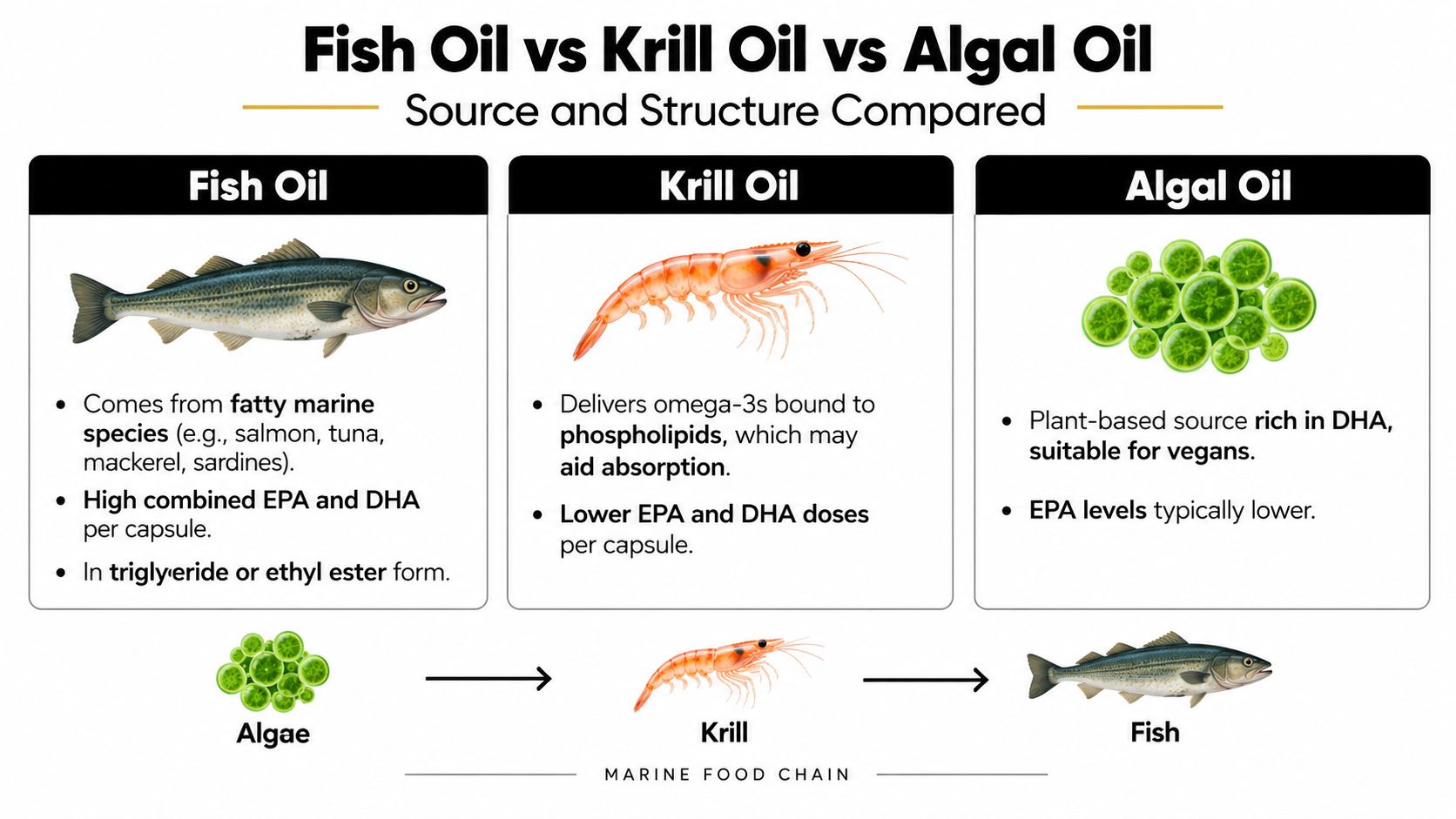
Fish oil, krill oil and algal oil can all be discussed in terms of EPA and DHA, but they aren't interchangeable products. Their sources, dietary suitability, concentration and label details differ. The right choice depends on what you eat, how much EPA or DHA you want, whether you avoid animal products and how easily you can take the product consistently.
Fish oil for broad availability
Fish oil comes from fatty marine species and is the most familiar source. It can provide a substantial combined amount of EPA and DHA per capsule, but concentration varies widely between products. That variation makes the back-label comparison essential.
Fish oil may suit someone who eats animal products and wants a conventional marine source. It can also make sense for people who specifically want a product with a meaningful EPA contribution, since some algal products place greater emphasis on DHA. Still, the source alone doesn't establish quality. Check the actual EPA and DHA amounts, freshness information and independent testing rather than treating “fish oil” as a quality grade.
Krill oil and the phospholipid question
Krill oil contains omega-3s bound to phospholipids and also includes astaxanthin. Some research has examined whether this structure affects absorption patterns, but a shopper shouldn't assume that a krill label automatically delivers more EPA and DHA.
Krill products often provide a lower amount of EPA and DHA per capsule than concentrated fish-oil products. Compare the combined quantity, not the perceived sophistication of the ingredient. A smaller capsule may be easier to swallow, but that convenience only helps if the stated daily serving fits your intended use.
Krill is also a marine animal source, so it isn't suitable for vegetarians or vegans. People with seafood allergies should take particular care and seek professional advice before choosing a marine supplement.
Algal oil for plant-based diets
Algal oil comes directly from algae and provides a plant-based source of marine omega-3s. It's the clearest fit for vegetarians and vegans, and it can suit people who prefer to avoid fish-derived ingredients.
Many algal formulas are especially DHA-focused, while EPA may be present at a lower level or absent. That doesn't make algal oil inferior. It means you need to decide whether you're looking for DHA, EPA, or both, then check the Supplement Facts panel accordingly.
| Source | Main practical strength | What to verify |
|---|---|---|
| Fish oil | Broad range of EPA and DHA formulations | Concentration, freshness and testing |
| Krill oil | Phospholipid-based formulation and astaxanthin | Actual EPA plus DHA per serving |
| Algal oil | Plant-based source of marine omega-3s | Whether the product provides EPA as well as DHA |
Source, structure and sustainability are separate decisions. A vegan label answers a dietary question, not a concentration question. Likewise, a marine-sourcing claim doesn't tell you how much EPA and DHA you'll receive.
Triglyceride vs Ethyl Ester Omega-3, Which Form Absorbs Better
The molecular form can make omega-3 labels more confusing. Natural fish oil commonly contains omega-3s in triglyceride form, while some concentrated products use ethyl ester forms created during refining. Both forms appear in commercial supplements, and the label may identify which one you're buying.
Triglyceride products can feel like the more familiar option because that structure occurs naturally in fish oil. Ethyl ester products can allow manufacturers to concentrate EPA and DHA efficiently, which may reduce the number of capsules needed for a stated daily amount. Concentration alone doesn't make an ethyl ester product ineffective, and a triglyceride label alone doesn't prove that a product is better made.
Compare the form with the full formulation
Absorption depends on more than the word “triglyceride” or “ethyl ester.” The meal you take the supplement with, the product's formulation, the amount provided and your digestive tolerance all influence whether the product works well for your routine. Taking an omega-3 supplement with food is often a practical way to make daily use easier and may help reduce aftertaste or digestive discomfort.
| Form | What it tells you | How to interpret it |
|---|---|---|
| Triglyceride | A natural oil structure commonly found in fish oil | Consider it alongside EPA and DHA concentration and tolerance |
| Ethyl ester | A refined form used in some concentrated products | Don't reject it automatically, especially when concentration and testing are clear |
| Re-esterified triglyceride | A processed product returned to a triglyceride-like structure | Confirm the manufacturer's terminology and compare the full panel |
A high-concentration ethyl ester may be practical for someone who wants fewer capsules. A triglyceride product may appeal to someone who prioritises a natural form or has found it more comfortable. Neither label removes the need to compare dose, quality controls and suitability.
For a broader explanation of how supplement formulation can affect what your body receives, see this guide to how to increase bioavailability. Keep the central question simple: how much EPA and DHA does the product provide, and can you take it consistently?
How to Read an Omega-3 Label Like a Pro
A useful label-reading routine takes less time than comparing bottle colours and marketing claims. Start with the panel that lists the ingredients and serving size, then work outward to quality and sourcing information.
Start with the active amount
Find the EPA line and the DHA line. Add them together for the combined amount per stated serving. If the product lists 1,000 mg of total fish oil but only a smaller combined amount of EPA and DHA, use the smaller figure for your comparison.
The British Dietetic Association identifies about 450 mg of combined EPA and DHA per daily supplement dose as roughly comparable with the amount obtained from eating one to two portions of oily fish weekly, while it doesn't routinely recommend omega-3 supplements for the general UK population because evidence for broad health benefits remains inconclusive. The British Dietetic Association's omega-3 reference gives useful context for treating supplementation as a dietary-gap decision rather than a race to the highest dose.
Then check whether the serving means one capsule, two capsules or a liquid measure. A product can look highly concentrated until you notice that its advertised amount requires several capsules.
Use this label checklist
- EPA and DHA: Record both amounts and calculate the combined figure.
- Serving size: Compare products using their complete daily serving, not an isolated capsule.
- Source: Confirm whether it's fish, krill or algae, and whether that fits your diet.
- Form: Look for triglyceride, ethyl ester or other structural information.
- Freshness: Check the expiry date and storage instructions. A strong rancid smell is a reason to stop using the product and contact the manufacturer.
- Independent testing: Look for a certificate of analysis or a recognised third-party programme that verifies contents and contaminant screening.
- Sustainability: Prefer specific, independently verifiable certifications over vague phrases such as “eco-friendly” with no supporting detail.
A certificate of analysis can show what was tested and what the manufacturer found, but its value depends on whether the document relates to the product and batch you're buying. Sustainability marks can also be useful when they identify an actual certification scheme rather than repeating an unverified brand claim.
If the front of a bottle still seems persuasive after you've checked the panel, use this practical explanation of what 1,000 mg fish oil really means. The headline number is only meaningful when you know how much of it is EPA and DHA.
Safety, Dosage Limits, and When More Is Not Better
A higher EPA and DHA number isn't automatically a better choice. Nutritional supplementation and prescription-level omega-3 therapy are different situations, and copying a high-dose regimen from a medical context can be inappropriate for general wellness.
Know the upper boundaries
The US Food and Drug Administration recommends no more than 5 g per day of combined EPA and DHA from dietary supplements, according to its consumer omega-3 guidance. The same NIH review reports that the European Food Safety Authority considers long-term consumption of up to approximately 5 g per day of combined EPA and DHA to appear safe for adults.
Those figures refer to combined EPA and DHA, not the total weight of fish-oil capsules. They also shouldn't be treated as a personal target. Someone can accidentally approach a high amount by combining an everyday supplement with a prescription product or several products that contain fish oil.
The FDA's label guidance also says supplement labels shouldn't recommend more than 2 g per day of EPA plus DHA, a separate point that reinforces the need to distinguish label instructions, regulatory limits and clinician-supervised treatment.
High-dose risks deserve a proper screen
A 2025 review reported that ordinary EPA and DHA supplementation generally doesn't materially raise overall bleeding risk, while high-dose purified EPA was associated with an approximately 50% relative increase in bleeding risk, with an absolute increase of about 0.6%. The same review raised the possibility of increased atrial fibrillation risk with high-dose therapy, especially among people already at high cardiovascular risk. Read the 2025 review of omega-3 safety for the dose- and formulation-specific context.
A separate 2025 meta-analysis associated omega-3 supplementation with increased incident atrial fibrillation, with RR 1.22 and a 95% confidence interval of 1.05 to 1.42, and with gastrointestinal adverse events. It found no significant increase in overall or major bleeding. These findings don't mean that ordinary fish-oil use is dangerous. They do mean that dose, product type and medical history matter.
High-dose omega-3 is a treatment question, not a shopping upgrade.
Before taking several grams daily, speak with a clinician if you've had atrial fibrillation, have significant cardiovascular risk, take anticoagulant or antiplatelet medicines, have a bleeding disorder, or combine multiple omega-3 products. People preparing for a procedure should also disclose supplement use to the relevant healthcare team.
Take safety guidance seriously across supplements, not only omega-3. The Luno: Self Care safety standards offer a useful example of how health information can set boundaries around responsible use.
This video can add a visual explanation of the practical considerations, but it shouldn't replace personalised medical advice.
For a more detailed look at how to think about personal intake, see these omega-3 dosage recommendations. The safest approach is to total EPA and DHA across every product you use and ask a professional before moving into high-dose territory.
Who Benefits Most From an Omega-3 Supplement
The most relevant candidate is often someone whose diet supplies little or no oily fish. UK advice recommends that the average person eat two portions of fish each week, including one portion of oily fish, according to NHS guidance on fish and shellfish. A supplement can help some people fill a dietary gap, but it doesn't make food-first guidance irrelevant.
Start with your actual pattern rather than your intention. Someone who eats oily fish regularly may need a different plan from someone who eats it rarely, avoids fish completely or follows a vegan diet. The product's source and EPA-to-DHA balance should reflect that difference.
Diet and preferences change the shortlist
A fish-oil product may suit an adult who eats fish and wants a conventional marine source. Krill oil may appeal to someone who prefers its particular formulation, although the EPA and DHA amount still needs checking. Algal oil can provide a plant-based alternative for vegetarians and vegans, with the important qualification that you should verify whether it contains DHA alone or both DHA and EPA.
Digestive tolerance matters too. Capsules, liquids and different formulations can feel very different in day-to-day use. A product you can take with a meal without discomfort is more practical than a theoretically attractive option that stays in a cupboard.
Pregnancy and life stage need extra care. NHS advice says girls, women planning pregnancy, women who may become pregnant, and pregnant or breastfeeding women should eat no more than two portions of oily fish per week. Anyone in this group should follow current professional guidance rather than treating a general adult supplement recommendation as automatically suitable.
A personalised decision beats a static list
A simple self-check can narrow your options:
- Fish intake: How often do you eat oily fish?
- Diet: Do you avoid fish, seafood or animal products?
- Purpose: Are you filling a dietary gap, or has a clinician advised a targeted regimen?
- Tolerance: Do you prefer a capsule or liquid, and can you take it with food?
- Medication: Could anticoagulants, antiplatelet medicines or heart-rhythm history affect the decision?
The British Dietetic Association doesn't routinely recommend omega-3 supplements for the general UK population because broad health benefits remain inconclusive. That doesn't rule out a supplement for an individual with low fish intake or a specific dietary preference. It means the decision should match your circumstances rather than a generic promise.
For readers comparing omega-3 with broader exercise and recovery choices, this guide to when to use recovery supplements offers helpful context. Recovery products shouldn't distract from food, training, sleep and medical considerations.
A personalised quiz can be useful when you're weighing several factors at once. VitzAi.com uses questions about goals, diet, fish intake, digestion, sleep, stress and exercise to provide supplement recommendations that explain why particular options may be relevant, rather than presenting every product as suitable for everyone.
Start by checking your diet, then compare the combined EPA and DHA amount on the label, source, form and testing information. Visit VitzAi.com to complete a personalised supplement quiz and explore guidance that connects omega-3 choices with your broader goals, diet and lifestyle.
This article is for informational purposes only and is not medical advice. Always consult a qualified health professional before starting any new supplement or major lifestyle change