

Best Pre Workout Supplements: Top Picks & Tips
Walking down the supplement aisle and seeing a wall of pre-workout tubs can be seriously overwhelming. The best pre workout supplements are all designed to kick your energy up a notch, sharpen your focus, and boost your performance, but the right one for you? That comes down to your unique goals and body. This guide is here to cut through the hype and give you some straight answers.
Your Guide to Pre Workout Supplements
So, what exactly is a pre-workout? Think of it as a specialized tune-up for your body right before you hit the gym. It’s a multi-ingredient formula you typically take about 30 minutes before training, designed to elevate your session so you can push harder, lift heavier, or run that extra mile.
This isn't about some magic powder, though. It’s all about targeted nutrition. A good formula gives your body the raw materials for peak performance right when it matters most. Whether you're just starting out and building confidence or you're a seasoned athlete fine-tuning your routine, understanding what's actually in the tub is the first step. To get the most out of it, you need to see how it fits into a well-structured modern athletic strength training program.
Why Is Everyone Using Pre-Workouts?
Let's be honest, their popularity has exploded for a reason. In 2019, the UK pre-workout market was already worth around £605 million, and it's on track to nearly double by 2027. That tells you something: people are getting serious about making their workouts count. Powders are still the go-to, but you're seeing more and more ready-to-drink options for convenience.
This boom means more choice, but it also means more confusion. Our goal here is to give you the knowledge to walk that aisle with confidence. We'll dive into the key ingredients, what they do, and everything else you need to know about supplements for energy and focus.
A pre-workout isn't a replacement for solid nutrition and hard work. Think of it as a strategic tool to get more out of the effort you're already putting in, helping you smash through plateaus and hit new personal bests.
Consider this your roadmap. We’re going to break down:
- Key Ingredients: What they are and what they actually do for your body.
- Goal-Oriented Formulas: How to pick the right product for strength, endurance, or focus.
- Proper Timing and Dosing: When and how much to take for the biggest impact.
- Safety First: Understanding potential side effects and how to steer clear of them.
Decoding Pre Workout Ingredients That Actually Work
Think of a pre-workout supplement as a specialized pit crew for your body. Each ingredient has a crucial job to do to get you race-ready. Staring at the back of a tub can feel like trying to read a foreign language, but getting to grips with the core components is the key to picking a formula that’s right for you. Once you know what to look for, you can cut through the marketing fluff and focus on what genuinely delivers.
Most formulas are built around three main pillars: energy, focus, and performance. This diagram shows how these pillars work together to get you in the zone.
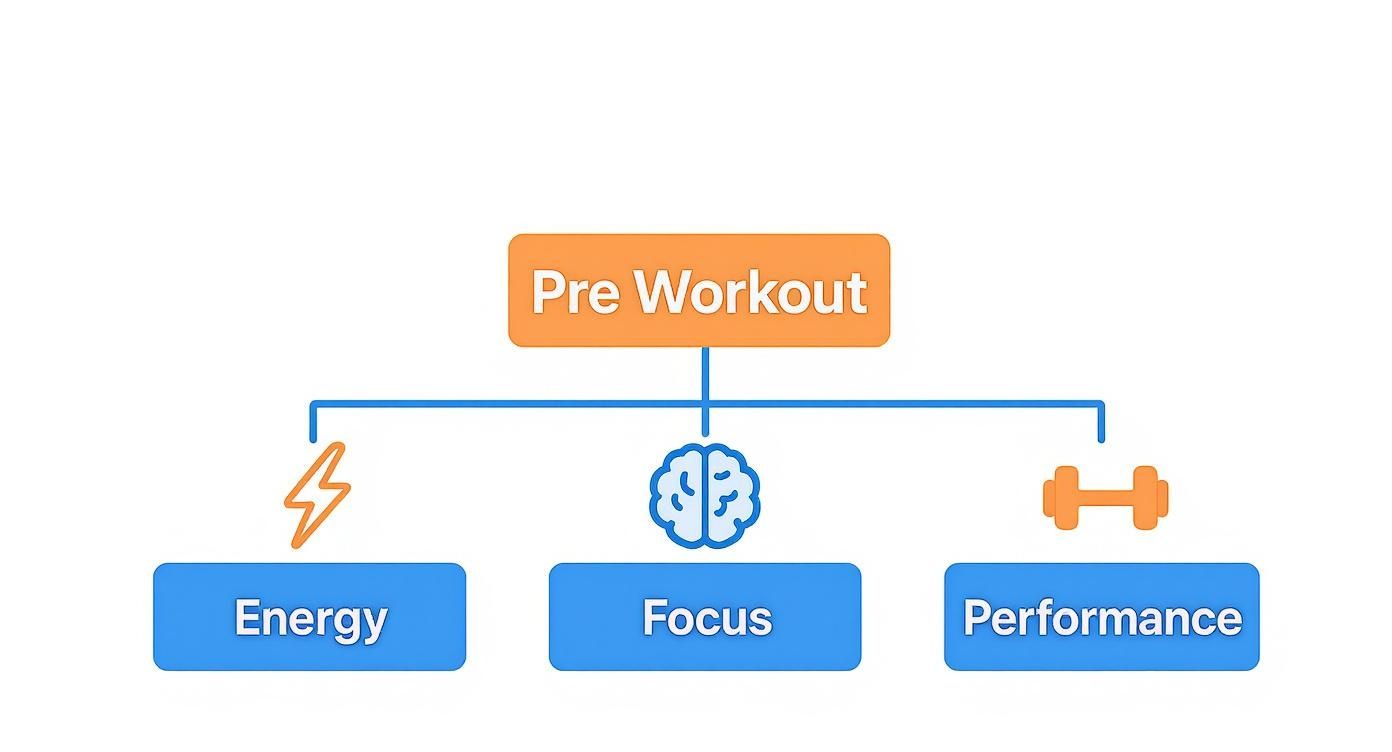
As you can see, a well-rounded pre-workout tackles both the mental and physical sides of training to give you a complete performance boost. Let’s break down the key players you'll find on the ingredient panel.
The Energy Igniters: Caffeine and L-Tyrosine
Caffeine is the 'starter motor' in most pre-workouts. It’s a central nervous system stimulant that blocks adenosine, a brain chemical that makes you feel tired. The result? Increased alertness, sharper focus, and a noticeable drop in how hard your workout feels, allowing you to push harder for longer.
There's a reason it's so popular. The International Olympic Committee recommends a dosage of 3 to 6 mg per kg of body weight to enhance athletic performance. For most people, that’s around 200 mg taken an hour before exercise.
Often working alongside caffeine is L-Tyrosine, an amino acid that supports the production of neurotransmitters like dopamine and adrenaline. Think of it as the 'mental clutch' that helps you stay dialled in, especially during really taxing workouts. When your body is under stress, tyrosine levels can drop; supplementing helps keep that sharp mind-muscle connection firing on all cylinders.
The Performance Powerhouses: Citrulline and Beta-Alanine
Next up, we have the ingredients that directly fuel your physical output. L-Citrulline (or its bonded form, Citrulline Malate) is a powerful 'pump' enhancer. It boosts nitric oxide production, which helps relax and widen your blood vessels.
This improved blood flow, known as vasodilation, delivers more oxygen and nutrients to your working muscles. You get that satisfying muscle 'pump', but more importantly, it boosts your endurance and can even help reduce soreness after your session.
Then there's Beta-Alanine, famous for that harmless tingling sensation known as paraesthesia. Its real job is to increase carnosine levels in your muscles. Carnosine acts as a buffer against the build-up of lactic acid—the stuff responsible for that burning feeling during intense sets. By holding off fatigue, Beta-Alanine lets you squeeze out those extra reps that really count.
Beta-Alanine doesn't give you more raw strength; it gives you more endurance at your peak strength. It's the difference between hitting a wall at eight reps and pushing through to ten.
The Strength and Power Generator: Creatine
Finally, we have Creatine, arguably one of the most researched and effective sports supplements on the planet. Think of it as a 'backup power generator' for your muscles. For quick, explosive movements, your body uses a molecule called ATP, but your natural stores run out in seconds.
Creatine helps rapidly regenerate that ATP, allowing you to sustain high-intensity effort for longer. This translates directly into more strength, better power output, and ultimately, more muscle growth over time. While many pre-workouts include a bit of creatine, you really need a consistent daily dose to see the best results. If you're serious about your strength goals, consider adding a dedicated serving of our premium creatine monohydrate to your daily routine.
The table below breaks down these key players and their typical effective dosages, giving you a quick reference for when you're checking out a new product.
Key Pre Workout Ingredients and Their Functions
| Ingredient | Primary Function | Effective Dosage Range |
|---|---|---|
| Caffeine | Increases energy, focus, and alertness | 100-300 mg |
| L-Citrulline Malate | Enhances blood flow and muscle pump | 6-8 g |
| Beta-Alanine | Buffers lactic acid to improve endurance | 3.2-6.4 g |
| Creatine Monohydrate | Boosts strength and power output | 3-5 g |
| L-Tyrosine | Supports focus and cognitive function | 500 mg - 2 g |
By understanding these core components, you’re no longer just guessing. You're making an informed choice, armed with the knowledge to read any label and know exactly how that formula is designed to fuel your performance.
Matching a Pre-Workout to Your Fitness Goals
The pre-workout you choose should be as unique as your training. Honestly, picking the best supplement isn’t about grabbing the tub with the flashiest label; it’s about finding a formula that actually matches what you’re trying to do. A generic, one-size-fits-all scoop rarely cuts it.
Think of it like picking the right tool for a job. You wouldn't use a sledgehammer for a delicate task, right? Same logic applies here. Your pre-workout should actively support your training style, whether you're focused on raw strength, long-distance endurance, or just getting your head in the game.
Let's break down how to line up your pre-workout with your goals, whether you're in the gym, on the track, or wherever you get your sweat on.
Formulas for Strength and Power
If lifting heavier and building muscle is your main goal, you need a formula built for pure, explosive power. These pre-workouts are usually loaded with ingredients that support anaerobic performance—those short, all-out bursts of effort.
Look for products that put these ingredients front and centre:
- Creatine Monohydrate: This is pretty much non-negotiable for strength. It helps your muscles churn out energy rapidly for powerful contractions, letting you squeeze out those extra reps and sets.
- Beta-Alanine: This is the stuff that fights the "burn." By buffering the acid that builds up in your muscles, it helps you push your sets further, which is exactly what you need to stimulate growth.
- Betaine Anhydrous: Research has shown this compound can support power output and muscular endurance, making it a seriously valuable addition for anyone lifting heavy.
Of course, a pre-workout is just one piece of the puzzle. For those serious about building muscle, getting enough protein is absolutely crucial. You can even explore plant-based protein for muscle building to round out your supplement stack. The pre-workout gets the job done in the gym; proper nutrition helps you rebuild and grow from it.
Blends for Endurance Athletes
If you’re a runner, cyclist, or swimmer, your needs are completely different. Your training isn't about a one-rep max; it’s about sustaining your performance over a long haul. A high-stimulant, pump-chasing pre-workout is probably not your best bet and might even work against you.
Instead, endurance athletes should be on the lookout for formulas that feature:
- L-Citrulline: By improving blood flow, it gets more oxygen to your working muscles. This is key for fighting off fatigue during those long sessions.
- Electrolytes: When you sweat, you lose vital minerals like sodium and potassium. Topping these up is essential for staying hydrated, preventing cramps, and just keeping your muscles firing correctly.
- Taurine: This amino acid helps with hydration and electrolyte balance right inside your cells and has been linked to better endurance performance.
An endurance blend is designed to be a steady source of fuel, not a sudden sledgehammer of energy. It's all about helping you hold your pace from start to finish.
Your fitness goal is the filter through which you should view every ingredient panel. Don't be swayed by marketing; focus on the formula and how its components align with your specific type of training.
Options for Focus and Mind-Muscle Connection
Sometimes, the biggest hurdle to a great workout isn't physical at all—it's mental. If you find your mind wandering or you just can't seem to feel the muscles you’re training, a nootropic-focused pre-workout could be a game-changer.
These blends are built to sharpen your cognitive function and lock in your focus. They often dial back the stimulants to avoid the jitters and pair them with brain-boosting compounds instead.
Key ingredients to look for include:
- L-Tyrosine: This is a building block for neurotransmitters like dopamine. It helps you stay mentally sharp and focused, especially when fatigue starts to set in.
- Alpha-GPC or Choline Bitartrate: These compounds support the production of acetylcholine, a neurotransmitter that’s vital for learning, memory, and muscle control.
- Ashwagandha: This adaptogen can help manage cortisol (the stress hormone), promoting a calmer, more focused headspace that lets you properly engage with every single rep.
Solutions for Different Needs
Beyond your main goals, your own body and lifestyle play a massive role. The best pre-workout brands understand this and offer options for different circumstances.
Think about which of these camps you fall into:
- Beginner-Friendly Doses: New to pre-workouts? Start with a product that has a lower caffeine content (around 100-150 mg). Better yet, just take a half-scoop the first few times to see how you feel.
- Stimulant-Free Alternatives: For anyone who trains late at night or is just sensitive to caffeine, "stim-free" versions are a brilliant choice. They rely on ingredients like citrulline and beta-alanine for performance without messing with your sleep.
- High-Stimulant Formulas: These are reserved for experienced users who know they have a high tolerance. Packing 300 mg or more of caffeine and other stimulants, they're designed for maximum intensity. Always, always approach these with caution.
By thinking critically about what you're trying to achieve—strength, endurance, or focus—and layering in your personal needs, you can move way beyond generic recommendations. This approach ensures you spend your money on a supplement that doesn't just give you a buzz, but gives you the right kind of support to smash your goals.
Perfecting Your Timing for Maximum Impact
You've picked out a great pre-workout for your goals, but when you take it is just as crucial as what's inside the tub. Think of it like a perfectly timed countdown for a rocket launch; getting the timing right ensures every ingredient hits its peak, giving you maximum lift-off for your workout.
The golden rule is to take your pre-workout 30 to 60 minutes before you start training. This window really is the sweet spot. It gives your body enough time to digest the ingredients and for them to enter your bloodstream, reaching their highest concentration just as you're hitting your warm-up.
Take it too early, and key ingredients like caffeine might peak before you even touch a weight. Take it too late, and you’ll be halfway through your session before you feel the full effects. Nailing this window ensures the energy, focus, and pump are all firing on all cylinders right when you need them most.

Start Low and Assess Your Tolerance
Before you dive in with a full scoop, it's vital to test the waters, especially with formulas high in stimulants. Not everyone handles caffeine the same way. A dose that gives one person clean, sharp energy might just give another the jitters and a sense of anxiety.
Here’s the smartest way to approach it:
- Start with a half-scoop for your first few workouts.
- Pay close attention to how you feel—your energy, your focus, and any side effects.
- If it feels good and you think you could use a bit more of a boost, you can gradually work your way up to a full scoop.
This simple step helps you avoid an overwhelming experience and lets you find the exact dose that works for your body. Remember, more isn't always better. The goal is to enhance your performance, not to have an uncomfortable, heart-pounding session.
Why Cycling and Hydration Are Non-Negotiable
Your body is incredibly smart and adaptive. If you take the same stimulant-based pre-workout every single day, your system will eventually get used to it. That initial kick you loved will start to fade, and you'll find yourself needing more and more just to get the same buzz. This is where cycling comes in.
Cycling your pre-workout isn't just a suggestion; it's a strategic necessity. It resets your body's sensitivity, making sure the supplement keeps working for you over the long term and preventing you from becoming dependent on it.
A common and effective approach is to use your pre-workout for 4-6 weeks, followed by a 1-2 week break. During this break, you can either train without a pre-workout or switch to a stimulant-free version to keep the pump going.
Finally, never, ever underestimate the power of hydration. Many pre-workout ingredients, like creatine and beta-alanine, need water to be activated and transported effectively through your body. Drinking plenty of water all day—and especially with your pre-workout shake—is absolutely crucial for unlocking its full potential and avoiding side effects like cramping.
This also ties into your overall mineral balance. Nutrients like magnesium are key for muscle function and hydration, which is why knowing the best time to take magnesium can give your recovery and performance another supportive nudge. By mastering your timing, tolerance, cycling, and hydration, you’re setting yourself up to get powerful, effective results from every single scoop.
Understanding Potential Side Effects and Staying Safe
While the right pre-workout can be a game-changer for your training, being smart about supplements always starts with being honest about them. Knowing what to expect—both good and bad—gives you the power to manage your experience and make sure it’s a positive one.
Some of the most common sensations you might feel are completely normal; in fact, they’re often a sign the ingredients are getting to work. Ever felt that tingling in your hands and feet after a scoop? That’s a classic, harmless side effect of beta-alanine called paresthesia. It’s temporary and usually disappears once you get moving.
That said, it’s crucial to know the difference between a harmless tingle and signs that you’ve overdone it. Pushing your dosage too high, especially with formulas loaded with caffeine, can lead to some pretty unpleasant results.
Common Signs of Overstimulation
So, how do you know if you’ve taken too much? Your body will tell you. Watch out for feelings of anxiety, a bad case of the jitters, or a heart that feels like it’s beating out of your chest. These are tell-tale signs that the stimulant level is more than your body is ready for.
Some people also run into digestive trouble, like an upset stomach. This often happens if you take your pre-workout on a completely empty stomach, as the concentrated ingredients can be a bit harsh.
The whole point of a pre-workout is to feel energised and focused, not anxious or sick. Listening to what your body is telling you is the most important skill in finding the right supplement and dose.
How to Mitigate Unwanted Effects
The good news is that sorting out these side effects is usually pretty straightforward. If you’re feeling off, a few simple tweaks can make all the difference.
Try these strategies:
- Start with a Lower Dose: Never jump in with a full scoop of a new product. Start with half a scoop to test the waters and see how you feel. You can always build up from there.
- Avoid an Empty Stomach: Have a small, easy-to-digest snack about an hour before your pre-workout. A bit of food can help buffer the ingredients and prevent an upset stomach.
- Stay Well-Hydrated: Water is non-negotiable. It’s essential for ingredients like creatine to work properly and helps your body process stimulants smoothly. Drink plenty before, during, and after your session.
- Choose a Stim-Free Option: If you know you’re sensitive to caffeine or you train late in the evening, a stimulant-free pre-workout is a brilliant choice. You’ll still get the performance perks without the jitters or a sleepless night.
A quick word of caution: if you have any pre-existing health conditions, you need to be extra careful. Anyone with high blood pressure or heart issues should absolutely speak with their doctor before trying any stimulant-based supplements. Knowing this stuff helps you use pre-workouts safely and get the most out of them.
Answering Your Top Pre Workout Questions
Right, let's get into some of the most common questions we hear about pre-workouts. Think of this as a quick-fire round to tackle those lingering thoughts, so you can feel completely confident when picking the right one for you.
Is a Pre Workout Just an Expensive Energy Drink?
Not even close. While they both might give you a caffeine kick, that’s pretty much where the similarities end. Your typical energy drink is just sugar and caffeine, designed for a quick, general buzz.
A properly formulated pre-workout, on the other hand, is a specialist tool built for athletic performance. It’s packed with a clever mix of ingredients like citrulline to get your blood flowing, beta-alanine for muscular endurance, and often nootropics to sharpen your focus. It’s not just about waking you up; it's about actively improving how you perform, both physically and mentally, during your session.
Can I Take a Pre Workout Every Day?
You could, but it’s not the smartest strategy. Your body is clever and can build a tolerance to stimulants like caffeine, which means you'll eventually need more and more to feel that same initial effect. This is precisely why cycling your pre-workout is so important.
A standard cycle might look like using it for 4-6 weeks, followed by a 1-2 week break. This little holiday gives your body's sensitivity a chance to reset, making sure the supplement keeps working for you in the long run. On your rest days or during a deload week, it's often best to skip it altogether and just let your body recover.
Are Stimulant-Free Pre Workouts Actually Effective?
Absolutely. It’s a huge myth that a pre-workout is only as good as its caffeine buzz. Stim-free versions are fantastic for boosting performance; they just go about it in a different way.
A stimulant-free pre-workout ditches the caffeine and goes all-in on performance and pump. You still get that incredible blood flow from L-Citrulline and the endurance boost from Beta-Alanine, but without any jitters or sleepless nights.
These formulas are a brilliant choice for a few reasons:
- Late-Night Training: Smash a great workout without finding yourself staring at the ceiling at midnight.
- Caffeine Sensitivity: Perfect for anyone who gets anxious or jittery from stimulants.
- “Off-Cycle” Training: You can use them during your break from caffeinated pre-workouts to keep the performance benefits rolling.
Will a Pre Workout Make Me Fail a Drugs Test?
For the vast majority of people, the answer is a firm no. The catch, however, is that the supplement industry isn't as tightly regulated as we'd like, which introduces a small risk. If you're a high-level competitive athlete, you need to be especially careful, as some products might contain banned substances that aren't on the label, often due to cross-contamination during manufacturing.
To play it safe, always stick with reputable brands that use third-party testing. Look for certifications like NSF Certified for Sport or Informed-Sport on the label. These act as a guarantee that the product is free from banned substances. For the average gym-goer, it’s less of a worry, but quality and transparency should always be your top priority.
Wrapping It All Up
So, what's the big takeaway here? Choosing the right pre-workout isn't about grabbing the tub with the flashiest label. It’s a personal journey. Think of it as matching the right tools to your specific job – aligning proven ingredients with your unique fitness goals, how you train, and what your body tells you.
By now, you understand the core components and how to use them smartly to elevate your focus, energy, and performance. You're no longer just guessing; you're equipped to make a truly informed choice that actually supports all the hard work you put in at the gym.
This article is for informational purposes only and is not medical advice. Always consult a qualified health professional before starting any new supplement or major lifestyle change.