

Best Supplements for Energy: A Science-Backed Guide
Caffeine is the most consistently evidence-backed acute energy supplement, with exercise doses of about 2–6 mg per kg of body weight and an FDA-cited daily amount of 400 mg that isn't usually associated with dangerous effects in healthy adults. Creatine is the leading non-stimulant option for repeated high-intensity exercise, commonly used at 3–5 g daily, while the right choice depends on whether your fatigue comes from poor sleep, stress, nutrient gaps, or physical exertion.
It's 3pm, your inbox is still full, and the sentence you've been reading for five minutes still doesn't make sense. You reach for coffee, an energy powder, or a handful of vitamins, hoping one of them will restore the energy you had that morning.
Sometimes that approach helps. Often, it misses the reason you're tired. Caffeine may improve alertness, but it won't correct a nutrient deficiency. Creatine may support hard training, but it isn't designed to fix a poor sleep routine. Magnesium may be relevant to sleep quality, while ashwagandha has a more specific role in stress-related fatigue.
The best supplements for energy are therefore less about finding one magical ingredient and more about matching the mechanism to the problem. This guide will help you identify the pattern behind your fatigue, compare stimulant and non-stimulant options, and decide when a personalised recommendation is more useful than another generic list.
Why You Feel Tired in the Afternoon
You wake up feeling reasonably well, manage breakfast, answer messages, and get through the morning. Then the afternoon arrives. Your concentration drops, your body feels heavy, and even a small task seems to require more effort than it should.
A second coffee might make you feel more alert for a while. But if last night's sleep was fragmented, your workload has kept your stress response active, or your diet hasn't supplied enough of a needed nutrient, caffeine is treating the sensation rather than the cause.
That distinction matters because fatigue has different biological routes. A person who is physically depleted after repeated resistance-training sessions needs a different strategy from someone who is anxious, sleeping poorly, or wondering whether low iron or vitamin D status is involved. Independent health guidance also distinguishes between nutrients that help when levels are low and caffeine, which offers short-term alertness but may worsen anxiety, restlessness, or insomnia for some people. Healthline's overview of supplements for energy offers useful context on this difference.

Start with the pattern, not the product
Consider two afternoon slumps. The first person slept badly, wakes several times, and feels tired before work begins. The second sleeps adequately but feels drained after demanding workouts and struggles most during repeated hard efforts. Recommending the same “energy” capsule to both people ignores the difference between sleep-related fatigue and exercise-related fatigue.
Stress creates another pattern. You may feel mentally wired but physically exhausted, with poor concentration and difficulty switching off. In that situation, taking more caffeine late in the day could make the cycle harder to break. If fatigue persists or feels unusual, an underlying health issue or deficiency deserves professional evaluation rather than indefinite self-treatment.
Practical rule: Use a supplement to support a clearly defined goal, not to conceal unexplained or persistent exhaustion.
A simple journal can help you notice the pattern. Record when fatigue appears, how you slept, whether you trained, how much caffeine you used, and whether the problem feels physical, mental, or both. For a broader checklist of possible causes, see this guide on why you may be tired all the time. If you're looking for a gentler afternoon ritual while you assess your routine, an afternoon pick-me-up tea may be a more suitable choice than automatically adding another strong stimulant.
Understanding the Four Types of Fatigue
Before choosing capsules, powders, or gummies, classify the fatigue as accurately as you can. These categories can overlap, but they offer a practical starting point for deciding which supplement class deserves attention and which claims should be treated cautiously.
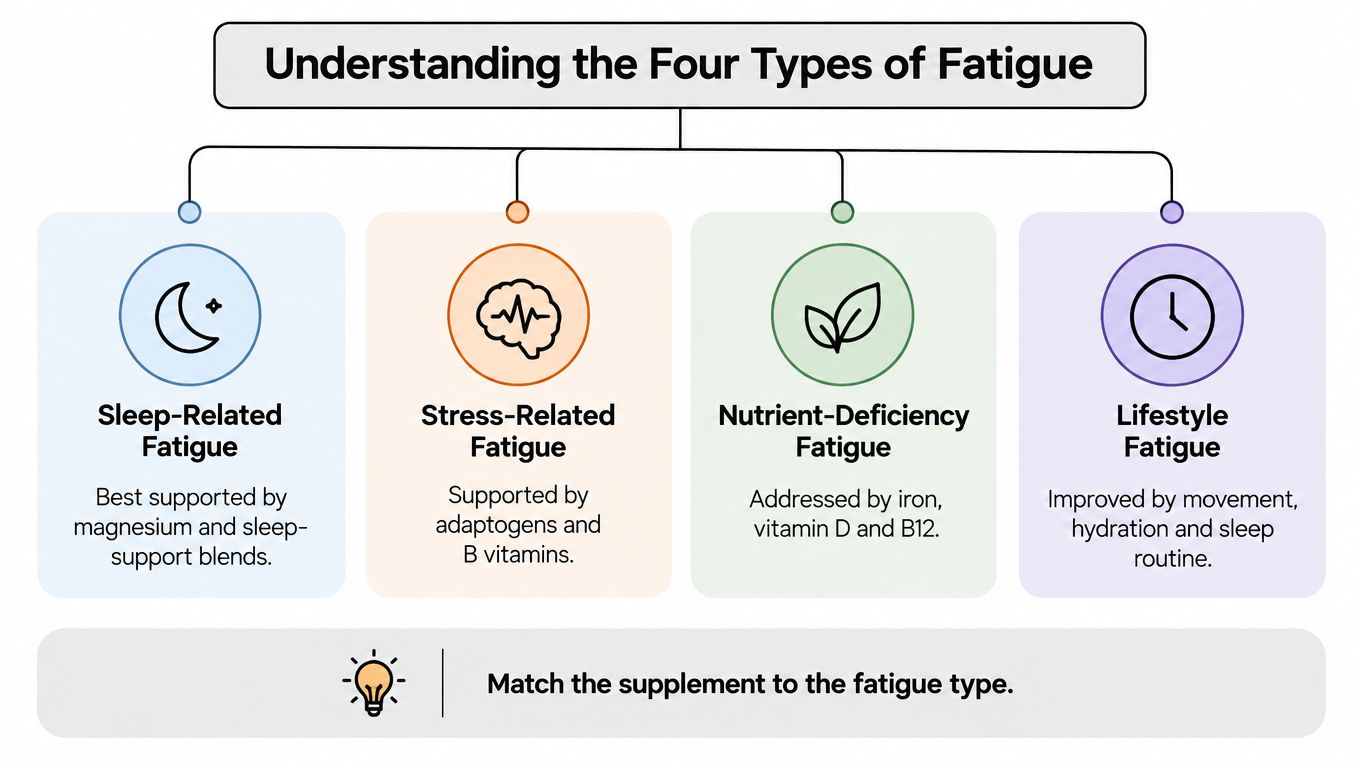
Sleep-related fatigue
This pattern often begins with insufficient or disrupted sleep. You may wake unrefreshed, rely on caffeine early, and feel your energy fade as the day progresses. Magnesium is not a direct stimulant, but it may be more relevant to sleep quality than to instant daytime alertness, particularly when intake or status is inadequate. Sleep-support blends can also be considered, but a product shouldn't replace attention to bedtime habits or investigation of ongoing sleep problems.
Stress-related fatigue
Stress can leave someone simultaneously tired and restless. Ashwagandha is the most relevant ingredient in this category among the options covered here. The NIH Office of Dietary Supplements review of ashwagandha describes trials lasting 6 to 8 weeks in 491 participants, using extracts at 240 to 1,250 mg per day. Those trials reported reductions in stress, anxiety, sleeplessness, fatigue, and serum cortisol, with stronger findings often appearing around 500–600 mg per day, especially 600 mg per day for at least 8 weeks.
Nutrient-deficiency fatigue
A deficiency-related pattern can't be identified reliably by shopping for a multivitamin. B vitamins, vitamin D, iron, and magnesium may be useful when levels are low, but taking more of a nutrient you already have enough of isn't automatically better. Iron deserves particular caution because supplementation should follow professional guidance rather than guesswork.
Diet, medical history, restricted eating patterns, digestive problems, and medication use can all affect the decision. If fatigue is significant or persistent, ask a qualified health professional whether testing is appropriate before building a high-dose supplement routine.
Exercise-related fatigue
Physical exhaustion after demanding training has a different mechanism. Creatine supports phosphocreatine, which helps regenerate ATP during repeated high-intensity efforts. Caffeine can support alertness and certain exercise outcomes, but it creates a different experience because it acts as a stimulant.
Lifestyle fatigue can sit alongside these categories. Poor hydration, irregular meals, long periods without movement, and an inconsistent sleep routine can all make energy less stable. Practical chronic fatigue relief strategies can help you assess those foundations, but persistent fatigue still warrants medical attention.
| Fatigue pattern | Supplement category to investigate | Important limitation |
|---|---|---|
| Sleep-related | Magnesium or sleep-support products | Not a substitute for addressing disrupted sleep |
| Stress-related | Ashwagandha and carefully selected adaptogens | Benefits are not immediate and safety depends on the individual |
| Nutrient-related | Targeted B vitamins, vitamin D, iron, or magnesium | Testing and professional advice may be needed |
| Exercise-related | Creatine, with caffeine for suitable users | The goal is performance support, not a general cure for tiredness |
The useful question isn't “What is the strongest energy supplement?” It's “Which biological problem am I trying to support?”
How Different Supplement Classes Work
Energy products use different mechanisms, so their effects shouldn't be lumped together. A stimulant changes alertness quickly. Creatine supports cellular energy availability over consistent use. An adaptogen such as ashwagandha is better understood through stress-related outcomes than through an instant boost.
Stimulants and alertness aids
Caffeine blocks adenosine receptors, reducing the perception of fatigue and increasing alertness. The NIH describes practical exercise use at roughly 2–6 mg/kg, taken 15–60 minutes before exercise, with benefits most evident for endurance, some strength and power tasks, and high-intensity team sports rather than very short sprint efforts. The NIH consumer fact sheet on exercise and athletic performance explains why timing and dose matter.
For a 70 kg adult, that range works out to approximately 140–420 mg, but that calculation isn't a target for everyone. Individual response varies, and higher intake can increase jitteriness, anxiety, and sleep disruption. A product with caffeine and L-theanine may feel smoother for some users than caffeine alone, but “smooth” doesn't mean risk-free or suitable late in the day.
Creatine and cellular energy
Creatine monohydrate doesn't create a stimulant buzz. It helps replenish phosphocreatine, which supports ATP regeneration during repeated hard efforts. That makes it most relevant to resistance training, sprint intervals, and repeated high-intensity work rather than a one-off feeling of mental brightness.
The NIH describes creatine as supporting short-term exercise capacity and considers it generally safe for healthy adults at up to 20 g per day during short loading periods and around 3 g per day for maintenance. A practical approach is either a loading phase followed by maintenance or consistent daily use at 3–5 g. The payoff is expected through training capacity and adaptation, not an immediate afternoon jolt. The NIH professional fact sheet on exercise and athletic performance provides the evidence context.
Vitamins and minerals
B vitamins participate in energy metabolism, but that doesn't mean a B-complex automatically makes a well-nourished person feel energised. Their role is most compelling when intake is inadequate or absorption is impaired. Vitamin D and iron follow the same principle, and iron should not be taken casually without appropriate guidance.
Magnesium supports nerve and muscle function and may be more useful for people whose sleep quality or intake is a concern. It isn't a replacement for caffeine when the goal is immediate alertness. A multivitamin can provide nutritional coverage, but it shouldn't be treated as a diagnostic tool or a cure for unexplained fatigue.
Adaptogens and cognitive formulas
Ashwagandha is an adaptogen associated with stress-related outcomes. In one placebo-controlled trial, 60 healthy stressed adults received 125 mg twice daily or 300 mg twice daily for 8 weeks, with both active-dose groups showing reductions in perceived stress and cortisol compared with placebo. The study also reported stronger statistical effects at 600 mg per day than at 250 mg per day. The full trial report gives the dose and design details.
A more recent randomised trial compared 125 mg, 250 mg, and 500 mg daily of Withania somnifera extract over 8 weeks, providing a dose-ranging design rather than a vague instruction to take “some” ashwagandha. The published dose-ranging study is useful when assessing labels.
Nootropics are products marketed around focus, memory, or mental performance, but the category includes ingredients with very different evidence bases. Learn how these products differ in what nootropics are before assuming that a focus blend is an energy supplement.
Functional mushroom blends, including products containing lion's mane, are also popular in cognitive and wellness formulas. Their presence on a label doesn't prove that the finished blend will improve your energy. Check the actual ingredients, quantities, intended use, and safety information instead of relying on the word “natural.”
Stimulants Versus Non-Stimulant Options
A stimulant can be the right tool for a morning workout or a demanding period that requires alertness. It can also be the wrong choice for someone whose tiredness is linked to anxiety, poor sleep, or sensitivity to caffeine. Non-stimulant options tend to work through slower or less noticeable pathways, so comparing them by the feeling they produce misses the point.
| Option | Primary role | Best fit | Main caution |
|---|---|---|---|
| Caffeine | Acute alertness and exercise support | Suitable adults who tolerate stimulants | May contribute to jitteriness, anxiety, or disrupted sleep |
| Creatine monohydrate | Repeated high-intensity exercise capacity | Strength training, intervals, and performance goals | It isn't an instant alertness product |
| Ashwagandha | Stress-related support | People exploring stress-linked fatigue | Dose, duration, medicines, and health conditions matter |
| Magnesium | Mineral support and sleep-related goals | People assessing intake or sleep quality | More isn't necessarily better |
| B-complex | Nutritional support | People with dietary or absorption concerns | Does not guarantee an energy boost when status is adequate |
| Energy powder | Convenient combination format | Users who want a measured drink format | Check caffeine, L-theanine, and total daily intake |
When caffeine makes sense
Caffeine is the clearest acute option because the mechanism is direct and the response is usually noticeable. The market's emphasis reflects that evidence. A 2024 estimate placed caffeine at 47.87% of energy-supplement ingredient share, while stimulant-based products represented 71.34% of the category. The same market source valued the global category at USD 1.12 billion in 2025 and projected USD 1.58 billion by 2030. These figures come from the market context included alongside the NIH exercise and athletic performance guidance.
Those numbers describe commercial prominence, not a promise that caffeine is right for you. Count caffeine from coffee, tea, energy drinks, powders, and pre-workouts together. If you notice sleep disruption, anxiousness, palpitations, or a cycle of needing more caffeine each day, reducing exposure may be more useful than adding another product.
When non-stimulants make more sense
Creatine is a logical non-stimulant for training goals. Ashwagandha may suit a stress-related pattern, while magnesium or a targeted nutrient may be more relevant when sleep or deficiency is the concern. None of these should be judged by whether they produce a sudden “rush.”
A supplement can support energy without making you feel stimulated. That distinction helps prevent a useful training product from being misused as a treatment for general fatigue.
People taking prescription medicines, managing a medical condition, pregnant people, and anyone with persistent or unexplained symptoms should seek professional advice before using herbs, high-dose minerals, or multi-ingredient energy products. Labels can also hide duplication, especially when a multivitamin, energy powder, and pre-workout all contain overlapping ingredients.
Choosing Supplements by Age, Sex, and Lifestyle
Age and sex can shape diet, health goals, training demands, and the likelihood of certain nutritional concerns, but they don't determine a supplement plan on their own. A 40-year-old woman who sleeps poorly and has a restricted diet may need a different conversation from a 40-year-old man training for strength, even if both search for “energy vitamins.”

Begin with your main outcome
Choose one primary outcome before adding several products.
- For strength and exercise: Creatine monohydrate is the most directly relevant option among the products discussed here because it supports repeated high-intensity work. Caffeine may be useful for suitable users who want an acute pre-exercise effect.
- For sleep and recovery: Magnesium may be worth discussing when intake or sleep quality is a concern. A sleep-support formula should complement, not replace, a consistent sleep routine.
- For stress and mental load: Ashwagandha has the clearest evidence-backed use case in this guide for stress-related fatigue. Its studied course is measured in weeks, not minutes.
- For general nutritional coverage: A multivitamin may help fill dietary gaps, while B vitamins, vitamin D, or iron should be considered in the context of diet, symptoms, and professional assessment.
- For healthy ageing and broader nutrition: Omega-3 products, multivitamins, and CoQ10 may fit a wider wellness plan, but they shouldn't be presented as interchangeable energy boosters.
- For focus and convenience: Mushroom blends and energy powders can be convenient formats, but inspect the ingredient panel and avoid assuming that a longer list means a stronger result.
Women may need particularly careful conversations around dietary intake, life stage, menstruation, pregnancy, or menopause, while men may prioritise training, muscle performance, or healthy ageing. Those are starting points, not diagnoses. The same person's needs can change when exercise, diet, sleep, medication, or health status changes.
Audit the basics before stacking products
Look at meal regularity, protein and overall diet quality, hydration, movement, training load, and sleep. A supplement may be sensible when it addresses a defined gap, but adding magnesium, omega-3, a multivitamin, an energy powder, and a mushroom blend at once makes it difficult to know what you tolerate or whether anything helped.
Keep a current list of products and doses. Show it to a pharmacist or doctor, especially if you use prescription medicines or are considering iron, concentrated herbs, or multiple products with overlapping ingredients.
How VitzAI Personalises Your Supplement Stack
A label can tell you what a product contains, but it can't decide whether that ingredient matches your reason for feeling tired. Personalised guidance starts with the person, then narrows the product category.
The VitzAI personalised quiz asks about factors such as age, sex, health and wellness goals, energy, sleep, stress, exercise, diet, fish intake, and digestion. The answers are used to create a curated plan and explain why particular products may be relevant. You can then remove products you don't want or already use rather than accepting a fixed stack.
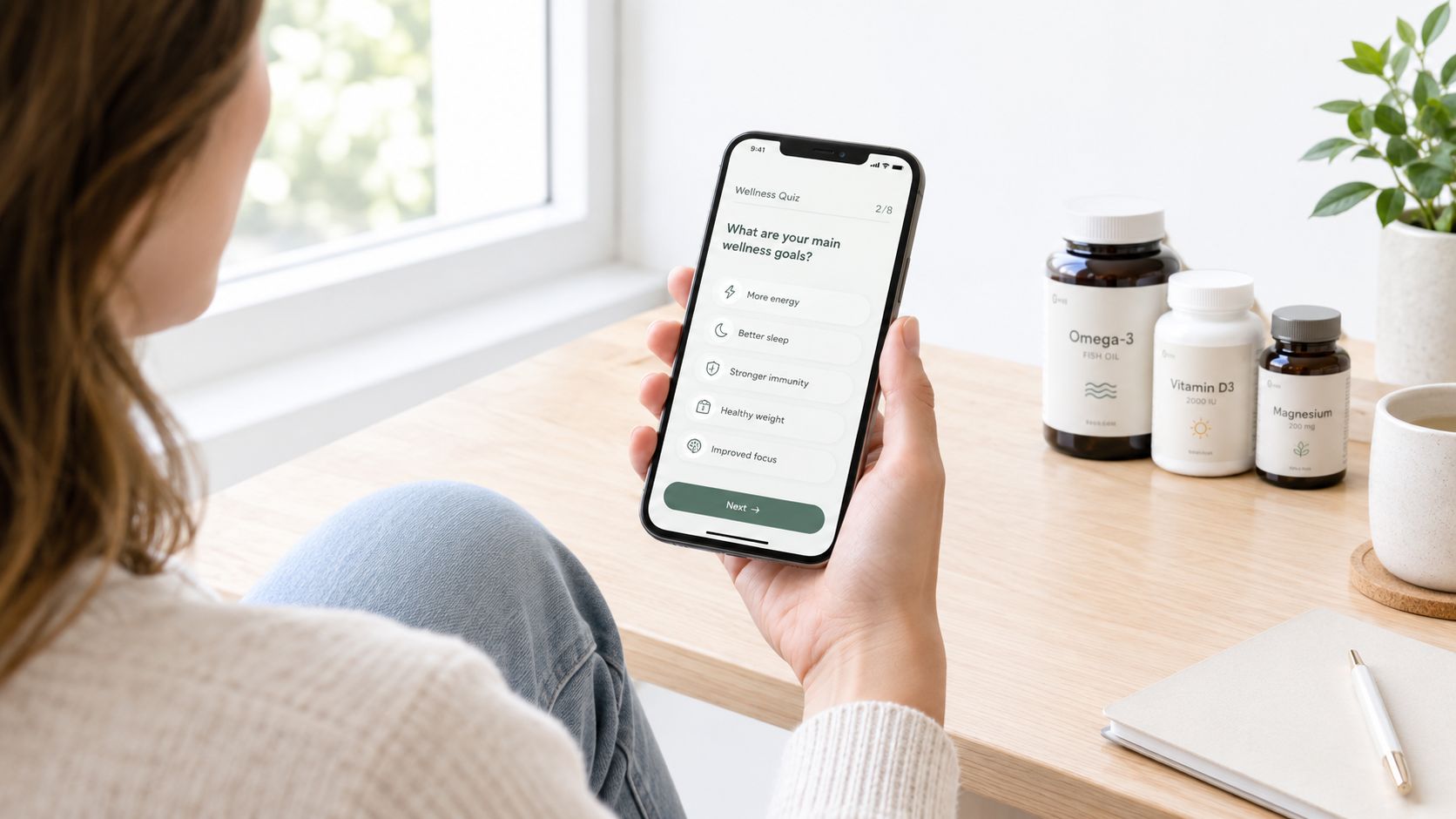
That approach is useful because “energy” is a broad goal. Someone seeking support for exercise recovery may be shown creatine monohydrate, while someone focused on sleep, stress, gut health, or general nutrition may need a different combination. The recommendation should still be reviewed against your medical history, current medicines, diet, and advice from a qualified health professional.
The platform's product range includes options such as magnesium glycinate, creatine monohydrate, omega-3, CoQ10, probiotics, multivitamins, sleep support, focus support, and an energy powder with caffeine and L-theanine. Product availability and formulations can change, so read the current label before purchasing or using anything.
For a closer look at how nutrient recommendations differ from a generic list, read this guide to personalised vitamins.
The quiz isn't a medical diagnosis. Its value is decision support. It helps turn a vague search for the best supplements for energy into more useful questions: What is my goal? What fatigue pattern fits? Which ingredients are relevant? What should I check before I start?
Here's a short visual introduction to the personalisation process:
Next Steps for Sustainable Energy
Start with the pattern behind your fatigue. Protect sleep, manage stress, eat regularly, stay hydrated, and keep movement appropriate to your current fitness and recovery. Then choose one supplement category that matches your goal instead of building a large stack from unrelated claims.
Caffeine can support immediate alertness, creatine can support repeated hard exercise, ashwagandha may suit stress-related fatigue, and targeted nutrients make most sense when a gap exists. If your tiredness is persistent, severe, or unexplained, arrange a professional assessment before relying on supplements.
This article is for informational purposes only and is not medical advice. Always consult a qualified health professional before starting any new supplement or major lifestyle change
VitzAi.com offers a personalised supplement quiz that uses your goals, diet, sleep, stress, exercise, and other lifestyle details to suggest a curated plan. Visit VitzAi.com to explore which supplement categories may be relevant to your energy goals and review your options with a clearer starting point.