

Best Vitamins for Muscle Growth: Your Ultimate Guide
When you think about building muscle, your mind probably jumps straight to protein shakes and heavy lifting. And you’re not wrong—those are the cornerstones. But if you’re serious about making real gains, you need to look a bit deeper. The best nutrients for muscle growth go beyond protein to include vital players like Vitamin D, the family of B Vitamins, and essential minerals like magnesium.
Think of these micronutrients as the unsung heroes of your fitness journey. They’re the catalysts that unlock your body’s true potential for repair, energy production, and, ultimately, getting stronger.
Your Blueprint for Building Stronger Muscles

It’s easy to fall into the trap of thinking muscle building is just about two things: lifting and eating protein. While that’s a massive part of the equation, it’s not the full story.
Let’s use an analogy. Imagine you’re building a house. Protein provides the bricks, but vitamins and minerals are the skilled tradespeople on site. They’re the project managers, electricians, and plumbers making sure every brick is laid perfectly and the whole structure is sound. Without them, you just have a pile of bricks.
Without these key micronutrients, your body simply can’t do its job properly. It struggles to repair damaged muscle tissue, convert your food into usable energy, or regulate the hormones that actually drive growth. It’s a complex biological symphony, and these specific vitamins and minerals are the conductors keeping everything in time.
Beyond the Basics of Protein
To really squeeze every last drop of benefit from your workouts and recovery days, you have to look past the macronutrients. This is where powerhouse supplements like creatine and magnesium, working alongside essential vitamins, come into play. Together, they create the perfect internal environment for muscle hypertrophy (that’s the scientific term for growth).
This isn't just gym-floor gossip; it's a trend backed by big numbers. In the UK alone, the demand for fitness-related supplements is soaring. The market is currently valued at around £3.8 billion and is expected to almost double by 2033. This growth is massively driven by products that support muscle development, including specialised protein, amino acids, and vitamin formulas. You can learn more about UK supplement market trends to see just how much people are prioritising smarter supplementation.
Think of your body as a high-performance engine. Protein is the fuel, but vitamins and minerals are the top-grade oil and coolants. They keep everything running smoothly, prevent overheating, and ensure you’re always performing at your peak.
We’re going to dive into the specific roles these vital nutrients play, helping you get past the basics and start achieving real, sustainable results.
To kick things off, here’s a quick overview of the key players we’ll be exploring in this guide.
Quick Guide to Key Nutrients for Muscle Growth
This table gives you a snapshot of the most important vitamins and supplements for muscle development. Think of it as your cheat sheet for understanding what each one does and why it deserves a spot in your routine.
| Nutrient / Supplement | Primary Role in Muscle Growth | Best For |
|---|---|---|
| Vitamin D | Supports muscle function & hormone regulation. | Overall strength & bone health. |
| B Vitamins | Crucial for energy metabolism. | Sustaining intense workouts. |
| Creatine | Fuels explosive power & strength. | Increasing lift capacity & muscle volume. |
| Magnesium | Aids in muscle relaxation & protein synthesis. | Enhancing recovery & sleep quality. |
| Omega-3s | Reduces inflammation & muscle soreness. | Consistent training & joint health. |
Getting to grips with how these elements work together is the first step toward building a plan that truly works for you. Let's get into it.
Why Micronutrients Are Your Secret Weapon
When we talk about muscle growth, protein hogs the spotlight. And rightly so. But focusing only on protein is like trying to build a house with just a pile of bricks; you've got the raw materials, but no cement, no tools, and no builders to put it all together.
That’s where micronutrients come in. Vitamins and minerals are the essential construction crew that turns your potential into actual progress.
These micronutrients act as the catalysts for countless processes in the body. They help convert the food you eat into usable energy, repair tissue after a tough workout, and even regulate the hormones that signal your muscles to grow. Without enough of them, all your hard work in the gym and your perfectly-timed protein shakes will never quite hit their full potential.
So, even if your protein intake is spot-on, a single vitamin deficiency could be the bottleneck holding back your gains. The best vitamins for muscle growth are the ones working tirelessly behind the scenes, making sure the entire system runs like a well-oiled machine.
The Role of B Vitamins in Energy Production
Picture your body as a high-performance engine. The food you eat—carbs, fats, and proteins—is the fuel. But that fuel isn't ready to use straight from the pump; it needs to be refined first. The B vitamin complex is that refinery.
This group of eight distinct vitamins is absolutely vital for energy metabolism.
Vitamins like B6, B9 (folate), and B12 are directly involved in breaking down the nutrients from your food to create ATP (adenosine triphosphate), which is your body’s primary energy currency. During an intense workout, your demand for ATP skyrockets.
Without enough B vitamins, this energy conversion process grinds to a halt. You’re left feeling fatigued and sluggish long before you’ve properly stimulated your muscles for growth. If you want to dive deeper into how these eight vitamins work together, you can explore what the vitamin B complex is good for in our detailed guide.
A strong B vitamin status doesn't just give you more energy; it directly supports protein synthesis. This means it helps your body effectively use the protein you consume to repair and build muscle tissue after a workout.
Vitamin D: The Muscle and Hormone Regulator
Often called the "sunshine vitamin," Vitamin D actually behaves more like a hormone in the body, and its importance for muscle function simply can't be overstated. Study after study has shown a powerful link between healthy Vitamin D levels and optimal muscle strength.
This is particularly true for your fast-twitch muscle fibres—the very ones responsible for explosive power and growth.
On top of that, Vitamin D plays a crucial role in regulating hormones, including testosterone, which is a key driver of muscle building in both men and women. For many of us here in the UK, especially during the darker winter months, getting enough sun exposure to produce adequate Vitamin D is a real challenge. That makes supplementation a genuinely smart strategy.
Vitamin C: The Recovery and Repair Agent
Every intense workout is a form of physical stress. While that stress is exactly what you need to trigger muscle growth, it also creates free radicals—unstable molecules that can damage your cells. This is where Vitamin C steps in.
As a powerful antioxidant, Vitamin C helps to neutralise these free radicals, which can reduce that post-workout inflammation and soreness.
But its job doesn't end there. Vitamin C is also essential for producing collagen, the main protein that makes up your connective tissues like tendons and ligaments. Keeping these tissues strong and healthy is crucial for preventing injuries that could completely derail your training progress.
By managing workout-induced stress and supporting tissue repair, Vitamin C makes sure your recovery is just as effective as your training, setting you up for consistent, long-term gains.
Spotlight on Creatine and Magnesium
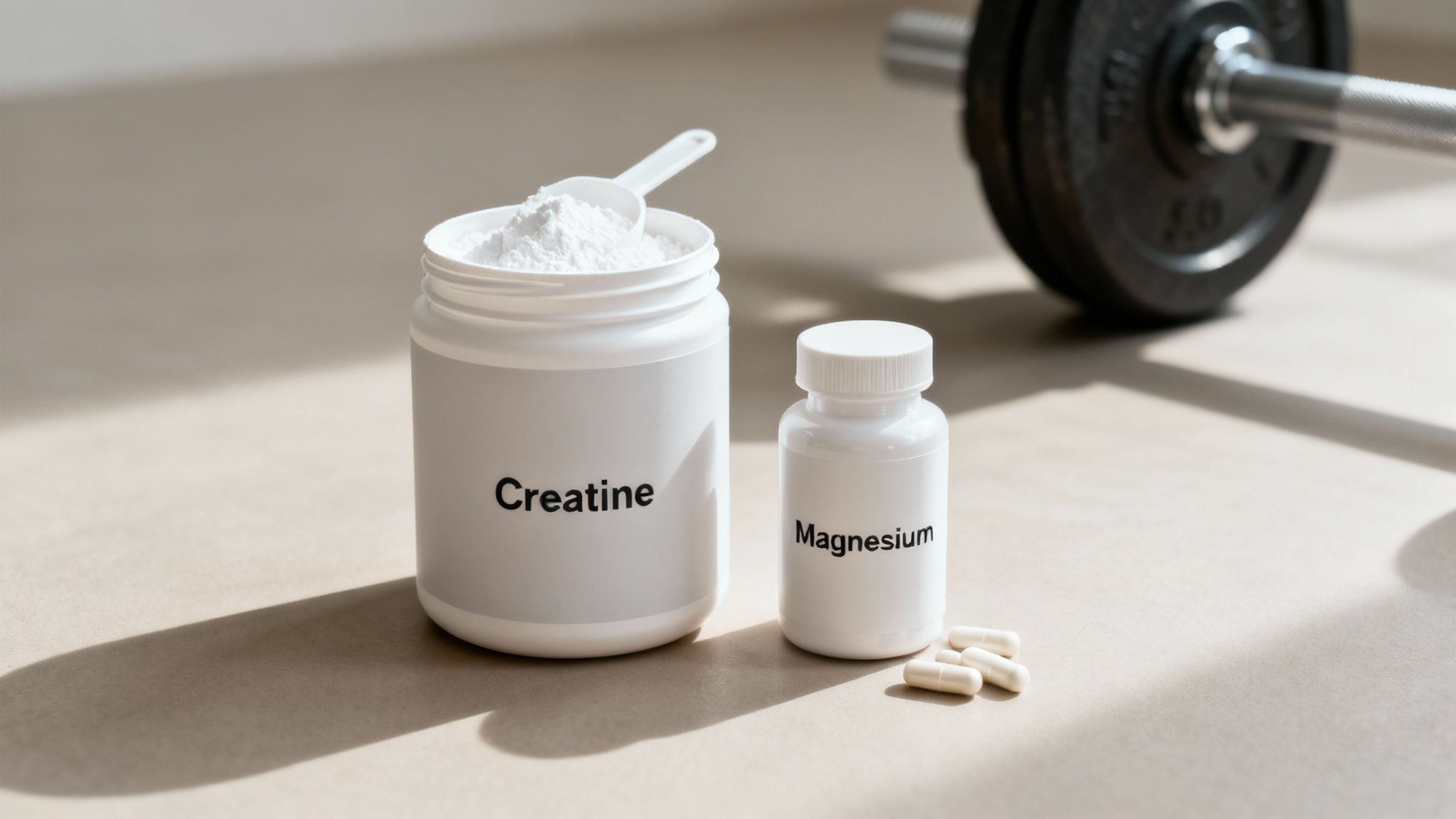
If you're looking for a one-two punch in your supplement stack, creatine and magnesium are it. They stand out because they hit both sides of the muscle-growth equation: energy and recovery.
Think of it like this: creatine is the high-octane fuel for your workout engine, while magnesium is the vital oil that keeps everything running smoothly and helps it recover overnight.
How Creatine Fuels Explosive Power
Creatine is all about giving you that extra gear during intense lifts. It works by helping your body regenerate ATP, which is the main energy currency for short, explosive movements. This means you can push for those extra reps, lift heavier, and sprint faster when fatigue would normally tell you to stop.
It's a genuine game-changer for your training volume. Here's what's happening under the bonnet:
- It rapidly regenerates ATP to power short, intense bursts of effort.
- It lets you crank out more reps per set, increasing total training volume.
- It helps hydrate muscle cells, a process called cell volumisation, which is a key signal for growth.
- It buffers pH levels in your muscles, which helps delay that burning sensation and fatigue during high-intensity sets.
The science backs this up. In the UK, creatine use has been linked to some pretty significant gains, with studies showing improvements in weight lifted by up to 32% and an average increase in muscle mass of 7.2%.
A typical loading protocol of 20 grams daily for 5–7 days can boost your muscle creatine stores by about 26%. After that, a maintenance dose of 3–5 grams a day keeps them topped up. That 26% increase is like going from a half-empty fuel tank to a full one, making sure you’re always ready for your next session.
Creatine Timing Tips
Once you've got your dosage sorted, the next step is timing. While the "anabolic window" concept can be a bit overblown, when you take your creatine can make a difference.
- Pre-workout: Taking it beforehand might give you a slight edge in immediate power and focus.
- Post-workout: Dosing after your session can take advantage of enhanced nutrient uptake.
- Split doses: Some people prefer to split their daily dose to maintain more stable levels throughout the day.
- Pair with carbs: Combining creatine with carbohydrates can help shuttle it into your muscles a bit faster.
For a really detailed breakdown of how to make your timing work for you, this best time to take creatine for muscle growth guide is well worth a read.
Forms of Creatine
You've probably noticed there are a few different types of creatine on the shelves. Let's cut through the noise.
Creatine monohydrate is the old faithful. It's the most researched, most effective, and cheapest form out there, with up to 99% muscle uptake when you dose it correctly. For most people, this is all you need.
However, some people find monohydrate gives them a bit of stomach discomfort or bloating. If that's you, other forms like Creatine Hydrochloride (HCL) or buffered versions might be a better fit.
- Monohydrate: The gold standard. Proven, effective, and budget-friendly.
- HCL: More soluble in water, which may reduce bloating for sensitive individuals.
- Kre-Alkalyn: A pH-stable formula designed to minimise side effects.
Your choice should come down to your personal tolerance, budget, and goals. The best supplement is the one you'll actually take consistently.
Magnesium’s Role in Recovery
While creatine is busy powering your lifts, magnesium is working behind the scenes to handle the recovery. It’s involved in over 300 different processes in the body, including crucial ones like protein synthesis and nerve function.
Its real magic for lifters lies in muscle relaxation. It helps ease those post-workout cramps and tension, paving the way for better repair. It also helps you get better quality sleep and manages stress hormones, both of which are absolutely critical for growth.
- It enhances sleep quality, which is when most muscle repair happens.
- It helps regulate cortisol, the stress hormone that can break down muscle tissue.
- It plays a part in ATP synthesis, supporting energy production.
- It balances calcium levels to ensure your muscles contract and relax properly.
When to Test Magnesium
Believe it or not, research suggests that up to 25% of UK adults have less-than-optimal magnesium levels, which can seriously hamper recovery.
If you’re often dealing with muscle cramps, poor sleep, or high stress levels, it might be worth getting your levels checked. A simple blood test can tell you where you stand. It's always a good idea to chat with a health professional to figure out the right dosage for you.
Magnesium Dosage and Sources
There are a few different forms of magnesium, and they aren't all created equal when it comes to absorption.
| Form | Typical Dose | Pros | Cons |
|---|---|---|---|
| Magnesium citrate | 200–300 mg daily | High absorption rate | May cause loose stools |
| Magnesium glycinate | 200–400 mg daily | Gentle on the stomach | Lower elemental content |
| Magnesium oxide | 250–500 mg daily | Widely available | Poor bioavailability |
A good target for most active people is 300–400 mg of elemental magnesium per day. Taking it before bed is a popular strategy to help with sleep, but you can also split the dose across your meals.
Combining Creatine and Magnesium
Using these two together is a brilliant strategy to cover all your bases—powering your performance and optimising your recovery.
- Take your creatine pre- or post-workout, sticking to your daily maintenance dose.
- Use magnesium in the evening to promote restful sleep and muscle repair.
- Stay on top of your hydration, as both supplements work best when you’re well-hydrated.
- Listen to your body and adjust your timing and dosages based on how you feel and the intensity of your training.
This simple pairing ensures you’re not just working hard in the gym but also recovering effectively, which is where the real growth happens.
Next Steps
Ready to give it a go? A great starting point is 3 grams of creatine daily and 300 mg of magnesium before bed. Track how you feel, your sleep quality, and your strength in the gym over four weeks. From there, you can adjust as needed to fine-tune your personal plan.
Fine-Tuning Your Recovery with Omega-3s and Ashwagandha
Here’s a truth every seasoned lifter knows: the real muscle-building magic doesn't happen when you're pushing weights. It happens in the quiet hours and days that follow. Recovery is everything. It’s when your body meticulously repairs those microscopic tears in your muscle fibres, rebuilding them bigger and stronger than before.
This is where we move beyond the basics and start fine-tuning the process. While intense training provides the stimulus, your body's internal environment dictates the results. Things like inflammation and stress hormones can either turbo-charge your progress or put the brakes on it. This is precisely where strategic supplementation with Omega-3s and Ashwagandha can be a total game-changer.
Cool Down Inflammation with Omega-3 Fatty Acids
Every tough workout creates a bit of inflammation. A small amount is a good thing—it’s the signal that tells your body to get to work on repairs. But when that inflammation becomes excessive or chronic, it leads to prolonged muscle soreness (hello, DOMS), slows down recovery, and can even increase your risk of injury.
Think of it like a construction site. You need a foreman directing the work, but you don't want constant roadblocks and disruptions slowing the whole project down.
This is where Omega-3 fatty acids, specifically EPA (eicosapentaenoic acid) and DHA (docosahexaenoic acid), step in. They act as powerful natural anti-inflammatories, helping to manage your body’s response to training. The result?
- Less DOMS: You'll feel less of that dreaded post-leg-day soreness, meaning you’re ready to hit your next session sooner.
- Faster Repairs: By keeping inflammation in check, Omega-3s clear the way for your body's repair crews to work more efficiently.
- Healthier Joints: These good fats also help lubricate your joints and support the connective tissues that take a hammering during heavy lifting.
A consistent intake of Omega-3s helps create an internal environment that supports recovery, rather than just reacting to damage. Of course, supplements are only one piece of the puzzle. They should always be paired with other effective muscle recovery strategies to truly maximise your gains.
Keep Stress in Check with Ashwagandha
Stress is the silent gains-killer. Whether it’s physical stress from training or mental stress from a hectic life, it all triggers the release of cortisol. Cortisol is a catabolic hormone—and in the world of muscle building, "catabolic" is a dirty word. It means "to break down."
When cortisol levels are high, your body can literally start breaking down hard-earned muscle tissue for energy. It directly undermines all your effort in the gym.
Ashwagandha is a powerful adaptogen, a class of natural herbs that help your body adapt to and manage stress. By helping to regulate cortisol levels, Ashwagandha encourages a more anabolic (muscle-building) state.
By keeping cortisol under control, Ashwagandha helps shift your body's hormonal balance away from muscle breakdown and towards growth and repair. It’s a crucial tool for protecting the muscle you've worked so hard for.
The benefits don't stop there. Ashwagandha is also known to improve sleep quality—another non-negotiable for recovery—and may even support healthy testosterone levels, a key hormone for muscle growth. Our complete guide on the best supplements for muscle recovery dives deeper into how these elements work together.
Don't Forget Your Multivitamin
While specific supplements target particular pathways, a high-quality multivitamin is your nutritional insurance policy. Even with the best diet in the world, the increased demands of hard training can create small but significant gaps in your micronutrient intake.
Think of it as making sure your construction crew has all the small but essential tools—the screwdrivers, wrenches, and measuring tapes. Without them, the big jobs simply can't get done right. A multivitamin provides the essential co-factors needed for thousands of bodily processes, including:
- Energy Production: B vitamins are absolute workhorses for converting food into usable energy.
- Protein Synthesis: Key minerals like zinc and magnesium are critical for building new muscle tissue.
- Immune Support: Vitamins C and D help keep your immune system robust, preventing pesky illnesses from derailing your training schedule.
This isn’t just theory; it’s common practice among those who train seriously. A 2008 study of elite UK athletes found that nearly half (48.1%) used supplements specifically for muscle-related benefits. Alongside the big hitters like protein and creatine, a solid 22.8% of these athletes were using multivitamins, showing they understand the need for both performance aids and foundational health.
By combining the targeted effects of Omega-3s and Ashwagandha with the broad-spectrum support of a multivitamin, you create the ideal internal landscape for consistent, effective muscle growth.
Building Your Personalised Supplement Stack
Knowing which vitamins are good for muscle growth is one thing. Knowing how to combine them into a plan that actually works for you is another thing entirely. It's the real key to success.
Truth is, there's no single "best" stack for everyone. Your ideal combination hinges on your unique goals, how hard you train, and even lifestyle factors like your sleep and stress levels.
Instead of just grabbing every shiny tub off the shelf, the smart approach is to build your stack logically. Think of it like putting together a toolkit. You start with the essentials—the hammer and screwdriver—and then add the specialised tools once you're tackling more advanced projects.
This way, you can actually feel how each new supplement benefits you before adding another one. You end up with a routine that’s not just effective, but also makes sense for your wallet.
Start with a Solid Foundation
Every good structure needs a solid base. When it comes to supplements, this means covering your essential micronutrients first. This supports your overall health and makes sure your body has all the raw materials it needs for repair and energy. Simple as that.
-
The Beginner’s Foundation: This is the perfect starting point for anyone new to supplements or just wanting to make sure all the core bases are covered.
- Multivitamin: Think of it as your daily insurance policy, filling in any small gaps in your diet.
- Vitamin D: Absolutely crucial for hormone regulation and muscle function, especially for those of us in the UK who don't see much sun.
- Magnesium: Supports sleep quality, helps your muscles relax, and is involved in hundreds of vital bodily processes.
Start with this trio for a few weeks. Really pay attention to your energy levels, how well you're sleeping, and your general well-being. Once you’ve got a feel for this baseline, you can start to add more targeted supplements into the mix.
Tailor Your Stack to Your Goals
With your foundation firmly in place, it's time to add supplements that line up with your specific fitness ambitions. Are you chasing more power in the gym, or is faster recovery your main priority? Let your goals be your guide.
A personalised stack is always more powerful than a generic one. By listening to your body and matching supplements to your goals, you stop guessing and start using a targeted strategy that delivers real results.
Here are a couple of examples of how this looks in practice:
- The Performance Maximiser: If your number one goal is to lift heavier and push out more reps, creatine is your next logical step. It directly fuels that explosive power, allowing you to ramp up your training intensity—which is the main driver of muscle growth.
- The Recovery Optimiser: If you find yourself constantly sore and struggling to bounce back between sessions, then recovery needs to be your focus. Adding Omega-3s helps manage inflammation, while Ashwagandha can help regulate the stress hormone cortisol, creating a much better environment for your body to repair itself.
This little infographic can help you visualise how to choose your recovery supplements based on how you’re feeling.

As you can see, the path is pretty simple: if general soreness is your main problem, Omega-3s are a great shout. But if stress and fatigue are what's really holding you back, Ashwagandha might be the better fit.
A Smart Checklist for Building Your Stack
Before you add any new supplement to your routine, run through this quick checklist. It’s a great way to empower yourself to make informed decisions and make sure you’re actually addressing the root cause of any plateau.
- Diet Check: Is my protein and overall calorie intake high enough to support growth? Am I eating a good variety of whole foods?
- Training Intensity: Am I consistently applying progressive overload in my workouts? Am I pushing myself?
- Sleep Quality: Am I getting 7-9 hours of quality, uninterrupted sleep every night?
- Stress Levels: Are my stress levels under control, or is cortisol likely getting in the way of my recovery?
By being honest with yourself here, you can build a stack that complements your lifestyle, rather than one that just tries to paper over the cracks.
For those looking for a pre-built combination where all the components work together, exploring a curated Active Build & Repair Stack can be a brilliant way to start with a balanced, synergistic formula.
The most important rule? Introduce only one new supplement at a time. Give it at least two to four weeks to see how it affects you before you think about making another change.
Got Questions? Let's Get Them Answered
Diving into the world of supplements always brings up a few questions. From whether you really need them to how long it'll take to see a difference, getting straight answers is crucial for building a smart muscle growth plan. Let's clear up some of the most common queries.
Can I Get All These Nutrients From Food Alone?
In a perfect world, absolutely. A flawlessly balanced diet, packed with whole foods, is the bedrock of good health and muscle growth. The reality, though? Hitting that ideal consistently is tough, especially when you’re pushing your body hard in the gym.
When you train intensely, your body’s demand for certain micronutrients like magnesium, B vitamins, and antioxidants goes through the roof. Trying to meet these heightened needs from food alone would mean eating a huge volume of food, which just isn't practical for most of us. Think of supplements as a convenient, efficient way to fill in those nutritional gaps, making sure your body has everything it needs to perform and recover at its best.
How Long Until I See Results?
This is the big one, and the honest-to-goodness answer is: it depends. The timeline for seeing results isn't one-size-fits-all. It varies based on the supplement you’re taking, how consistent you are with training and diet, and even your own genetics.
Think of supplements as accelerators, not magic bullets. They amplify the results of the hard work you’re already putting in at the gym and in the kitchen; they don't replace it. Consistency is what really moves the needle.
But to give you a rough idea:
- Creatine: You could feel its impact on your performance – like squeezing out an extra rep or two – within the first couple of weeks, especially if you do a loading phase.
- Vitamins (D, B-Complex): These are the unsung heroes working behind the scenes. You might start noticing better energy levels and smoother recovery over several weeks to a few months as your body replenishes its stores.
- Adaptogens (Ashwagandha): Effects on stress levels and sleep quality can often be felt within a few weeks of consistent, daily use.
Are There Any Side Effects to Be Aware Of?
For the most part, the vitamins and supplements we’ve covered are safe for healthy adults when taken at the recommended doses. That said, it's vital to approach supplementation with a bit of common sense.
Going overboard with high doses of certain nutrients can cause problems. For instance, too much magnesium might lead to an upset stomach, while excessive zinc can mess with your copper absorption. This is exactly why starting with a lower dose and always following the instructions on the label is non-negotiable.
And remember, quality matters. Always opt for high-quality products from reputable brands that use third-party testing. It’s your best guarantee of purity and potency, so you know you're actually getting what you paid for.
Ready to build a smarter supplement stack that’s truly personalised to your goals? Discover tailored recommendations and premium formulas at VitzAi.com. Explore our curated stacks and take the guesswork out of your health journey. Find your perfect fit at https://vitzai.com.
This article is for informational purposes only and is not medical advice. Always consult a qualified health professional before starting any new supplement or major lifestyle change.