

Blood Flow Supplements Explained Simply
Most advice on blood flow supplements skips a point. Raising nitric oxide doesn't automatically mean your circulation improves in a meaningful way. You can raise a blood marker and still feel no difference in workout performance, hand warmth, or day-to-day energy.
That's why this category confuses people. Labels promise better pumps, stronger performance, healthier vessels, and smoother circulation, all from one scoop or capsule. Real life is messier. Some ingredients do support nitric oxide pathways or vascular tone, but the payoff depends on the ingredient, the timing, your baseline health, and what you're trying to improve.
If you think of blood flow supplements as tools rather than magic, they make much more sense. Some are aimed at exercise performance, especially endurance or submaximal work. Some are used for everyday circulation support, like people who sit all day and feel sluggish. Others fit better into a long-term cardiovascular support plan alongside basics like movement, sleep, omega-3 intake, and a generally solid diet.
What Blood Flow Supplements Really Do
The marketing story is simple. More nitric oxide equals wider blood vessels, and wider blood vessels equal better blood flow. The physiology is real, but the shortcut is too neat.
Blood flow supplements are usually oral products that try to support endothelial function, vascular tone, or nitric oxide signaling. In plain English, they aim to help your blood vessels relax and respond well when your body needs to move oxygen and nutrients around. That can matter during exercise, after long sedentary stretches, or as part of a broader heart-health routine.
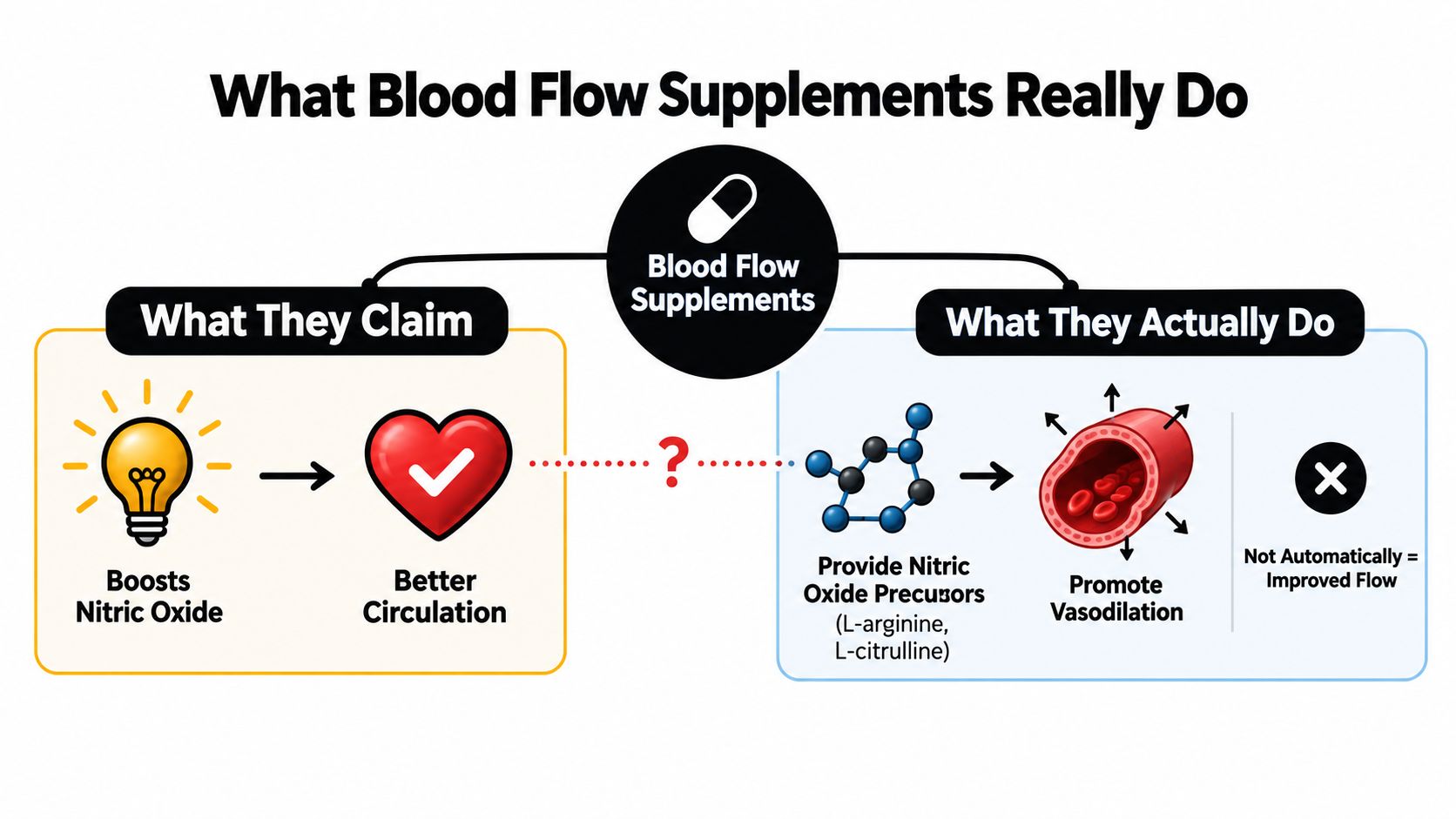
What they can do and what they can't
They can support pathways involved in vasodilation. They can't unclog arteries, replace prescribed treatment, or override a routine built on poor sleep, high stress, dehydration, and no movement.
That distinction matters because people often lump very different goals together:
- Exercise support: Better endurance, lower oxygen cost during steady efforts, or improved workout feel.
- Everyday circulation support: Feeling less sluggish after sitting, or noticing better comfort during long workdays.
- Longer-term support: Building habits that may help vascular health over time.
Practical rule: A supplement that changes a nitric oxide marker may still do nothing noticeable for your workouts or daily circulation.
The research on L-citrulline is a good example. A review found it's one of the better-studied ingredients for raising arginine availability and supporting nitric oxide production, but it also noted that short-term use often failed to improve flow-mediated dilation even when arginine and nitrate-related biomarkers increased. In one cited human study in older men, L-citrulline did increase femoral blood flow by 11% and vascular conductance by 14% during lower-limb exercise, which shows the effect can be real but context-dependent (review summary).
Why realistic expectations matter
Some people feel a clear difference from these products. Others mostly see subtle changes, or none at all. That doesn't mean the whole category is useless. It means blood flow supplements are not one-size-fits-all.
Safety is the other part people miss. If you take heart medications, blood pressure drugs, aspirin, or anticoagulants, check interactions before experimenting. A practical place to start is this guide to supplement drug interactions for heart, because the “natural” label doesn't remove the need for caution.
The Main Ingredients Behind the Label
Look at ten blood flow supplements and you'll usually see the same small group of ingredients repeated in different combinations. The trick is knowing which ones are trying to do what.
The major ingredient families
Some ingredients act as nitric oxide precursors. Others supply dietary nitrates. Others are included for broader vascular support rather than a fast vasodilation effect.
| Main blood flow supplement ingredients at a glance | ||
|---|---|---|
| Ingredient | Primary Action | Evidence Strength |
| Beetroot and other nitrate sources | Support nitrate to nitrite to nitric oxide pathway | Stronger for acute nitrate rise and endurance-related use |
| L-citrulline | Raises arginine availability to support nitric oxide production | Mixed but well studied |
| L-arginine | Direct nitric oxide precursor | Mixed and often less reliable orally |
| Cocoa flavanols and pine bark extracts | Support endothelial function and vascular responsiveness | Promising but product-dependent |
| Omega-3 EPA and DHA | Support cardiovascular health and endothelial function | Useful for broader heart-health goals, not a classic vasodilator |
| Nitrosigine and glycine propionyl-L-carnitine | Often used in performance formulas | More preliminary in mainstream consumer use |
| Rhodiola and ginseng | Sometimes added for energy or perceived performance support | Not primary blood flow ingredients |
What tends to sit at the center of formulas
Beetroot products are built around dietary nitrate. They're often used before cardio sessions, long runs, cycling, or any session where exercise efficiency matters more than a gym “pump.”
L-citrulline shows up constantly because it tends to raise circulating arginine more reliably than oral arginine. That's one reason many pre-workouts lean on citrulline rather than making arginine the star.
L-arginine still appears on labels because the mechanism is intuitive. The problem is that “intuitive” doesn't always mean effective in practice. If you want the food-first version of that conversation, this guide to L-arginine-rich foods is a useful companion.
The supporting cast
Flavonoid-rich ingredients like cocoa extracts and pine bark usually appeal to readers who care less about a workout buzz and more about vessel function over time. They're often quieter ingredients. You may not “feel” them the way someone feels a stimulant or a strong pre-workout.
Omega-3s belong in a different bucket. They're often discussed alongside circulation because they support overall cardiovascular health, but they're not really pump ingredients. They fit better in a long-game stack than a pre-training nitric oxide formula.
Some stacks are built for an acute workout effect. Others are built for everyday cardiovascular support. They may share shelf space, but they're not solving the same problem.
How Nitric Oxide and Vasodilation Actually Work
More nitric oxide does not automatically mean better circulation.
That shortcut is behind a lot of blood flow supplement marketing, but the process is less tidy. Nitric oxide is a signalling molecule. Its job is to tell the smooth muscle around a blood vessel to relax. When that happens, the vessel can widen, and blood can move with less resistance. That widening is called vasodilation.
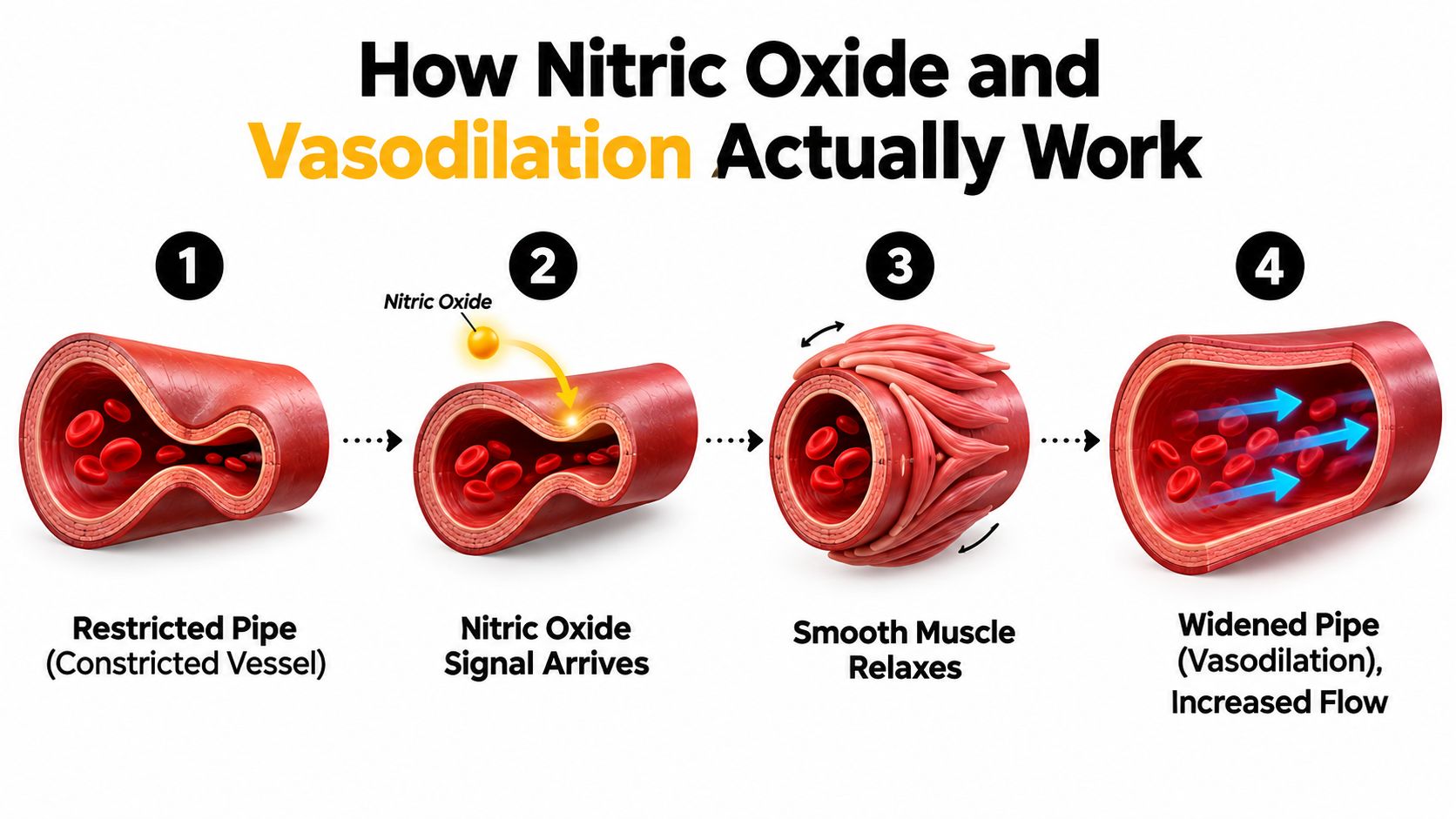
A simple way to picture it is a garden hose with an adjustable nozzle. Open the nozzle a bit more and water flows more freely. Blood vessels are far more complex than a hose, of course, because they respond to nerves, stress, exercise, medications, and the health of the vessel lining itself. Still, the comparison helps explain why vasodilation can matter without pretending the body works like plumbing.
Your body can raise nitric oxide through two main routes.
The first is the arginine route.
Cells lining your blood vessels use L-arginine to make nitric oxide with the help of an enzyme called endothelial nitric oxide synthase. Citrulline fits into this story because your body can convert citrulline into arginine, which is why citrulline often shows up in formulas aimed at pumps or exercise support.
The second is the nitrate route.
Dietary nitrate, including the kind found in beetroot, follows a different path. It is converted to nitrite and then into nitric oxide. That route is one reason beetroot products sit in a slightly different category from amino acid based formulas. If you want a practical food-and-supplement overview of that angle, this SupplementSource.ca beetroot juice guide is a handy read.
Timing matters here. Nitrate does not work like flipping a switch the second you swallow it. The body has to absorb it, convert it, and circulate the byproducts before you might notice anything. That is why some products work better when taken ahead of an event or workout rather than right as it starts.
The vessel lining matters too. A younger, well-rested, active person with good baseline vascular function may respond differently from someone dealing with poor sleep, smoking history, high stress, or medications that already affect blood pressure. Same ingredient. Different result.
Here's a quick visual explainer before one more practical point:
This is why “nitric oxide booster” is a fuzzy promise. A supplement may raise a marker related to nitric oxide yet do little for the outcome you care about, whether that is warmer hands, better endurance, easier walking, or a stronger gym pump. The gap between mechanism and real-world effect is where a lot of label claims get ahead of the research.
For people comparing formulas, that is also why VitzAI nitric oxide options are more useful when filtered by goal, timing, and medications. The same ingredient can make sense for one person and be a poor fit for another.
What the Research Actually Shows
The hype usually falls apart a little. The evidence isn't empty, but it's more uneven than most sales pages suggest.
Citrulline and arginine
L-citrulline is one of the better-studied options, but even here the story is mixed. A 2021 review found that a single 6 g dose increased nitric oxide bioavailability yet didn't improve respiratory performance or inspiratory muscle oxygenation, and earlier work cited in that review also found no blood-flow increase after acute citrulline use in young or older adults (2021 review).
That's why the old shortcut, “more nitric oxide equals better circulation,” doesn't hold up cleanly.
Arginine looks even shakier in many exercise settings. A 2023 review reported that oral arginine in healthy participants did not improve aerobic capacity or nitric oxide synthesis even at 0.075 g/kg or 6 g doses, and acute or short-term use up to 7 days did not improve endothelial function by brachial artery flow-mediated dilation despite higher arginine availability and urinary nitric oxide metabolites (2023 review).
Beetroot, omega-3, and flavonoids
Beetroot has a cleaner evidence base for the nitrate pathway than many “pump” formulas do. The best-supported short-term effect is the rise in nitrate-related markers and the timing window discussed earlier. That seems most relevant for endurance or submaximal exercise, while resistance-training or strength outcomes look less predictable.
Independent review commentary also notes that beetroot juice can raise plasma NOx without necessarily improving blood flow, metabolic efficiency, or leg-extension performance in some strength-focused settings, which is a useful reminder that a biochemical shift isn't the same as a practical result (review discussion).
Omega-3s fit a different role. They're less about acute vasodilation and more about broader cardiovascular support. They also come with labeling limits worth knowing. The FDA says supplement labels should not recommend more than 2 g/day of EPA and DHA combined from supplements, and it considers supplements providing no more than 5 g/day combined EPA and DHA safe when used as recommended. The NIH Office of Dietary Supplements also notes that FDA recommends no more than 5 g/day combined EPA and DHA from supplements (NIH omega-3 guidance).
| Evidence strength for common blood flow supplements | |||
|---|---|---|---|
| Ingredient | Main vascular effect | Evidence strength | Typical result |
| L-citrulline | Supports arginine availability and nitric oxide signaling | Mixed but substantial | May shift biomarkers more consistently than practical blood-flow outcomes |
| L-arginine | Direct nitric oxide precursor | Mixed to weaker orally | Often less reliable in real-world supplementation |
| Beetroot nitrate | Supports nitrate to nitric oxide pathway | Stronger for acute pathway support | Most useful around endurance or submaximal exercise |
| Omega-3 EPA and DHA | Supports cardiovascular health | Strong in broader heart-health context | Better viewed as foundational support, not a fast vasodilator |
| Flavonoid-rich extracts | Support endothelial responsiveness | Promising but variable | Product quality and formulation matter a lot |
For a broader decision guide on this category, VitzAI's article on supplements for circulation is a helpful next step.
Safety, Medications and Who Should Be Cautious
This is the part most blood flow supplement guides rush past. It's also the part that matters most if you already take medication.
Some supplement-focused health guidance warns that beetroot, garlic, and arginine may lower blood pressure, while ginkgo and similar ingredients may raise bleeding risk when combined with warfarin or aspirin. It also points out that the research base for these products often measures surrogate markers rather than hard cardiovascular outcomes, which is exactly why caution matters (interaction overview).
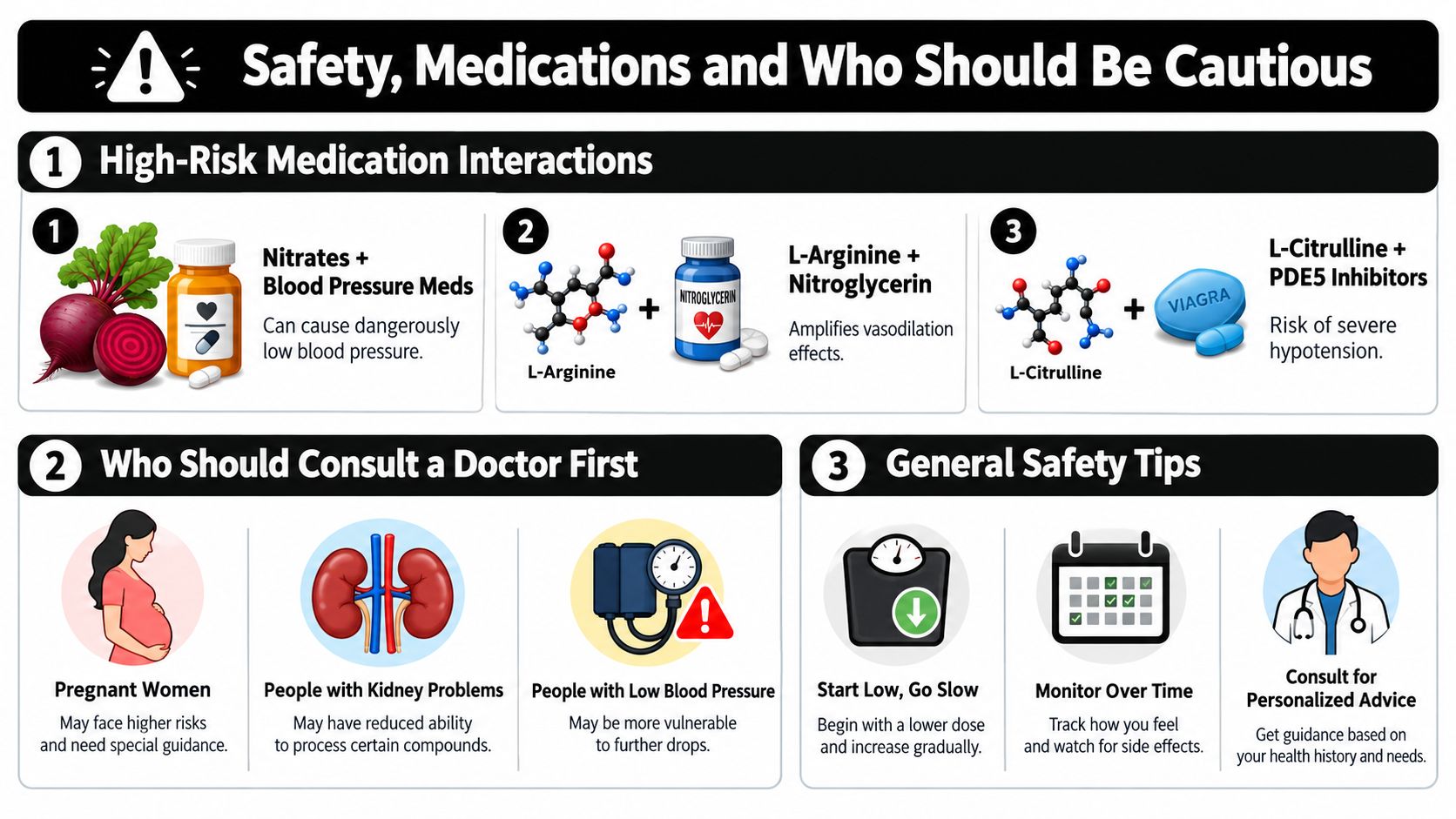
The combinations that deserve a pause
You don't need to panic about every capsule. You do need to slow down if you use products that already affect blood pressure or clotting.
- Blood pressure medications: Beetroot nitrate products, arginine, and sometimes citrulline may add to the blood-pressure-lowering effect.
- Anticoagulants and antiplatelet drugs: Some circulation-focused ingredients can complicate the picture, especially if a product includes extras like ginkgo.
- PDE5 inhibitors: Anything that supports vasodilation deserves an extra conversation if you also use medication in this category.
- After a cardiac event or with kidney or liver concerns: This is not the time for self-experimenting based on gym forums.
Ask a pharmacist or clinician about the pairing, not just the supplement on its own. Interactions happen in combinations.
Who should be extra careful
Pregnant readers, people recovering from cardiovascular events, and anyone managing several prescriptions should treat “natural” as a description, not a safety guarantee.
The same applies to stackers. A single product may be modest. Three products with overlapping vasodilation or blood-thinning effects are a different situation. Caution isn't a downside here. It's part of using supplements like an adult instead of treating labels like harmless wellness decor.
Typical Doses, Timing and Stacking Habits
For everyday circulation support, a single well-timed ingredient is often enough to test before adding a second. That approach makes it easier to notice what helps, instead of giving all the credit to a crowded label.
Timing changes the result more than many labels admit. Beetroot nitrate is the clearest example. If someone takes it seconds before a workout and feels nothing, the supplement may not have failed. The schedule may have. As noted earlier, nitrate products tend to make more sense when taken well before training rather than as a last-minute scoop.
Omega-3s work differently. They are not a classic pre-workout ingredient, so the main question is not "What minute should I take this?" It is "Does this fit my broader goal, and am I staying within the guidance noted earlier for EPA and DHA?"
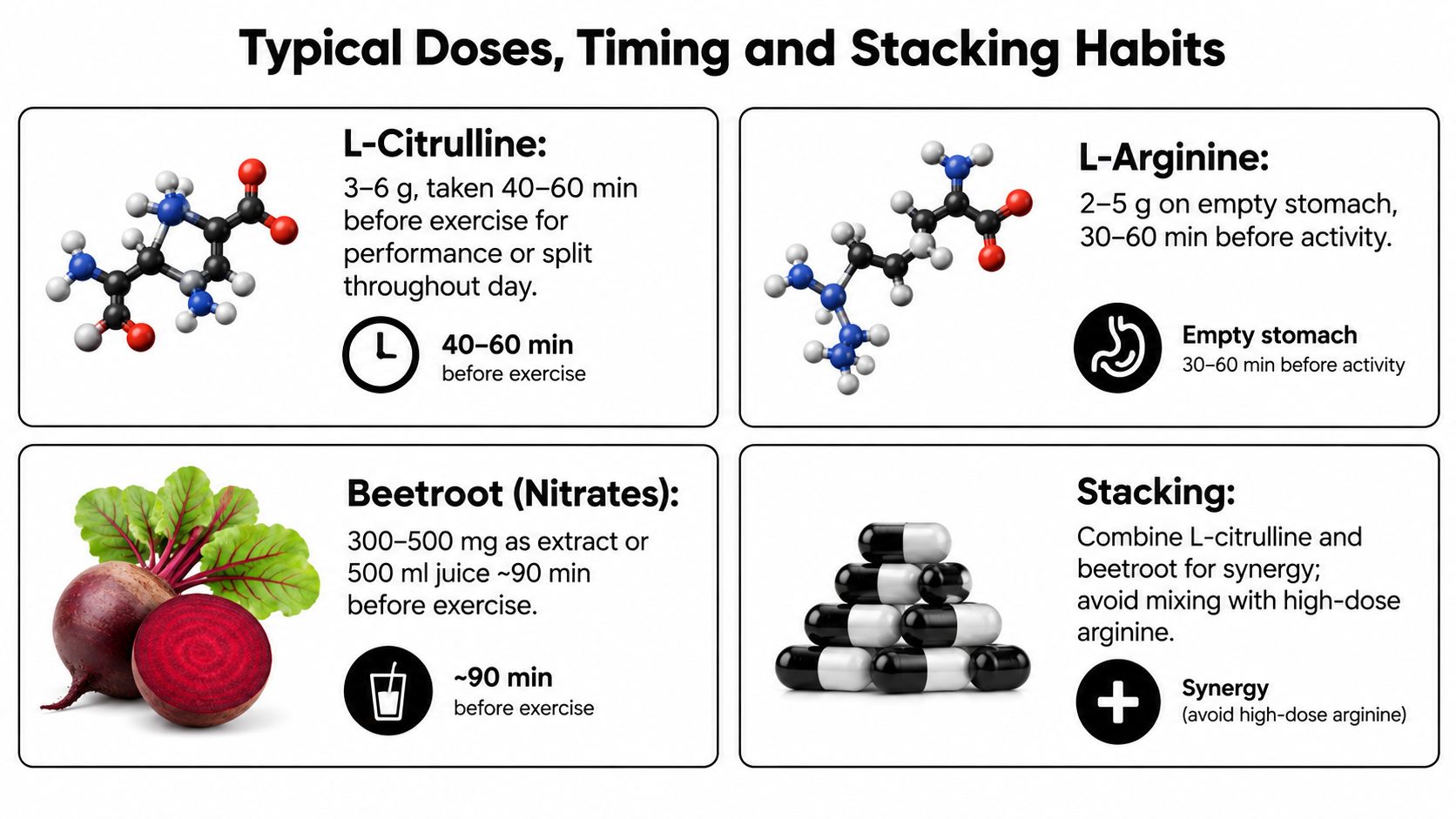
Stacking works best when each ingredient has a job.
- Before endurance training: Beetroot is often the first ingredient people test because its use case is fairly specific.
- For nitric oxide precursor support: Citrulline usually gets tried before arginine because it tends to be more dependable in real-world use.
- For longer-term cardiovascular support: Omega-3s fit better here than in a pump-chasing stack.
- For general wellness support: Cocoa flavonoids or similar add-ons may suit daily use better than a dramatic pre-gym effect.
A simple rule helps here. Do not stack three ingredients that all sound like they "boost nitric oxide" and assume more is better. Blood flow supplements act more like tools in a small toolkit than horsepower parts on a race car. If two tools do nearly the same job, doubling them does not always double the result.
That matters because a rise in a blood marker is not the same thing as a noticeable circulation benefit. One Frontiers paper reported that citrulline malate increased serum arginine without clearly improving flow-mediated dilation over the short testing window in healthy young men (Frontiers 2026 article). That is a useful reality check for marketing claims that treat "more nitric oxide support" as an automatic win.
A better habit is to test one change at a time, keep the reason for it clear, and let your goal decide the stack. That is also the logic behind VitzAI's quiz. It sorts ingredients by goal, routine, and medication context, instead of treating every blood flow formula as if it fits every reader.
Matching the Right Ingredients to Your Goals
The best blood flow supplements for one person can be a waste of money for another. Goal matters more than hype.
The endurance athlete
Take someone training for long cycling sessions, steady-state running, or mixed conditioning work. They usually care about oxygen delivery and exercise efficiency more than an exaggerated gym pump.
For that person, beetroot is often the first thing to test because its strongest case is around the nitrate pathway and pre-exercise timing. Citrulline may still show up, but it's not automatically the star. Hydration, sleep, and pacing strategy will shape the result as much as the supplement will.
The desk-bound professional
This person often shops for “circulation” help when the issue is too much sitting, too little walking, and too many hours at a screen. Their hands feel cold, their energy dips after lunch, and they want a supplement to fix what movement habits are causing.
A gentler approach usually makes more sense here. Think supportive ingredients, regular water intake, standing breaks, short walks, and less obsession with pre-workout-style nitric oxide claims.
If you sit for most of the day, a supplement can support the routine. It can't replace the routine.
The healthy-ageing reader
This reader isn't chasing a pump at all. They care about steady cardiovascular support, healthy habits, and staying active over time.
Omega-3s often make more sense here than trendy nitric oxide blends, especially as part of a bigger routine that also includes sleep support, stress management, and basic nutritional coverage. That broader lens matters because circulation isn't isolated from the rest of your physiology. Poor sleep, unmanaged stress, and low activity blunt the effect of almost everything.
Supplement categories start to overlap. Someone focused on healthy ageing might also look at magnesium for sleep, but the evidence there is limited and mixed. The National Center for Complementary and Integrative Health says there is very little research on magnesium for insomnia and points to a 2021 review of 3 studies with 151 participants suggesting possible improvement in sleep-onset latency in older adults, alongside a 2022 review of 9 studies with 7,582 participants that found conflicting results and called for better trials (NCCIH magnesium and sleep summary). That doesn't make magnesium irrelevant. It just means you should treat it as a potentially useful support, not a guaranteed sleep fix.
Building Your Personalised Stack With VitzAI
Generic “top 10 blood flow supplements” lists flatten a real-world decision into a shopping list. That's the opposite of what most adults need.
A better starting point is to ask a few grounded questions. What's the goal? Workout support, everyday circulation, or long-term cardiovascular health? Do you already take blood pressure medication, aspirin, or an anticoagulant? Are you looking for a pre-exercise tool, or for something more foundational, like omega-3s as part of a broader healthy-ageing plan?
That's where personalisation helps. VitzAI's quiz takes details like goals, age, diet pattern, training load, and current supplement habits, then narrows the field into a more realistic shortlist. The point isn't to generate a perfect answer from a screen. It's to cut through guesswork so the next conversation with your clinician, pharmacist, or dietitian starts from something more useful than a random influencer stack.
The same ingredient can be sensible for one person and a poor fit for another. That's especially true in a category where medication interactions, timing, and baseline health matter as much as the ingredient itself.
If you take one thing from this guide, let it be this. Blood flow supplements can support a goal, but they don't erase the need for movement, sleep, hydration, diet quality, and medication awareness. Those basics still decide whether a supplement adds something meaningful or just adds capsules.
If you want help narrowing down which supplements fit your goals, diet, and current routine, VitzAi.com offers a personalised supplement quiz and curated recommendations. It's a practical way to sort through options like omega-3s, magnesium, and circulation-focused products without relying on generic listicles or trial-and-error buying.
This article is for informational purposes only and is not medical advice. Always consult a qualified health professional before starting any new supplement or major lifestyle change