

Choline & Inositol: Benefits, Forms and Smart Stacking
Most choline and inositol content swings too far in one direction. It either treats them like obscure micronutrients nobody needs to think about, or it sells them as a universal fix for brain fog, liver concerns, hormones and energy. The more useful, less dramatic reality is this. Choline is an essential nutrient, and EFSA set an Adequate Intake of 400 mg/day for healthy adults in 2016. That gives you a real benchmark instead of a wellness slogan, and it's the right place to start if you want to judge whether a food or supplement truly makes sense for you EFSA benchmark and UK context.
Choline & inositol are worth understanding together because they're often bundled, but they don't do the same job. Choline is tied to membrane structure, liver fat handling and nerve signalling. Inositol is tied to cell messaging and insulin-related pathways. Used well, they're supportive nutrients. Used carelessly, they become a label-reading trap, especially when products blur the difference between a compound's weight and the actual nutrient you're getting.
Why Choline and Inositol Deserve a Second Look
The easy story says these two belong either in the “too niche to matter” basket or the “take them for everything” basket. Both misses the point. Choline has an official adult intake benchmark of 400 mg/day, and that matters because it frames the nutrient as something you can compare against your diet, not just an optional add-on EFSA benchmark and UK context.
Nutrients, not miracle ingredients
That same benchmark is why the conversation should start with adequacy, not hype. If you're eating a varied diet, you may already be close. If you're not, especially if you eat fewer animal foods or keep calories tight, you may be missing more than you realise. The point isn't to panic about deficiency. It's to replace guesswork with a real target.
Practical rule: if a product can't tell you how much elemental choline it provides, you can't judge it properly.
A lot of supplement marketing skips that step and jumps straight to claims about focus, liver health or “detox”. Those claims aren't wrong in a mechanistic sense, but they're often way ahead of the human evidence. The more honest view is that these nutrients are best understood as part of everyday nutritional support first, and only then as possible extras for specific goals.
That's the framework to use here. You'll see what each nutrient is, what it does in the body, how to compare forms on a label, where food fits in, and which groups are most likely to need a closer look. You'll also see where the evidence stops, because that's where most product pages get vague.
What Choline and Inositol Actually Are
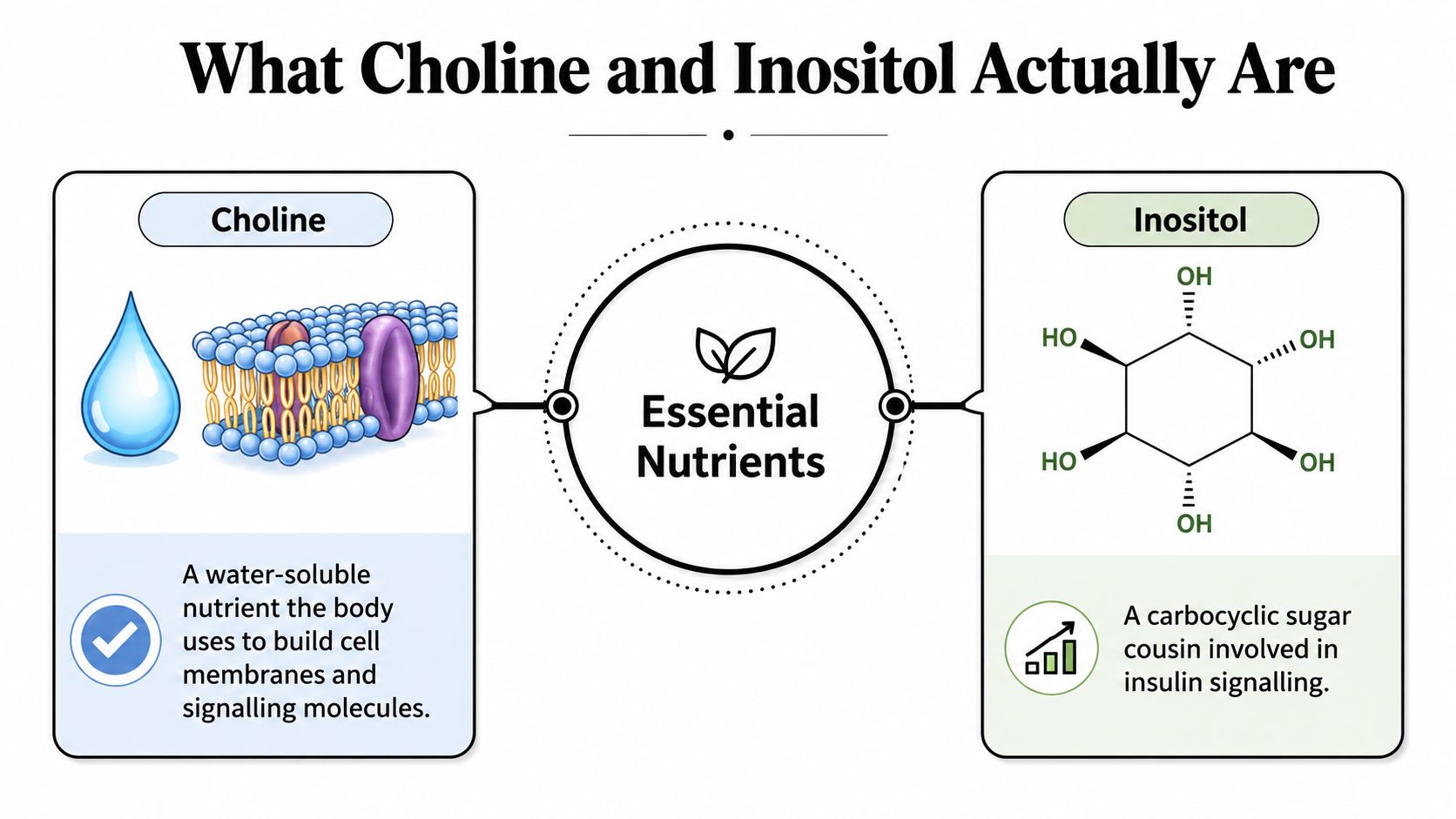
Choline is a water-soluble nutrient the body uses to build cell membranes and signalling molecules. Inositol is a carbocyclic sugar cousin that helps with cell communication, including pathways involved in insulin signalling and neurotransmitter response. They're usually discussed together because they sit in overlapping parts of metabolism, but they aren't interchangeable.
A simple construction-site analogy
Think of your cells as buildings under constant maintenance. Choline supplies the bricks, because it helps form phospholipids that make up membranes. Inositol supplies the wiring, because it sits inside signalling systems that help cells respond to messages. That's not a perfect analogy, but it's useful because it keeps the roles separate in your head.
Inositol used to be labelled “vitamin B8” in older nutrition language, but it's now better understood as a pseudovitamin. The practical takeaway is simpler than the taxonomy. You don't need to memorise the classification to make good decisions. You do need to know that the compound weight on a label is not always the same thing as the active nutrient dose you think you're buying.
That distinction matters most with choline products. A capsule may list choline bitartrate, but the body does not see every milligram of that salt as elemental choline. If you miss that difference, you can easily overestimate how much real choline you're getting.
For readers who also care about methylation and nutrient overlap, it's useful to compare this topic with methylated vitamins and why they matter in stacked supplements. Choline sits in the same broader conversation about efficient nutrient use, but it's its own nutrient with its own label rules.
Why they show up in the same supplement
The pairing makes sense because the body uses both in structural and signalling pathways. That's why you'll often see them together in formulas aimed at liver support, metabolic support or daily wellness. The pairing doesn't prove a cure. It reflects that the nutrients touch related systems.
The Real Biological Roles Inside Your Body
Choline earns its reputation in four places. It helps the liver package and export fat, it supports acetylcholine production for memory and muscle control, it contributes to membrane integrity, and it plays a role in methylation alongside folate. Inositol is different. It's more closely tied to insulin signalling, neurotransmitter modulation and membrane structure mechanistic overview of choline.
Why the liver conversation keeps coming up
When the liver has to ship fat out, it relies on phosphatidylcholine. Without enough choline, that process becomes harder. A useful way to think about it is that the liver needs proper labels on its lipid parcels before they can leave the warehouse.
The liver can make phospholipid-rich export particles more efficiently when choline is available, which is why low intake keeps turning up in conversations about fat handling.
That doesn't mean choline is a treatment for liver disease. It means the biology is real, and it explains why people with low dietary intake often become interested in it. It also explains why a generic “energy supplement” pitch misses the point entirely. Choline is about structure and transport as much as it is about any subjective feeling.
Brain, nerves and cell signalling
Choline's role in acetylcholine is the part many people recognise first. That's the neurotransmitter linked with memory and muscle activation, so it's easy to see why choline gets marketed for focus. The leap from biochemical pathway to noticeable cognitive benefit is where the evidence gets much less tidy, especially in healthy adults.
Inositol works in a different lane. It helps cells respond to signals, and that's why it appears in discussions about insulin-related pathways and hormonal balance. It's also why myo-inositol gets so much attention in PCOS-related research, while D-chiro-inositol gets discussed more narrowly in some formulations. The body doesn't care about marketing categories, only about what's available, what form it is, and whether the dose is sensible.
How the nutrients feel in real life
A person with a low-choline diet may not notice anything dramatic for a long time, which is part of the problem. Nutrient support is often quiet until intake is clearly off. Inositol is similar. People tend to look for it when they want support for metabolic or hormonal concerns, but the right question is always the same, which form, what dose and for what target.
Comparing the Different Forms on a Supplement Label
The label is where good intentions get expensive. Choline and inositol supplements are not all equal, and “stronger” isn't the same thing as “better”. For everyday use, choline bitartrate often makes the most sense. For more targeted nootropic-style use, people usually look at CDP-choline or alpha-GPC. For membrane-focused nutrition, phosphatidylcholine is a common option. For inositol, myo-inositol is the main everyday form, while D-chiro-inositol shows up in more specific stacks.
| Form | Key trait | Best for |
|---|---|---|
| Choline bitartrate | Usually the cheapest, but only a fraction is elemental choline | Basic nutritional top-up |
| CDP-choline | Often used in cognitive-focused products | Focus and brain-oriented stacks |
| Alpha-GPC | Popular in performance and nootropic products | Short-term cognitive support |
| Phosphatidylcholine | Membrane-oriented phospholipid form | General structural support |
| Myo-inositol | The most common supplemental form | Metabolic and hormonal support |
| D-chiro-inositol | More specialised form | Formula-specific use cases |
Don't pay for a form you don't need
If your goal is to close a dietary gap, the cheapest form can be the smartest one. If your goal is cognitive focus, a more targeted choline form may be more appropriate, although that still doesn't guarantee a bigger real-world effect. For many people, the cost difference is paying for positioning, not necessarily better nutrition.
This is also where a neutral shop page or buy pure inositol listing can be useful, because you can compare a plain ingredient against a blended formula and see what you're really choosing. The important part is reading it as a dose question, not a branding question.
What to look for on the inositol side
Myo-inositol is the form you'll encounter first, and that makes sense because it's the one most often used in research and supplements. D-chiro-inositol is more niche and usually belongs in a more specific purpose-driven formula. If the label doesn't explain why it chose one over the other, don't assume the fancier-looking option is the right one.
For people who like to compare supplement specs properly, understanding supplement labels is the skill that saves money and avoids confusion. The same principle applies here. The name on the front of the pack matters less than the actual compound and dose on the panel.
Smart Dosage Ranges and How to Read a Label
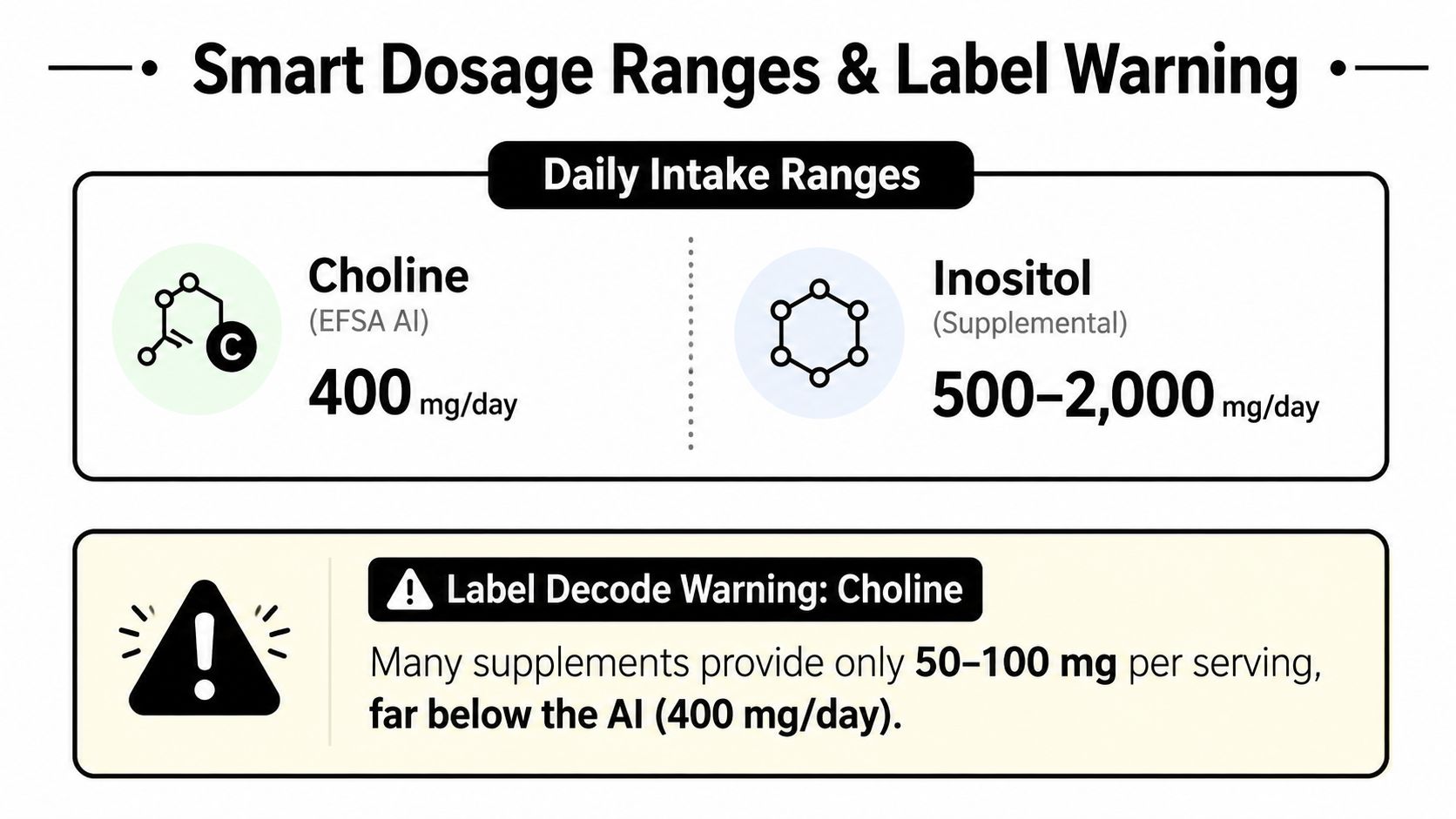
For choline, the cleanest anchor is the 400 mg/day EFSA adequate intake for healthy adults EFSA benchmark and UK context. For inositol, common supplemental use sits in the 500 to 2,000 mg/day range in the UK-facing evidence summaries UK pharmacy review. That doesn't mean everyone should take those amounts. It means those are the ranges you'll most often see when people are using these nutrients in practice.
The bitartrate trap
Here's the part most buyers miss. Choline bitartrate is only about 41.1% elemental choline compound composition reference. So if a serving gives you 250 mg of choline bitartrate, that does not mean 250 mg of choline. It delivers roughly 102 to 103 mg of actual choline. That gap is big enough to change how you judge the product.
Worked example: if you want to reach the 400 mg/day adult benchmark from a supplement alone, a label showing 250 mg of choline bitartrate is only giving you about a quarter of that target.
This is why some products look impressive on the front but under-deliver in practice. The serving size may be fine as a small top-up, but it won't meaningfully close a bigger gap on its own. A careful label reader checks the compound form first, then checks the elemental amount, then decides whether food fills the rest.
Practical label reading
Split dosing can help if a product upsets your stomach, although many people do fine taking it with food. That matters more for habit and tolerance than for any special absorption trick. For food tracking, eggs, meat and soy all contribute choline, but the question is your overall pattern across the day, not one meal.
If you want a quick reference for how nutrition reference values are framed, the explanation in what nutrient reference values mean is helpful. It turns abstract label numbers into something you can compare against your actual intake.
The practical takeaway is simple. Read the compound, calculate the elemental amount, and compare that number against your food intake before you buy a second bottle you may not need.
Food First and Where UK Diets Typically Fall Short
The most straightforward way to improve choline status is still food. Egg yolks, beef liver, chicken, salmon, soybeans, peanuts and cruciferous vegetables are the foods typically thought about first when starting to pay attention to choline. Inositol is easier to cover broadly because it appears in fruit, beans, grains and nuts.
A realistic food pattern
A high-protein, low-carb eating pattern can push choline intake down if it crowds out eggs, dairy, soy or mixed meals. That doesn't make the plan bad. It just means the nutrient profile changes with the pattern. If someone is training hard, eating lean and trying to keep calories low, they may need to think more deliberately about choline-rich foods than the average person does.
A simple breakfast or lunch can do more work than people expect. Eggs on wholegrain toast, a soy-based lunch bowl, or salmon with beans gives you a better nutritional base than a snack-heavy day built around coffee and convenience bars. You don't need organ meats every week to improve the picture.
Useful filter: if your plate is built mostly from protein powder, lean meat and low-carb vegetables, ask where your choline is coming from before you assume a supplement will cover it.
When food alone may not be enough
Hitting 400 mg/day from food alone can be difficult for many adults EFSA benchmark and UK context. That doesn't mean everyone needs a supplement. It does mean that a food-first approach won't always close the gap, especially for people with restricted diets or lower appetite.
For a broader food strategy that supports brain health as well as micronutrient intake, best brain food guidance is a useful companion read. Choline fits best when it sits inside a balanced eating pattern, not when it replaces one.
Tailored Recommendations by Age and Sex
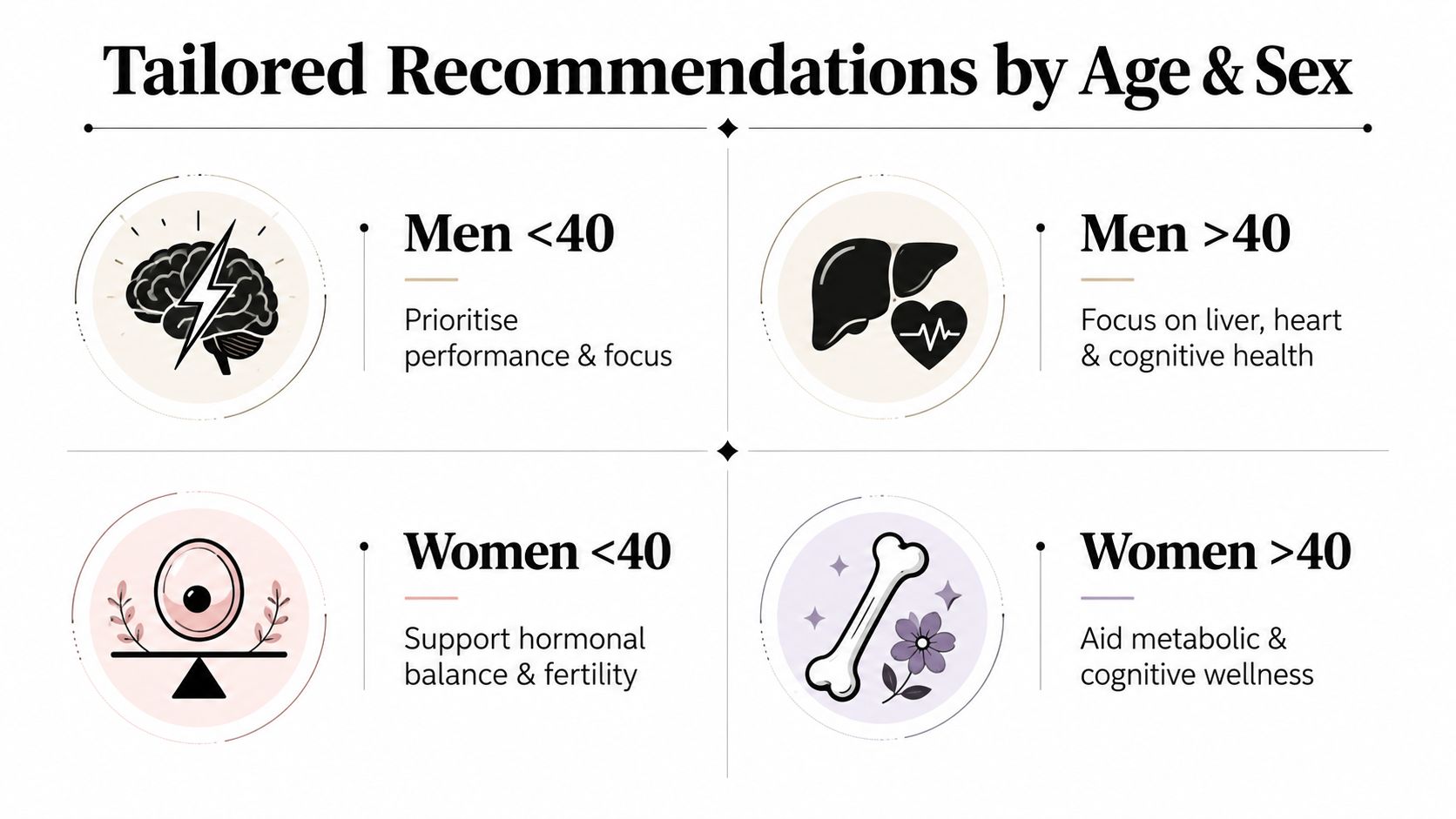
One-size-fits-all advice breaks down fast with choline and inositol. A young man focused on training, a woman in her thirties thinking about hormones, and a man in his fifties trying to protect long-term cognitive health are not starting from the same place. The table below keeps the choices simple.
| Demographic | Primary goal | Suggested dose | Stack note |
|---|---|---|---|
| Men under 40 | Performance and focus | Food-first, then a modest choline top-up if diet is light on eggs or soy | May overlap with creatine and energy powders |
| Men over 40 | Liver, heart and cognitive longevity | Use intake awareness first, then consider a choline form that matches the goal | Can duplicate nutrients already in a multivitamin |
| Women under 40 | Energy, hormones and skin | Myo-inositol is the more common fit when hormonal support is the goal | Check overlap with multivitamins and magnesium |
| Women over 40 | Hormones, bones and vitality | Food-first, then targeted support if intake is low | Watch for stacking with omega-3 and daily blends |
Men under 40
For men under 40, the strongest use case is usually performance-adjacent rather than therapeutic. If you already use creatine, an energy powder or a multivitamin, you may already have some overlapping support for daily training and alertness. Choline can still be useful if your diet is light on eggs, but it's not automatically the missing piece.
Men over 40
For men over 40, the conversation shifts toward maintenance. That means being more aware of liver-supportive nutrition, cognitive support and what's already in the stack. A multivitamin might already cover small amounts, but it often won't get you close to the adult choline benchmark.
Women under 40
For women under 40, inositol is the more likely candidate when the goal is hormonal or metabolic support. That said, it shouldn't be treated like a universal fertility or skin solution. If you already take magnesium, a multivitamin or omega-3, check whether the new product adds something distinct or just repeats the same basic daily support.
Women over 40
For women over 40, the key issue is overlap and simplicity. Many people already have a busy routine built around a multi and omega-3, so adding another bottle only helps if it fills a clear gap. Choline and inositol can both be useful, but the reason for adding them should be specific, not generic.
Safety, Contraindications and What the Evidence Will Not Support
Choline and inositol are generally well-tolerated at standard supplemental doses, but they are not without potential side effects. Very high choline intakes can cause fishy body odour and gastrointestinal upset. In people with certain genetic variants, higher intake can also raise TMAO, which is why anyone with cardiovascular concerns should be more cautious about self-experimenting.
Medication and health context matter
Choline can matter more if you're taking medicines that affect acetylcholine signalling, and that includes both anticholinergic and cholinergic drugs. In that setting, the issue isn't just nutrition, it's interaction risk. If you're on regular medication, get advice before adding a dose that pushes you well beyond food intake.
The other big correction is simple. NHS- and NICE-aligned UK guidance does not recommend choline and inositol supplements as a treatment for fatty liver disease, because the clinical evidence is still limited UK pharmacy review summarising NICE guidance. That does not make the nutrients meaningless. It means the evidence supports nutritional support more clearly than it supports disease treatment.
Where the evidence stops
This is the distinction you need to hear clearly. Nutritional support helps you cover intake gaps and support normal physiology. Disease treatment asks for a much stronger evidence base, clearer dosing and better outcomes data. Choline and inositol have real biological roles, but that doesn't turn them into proven therapies for NAFLD, weight loss or hormone balancing across the board.
Don't use a plausible mechanism as a substitute for a clinical recommendation.
Some groups deserve extra caution. Pregnant and breastfeeding people should be guided by a professional because life-stage needs change. Vegans may need a closer look at choline intake because their food pattern can be lighter on major choline sources. Endurance athletes and people using lipid-lowering drugs should also consider the bigger context of diet, recovery and any existing medication plan before adding another nutrient.
The most sensible approach is a short checklist. Anchor daily choline against the 400 mg/day EFSA benchmark, choose a form that fits the goal, read the label for elemental content, build food intake first, and check stack overlap if you already use creatine, magnesium, omega-3 or a multivitamin. If you want to turn that into a personalised plan instead of guessing, the simplest next step is VitzAi's questionnaire at VitzAi.com.
This article is for informational purposes only and is not medical advice. Always consult a qualified health professional before starting any new supplement or major lifestyle change
If you want a stack that fits your age, sex and goals without doubling up on nutrients you already take, visit VitzAi.com. The AI questionnaire helps you translate this kind of nutrition advice into a practical daily plan, with fewer overlaps and less guesswork.