

Creatine Before or After Workout: What Actually Works
Most advice about creatine before or after a workout makes the timing decision sound far more important than it is. It isn't. Creatine doesn't act like caffeine, where the clock can change how you feel during one session. It builds muscle creatine availability through repeated use, so the best timing is the one that helps you take it every day.
If you want the shortest practical answer, take 5 g of creatine monohydrate daily. Post-workout is a reasonable default, and the limited evidence gives it a slight advantage for body composition, but pre-workout works just as well if that's the dose you'll remember.
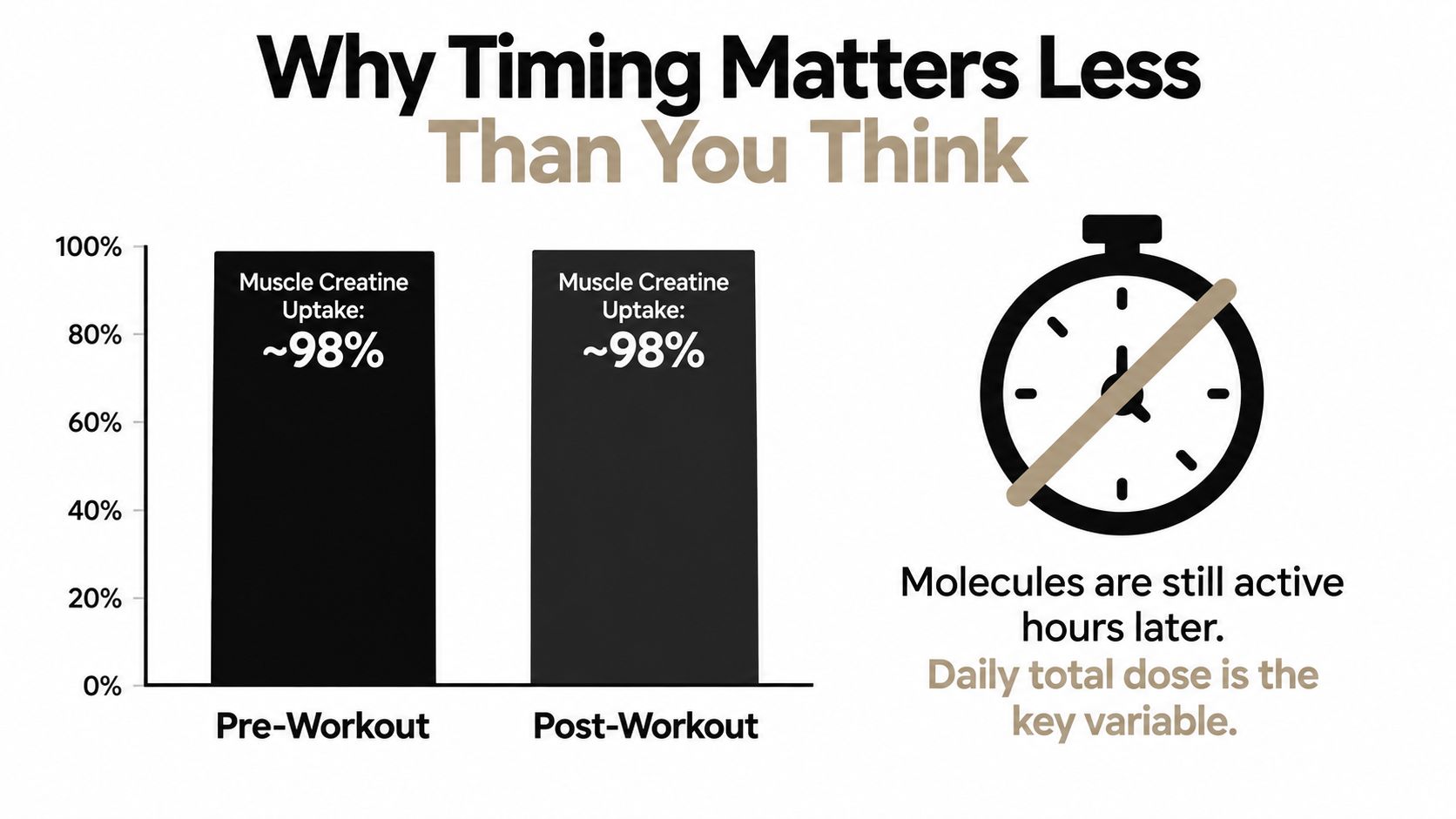
Why Timing Matters Less Than You Think
The supplement industry has turned creatine timing into a false precision problem. Articles argue over whether you should take it immediately before your first set or during the narrow period after your final set, even though the strongest direct evidence doesn't show a meaningful performance penalty when you choose the “wrong” side.
A 2022 randomized, double-blind, placebo-controlled trial assigned 34 healthy resistance-trained men and women to take 5 g of creatine monohydrate within 1 hour before or within 1 hour after training for 8 weeks. Both groups improved similarly, and the authors concluded that timing didn't add an additional influence to the measured outcomes.
That finding changes the priority list. Daily intake matters more than minute-by-minute placement. If you take creatine before training on Monday, after training on Wednesday, and with breakfast on a rest day, you're still following a sensible protocol. Missing doses because you're trying to protect a narrow workout window is the bigger mistake.
Why the debate keeps going
Earlier research did suggest a modest post-workout advantage. A 2018 review of the timing evidence reported a meta-analytic effect favoring post-workout creatine for muscle mass, with a standard mean difference of 0.52, a 95% confidence interval from 0.03 to 1.00, and p = 0.04. The same review found no matching strength benefit.
That means post-workout may deserve the default recommendation if you're optimizing body composition, but the evidence doesn't justify treating pre-workout use as ineffective. The useful conclusion is simple: take it consistently, then fine-tune timing only if you have a specific reason.
What Creatine Does During Exercise
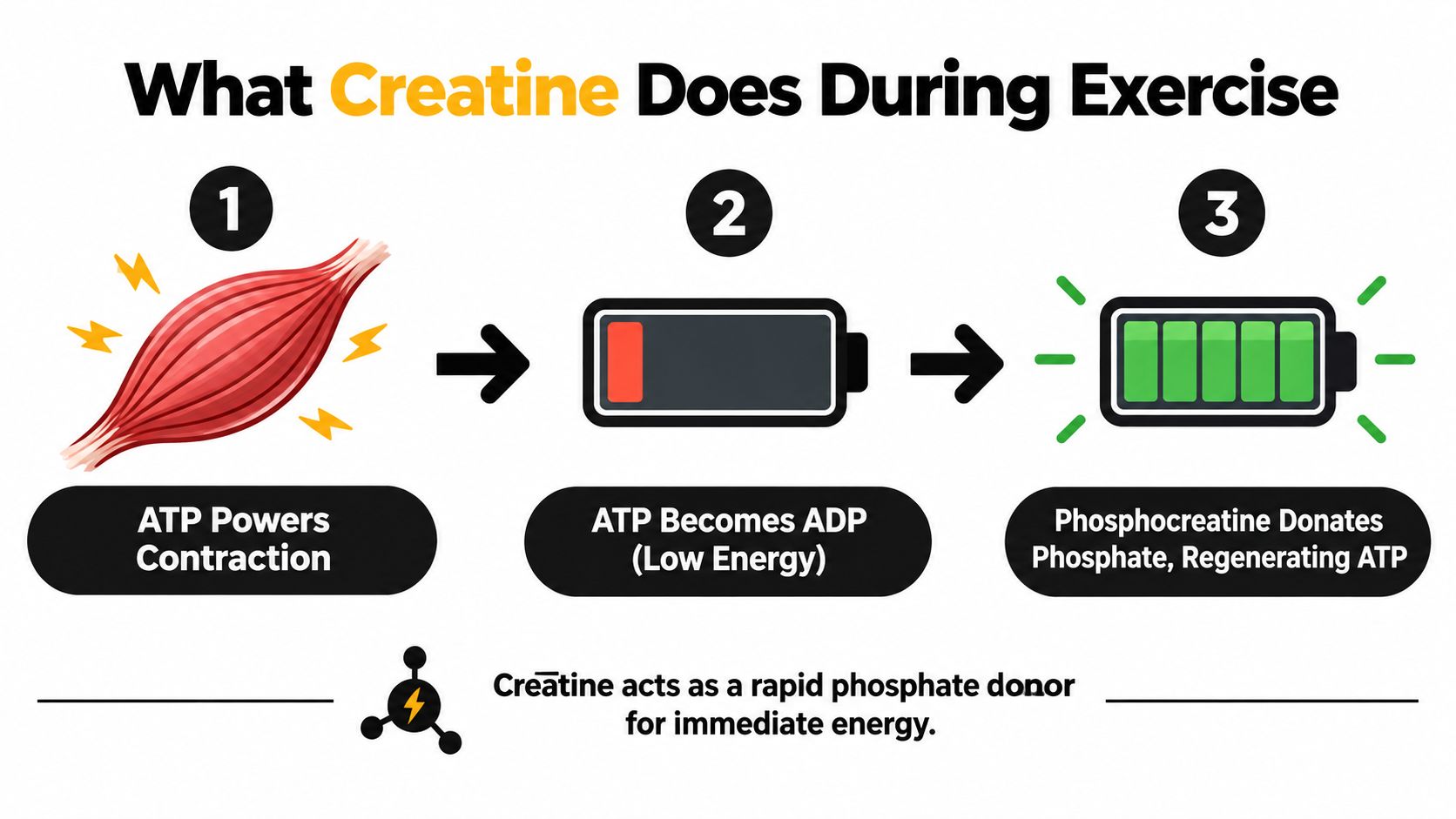
Creatine supports the phosphocreatine energy system, which helps skeletal muscle regenerate ATP during brief, demanding efforts. ATP powers contraction, then becomes ADP after releasing energy. Phosphocreatine donates a phosphate group to ADP, helping form ATP again so the muscle can continue producing force.
This matters most during explosive work, such as heavy repetitions, short sprints, jumps, and other efforts that demand rapid energy production. Creatine isn't a stimulant, and a single serving won't create an obvious sensation before training. Its value comes from maintaining the muscle's available phosphocreatine pool over time.
Why the mechanism favors consistency
Your workout uses the energy system, but your supplement routine maintains the raw material that supports it. That's why taking creatine once immediately before a session isn't the key event. The important behavior is replenishing your daily intake so muscle stores remain supported across training and rest days.
The practical effects can include better support for repeated high-intensity efforts, more productive work across a session, and improved training consistency over time. Those outcomes depend on the quality of your program, nutrition, sleep, and recovery too. Creatine is one piece of the system, not a replacement for the system.
For a straightforward explanation of what the supplement may contribute to a training routine, see this guide to creatine benefits. Keep the underlying principle in view: creatine works through stored availability, not a dramatic pre-workout feeling.
Pre-Workout vs Post-Workout Dosing Compared
Pre-workout dosing has a logical appeal. You take the supplement before the session, so it feels as though the ingredient is present when you need it. That may make sense as a routine, especially if you already mix supplements into a pre-training drink.
Post-workout dosing has slightly stronger support when the outcome is body composition. The older evidence summarized in the 2018 review favored taking creatine immediately after resistance training for muscle mass, but it didn't show a significant strength advantage. The result is useful, but it isn't strong enough to justify rigid rules.
A more recent 16-week randomized, double-blind study compared 5 g immediately before or immediately after resistance sessions in trained young adults. It found no meaningful differences in body composition, limb muscle thickness, or performance between the timing groups.
| Study | Duration | Pre-Workout Outcome | Post-Workout Outcome | Verdict |
|---|---|---|---|---|
| 2022 randomized trial | 8 weeks | Similar improvement | Similar improvement | No timing advantage |
| 2018 review and meta-analysis | Not applicable | Lower muscle-mass estimate in the comparison | Small muscle-mass advantage, no strength advantage | Post-workout edge for body composition only |
| Trained young-adult randomized study | 16 weeks | No meaningful difference | No meaningful difference | Consistency outweighs timing |
The recommendation
Choose post-workout when your priority is squeezing out a possible body-composition edge and you can take the dose reliably with your recovery meal. Choose pre-workout when it fits your schedule better. The “best” option that gets forgotten is worse than the merely good option you take daily.
Recovery also depends on sleep, not just supplement placement. If you're comparing options for melatonin-free recovery support from SleepHabits, treat that as a separate part of the recovery plan rather than a reason to overcomplicate creatine timing.
Building Your Daily Creatine Protocol
Start with the simplest protocol that you can follow without friction.
Use a steady daily dose
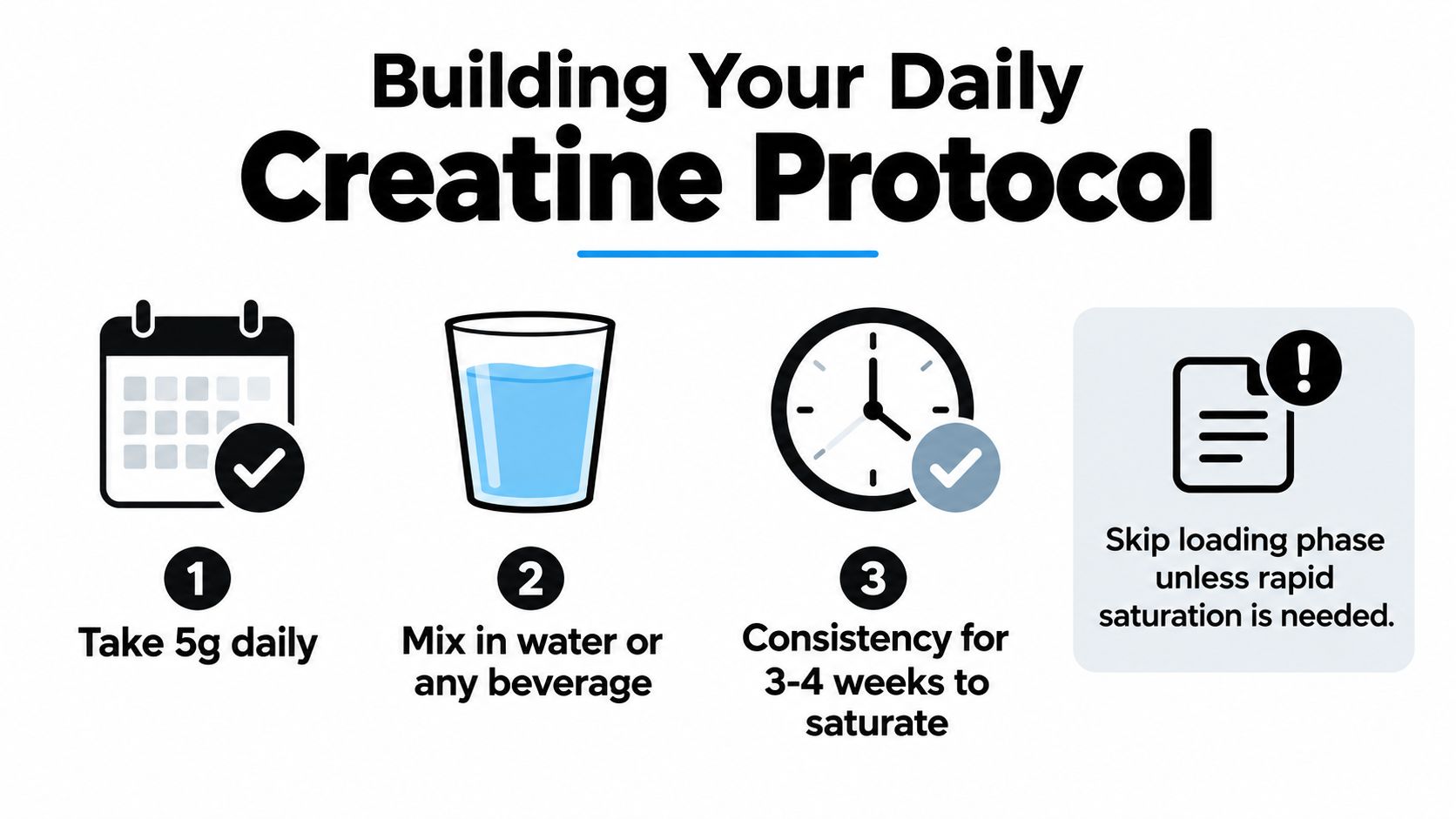
Take 5 g of creatine monohydrate every day. Mix it into water, juice, a smoothie, or another beverage you already consume. Without a loading phase, daily use generally brings muscle stores toward saturation over roughly 3 to 4 weeks, as described in the evidence review on creatine timing.
Loading is optional. If you need faster saturation, the product snapshot provides a loading approach of 20 g per day, divided into four servings, for 5 days. That approach can be harder on digestion and may increase bloating, so many individuals don't need it.
Pair it with a routine, not a perfect window
On training days, take your serving with the meal or shake that follows your workout if that's convenient. On rest days, attach it to breakfast or another meal you rarely skip. A meal containing carbohydrate and protein is a practical pairing, but don't delay the dose for hours because the ideal meal isn't available.
You can combine creatine with whey, casein, beta-alanine, electrolytes, or a caffeinated pre-workout. The combination doesn't turn creatine into an acute stimulant. It makes the daily habit easier to maintain.
A guide to creatine monohydrate powder covers the form most commonly used in research. If you want an unflavored option, Creatine Monohydrate lists creatine monohydrate as its ingredient, with a suggested loading instruction followed by ongoing use according to the label or a health professional's direction.
Matching Timing to Your Training Goal
Your goal can justify a preference, but it rarely justifies an obsession. The timing evidence mainly comes from resistance-training settings, so recommendations should stay proportional to what researchers have tested.
| Goal | Best Timing | Why |
|---|---|---|
| Strength and power | Post-workout if convenient | The limited evidence gives post-workout a modest advantage in some body-composition analyses, but not a clear strength advantage |
| Muscle growth | Post-workout with a meal | This is the most defensible timing preference when you want to follow the small muscle-mass signal |
| Endurance training | Any reliable daily time | Research on timing around aerobic or endurance exercise is comparatively limited, so precision isn't justified |
| Hybrid or intermittent sport | Any reliable daily time | Your weekly consistency matters more than placing the serving around one session |
| Older adults training for muscle support | Any reliable daily time | Workout proximity shouldn't determine whether the daily dose gets taken |
| Fat-loss phase | Post-workout with a normal meal | This keeps the routine simple, but creatine timing doesn't replace calorie control or adequate protein |
Strength and hypertrophy
If you're training primarily for strength, take creatine after training only if it doesn't create a compliance problem. The 2022 timing trial found similar improvements between pre- and post-workout groups, so there isn't a sound reason to abandon a reliable pre-workout routine.
For hypertrophy, post-workout is the reasonable tie-breaker. The earlier meta-analytic finding favored post-workout muscle mass while showing no corresponding strength benefit, so call it a small body-composition preference, not a guaranteed growth multiplier.
Endurance and mixed training
Timing recommendations become weaker when the workout isn't a conventional resistance session. Independent coverage of creatine timing around different workout types notes that research is limited for aerobic and endurance exercise. If you run, cycle, row, play an intermittent sport, or combine several modes, choose the meal or daily routine that makes adherence automatic.
The Consistency Habit That Beats Timing
The main issue isn't taking creatine 45 minutes too early. It's forgetting the dose, running out, or taking it only on training days. A small timing preference can't rescue an inconsistent protocol.
Build a system that removes decisions. Put the container beside something you already use every day, set one alarm while the habit is forming, and pre-measure servings if scooping slows you down. The goal isn't to track creatine forever. The goal is to make the dose so ordinary that you stop negotiating with yourself about it.
Use a low-friction setup
- Anchor the dose: Pair it with breakfast, your post-workout shake, or another meal that already happens.
- Prepare ahead: Measure several servings at once so busy mornings don't become an excuse.
- Use one reminder: A single daily alarm is enough while the routine becomes automatic.
- Plan for rest days: Keep the dose connected to a meal, not only to gym attendance.
- Reset immediately: If you miss a serving, take the next planned dose. Don't turn one missed day into a missed week.
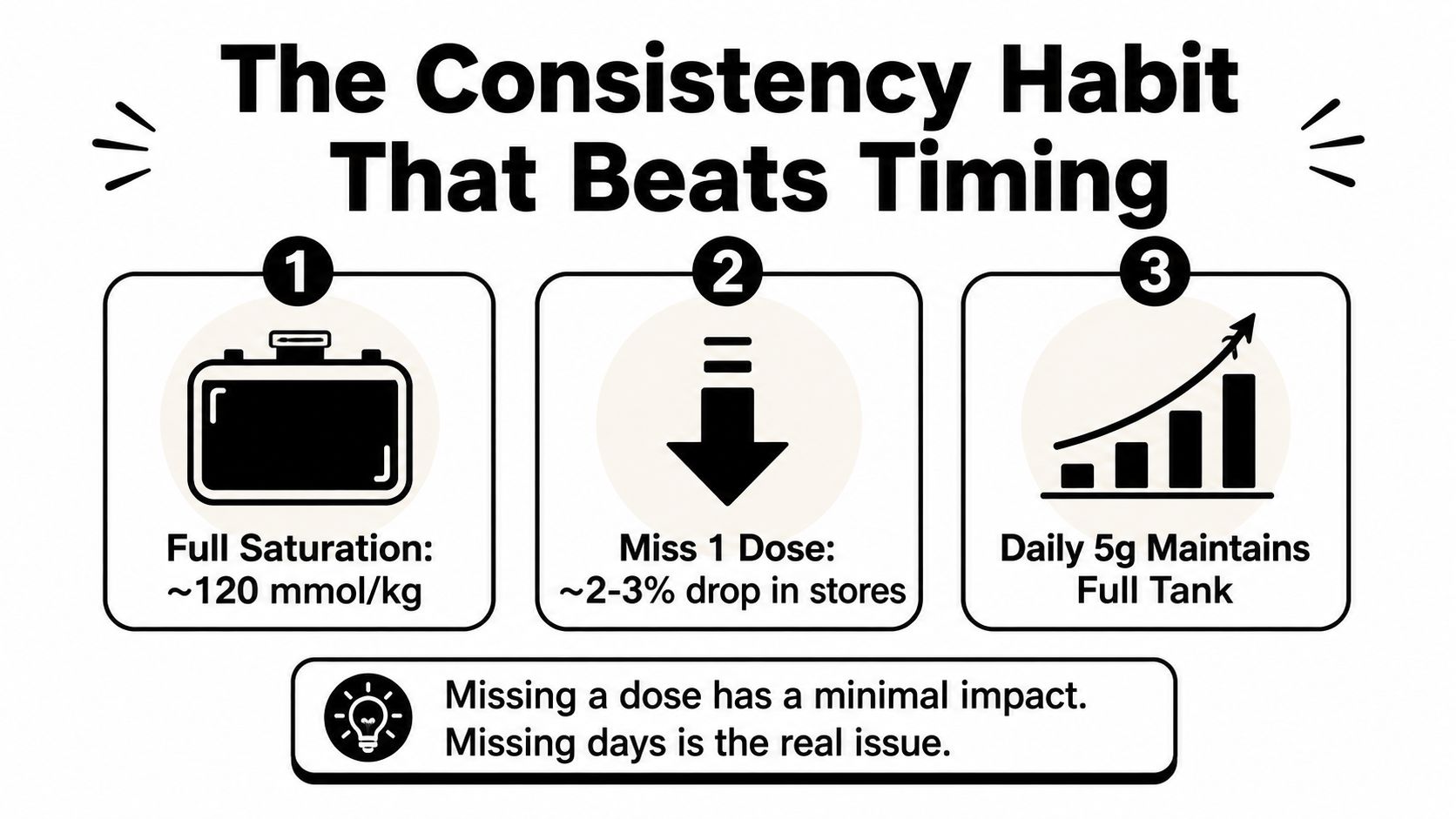
Practical rule: The best creatine schedule is the one you can repeat on training days, rest days, travel days, and chaotic days.
For broader ideas on supporting training recovery, use this practical guide to supplements for gym recovery. Keep the same standard here: choose useful habits over impressive-looking complexity.
Putting It All Together
Use this decision rule: take 5 g of creatine monohydrate with a meal at the time you'll remember most reliably. If you're specifically prioritizing body composition and post-workout dosing is convenient, take it within the hour after training. Otherwise, pre-workout, during-workout, breakfast, or dinner can all work as practical choices.
A simple week might look like this:
- Monday: Take 5 g with your post-workout meal after resistance training.
- Tuesday: Take 5 g with breakfast on a rest day.
- Wednesday: Take 5 g in your pre-workout drink if that's your established routine.
- Thursday: Take 5 g with lunch on a rest day.
- Friday: Take 5 g with your post-workout shake.
- Saturday: Take 5 g with the first substantial meal after a morning session.
- Sunday: Take 5 g with breakfast, regardless of whether you train.
Training fasted in the morning? Take the serving with your first meal rather than inventing a complicated pre-workout ritual. Doing double sessions? One daily serving is the key routine, so don't use the second workout as an excuse to double the dose.
Travel creates the same problem in a different setting. Pack the powder in a clearly labelled container, or use a travel-friendly serving system, and tie it to the meal you know you'll eat. If you have pre-existing kidney disease or take medication that affects kidney function, speak with a physician before starting creatine. Healthy adults should still treat new supplementation as a health decision, not as a reason to ignore individual medical context.
Set one daily alarm, or place your creatine beside the coffee maker. The timing debate is settled well enough. Your consistency is the part that still needs work.
VitzAi.com offers a personalised supplement quiz that uses your goals, diet, exercise, sleep, stress, and other lifestyle details to suggest a curated supplement plan. Visit VitzAi.com to see whether creatine or another supplement fits your routine instead of adding products at random.
This article is for informational purposes only and is not medical advice. Always consult a qualified health professional before starting any new supplement or major lifestyle change