

A UK Guide to Gut Health Supplements
Gut health supplements are specially created formulas that support your digestive system and help keep the good bacteria in there happy and balanced. Things like probiotics, prebiotics, and digestive enzymes are designed to improve everything from how you absorb nutrients to how well your immune system works, all by looking after your gut microbiome.
Your Journey to Better Gut Health
Picture your gut as a complex, bustling garden inside you. This internal ecosystem, known as the gut microbiome, is home to trillions of microorganisms that do far more than just help with digestion. When this garden is out of balance, it can lead to things like fatigue, mood swings, and a less-than-stellar immune system. But when it’s thriving, it supports your entire wellbeing, from your mental clarity to your physical performance.
This guide is your starting point for learning how to tend to that garden properly. We’ll dig into how the right support can directly connect your personal wellness goals—like better recovery after a workout or staying sharp all day—to the health of your gut. Taking control of your digestive health is a powerful step toward feeling your best, and it's much more straightforward than you might think.
Why Is Everyone Talking About Gut Health?
The link between our gut and our overall health is clearer than ever, and people are definitely paying attention. The UK gut health supplement market has exploded, which shows just how much more aware we all are of our digestive wellbeing. This isn't slowing down either, with predictions showing an 8% compound annual growth rate (CAGR) in the coming years. You can see more on the UK market's growth over at Grandview Research.
This surge in interest isn't just a flash in the pan; it's a real shift towards being more proactive about our health. So many people are realising that the everyday issues they’ve been putting up with can often be traced right back to an imbalanced gut.
The Key Players in Your Gut
To get that gut garden of yours flourishing, you need to know who the main players are. We’ll get into the nitty-gritty of each one later, but here’s a quick rundown of the core components you’ll often find in gut health supplements:
- Probiotics: These are the "good" bacteria, the friendly residents that help keep your internal ecosystem in check. They handle essential jobs like helping with digestion and supporting your immune system.
- Prebiotics: Think of these as the fertiliser for your gut garden. Prebiotics are specific types of fibre that feed the beneficial probiotic bacteria, helping them thrive and multiply.
- Enzymes: These are the hard workers that break down the food you eat. Digestive enzymes make sure you’re actually absorbing the nutrients from your meals, which can help with things like bloating and indigestion.
Getting your head around these elements is the first step. This guide will give you practical, science-backed solutions to help you make choices that make sense for you, moving you from confusion to feeling healthier and more vibrant.
So, What Are We Actually Talking About with Gut Health Supplements?
To really get to grips with gut health supplements, it helps to know who the main players are and how they work together. Think of it like managing a garden—you need the right seeds, good fertiliser, and a team of helpers to get the best results.
Let's break down the key players you'll find in the world of gut health: probiotics, prebiotics, digestive enzymes, and the lesser-known but equally important postbiotics.
This simple map shows just how central your gut is to your overall energy, mood, and immune function.
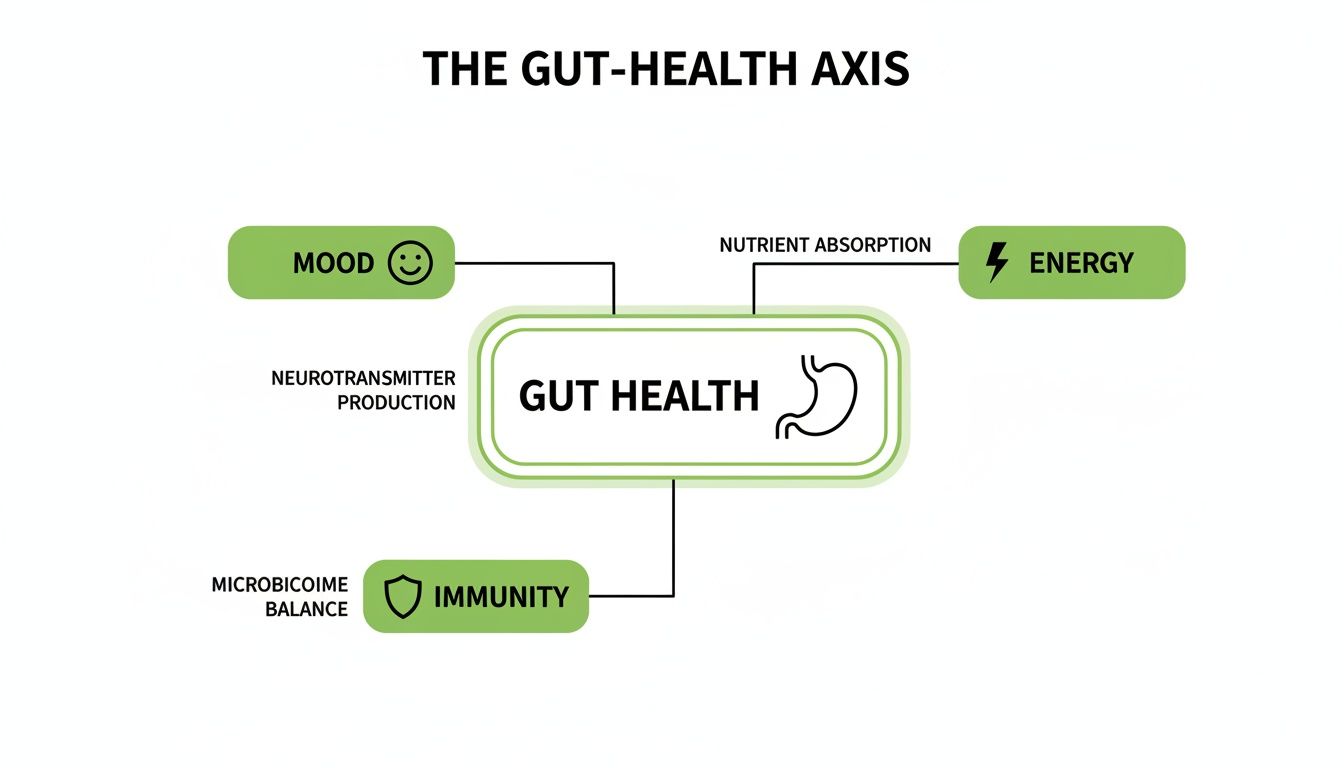
As you can see, a happy gut doesn't just mean good digestion. Its influence radiates outwards, touching almost every part of your daily wellbeing.
Probiotics: The Good Bacteria
Probiotics are the "good" live bacteria that set up shop in your gut. When you take a probiotic supplement, you're essentially sending in reinforcements to populate your internal ecosystem. These friendly microbes are vital for keeping things balanced, supporting digestion, and helping your immune system do its job properly.
There are many different types, or strains, of probiotics, and each one has a slightly different specialism. For instance, the Lactobacillus and Bifidobacterium families are two of the most famous and well-researched groups out there.
Here in the UK, Lactobacillus is a real front-runner. In fact, it currently holds 46% of the UK probiotic supplements market share, largely thanks to its long list of proven health benefits.
Prebiotics: The Fertiliser for Your Gut
If probiotics are the seeds you're planting in your gut garden, then prebiotics are the quality fertiliser that helps them grow. Prebiotics are specific types of fibre your body can't digest on its own. Instead, they make their way down to your lower digestive tract, where they become a feast for your beneficial bacteria.
By feeding your existing good microbes, prebiotics help them thrive and multiply. This creates a much more supportive environment for a healthy microbiome. You’ll often find them in these forms:
- Inulin: Found in foods like chicory root, onions, and garlic.
- Fructo-oligosaccharides (FOS): Naturally present in bananas and asparagus.
- Galacto-oligosaccharides (GOS): Often found in legumes and some dairy products.
When you combine probiotics with prebiotics, you get what’s known as a symbiotic effect. It's a fancy way of saying they work much better together than either could alone. This powerful combination is often called a "synbiotic."
That's why many people look for supplements that include both, covering all their bases. Products like Active Green Pro Prebiotic Fibre Boost Probiotic are designed with this synergy in mind. Our own formula at Vitz is built on this principle, combining 40 billion CFU of probiotics with powerful prebiotics to provide comprehensive digestive support.
Digestive Enzymes And Postbiotics: The Helpers and The By-Products
While probiotics and prebiotics focus on the bacterial ecosystem, digestive enzymes play a different but essential role. These are proteins that act as catalysts, helping to break down the food you eat into smaller, more absorbable nutrients. They get to work on fats, proteins, and carbohydrates, making them easier for your body to process.
Ever feel bloated or uncomfortable after a meal? It could be a sign that your body's natural enzyme production needs a bit of a boost.
Finally, let's talk about postbiotics. These are the beneficial compounds that probiotics produce when they munch on prebiotics. You can think of them as the "waste" products of good bacteria—but this is waste you definitely want! Postbiotics include things like short-chain fatty acids (such as butyrate), which help nourish the cells lining your gut and reduce inflammation. They're the valuable end-product of a healthy, functioning microbiome.
To give you a clearer picture, here’s a quick-reference table summarising these key players.
Key Gut Health Supplements And Their Roles
| Supplement Type | Primary Role | Common Sources or Examples |
|---|---|---|
| Probiotics | Introduce live, beneficial bacteria to the gut | Lactobacillus, Bifidobacterium, fermented foods |
| Prebiotics | Act as "food" to nourish existing good bacteria | Inulin, FOS (fructo-oligosaccharides), GOS (galacto-oligosaccharides) |
| Digestive Enzymes | Help break down food into absorbable nutrients | Protease (for protein), Lipase (for fat), Amylase (for carbs) |
| Postbiotics | Beneficial by-products from probiotic activity | Short-chain fatty acids (e.g., butyrate), vitamins, enzymes |
Understanding these different roles is the first step in figuring out what your gut might need to feel its best. Each component contributes something unique to the incredible complexity of your digestive health.
How to Choose the Right Gut Supplement
Stepping into the supplement aisle can feel a bit like navigating a maze. With rows upon rows of bottles all promising better gut health, it’s easy to feel overwhelmed. But here’s the thing: finding the right one isn't about grabbing the most popular bottle. It’s about ditching the one-size-fits-all mentality and finding a match for your personal health, lifestyle, and goals.
Your body isn't static; its needs shift depending on your daily habits. Think about it: a busy professional wrestling with high-stress levels has a completely different gut environment to a competitive athlete focused on muscle recovery. Getting to grips with these personal factors is the first real step toward making a smart choice.
Start With Your Unique Health Goals
Before you even think about picking up a bottle, take a moment to ask yourself what you’re trying to achieve. Is your main goal to finally tackle that post-meal bloating? Are you hoping to give your immune system a bit of a boost? Or is it simply about supporting your overall digestive wellness? Your goal is your roadmap.
- For General Digestive Balance: If feeling bloated or irregular has become your normal, a broad-spectrum probiotic paired with a prebiotic fibre could be a brilliant place to start. This combo works in two ways: it introduces friendly bacteria and then gives them the fuel they need to thrive.
- For Immune Support: Certain probiotic strains are known for their links to immune function. Keep an eye out for supplements that specifically mention strains like Lactobacillus rhamnosus GG or Bifidobacterium lactis.
- For Athletic Recovery: Pushing your body with intense physical activity can put your gut under stress. Athletes might find a formula that includes amino acids like L-glutamine—which helps support the gut lining—alongside a robust probiotic particularly helpful.
By figuring out your primary objective first, you can immediately cut through the noise and focus on supplements designed for that specific purpose.
Consider Your Lifestyle and Life Stage
Your daily routine and your age play a massive role in what’s happening inside your gut. What works wonders for a 25-year-old marathon runner probably isn’t the best fit for a 45-year-old office worker.
Take a consistently stressful job, for example. It can throw your gut microbiome completely off-kilter. For anyone in a high-pressure role, a supplement containing adaptogens like Ashwagandha alongside probiotics could offer support for both stress and digestion. It’s a win-win.
Likewise, women often experience major hormonal shifts during perimenopause and menopause, which can really impact digestion. A supplement tailored for women's health might include specific probiotic strains and botanicals that help support that hormonal equilibrium.
Key Takeaway: Your gut doesn't exist in a vacuum. It's directly influenced by your stress levels, diet, age, and even your hormones. Choosing a supplement means matching it to the realities of your everyday life.
Know What to Look For
Once you’ve got a goal in mind, it’s time to get down to the nitty-gritty and look at the products themselves. The UK digestive health market is huge, but you can simplify things by zooming in on a few key details.
When it comes to probiotics, you'll see CFU (Colony Forming Units) on the label. This is just a measure of the live bacteria in each dose. A higher number isn't automatically better; what’s more important is choosing a product with a clinically relevant dose for the strains it contains, which often falls somewhere between 5 to 50 billion CFU.
Also, have a look at the type of fibre in prebiotic formulas. Different fibres feed different types of bacteria, so a blend of fibres like inulin and FOS can offer more comprehensive nourishment for your microbiome.
Interestingly, while probiotics are still the crowd favourite, making up 84.22% of revenue in the UK digestive health supplement market, it's digestive enzymes that are the fastest-growing segment. This signals a growing awareness of how enzymes can help break down food and ease digestive discomfort. You can dive deeper into this trend by checking out the UK digestive health market report on grandviewresearch.com.
By aligning your personal goals with these key product details, you can confidently choose a gut health supplement that’s right for you, not just for the average person.
Decoding Supplement Labels Like a Pro
Ever felt like you need a science degree to understand the supplement aisle? You’re not alone. The labels on gut health supplements can be a minefield of scientific jargon, percentages, and acronyms that leave you feeling more bewildered than confident. But learning to see past the flashy marketing claims and understand what’s actually in the bottle is the single most important skill for choosing a product that will genuinely help you.
Becoming a savvy shopper starts with knowing what you’re looking for. The real story isn't on the front of the box; it's always in the small print on the back. Once you know how to spot a few key signs of quality, you can make choices that truly support your health goals.

Green Flags: What to Look For
Think of these as the good signs—indicators that a company has put real thought and transparency into its formula. When you spot these on a label, you know you’re on the right track.
- Specific Probiotic Strains: A quality supplement won’t just list a vague "Lactobacillus blend." It will get specific, naming strains like Lactobacillus rhamnosus GG or Bifidobacterium lactis BB-12. Different strains have different jobs in the gut, so this level of detail shows the product is targeted and backed by research.
- Third-Party Testing: Keep an eye out for seals from independent bodies like NSF International or USP (United States Pharmacopeia). This certification is your assurance that an impartial organisation has verified the product contains what the label claims and is free from nasty contaminants.
- Clear Dosages and CFUs: For probiotics, the label needs to state the CFU (Colony Forming Units) count—that’s the number of live, active bacteria. Crucially, this should be guaranteed at the time of expiry, not just when it was made. For other ingredients, the amounts should be clearly listed in milligrams (mg) or micrograms (mcg).
Red Flags: What to Avoid
Just as there are good signs, there are also some serious red flags that should give you pause. These often point to a lack of transparency or a company that’s more focused on marketing spin than actual substance.
A massive red flag is the "proprietary blend." This is a tactic where manufacturers hide a list of ingredients under a single trademarked name, only telling you the total weight of the blend. You have absolutely no way of knowing how much of each ingredient you’re getting.
Be wary of these other warning signs:
- Vague "Proprietary Blends": As mentioned, these blends are a mystery box. You can’t tell if you're getting an effective dose of the good stuff or just a tiny, ineffective sprinkle.
- Unnecessary Fillers and Additives: Always scan the "other ingredients" list. While some are needed to make the capsule, watch out for artificial colours, flavours, and excessive binders like magnesium stearate or titanium dioxide.
- Generic "Probiotic Blend": If a label doesn’t name the specific strains, you can't be sure what you're putting in your body. It's a hallmark of a less targeted and potentially lower-quality formula.
By learning to spot these green and red flags, you can shift from being a confused shopper to an empowered one. You’ll be able to confidently pick out gut health supplements based on real quality, not just clever advertising.
How AI Can Personalise Your Gut Health
Generic "take this for gut health" advice often misses the mark. Why? Because your body is entirely unique. What works wonders for a friend or a social media influencer might not do a thing for you, and this is where modern tools are completely changing the game.
We're moving beyond guesswork and towards smart, individualised support. Imagine having a personal health coach that truly gets your specific biology, lifestyle, and goals. That's the power of AI-driven personalisation. By analysing key details about you, it can recommend a supplement plan that’s genuinely built for your body's needs.
This means you can finally stop wasting money on supplements that aren't the right fit. Smart technology cuts through the noise, offering clear, data-informed suggestions that actually line up with your personal health profile.
Moving Beyond One-Size-Fits-All
The standard approach to supplements often involves reading a few articles, trying whatever is popular, and just hoping for the best. An AI-powered system flips this script entirely by starting with you. It asks the important questions that generic advice simply can't.
For example, an AI questionnaire might gather information on:
- Your primary health goals: Are you focused on improving digestion, boosting your energy levels, or managing stress?
- Your daily diet: Do you follow a specific eating style like vegan or keto, or do you struggle to get enough fibre in?
- Your lifestyle factors: Do you have a high-stress job, work night shifts, or train intensely at the gym?
- Your age and sex: Are you a man over 40 concerned with longevity or a woman under 40 focused on hormonal balance?
This detailed picture allows the technology to connect the dots between your life and your gut's needs in a way you couldn’t easily do on your own. It acts as a filter, narrowing down the huge world of gut health supplements to a few precise recommendations.
Practical Examples of AI in Action
So, what does this actually look like in the real world? It's about getting specific suggestions that make sense for your situation. Instead of just hearing "take a probiotic," an AI system can provide a much more nuanced recommendation.
A smart system might suggest a probiotic with specific stress-reducing strains, like Lactobacillus helveticus, for a professional dealing with constant deadlines. For another person reporting frequent post-meal bloating, it might recommend a digestive enzyme blend containing amylase and protease to help break down their food more effectively.
This level of detail is a major step forward. The technology can spot patterns and suggest targeted solutions that would otherwise be missed. It’s the same core principle that’s being applied in other areas of wellness; just as AI can tailor your nutrition, it’s interesting to see how AI-powered training can revolutionize your workout by creating fitness plans that adapt to your progress.
This approach effectively turns a complex, often confusing decision into a simple, logical next step. It’s not about replacing professional medical advice, but about empowering you with better information to make smarter choices on your wellness journey.
Integrating Supplements Into Your Daily Routine
You’ve found the right gut health supplements – that’s a massive first step. But the real magic happens when they become a consistent part of your life. Lasting results don't come from a flash-in-the-pan effort; they come from building a routine that feels second nature. It’s less about a complete life overhaul and more about cleverly weaving new habits into your existing schedule.
Think of it like tending to a garden. A splash of water here and there won't do much, but steady, reliable care helps everything flourish. The trick is to find a rhythm that works for you and stick with it. It's this consistency that gives the good bacteria a chance to settle in and start making a genuine difference to your digestive wellness.

Finding Your Perfect Timing
One of the first questions people ask is, "So, when do I actually take these?" While there isn't a single answer that fits everyone, a few simple guidelines can help you get the most out of them.
- Probiotics: Many experts recommend taking probiotics on an empty stomach. This could be 20-30 minutes before your first meal of the day or just before you head to bed. The idea is to give the live bacteria a clearer path through your stomach acid.
- Digestive Enzymes: These are your mealtime helpers. Take them just before or as you start eating your main meals. This timing ensures they're ready to get to work the moment food arrives.
- Fibre and Prebiotics: These are usually a bit more flexible. You can easily mix them into a morning smoothie, a glass of water, or stir them into a bowl of yoghurt. The most important thing is simply to get them in every day.
Top Tip: Try pairing your supplement with something you already do without thinking, like making your morning coffee or brushing your teeth. It’s a technique called "habit stacking," and it makes remembering your new routine so much easier.
Creating Synergy With Your Lifestyle
Supplements are fantastic tools, but they work best when they're part of a bigger picture. They are designed to supplement a healthy lifestyle, not replace it. Your daily choices create the very environment in which your supplements will either thrive or struggle.
To get the best return on your investment, it pays to focus on these supporting habits:
- Eat a Fibre-Rich Diet: Pack your plate with a colourful mix of fruits, vegetables, whole grains, and legumes. These foods are packed with the prebiotics that act as fuel for your good gut bacteria.
- Manage Your Stress: It's no secret that chronic stress can throw your gut out of balance. Try to build stress-reducing activities into your week, like walking, yoga, or mindfulness. Even just 10 minutes a day can make a difference.
- Prioritise Sleep: Aim for a solid 7-9 hours of quality sleep each night. A lack of good sleep can negatively impact your microbiome, essentially undoing all the good work your supplements are doing.
When you create this supportive foundation, you amplify the benefits of any gut health formula you're taking. For those after an all-in-one solution, our Natural Gut Wellness Capsules are specifically formulated to work in harmony with a healthy lifestyle to support your digestive balance.
Your Questions, Answered
Alright, we've covered a lot of ground, from prebiotics to postbiotics and everything in between. But you probably still have some practical questions about how this all works in the real world. Let's tackle some of the most common ones that come up.
How Long Until I Notice a Difference?
This is the big question, isn't it? The honest answer is: it varies. Everyone's gut is unique. Some people start to feel a shift in things like bloating or regularity within the first few days to a week.
But for the deeper benefits—like shoring up your immune system or feeling a real change in your mood—you need to play the long game. Think in terms of several weeks, or even a couple of months. This gives the beneficial microbes a proper chance to set up shop and really make a difference. Consistency is absolutely everything here.
Can't I Just Get This Stuff From Food?
A food-first approach is always the best foundation. A diet brimming with high-fibre plants and fermented goodies like kimchi, kefir, yoghurt, and sauerkraut is the cornerstone of a happy gut. They provide a natural mix of probiotics and the prebiotic fibre they need to thrive.
So, where do supplements fit in? They offer a more targeted, potent dose of specific beneficial strains that you’d be hard-pressed to find in your diet alone. This can be a game-changer if you’re trying to address a specific health issue, have dietary restrictions, or are bouncing back after a course of antibiotics has wiped the slate clean.
Think of it like this: your diet is the daily upkeep of your garden—watering, weeding, and general care. A supplement is like calling in a specialist to plant specific flowers or add a concentrated fertiliser to give the whole plot a boost.
Are There Any Side Effects to Worry About?
For most people, gut health supplements are very well tolerated. When you first start, it's not unusual to experience a bit of a settling-in period as your gut ecosystem adjusts to the new arrivals.
You might notice:
- A bit of mild, temporary gas
- Slightly more bloating than usual
- Changes in your toilet habits
This is usually just a sign that things are changing for the better, and it typically clears up within a few days. If you have a compromised immune system or a serious underlying condition, it's vital to chat with your doctor first. The same goes if any of these initial symptoms stick around. A good tip is to start with a lower dose and slowly build up to let your system get used to it.
Ready to stop guessing and start supporting your gut in a way that’s designed just for you? Take the VitzAI health quiz today. You'll get a personalised supplement report based on your unique biology and lifestyle. Discover the smart way to optimise your gut health at https://vitzai.com.
This article is for informational purposes only and is not medical advice. Always consult a qualified health professional before starting any new supplement or major lifestyle change.