

How to Read a Supplement Label the Smart Way
You're standing in a supplement aisle with two bottles in front of you. Both promise support for energy, recovery, sleep, or focus. One has a bold “high strength” claim and an impressive capsule count. The other looks almost identical, but its back label gives you more detail. The Supplement Facts panel is where comparison begins.
Learning how to read a supplement label helps you compare the amount you'll take, identify the form of each ingredient, spot hidden doses, and check whether the product suits your diet and routine. It also helps you avoid paying for a large capsule count, a dramatic front-of-pack claim, or a proprietary blend that tells you very little about the formula.
Why the Label Matters Before You Buy
You pick up a bottle because the front promises energy, calm, recovery, or better sleep. The part that tells you what you are buying is the label on the back. For supplements sold in the United States, that panel has to identify the product as a dietary supplement, show serving size and servings per container, list dietary ingredients and their amounts, and include other required details. The FDA's guidance on Daily Value and Supplement Facts labels is useful here because it shows why serving size is the first thing to check. The numbers in the panel usually apply only to that stated serving.
That one detail changes the whole comparison.
A creatine powder may define one scoop as a serving. A magnesium product may define two capsules as a serving. An omega-3 label may feature total fish oil, even though the more useful question is how much EPA and DHA you get. A mushroom or energy formula may give one combined weight for a blend, while the individual ingredients stay unclear. If you do not normalise each product to the amount you would take in a day, side-by-side comparison gets fuzzy fast.
Practical rule: Ignore the front of the bottle until you've checked the serving size, daily directions, active amounts, and ingredient forms.
Read the label as a small regulatory document, not as a sales pitch. That shift helps because the front panel is built to catch your eye, while the facts panel is built to disclose what the product contains and how the maker presents it. The same reading habit shows up in other product categories too. The Mesoderm RX sunscreen guide is a good example of looking past a bold claim on the front and checking what the label language really means.
A useful label check has four parts. First, look for quantified doses. Each ingredient that matters should have its own amount, so you can judge what you are getting. Second, assess formula transparency. A proprietary blend can hide the dose of each component inside one total number. Third, identify the form of the ingredient, because a nutrient name alone does not tell you the whole story. Magnesium glycinate and magnesium oxide are both magnesium on a label, but they are not the same form. Fourth, look for evidence of independent testing, such as a recognisable verification or a batch-specific certificate of analysis.
Four Label Checks That Beat the Front-of-Pack Claims
| Check | What it tells you | Where to find it |
|---|---|---|
| Quantified doses | How much of each active ingredient you receive | Supplement Facts panel |
| Transparent formula | Whether individual ingredients have disclosed amounts | Supplement Facts panel |
| Named forms | What chemical, plant, or nutritional form you're buying | Ingredient line and other label text |
| Quality verification | Whether the manufacturer provides independent testing information | Certification details or brand documentation |
This approach helps you compare what you will really take each day, and it helps you spot when the same nutrient appears in several products you already take.
A Walk Around the Bottle
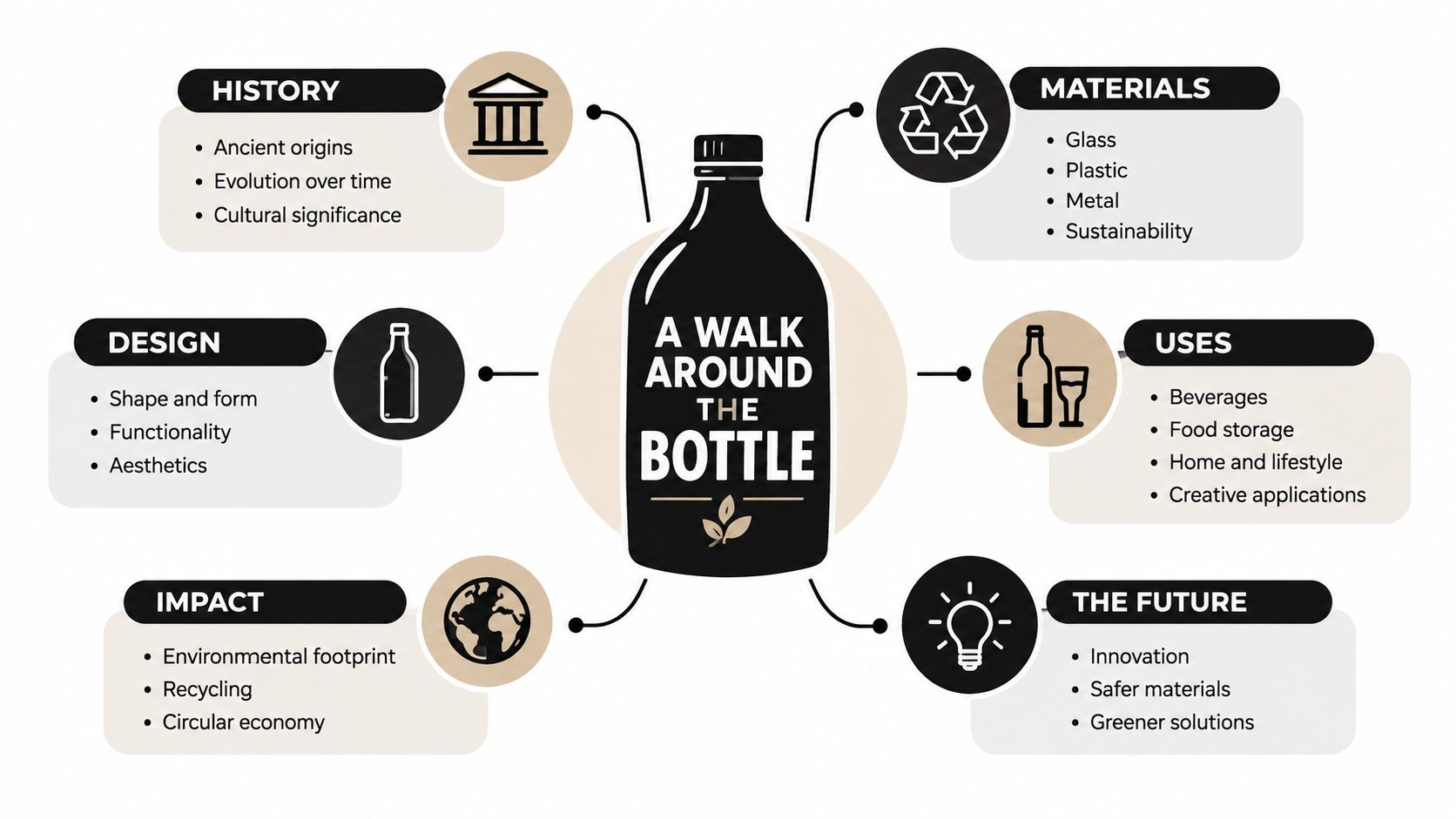
Treat the bottle as a map. Scan it in the same order every time, and you'll quickly find the information that matters.
Start on the front panel. Look for the product identity statement, such as “dietary supplement,” the product name, and the net quantity of contents. Net quantity might be expressed as a capsule count, powder weight, or liquid volume. The product identity is required, so it isn't merely a decorative phrase. The net quantity tells you what is physically in the container, but it doesn't tell you how long the product will last.
Next, turn to the Supplement Facts panel. Find serving size first, then servings per container, followed by the listed dietary ingredients and their quantities. FDA rules require certain nutrient amounts to appear in milligrams or micrograms and, where an official value exists, as a percentage of Daily Value. Don't compare a product until you've checked whether the listed amount covers one capsule, two capsules, a scoop, or another manufacturer-defined serving.
The parts shoppers often skip
Under or beside the facts panel, find Other Ingredients. This list can include capsule materials, binders, fillers, preservatives, sweeteners, colours, and flavourings. These ingredients appear in descending order by weight, so the first listed items generally occur in the greatest amounts. They aren't necessarily harmful, but they may matter if you avoid gelatin, allergens, artificial sweeteners, or particular excipients.
Then read directions and warnings. Directions tell you the recommended daily dosage, timing, and whether the product should be taken with food or water. Warnings may mention pregnancy, allergies, medical conditions, interactions, or age-related cautions. UK consumer guidance also tells users to read the label, follow warnings, and follow the recommended daily dosage, as described in the UK guidance on food supplements.
Finish with the manufacturer, packer, or distributor information, place of business, lot number, storage instructions, and expiry or best-before date. A named business and traceable lot information make it easier to ask questions about a product or report a problem. You don't need to memorise every line. You do need to know where each line is.
Here's a video walkthrough to reinforce the scan order:
Serving Size, Servings per Container and Daily Dose Maths
Serving size is the first calculation, not a footnote. Manufacturers decide the serving size, and it can mean one tablet, two capsules, one scoop, one packet, or another stated amount. FDA rules don't impose one universal serving amount for every supplement, so a larger number printed beside an ingredient doesn't automatically mean a stronger product.
Suppose a bottle contains 60 capsules and the label defines two capsules as one serving. That bottle contains 30 servings, not 60. If the directions say to take one serving each day, it may last 30 days. If the directions require two servings daily, the supply is shorter still. Check the serving definition before you compare capsule counts or estimate a monthly supply.
Normalize the label to your actual routine
Use this simple calculation:
Amount per serving × servings taken per day = daily amount
For a creatine monohydrate product, the label might define one scoop as a serving and list the creatine amount for that scoop. If the directions call for one scoop daily, the serving amount and daily amount match. If the directions call for more than one scoop, multiply the listed amount by the number of scoops you take.
For magnesium glycinate, check whether the stated quantity refers to the magnesium itself or the entire magnesium compound. Then check whether one serving means one capsule or several. Two bottles can show similar capsule counts while delivering different daily amounts because their serving definitions differ.
A B-complex may list several vitamins per serving, but the label still needs to be read alongside the directions. If the suggested use is more than one serving per day, the total daily intake is higher than the number shown in one Supplement Facts line.
| Label question | Why it matters |
|---|---|
| What is one serving? | It may be more than one physical capsule |
| How many servings are in the container? | This determines the realistic supply |
| How many servings do the directions require? | This gives your actual daily dose |
| What is the amount per serving? | This is the starting figure for comparison |
| What is the amount per day? | This is the figure that matters for your routine |
For a practical introduction to serving-size reading, you can also consult this guide to serving sizes on snack labels. The principle transfers well to supplements: the package count isn't meaningful until you know what the label calls a serving.
The same issue appears with omega-3 products. A bottle may advertise 1,000 mg fish oil, but that doesn't necessarily mean it contains 1,000 mg of EPA plus DHA. This explanation of what 1,000 mg fish oil means shows why you should find the chemically relevant components instead of stopping at the largest number.
US and UK or EU-style labels can also frame quantities differently. A US label commonly shows amounts tied to the labeled serving, while UK and EU-style rules commonly present vitamin and mineral quantities for the manufacturer's recommended daily portion. Always read the directions beside the nutrient table when comparing products sold in different markets.
Active Ingredients, Forms and What %DV Means
Two bottles can list the same ingredient on the front and still give you very different information once you reach the Supplement Facts panel. That panel is where you check what is included, how much is included, and in what form. Read each active line like a label reviewer would, not like an ad reader would.
Form changes the meaning of the number. “Magnesium” may mean the amount of elemental magnesium, or it may refer to the weight of the magnesium compound carrying it. “Fish oil” is different from EPA plus DHA. “Turmeric extract” is different from a clearly stated amount of curcumin. With botanicals, look for the plant name and, when the label gives it, the plant part as well.
This is why the biggest milligram number is not automatically the most useful one.
A product can show a larger weight for a whole compound yet deliver less of the active component you are trying to compare. Reading labels well means normalising the formula to the active substance, not stopping at the boldest number on the bottle.
Reading %DV without overinterpreting it
For nutrients with an established Daily Value, %DV is a regulatory reference. The FDA explains in its FDA compliance guide for Daily Value calculations that the percentage comes from the labeled quantitative amount compared with the applicable Daily Value, and that the listed %DV generally applies to adults and children aged four years and older unless the label states otherwise.
Use that percentage as a ruler. Do not use it as a quality score or a personal prescription. General FDA guidance treats 5% DV or less as low and 20% DV or more as high. That helps you place a nutrient on the scale, but it does not tell you what fits your diet, your reason for taking the supplement, or what you already get from food.
Many botanicals, amino acids, probiotics, and specialty compounds show “DV not established.” That statement has a narrow meaning. It tells you there is no established regulatory reference value for calculating %DV for that ingredient. It does not tell you whether the ingredient is useful, useless, suitable, or unsuitable for you.
A 100% DV claim is a reference point, not a universal quality score.
If you are comparing creatine, magnesium, ashwagandha, omega-3, a multivitamin, or an energy powder, pause on three questions:
- What is the amount per serving and per day?
- What exact form supplies that amount?
- Does that stated quantity fit my goal and my existing diet?
| Nutrient | Watch for on the label | Form worth knowing |
|---|---|---|
| Magnesium | Whether the quantity identifies elemental magnesium | Magnesium glycinate and magnesium oxide are different compounds |
| Omega-3 | Total fish oil versus individual fatty acids | EPA and DHA are the relevant components to locate |
| Creatine | The named creatine compound and serving definition | Creatine monohydrate is a clearly identified form |
| Botanicals | Plant identity, extract details, and absence or presence of a DV | Ashwagandha and mushroom ingredients may need more detail than a broad blend name |
| Multivitamins | Nutrient amounts, forms, and overlapping ingredients | Compare the full panel, not only the percentage claims |
If percentage language still feels slippery, this guide to Nutrient Reference Value can help you connect UK and European reference terms with the way supplement labels are compared more broadly.
Spotting Proprietary Blends and Hidden Doses
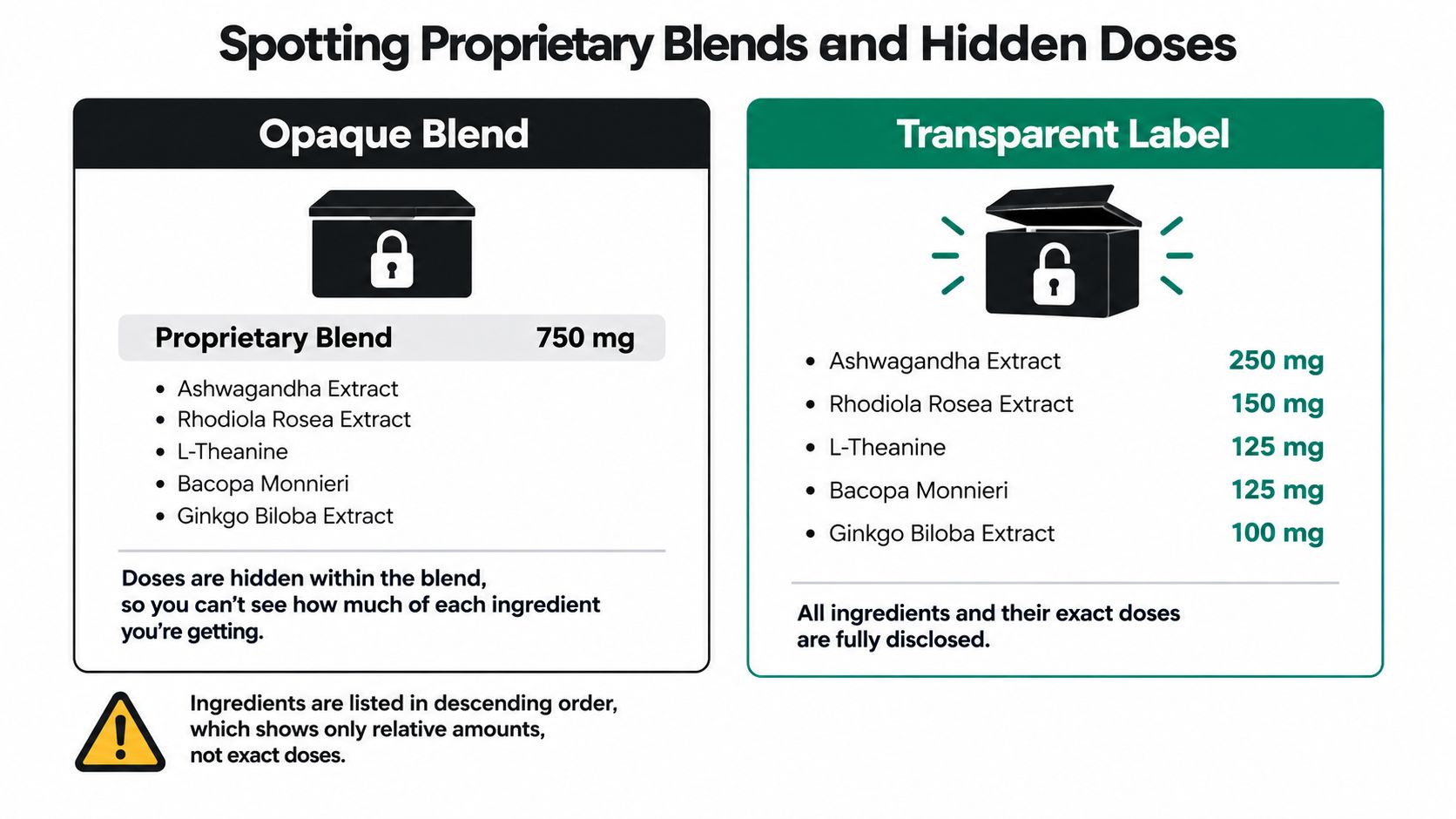
A proprietary blend usually gives you one combined weight and a list of ingredients, but not the amount of each ingredient. The components are listed in descending order by weight. That tells you only that an ingredient higher on the list weighs more than the ingredients below it. It doesn't prove that the first ingredient reaches a meaningful dose.
Compare these two declarations:
| Fully quantified formula | Proprietary blend |
|---|---|
| Creatine monohydrate, amount stated | Energy blend, total weight stated |
| Caffeine, amount stated | Caffeine listed without its own amount |
| Beta-alanine, amount stated | Beta-alanine listed without its own amount |
| Ashwagandha extract, amount stated | Ashwagandha listed without its own amount |
With the transparent version, you can compare the daily dose, assess duplicate ingredients, and decide whether the formula suits your routine. With the blend, you know only the total weight shared by all components.
This matters in mushroom blends, energy powders, testosterone formulas, and pre-workout products. A label may mention creatine, caffeine, ashwagandha, beta-alanine, or several mushroom species, yet leave you unable to determine how much of each one you receive.
The transparency test
Look for phrases such as proprietary blend, matrix, complex, or exclusive formula. These terms aren't automatically proof of a poor product, but they should prompt a closer look. Ask whether the manufacturer provides a batch-specific certificate of analysis, names the testing laboratory, and identifies the lot covered by the document.
The FDA's supplement labeling guide explains that individual amounts are required for dietary ingredients except those inside proprietary blends. It also confirms that blend components are listed in descending order by weight, not by proven effectiveness or importance.
If you can't calculate the amount of an ingredient, you can't make a reliable dose comparison.
A transparent formula isn't a guarantee that every ingredient suits every person. It is a better starting point for asking informed questions.
Other Ingredients, Allergens, Warnings and Expiry
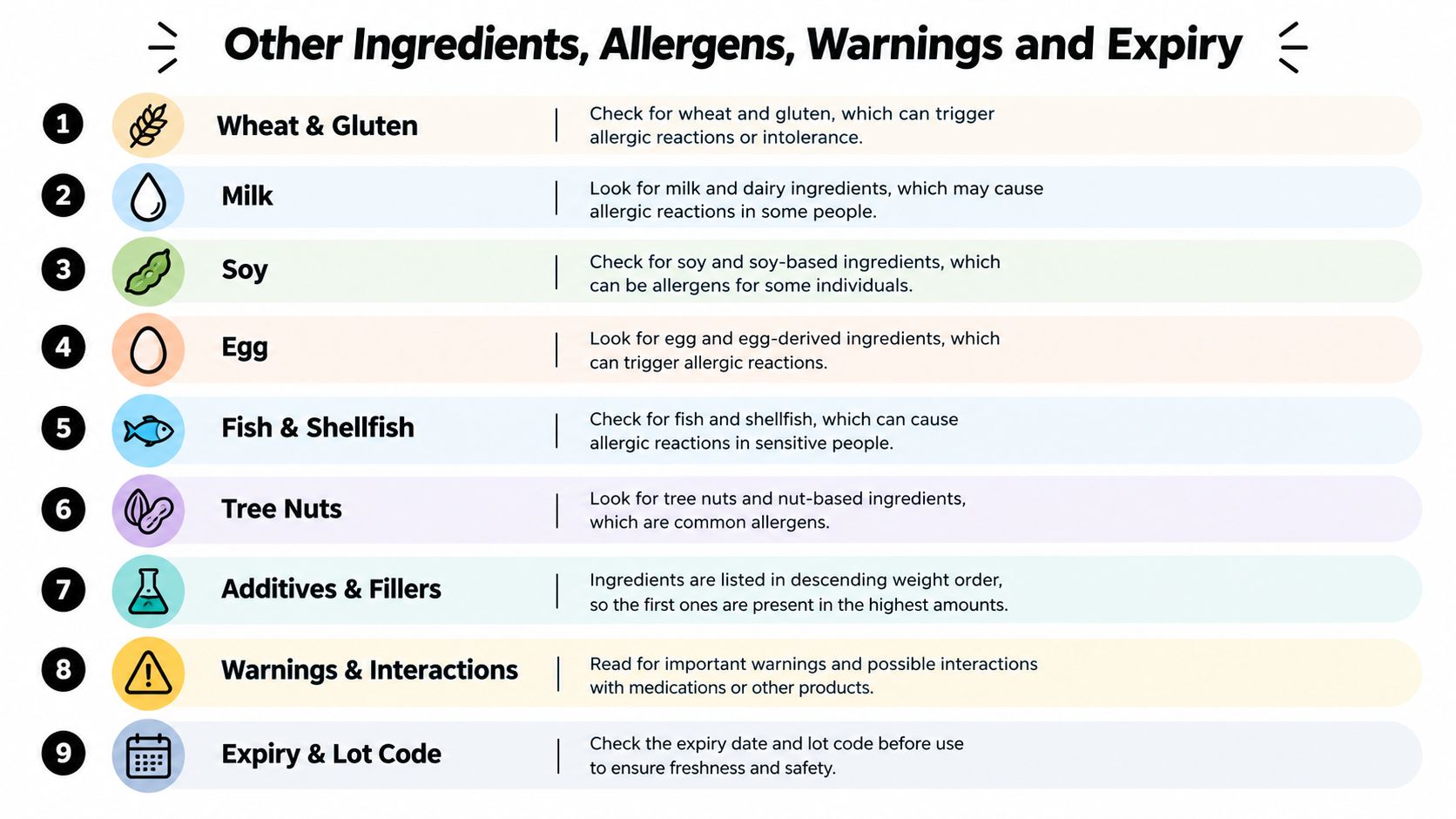
The active ingredients get most of the attention, but Other Ingredients can determine whether you can comfortably use a product. Read this list from top to bottom because fillers, binders, preservatives, sweeteners, capsule materials, and flavourings appear in descending order by weight.
Check for allergens that matter to you, including milk, soy, egg, fish, shellfish, tree nuts, wheat, peanuts, and sesame. Then look at the capsule shell. Gelatin may not suit a vegan, vegetarian, halal, or kosher preference, while a plant-based capsule may be more suitable. Powders also deserve a close scan for sweeteners, colours, flow agents, and flavouring systems.
A label may show two magnesium products with the same active magnesium amount. One could contain a capsule material or sweetener you avoid, while the other may fit your diet. The active dose is only one part of suitability.
Read the safety lines before the first serving
Directions and warnings deserve the same attention as the ingredient table. Follow the labelled daily dosage, note any storage requirements, and check whether the product should be taken with food or kept away from heat and moisture. If you're pregnant, managing a health condition, taking medication, or combining several supplements, ask a qualified health professional about possible interactions.
Expiry and lot information are practical quality checks. Don't use a product past its expiry or best-before date without professional advice, and keep the lot number if you need to contact the manufacturer. A brand that provides a named manufacturer, traceable lot information, and testing documentation gives you more useful information than a product that relies only on “advanced” or “maximum strength” language.
For a plain-language explanation of why some formulations include bulking agents, see this guide to bulking agents. The important point is not that every additive is unacceptable. It's that you should know what you're consuming and decide whether it fits your needs.
Your Label-Reading Checklist and Personalised Next Step
Keep this scan order beside you when you shop or compare products at home:
- Identity: Is it clearly labelled as a dietary supplement?
- Net quantity: Does the capsule, powder, or liquid amount tell you anything about supply?
- Serving size: How many capsules, tablets, scoops, or packets make one serving?
- Daily directions: How many servings will you take?
- Active amounts: Can you see the quantity of every important ingredient?
- Ingredient forms: Does the label identify the relevant compound, extract, or active component?
- %DV context: Is the percentage available, and do you understand what it represents?
- Other ingredients: Are there allergens, sweeteners, capsule materials, or additives you avoid?
- Warnings and storage: Are the directions compatible with your circumstances?
- Expiry, lot, and verification: Can you trace the product and find meaningful testing information?
Start one new product at a time when possible. Keep to the labelled daily dose, write down what you're taking, and review your full routine for duplication across a multivitamin, magnesium, omega-3, creatine, sleep support, or energy formula. If you take medication or have a medical condition, check with a qualified health professional before adding a supplement.
Reading a label tells you what a product declares. Choosing what may be relevant still depends on your goals, diet, health history, and lifestyle. A personalised supplement service such as VitzAi.com uses information about areas such as energy, sleep, stress, exercise, diet, fish intake, and digestion to help users review a curated supplement plan rather than choosing from an overwhelming list.
Visit VitzAi.com to complete a personalised supplement quiz and review recommendations connected to your goals, diet, and lifestyle. Use the label-reading checklist alongside any suggested plan so you can confirm each serving, active form, daily dose, and other ingredient before you buy.
This article is for informational purposes only and is not medical advice. Always consult a qualified health professional before starting any new supplement or major lifestyle change