

Men Hair Vitamins: What Actually Works in 2026
Close to 50% of men are affected by pattern hair loss by age 50, yet the strongest evidence for vitamins supports correcting specific, confirmed deficiencies, not taking high-dose, multi-ingredient products without testing. Men hair vitamins can support hair health in the right context, but they can't out-supplement genetic follicle sensitivity.
Biotin and generic multivitamins remain the most popular advice. They also create some of the biggest misunderstandings. A nutrient deficiency can contribute to shedding, but male pattern hair loss usually has a different driver, and taking more of a nutrient you already have enough of may do nothing or create new problems.
The Hard Truth About Men Hair Vitamins
A bottle labelled “hair growth” can make a simple promise look medically complicated. You take the capsules, wait for thicker hair, and expect the shedding to stop. That expectation is understandable, especially when hair loss affects close to 50% of men and women by age 50, according to a 2017 review of pattern hair loss.
The uncomfortable part is that prevalence doesn't prove a vitamin deficiency. Pattern hair loss is usually a genetic process involving follicle sensitivity, while deficiencies represent a separate, potentially correctable cause of shedding. A man can have both, but correcting a deficiency won't necessarily reverse inherited thinning.

Why more isn't automatically better
Biotin receives most of the attention, yet the clinical evidence doesn't support routine biotin for androgenetic alopecia when no deficiency exists. Zinc, vitamin E, selenium, vitamin A and other ingredients can also appear in broad formulas, but adding them blindly doesn't make the product more effective.
The earlier review found no clinical trials showing that biotin improves hair loss in people without a deficiency. It also warned that excessive intake of nutrients such as vitamin A, vitamin E and selenium can worsen hair loss. That turns the usual “more is better” supplement logic on its head.
Practical rule: Treat a confirmed nutritional problem, not a marketing category.
A smarter question is not “Which hair vitamin should I buy?” It's “What type of hair loss do I have, and is a deficiency contributing to it?” That shift protects you from spending on an expensive formula that targets the wrong mechanism.
Why Men Lose Hair and What Vitamins Can Actually Do
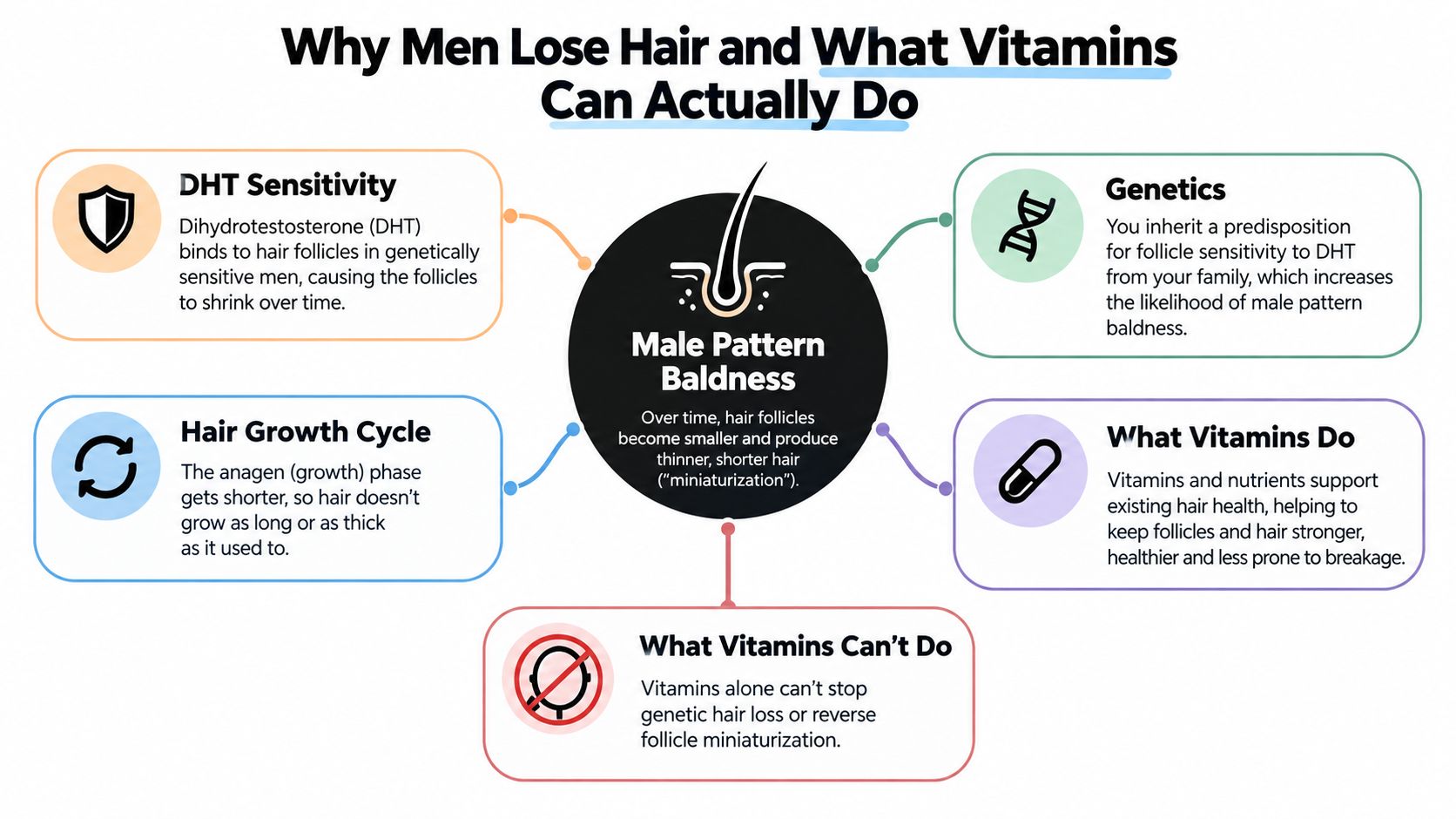
Male pattern hair loss, also called androgenetic alopecia, develops when genetically sensitive follicles respond to dihydrotestosterone, or DHT. Over time, those follicles become smaller and produce finer hairs. The growth phase can also become shorter, so the visible hair gradually loses coverage and density.
Vitamins don't block DHT. They can help provide the raw materials needed for normal hair production, but they don't remove the inherited sensitivity that drives follicle miniaturization. That distinction matters because a supplement may support the quality of existing hair without restoring a receding hairline.
Where nutrients fit
Nutrient status can still influence the amount of shedding a man experiences. Reviews have examined vitamin B, vitamin D, iron, selenium and zinc as possible modifiable factors, although the findings aren't fully consistent and some studies show no meaningful association. The practical implication is measured and specific: nutritional status may matter, but not every case of thinning is a vitamin problem.
Stress, poor sleep, restrictive eating and inadequate protein can also undermine general recovery. Correcting those pressures may help hair return toward its normal growth pattern when they contribute to shedding, but that isn't the same as treating genetic baldness.
If your hairline is changing or the crown is thinning, a dermatologist can help distinguish pattern loss from other conditions. A resource on treating hair loss for men can also help you understand why diagnosis should come before choosing a supplement or treatment path.
Collagen is another commonly discussed option. It may support the structure of existing hair, but it shouldn't be presented as a proven way to reverse male pattern loss. For background, see this guide to collagen for hair.
What Recent Reviews Say About Supplements and Hair Density
The supplement category has moved beyond pure anecdote, but the newer evidence still doesn't justify treating every capsule as interchangeable. A 2025 systematic review analysed 19 randomised controlled trials involving 1,658 patients. The review reported that several specific categories, including standardised plant extracts, tocotrienols, pumpkin seed oil, probiotics and certain multi-ingredient formulas, improved hair density or terminal hair density compared with placebo in the relevant trials. (Review of dietary supplements for androgenetic alopecia)
That result is useful, but it has limits. The studies tested particular formulations, doses and populations. A positive result for pumpkin seed oil or a standardised botanical extract doesn't validate an unrelated product that happens to use the words “hair complex” on its label.
What the newer synthesis means
A 2026 systematic review pooled 14 studies with 967 participants and found modest but significant improvements in hair density, thickness and shedding for commercial oral nutraceuticals compared with placebo. (2026 review of oral nutraceuticals)
“Modest” is the important word. These products may provide an adjunct for some men, particularly when a formula has been studied directly, but they aren't a reliable substitute for assessment or established medical options. The evidence is also heterogeneous, with small trials and inconsistent outcome measures.
The useful conclusion is not that hair supplements work or fail as a group. It's that some formulations show limited signals, while generic products remain an open question.
When evaluating a product, look for named ingredients, transparent amounts and research on the actual formulation. A Nutrafol supplement guide may help you compare how commercial products are positioned, but marketing claims still need to be separated from trial evidence.
Deficiency Correction vs. High-Dose Multivitamins
There are two very different ways to approach men hair vitamins. The first is deficiency correction. You discuss symptoms and diet with a clinician, arrange appropriate testing, and replace a nutrient that is genuinely low. The second is taking a high-dose formula regardless of your baseline status.
The first approach has a clearer rationale. Major reviews describe limited or conflicting evidence for biotin, zinc, riboflavin, folate, vitamin B12 and vitamin E as direct hair-loss treatments. Biotin can cause hair loss when someone is deficient, but supplementation without deficiency has no established hair-growth benefit. (Review of vitamins and hair loss)
| Strategy | Best For | Evidence Level | Key Risk |
|---|---|---|---|
| Deficiency correction | Men with a confirmed nutritional shortfall or a clinician-identified risk | Strongest when the deficiency is real and relevant | Self-testing or treating without proper interpretation |
| High-dose multi-ingredient formula | Men choosing a studied product as an adjunct, with realistic expectations | Mixed, modest and formulation-specific | Excess nutrients, interactions and unnecessary cost |
The risks hidden inside “hair support”
High-dose vitamin A, vitamin E and selenium deserve caution because excessive intake can worsen hair loss. A broad formula can therefore create a poor trade-off, especially when it contains several nutrients at doses you don't need. The label may look complete, but complexity isn't the same as clinical value.
Biotin has a separate problem. High-dose biotin can interfere with laboratory tests, including thyroid and cardiac testing, and may produce misleading results that affect clinical decisions. Tell your clinician about biotin before blood work, and don't assume a supplement is harmless because it is sold without a prescription.
The practical UK position is also clear. A UK pharmacy guide on hair vitamins states that routine biotin supplementation isn't recommended without confirmed deficiency, and these products aren't licensed by the MHRA as treatments for hair loss.
If you want food-based context, review foods high in biotin, but don't confuse dietary information with a reason to take concentrated doses.
How to Build a Smart Hair Support Routine
Start with the cause, not the capsule. Arrange a medical assessment if shedding is sudden, patchy, unusually heavy or accompanied by scalp symptoms. A clinician can decide whether tests for iron status, vitamin D, zinc or B vitamins make sense for your situation.
A practical sequence
- Record the pattern. Note whether the change involves the temples, crown, diffuse shedding or distinct patches. Photos taken under similar lighting can make gradual change easier to discuss with a professional.
- Review the foundations. Regular meals, adequate protein, consistent sleep and stress management support normal recovery. No supplement can compensate fully for chronic under-eating, sustained stress or consistently poor sleep.
- Match the product to the evidence. If testing identifies a deficiency, use the appropriate nutrient under professional guidance. If you're considering a non-deficiency formula, choose one with transparent ingredients and published research on the formulation rather than a vague proprietary blend.
- Treat supplements as support. Pumpkin seed oil and saw palmetto are often discussed as natural DHT-related options, but they shouldn't be treated as interchangeable with clinically supervised hair-loss treatment. Discuss benefits, limitations and side effects with a dermatologist.
For a broader overview of supplements for hair growth, compare the proposed mechanism with the type of loss you're experiencing. A guide to hair vitamins that actually work can offer another product-focused perspective, but the same rule applies: a claim is more useful when it identifies the tested ingredients and the limits of the evidence.
Use this video as an additional visual introduction to the topic, not as a substitute for medical assessment.
Real-World Scenarios - Who Benefits Most?
Consider a student or professional in his twenties who notices diffuse shedding after prolonged stress, irregular meals and poor sleep. His priority isn't automatically biotin. A clinician should assess the pattern and diet, while restoring adequate food intake, recovery and stress control may address contributors that a capsule alone won't fix.
A man in his thirties or forties with a gradually receding hairline and thinning crown fits a different picture. Vitamins may support overall hair quality or correct a coincidental deficiency, but they won't address the inherited follicle sensitivity driving the pattern. He should discuss diagnosis and treatment options with a dermatologist rather than waiting for a multivitamin to reverse progression.
An active man who trains regularly may focus on magnesium, zinc or a general multivitamin for broader nutrition and recovery goals. Those products can make sense when his diet leaves a genuine gap, but training alone doesn't prove a deficiency, and high doses aren't automatically helpful for hair.
The right supplement depends less on your age or identity than on the cause of the shedding, your nutritional status and the product's evidence.
Key Takeaways and Next Steps
Men hair vitamins aren't a miracle cure, but they can have a role when you use them for a defined reason.
- Start with the diagnosis: Genetic sensitivity commonly drives male pattern loss, while sudden or diffuse shedding may have other contributors.
- Correct confirmed deficiencies: Test and replace nutrients that are genuinely low instead of taking a high-dose blend by default.
- Treat biotin cautiously: Routine biotin without deficiency isn't recommended, and high-dose biotin can distort thyroid and cardiac laboratory tests.
- Judge formulas individually: Recent reviews report modest benefits for some studied nutraceuticals, not proof that every multivitamin regrows hair.
- Protect the basics: Sleep, stress management, adequate protein and a balanced diet support the conditions hair needs to grow normally.
Book an assessment before starting a new hair formula, especially if shedding is rapid, patchy or unexplained. Bring every supplement label to the appointment, including biotin, and ask whether testing or evidence-based hair-loss treatment is more appropriate than empirical supplementation.
This article is for informational purposes only and is not medical advice. Always consult a qualified health professional before starting any new supplement or major lifestyle change
VitzAi.com offers a personalised supplement quiz that uses your goals, diet and lifestyle to suggest a curated plan, including options relevant to general nutrition, sleep, stress and exercise recovery. Visit VitzAi.com to explore that guidance alongside, not instead of, professional assessment for hair loss.