

Most Bioavailable Form of Magnesium Compared
“Magnesium glycinate is the most bioavailable form of magnesium.” You've probably seen that advice everywhere. It's convenient, popular, and too simplistic.
The strongest absorption evidence points to magnesium citrate over magnesium oxide, while other forms may fit specific goals better. Glycinate is a sensible choice for people who prioritise evening use and gastrointestinal comfort, but the research doesn't prove that it universally beats citrate, chloride, lactate, or other soluble forms. The right decision depends on what you want magnesium to do, how your digestion responds, your diet, kidney function, and any medicines you take.
Why One Magnesium Form Does Not Fit Everyone
The phrase “most bioavailable magnesium” suggests there's one permanent winner. There isn't. Magnesium citrate, glycinate, malate, L-threonate, taurate, chloride, lactate, aspartate, and oxide all deliver the same mineral through different chemical forms, and those forms affect solubility, elemental content, gastrointestinal effects, and practical usefulness.
Glycinate has earned its reputation because it's generally comfortable for daily use and suits people who want an evening routine. That doesn't make it the automatic choice for constipation, exercise-related replenishment, or a budget-conscious product. Citrate can be a better fit when bowel regularity matters. Malate may appeal to people focused on daytime energy and training. L-threonate is a targeted option for cognitive research, not a general replacement for every other form.
The practical rule: Choose the magnesium form that fits the job, not the form with the loudest marketing claim.
Individual context changes the decision further. Age, gut health, kidney function, dietary intake, medication use, and the amount taken at once can all influence the result. Magnesium absorption from food itself isn't complete. NIH sources estimate typical dietary absorption at roughly 50%, while balance studies commonly report net absorption around 40–60%, depending on the food source and conditions. The NIH magnesium fact sheet explains why soluble forms generally absorb better than poorly dissolving forms.
That makes a one-size-fits-all recommendation wasteful. Someone with loose stools shouldn't blindly choose citrate because it ranks well in an absorption study. Someone seeking bowel support may find glycinate too neutral. Someone interested in cognition may care less about the highest general absorption and more about whether a form has been studied in the central nervous system.
The working conclusion is straightforward: the most bioavailable form of magnesium is the one that delivers enough elemental magnesium, absorbs reliably in your situation, and matches your intended outcome.
What Bioavailability Really Means for Magnesium
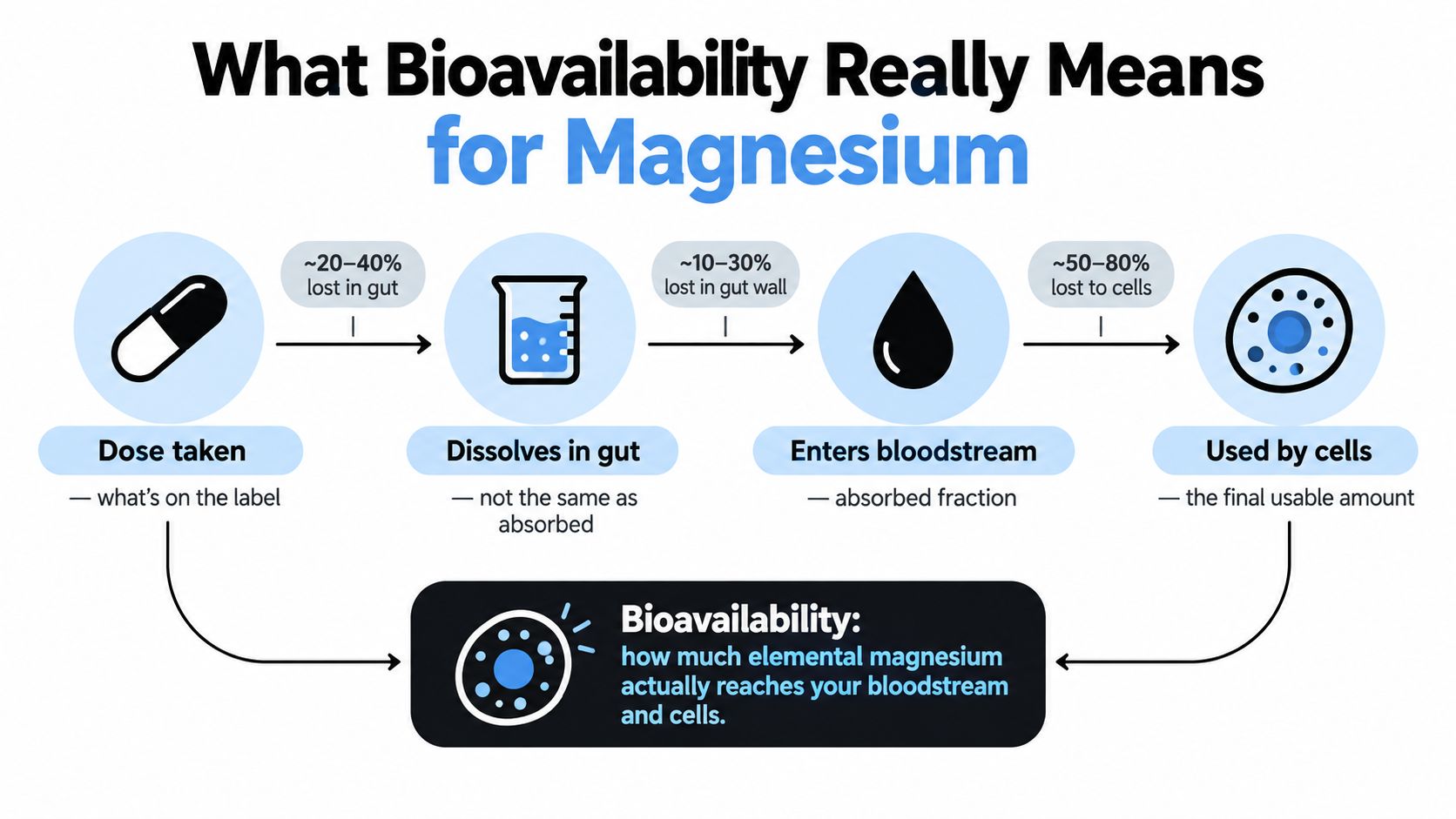
Bioavailability is the amount of magnesium from a dose that gets absorbed, reaches circulation, and becomes available for the body to use. It isn't the same as the number printed beside the compound name, and it isn't proven merely because a powder dissolves in water.
A supplement label can show a large amount of magnesium citrate or glycinate compound while providing a smaller amount of elemental magnesium, which is the amount you need to compare. Then the body still has to dissolve the compound in the gut, release magnesium ions, move them across the intestinal lining, and retain or use the absorbed mineral.
Several variables influence that journey:
- Solubility: A compound that dissolves readily is generally easier for the gut to process.
- Chemical pairing: The accompanying citrate, glycinate, malate, taurate, chloride, or oxide changes how the supplement behaves.
- Dose size: A large single dose can produce different absorption and gastrointestinal effects than smaller divided doses.
- Food and gut conditions: Meals, intestinal transit, gut health, and local pH can change the amount absorbed.
- Study design: A single-dose trial in healthy adults doesn't answer exactly the same question as a longer study in people with low magnesium status.
Researchers also use different outcomes. Fractional absorption asks what proportion of a dose enters the body. Urinary recovery measures how much magnesium appears in urine after dosing, which can indicate systemic uptake but isn't a perfect direct measurement of every physiological use. Serum magnesium can change without fully describing tissue status, while red-blood-cell measurements assess a different compartment.
For a broader explanation of how dissolution, dose, food, and formulation interact, see this guide to how to increase bioavailability. Use absorption rankings as direction, not as a promise that one capsule will perform identically for every person.
Magnesium Citrate, Glycinate, Malate, L-Threonate and Oxide Compared
The most useful comparison starts with the evidence that is strongest, not with the form that has the best reputation.
Magnesium citrate has the clearest practical case for general oral absorption and digestive regularity. Comparative human research found higher urinary magnesium excretion and greater serum increases after citrate than oxide. It's soluble and useful when you want repletion alongside a softer bowel effect. The drawback is obvious: the same osmotic action that helps constipation can cause loose stools.
Magnesium glycinate or bisglycinate is the comfort-first option. It's widely chosen for evening routines, stress-related tension, and people who don't tolerate laxative forms. The carrier glycine may contribute to the appeal, but direct evidence doesn't establish glycinate as the universal absorption champion.
Magnesium malate makes more sense for daytime use, fatigue-dominant complaints, and exercise routines. Its malate component is linked to cellular energy metabolism, but its comparative absorption evidence is less established than citrate-versus-oxide evidence.
Magnesium L-threonate is a targeted cognitive option. It's studied for brain and age-related cognitive outcomes and shouldn't be treated as the most economical way to deliver a large amount of general elemental magnesium.
Magnesium taurate is relevant when cardiovascular context matters, because taurine has its own physiological role. It's less broadly established as a general-purpose repletion form.
| Form | Relative absorption | GI tolerability | Typical elemental magnesium | Best-fit use |
|---|---|---|---|---|
| Citrate | High compared with oxide | Can loosen stools | Product-dependent | General use, digestive regularity, exercise support |
| Glycinate or bisglycinate | Generally well absorbed and gentle | Usually well tolerated | Product-dependent | Evening routines, stress, sensitive digestion |
| Malate | Soluble organic form, with less comparative evidence | Usually neutral | Product-dependent | Daytime use, fatigue-focused routines, training |
| L-threonate | Targeted central nervous system research | Usually neutral | Often lower than common repletion forms | Focus and cognitive goals |
| Oxide | Poorer absorption than citrate and other soluble forms | More likely to have osmotic effects | High compound content can mislead | Low-cost bowel support, not first choice for repletion |
| Taurate | Soluble form with a cardiovascular rationale | Generally neutral | Product-dependent | Cardiovascular and blood pressure context |
Don't compare products by the front-label compound weight. Compare the elemental magnesium per serving, then assess whether the carrier suits your goal and digestion. A premium-sounding form with a tiny elemental dose may be less useful than a straightforward citrate product with a meaningful, tolerable serving.
The Absorption Gap Between Citrate and Oxide
Magnesium oxide looks attractive because it can contain a high proportion of elemental magnesium by weight. That's where the label comparison often goes wrong. A high elemental figure doesn't compensate for poor dissolution and weak absorption.
In a controlled human crossover study, magnesium citrate produced significantly higher 24-hour urinary magnesium excretion than magnesium oxide. The adjusted mean difference was 0.565 mmol in favour of citrate, with a 95% confidence interval of 0.212 to 0.918 mmol and p = 0.0034. The published crossover analysis also found greater serum magnesium rises at several post-dose time points after citrate.
A separate comparison using 350 mg elemental magnesium found a 5.13% blood magnesium increase from citrate versus 2.38% from oxide after 24 hours. In red blood cells, citrate reached 6.44% compared with 3.98% for oxide, while Sucrosomial magnesium reached 10.53% in blood. These figures come from the synthesis reported in a recent review of comparative magnesium formulations. The review in PMC shows why product rankings should focus on measured uptake rather than elemental content alone.
Older solubility and urinary-excretion work found magnesium oxide was virtually insoluble in water, while citrate was substantially more soluble. The same comparison reported urinary magnesium increments of 0.22 versus 0.006 mg per mg creatinine during the first four hours after dosing, with p < 0.05. The comparative study provides the basic mechanism behind the practical difference.
| Metric | Magnesium citrate | Magnesium oxide |
|---|---|---|
| Solubility | High relative to oxide | Very low in water |
| 24-hour urinary recovery | Higher than oxide | Lower than citrate |
| Blood magnesium response | Greater in comparative testing | Smaller in comparative testing |
| Main practical advantage | Better systemic uptake with digestive utility | Low cost and osmotic bowel effect |
| Main limitation | Can loosen stools | Poor choice when efficient repletion is the goal |
Oxide may still increase serum magnesium, especially when someone starts from a low status, but that doesn't make it equivalent to citrate. The question is not just, “Which bottle costs less?” It's how much absorbed magnesium you get per tolerable dose. For general repletion, citrate wins this comparison.
Matching Magnesium Forms to Sleep, Stress, Recovery and Focus
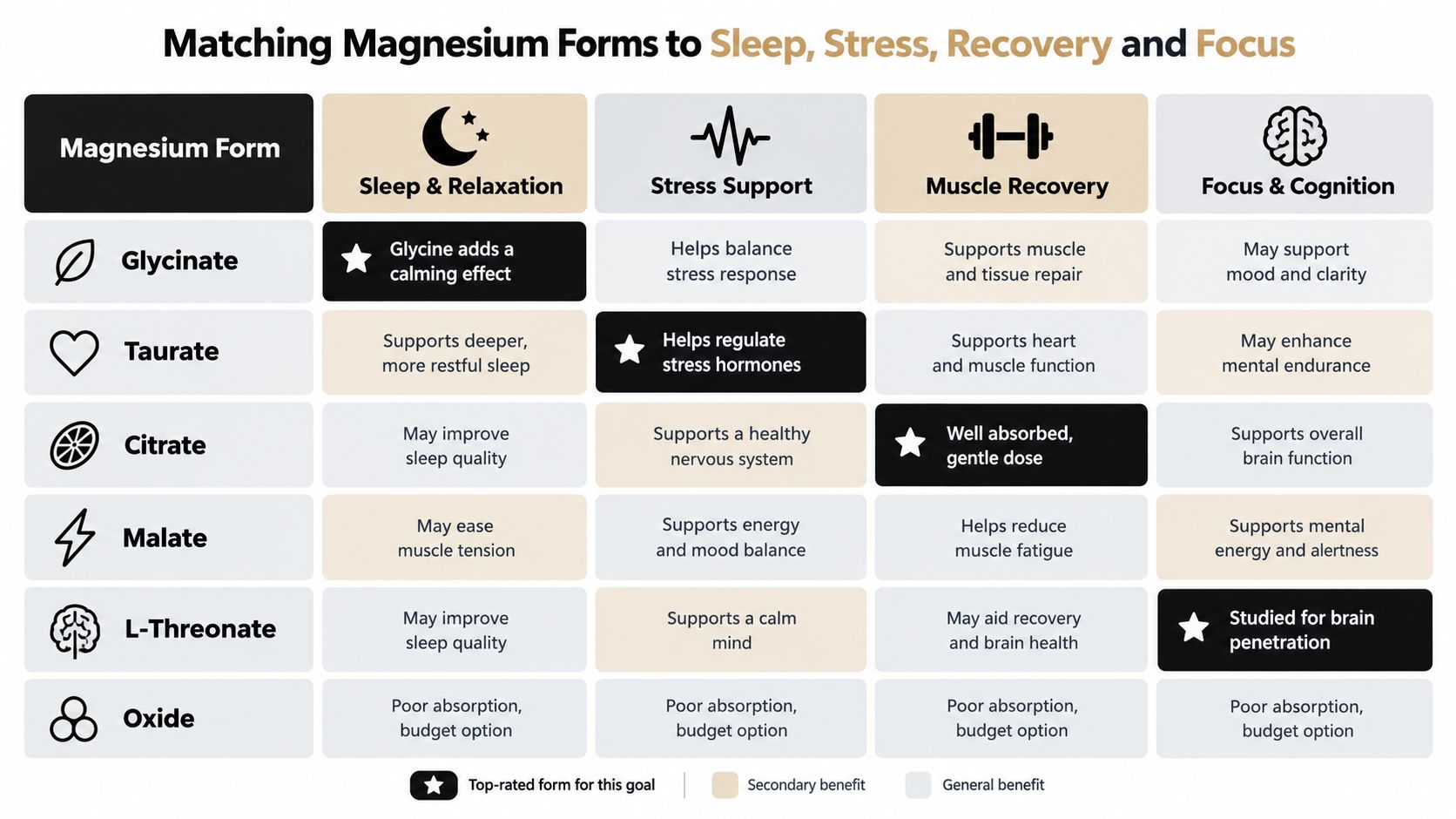
The cleanest way to choose magnesium is to start with the outcome. Absorption matters, but the carrier and gastrointestinal profile can determine whether you'll keep taking the supplement.
For sleep and relaxation, glycinate is the sensible first choice. It's generally gentle, and the glycine component makes it popular in evening routines. Taurate is another option for people who want a non-laxative form with a taurine-based cardiovascular rationale. Don't expect either form to override late caffeine, irregular bedtimes, or a bedroom that keeps you alert. These practical sleep hygiene tips for deeper rest are worth addressing alongside supplementation.
For stress, glycinate is usually easier to live with than citrate, particularly if your digestion is already sensitive. Citrate remains reasonable when you also want bowel support. Start with the form you can take consistently, not the one that promises the most dramatic effect.
For exercise recovery, citrate and malate are the stronger practical candidates. Citrate combines good comparative absorption with a useful electrolyte role. Malate fits daytime routines and fatigue-focused training plans, although its absorption evidence isn't as decisive as the citrate-versus-oxide data. Hydration, food, sodium, and adequate recovery still matter more than turning magnesium into a performance shortcut.
For focus and age-related cognitive goals, L-threonate is the targeted pick. It has human cerebrospinal-fluid research, which makes it distinct from forms selected mainly for systemic repletion. That doesn't prove it will improve every person's memory, and it's not the form I'd choose if your primary need is inexpensive general magnesium.
For digestion and bowel regularity, citrate is the better compromise when you also want absorbed magnesium. Oxide can act as an osmotic agent and costs less, but its poor systemic uptake makes it a weak choice for repletion. If you already have loose stools, don't use a laxative effect as a selling point.
The practical dose depends on the product's elemental magnesium and your health context. Avoid copying high-dose protocols from online articles, especially if you have kidney disease or take prescription medicines. For a focused explanation of the popular evening form, read magnesium glycinate supplementation.
Best Magnesium Form by Reader Profile
Different readers need different answers. Here's the direct version.
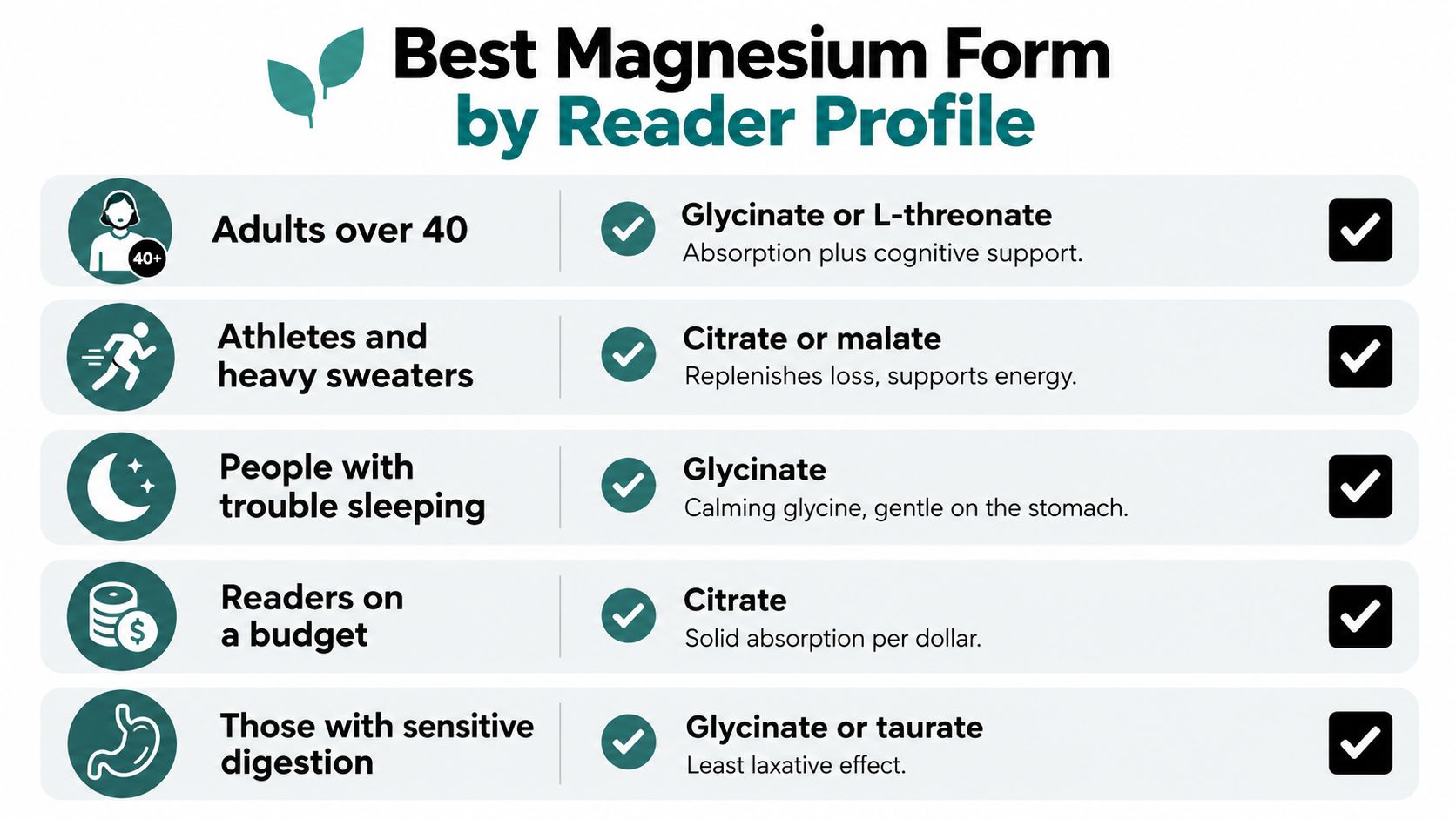
Adults over 40
Choose glycinate if sleep, muscle tension, or daily tolerability is the priority. Choose L-threonate when the main goal is cognitive support and you accept that it's a more targeted, less general-purpose option. Take care with kidney function and medicines, because age alone doesn't determine whether supplementation is appropriate.
Action step: Pick glycinate for routine repletion or L-threonate for a cognition-focused plan, then review the response rather than switching forms every few days.
Athletes and heavy sweaters
Choose citrate for a straightforward, well-absorbed mineral form with a possible digestive benefit, or malate for a daytime training routine. Pair the decision with a complete electrolyte strategy rather than treating magnesium as a replacement for fluid and sodium.
Action step: Use citrate or malate around the part of the day when training and recovery are most relevant, and monitor gastrointestinal tolerance.
People managing PMS or perimenopause
Glycinate is the better baseline option when you want a gentle daily form. Citrate becomes useful when bowel regularity is also an issue. Don't assume a more aggressive laxative effect means better support.
Action step: Start with glycinate if digestion is sensitive, then consider citrate only when its bowel effect is genuinely useful.
Busy professionals with stress-driven sleep issues
Glycinate fits the evening because it's usually easy to tolerate and aligns with a calming routine. Taurate may be worth considering when cardiovascular context matters, but it isn't a substitute for clinical care or prescribed treatment.
Action step: Add glycinate to a consistent evening routine and fix the sleep schedule, caffeine timing, and light exposure that often matter more than the capsule.
Supplement beginners
Glycinate is the safest default for someone who wants a non-laxative, uncomplicated starting point. Citrate is the better beginner option if constipation is part of the reason for buying magnesium. Avoid oxide unless the main priorities are low cost or bowel action.
Action step: Start with the product's labelled elemental amount, take it with food, and change one variable at a time.
How to Read Any Magnesium Supplement Label
Start with the elemental magnesium amount, not the total weight of the compound. “Magnesium glycinate” or “magnesium citrate” on the front of a bottle doesn't tell you how much actual magnesium the serving supplies. The Supplement Facts panel should list the elemental amount beside magnesium.
Then check the exact form. A product marketed as glycinate may use a blend that includes oxide, so read the ingredients rather than trusting the front label. If the product combines several forms, identify how much elemental magnesium comes from the blend and whether the manufacturer explains the proportions.
Next, assess the serving size and your total intake from all supplements. Splitting a larger amount can improve tolerance, but don't increase the dose just because the label makes a large compound number look impressive. The guide to how much magnesium to take can help you think through elemental magnesium, food intake, and personal context.
Look for credible third-party testing marks such as USP, NSF, or Informed Choice. These certifications can provide additional reassurance about identity, purity, and label accuracy. Finally, check added ingredients such as B6, taurine, or zinc, especially if you already use a multivitamin or take prescription medication.
People with kidney disease should speak with a qualified clinician before supplementing. Magnesium can also interact with medicines, including some antibiotics, bisphosphonates, and thyroid treatments. If you take regular medication, separate doses only according to professional guidance rather than guessing.
Choosing the Right Magnesium Form for Your Goals
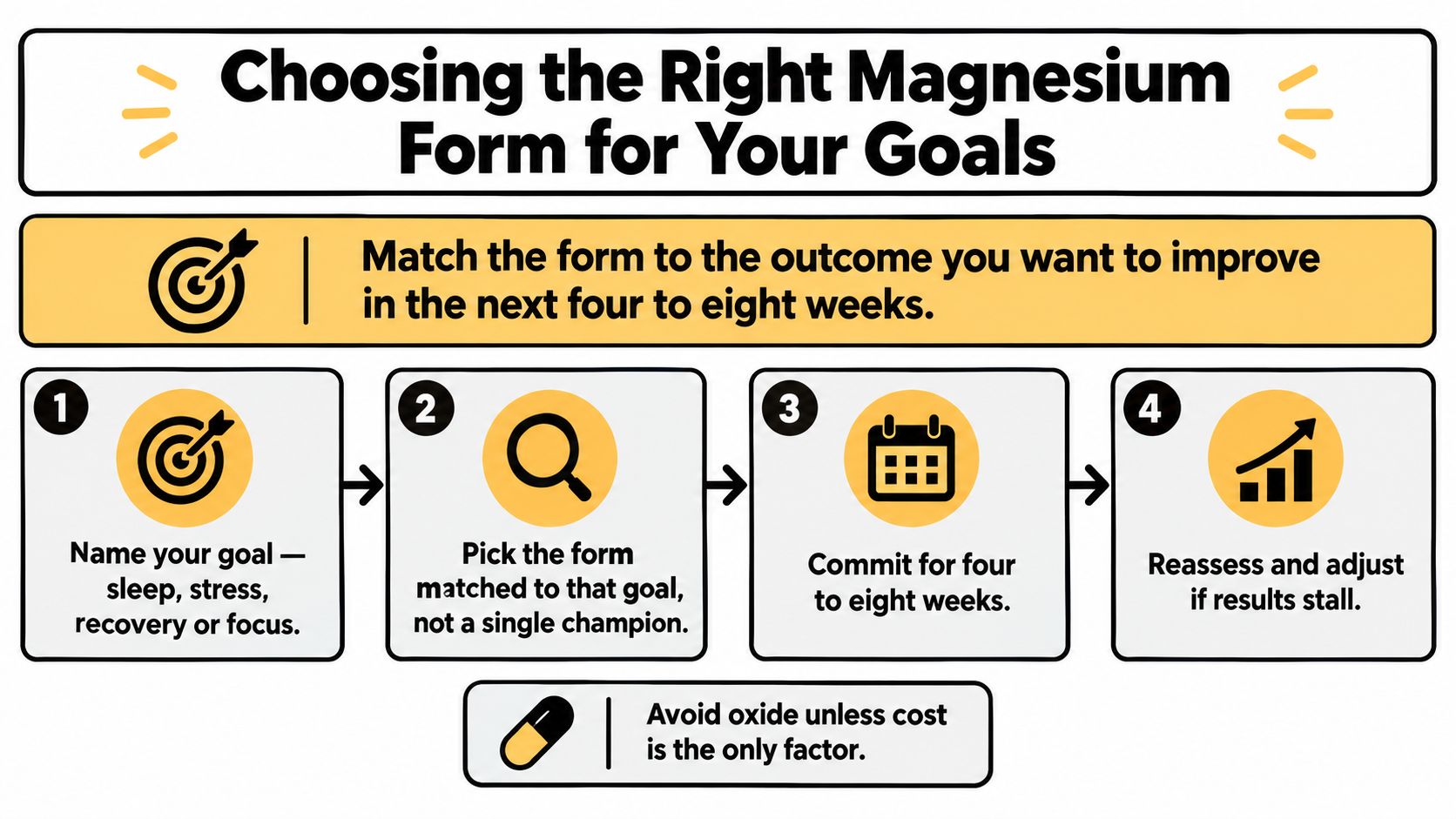
Use a simple decision rule: match the form to the outcome you want to improve over the next four to eight weeks, then verify the elemental amount and product quality.
| Goal | Primary form | Practical expectation |
|---|---|---|
| Digestive regularity | Citrate | Useful when a softer bowel effect is welcome |
| Sleep and evening comfort | Glycinate | Gentle option for consistent use |
| Training and daytime recovery | Malate or citrate | Choose according to tolerance and routine |
| Cognitive focus | L-threonate | Targeted option for brain-related research |
| Lowest-cost bowel support | Oxide | Poorer systemic absorption, but an inexpensive osmotic option |
Your diet, kidney function, gastrointestinal health, and medicines can change that choice. If symptoms persist or you're using magnesium long term, discuss serum or red-blood-cell magnesium testing with a health professional rather than assuming the supplement is working.
VitzAi.com offers personalised supplement guidance through a short quiz that considers goals such as sleep, stress, exercise, digestion, diet, and healthy ageing. Visit VitzAi.com to see which curated supplement options may fit your routine, then check any magnesium recommendation against your health history and professional advice.
This article is for informational purposes only and is not medical advice. Always consult a qualified health professional before starting any new supplement or major lifestyle change