

Muscle Recovery Time: What Science Says
You finish a hard session with heavy legs, a dry mouth, and that familiar question: can you train again tomorrow, or do you need to back off? That confusion is normal, because muscle recovery time isn't one stopwatch. Your muscles, fuel stores, soreness, and usable strength all come back on different schedules.
A lot of people treat recovery like a single 48-hour rule. That rule is simple, but it's also why so many lifters, runners, and busy adults misread their own readiness. If you know which part of recovery is lagging, you can make a better call on whether to push, trim the session, or rest.
Why Muscle Recovery Time Is Not Just One Clock
The simplest mistake is assuming that soreness, repair, and readiness all finish at the same time. They don't. One person can walk out of the gym feeling almost normal while their legs still haven't fully refueled, and another can feel sore yet still move well enough for a light session.
Three separate timelines are running at once
Think of training like starting three different timers. Fuel restoration is one. Tissue repair and rebuilding is another. Soreness and nervous system fatigue are a third, and they don't always peak or fade together.
That's why two people can do the same workout and recover differently. The person who ate enough carbohydrate, slept well, and stopped short of failure may feel ready sooner than the person who trained harder, slept badly, or stacked the workout on top of a stressful day. Recovery is shaped by the session itself and by everything that happened before and after it.
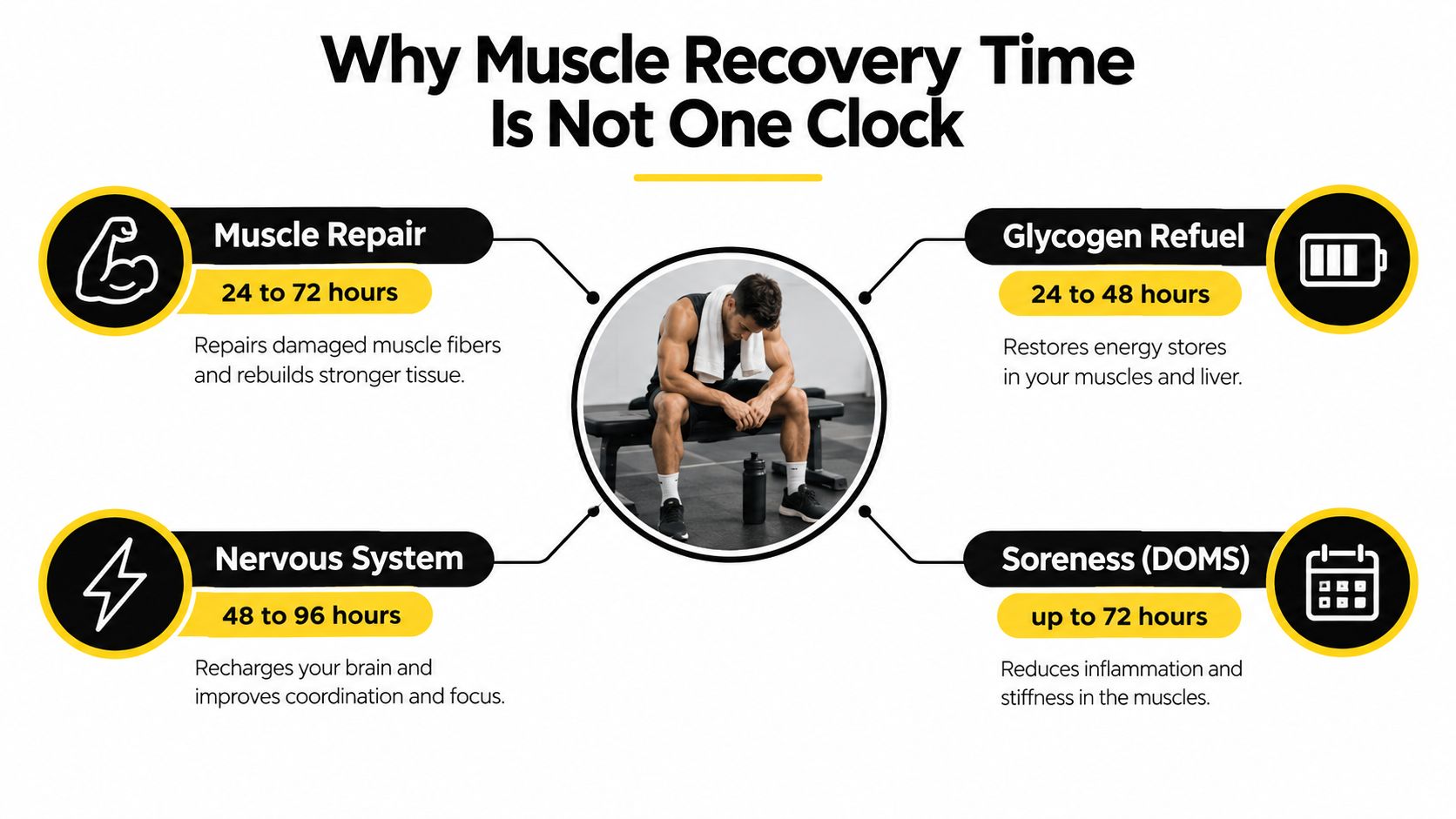
Practical rule: if one clock is still lagging, the whole body can feel “not ready,” even when soreness has eased.
A useful way to think about it is this. Soreness is only one signal, not the whole story. Fuel, muscle function, and movement quality each deserve a separate check.
The Physiology Behind Muscle Recovery
After exercise, your body isn't doing one job, it's doing several at once. It's topping up fuel, repairing worn tissue, and adjusting the way muscle fibers behave under load. That's why recovery can feel quick in one sense and slow in another.
Fuel refill and protein repair don't run on the same clock
Muscle glycogen, which is the stored carbohydrate in muscle, usually replenishes fastest right after hard depletion, then slows down as stores recover. In the human physiology review cited in the evidence base, the first 45 to 60 minutes after severe depletion were the quickest, with later recovery slowing down and generally finishing within about a day when carbohydrate intake was adequate. A later review described normalisation commonly taking around 20 to 24 hours after extreme depletion, and in some cases 36 to 48 hours for supercompensation when rest and carbohydrate intake were both in place.
That's one reason a person can feel capable of moving again before fuel stores are fully topped off. It's also why a hard session followed by low carbohydrate intake often feels worse the next day. If the workout emptied the tank, the refill matters.
Muscle protein synthesis follows a different pattern. After resistance exercise, it rises within hours and can stay elevated for roughly 24 to 48 hours, with some individuals showing longer responses. For that reason, the body may still be in a rebuilding phase even after soreness has settled. The physiological response is real, but it isn't the same thing as complete performance recovery.
If you want a plain-language explainer that stays close to the repair process, recovery wear insights on muscle healing is a useful companion read. For the building blocks themselves, what amino acids do in recovery fits neatly into the same picture.
Muscle recovery looks less like a countdown and more like a construction site, with demolition, rebuilding, and restocking happening side by side.
Microscopic damage and the inflammation that follows also matter. They help drive adaptation, but they can make the muscle feel stiff, tender, or weak for longer than the fuel clock would suggest. If you're comparing sessions, that's where exercise type matters most.
Typical Recovery Timelines by Workout and Age
Some sessions fade quickly, others linger. Light cardio often clears faster than a heavy leg day, and repeated failure training tends to hang around longer than controlled work stopped short of the limit. The point isn't to memorize one universal number, it's to match the recovery window to the stress you created.
What different sessions usually demand
| Session type | Soreness usually fades | Strength back to baseline | Fuel stores restored |
|---|---|---|---|
| Light cardio or easy movement | Often within about a day | Usually within about a day if effort stayed modest | Usually within about a day with normal eating |
| Upper-body resistance work | Often around 24 to 48 hours | Often around 24 to 48 hours | Usually faster than hard lower-body depletion |
| Heavy lower-body resistance work | Commonly 48 to 72 hours | Often 48 to 72 hours or longer after a demanding session | Often about 24 hours with enough carbohydrate |
| Training to failure | Often longer than non-failure work | Can stay impaired up to 48 hours | Varies with session size and carbohydrate intake |
| Eccentric-heavy work | Can linger several days | Can take about a week when the session is very damaging | Usually returns sooner than force production |
| Very hard endurance or event effort | Can last several days | May need several days or more, depending on the event | Can recover in about a day if carbohydrate intake is strong |
A lower-body session usually costs more than an upper-body session, especially when the work is unfamiliar or close to failure. The recovery literature in older adults also shows a slower return to full function in many cases, with muscle function often taking more than 72 hours to normalise after damaging exercise. That doesn't mean older adults can't train well, it means the gap between sessions may need to be longer when the workout is demanding.
A 2024 review of resistance-training studies found that recovery changes with volume, exercise selection, and how close the set went to failure. Lower-body sessions commonly need 48 to 72 hours, while upper-body recovery may happen in 24 hours or less, which is why a blanket “every muscle needs 48 hours” rule can be misleading. The same review also noted that training closer to failure can independently lengthen recovery, even when total volume is matched.
What Speeds Up or Slows Down Muscle Recovery
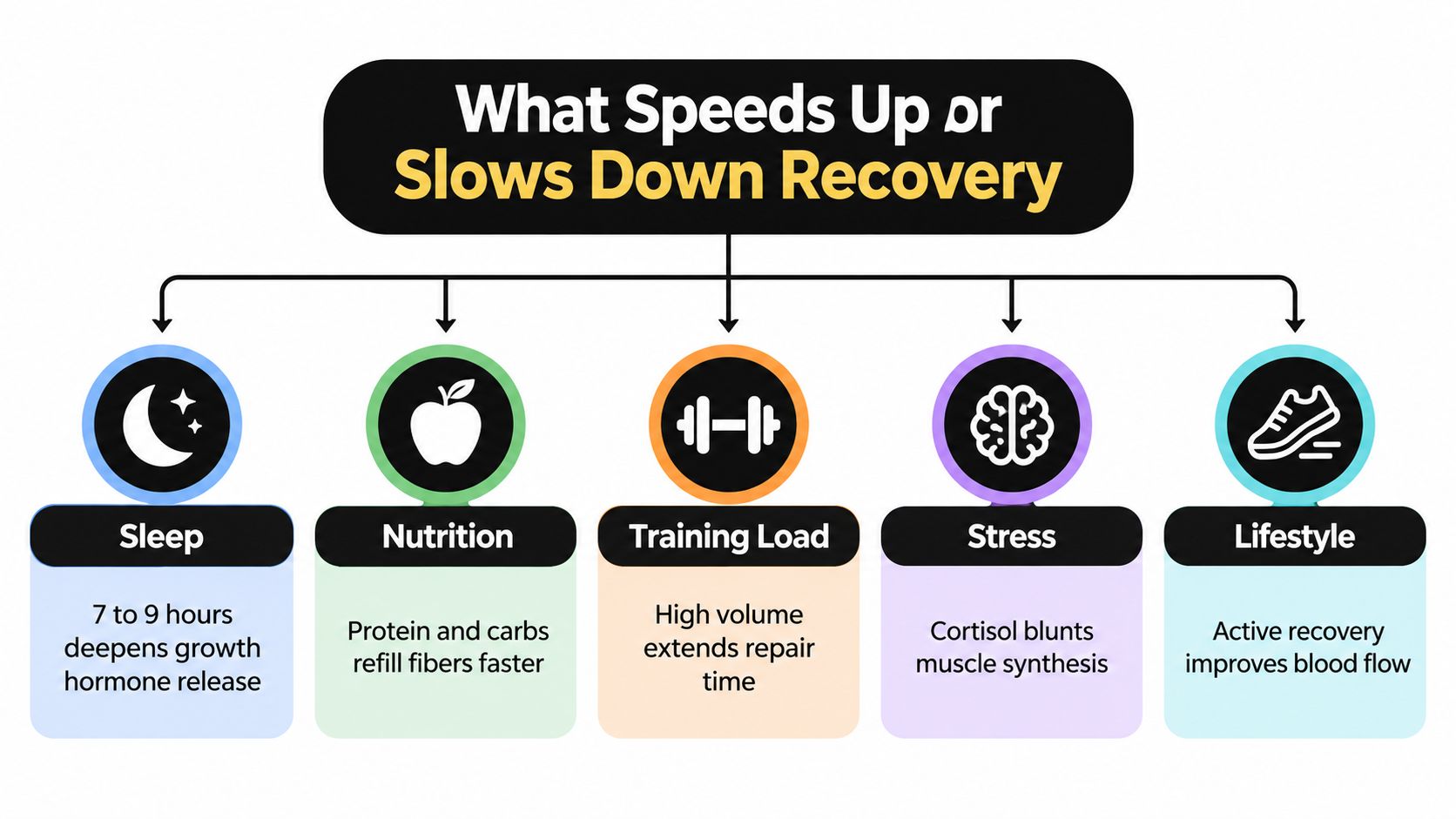
Recovery usually stretches or shrinks because of a few obvious things: sleep, food, the amount of work you did, and how much stress is sitting on top of the training. Those are the big levers. Supplements matter far less if those are off.
Sleep and stress shape the next day's readiness
A bad night doesn't erase all progress, but it can blunt how well you bounce back. Poor sleep makes it harder to feel fresh, and high stress often leaves you with heavier legs, slower warm-up sets, and less desire to train hard. If your recovery feels worse than expected, look at the night before before you blame the workout.
Training load matters just as much. A long session, a big increase in volume, or a workout packed with novel movements creates more repair work afterward. That's especially true when the exercise includes lots of lowering under tension, because eccentric work is rougher on tissue than many people expect.
Experience changes the recovery picture
Beginners often need longer after a new movement, because unfamiliar work creates more disruption. Trained lifters can sometimes repeat quality work sooner, but only when the session is planned well and the rest of life isn't piling up fatigue. Age, training history, and the type of session all push the timeline in different directions.
Useful check: if warm-up sets feel sluggish, range of motion is tight, and the first working set drops off hard, the issue probably isn't just soreness.
Lifestyle also matters. If you're training while standing all day at work, running after sessions, or juggling poor sleep and irregular meals, recovery slows down even when the gym program looks reasonable on paper. The body doesn't separate “training stress” from “life stress” very well.
Evidence-Based Habits and Supplements That Support Recovery
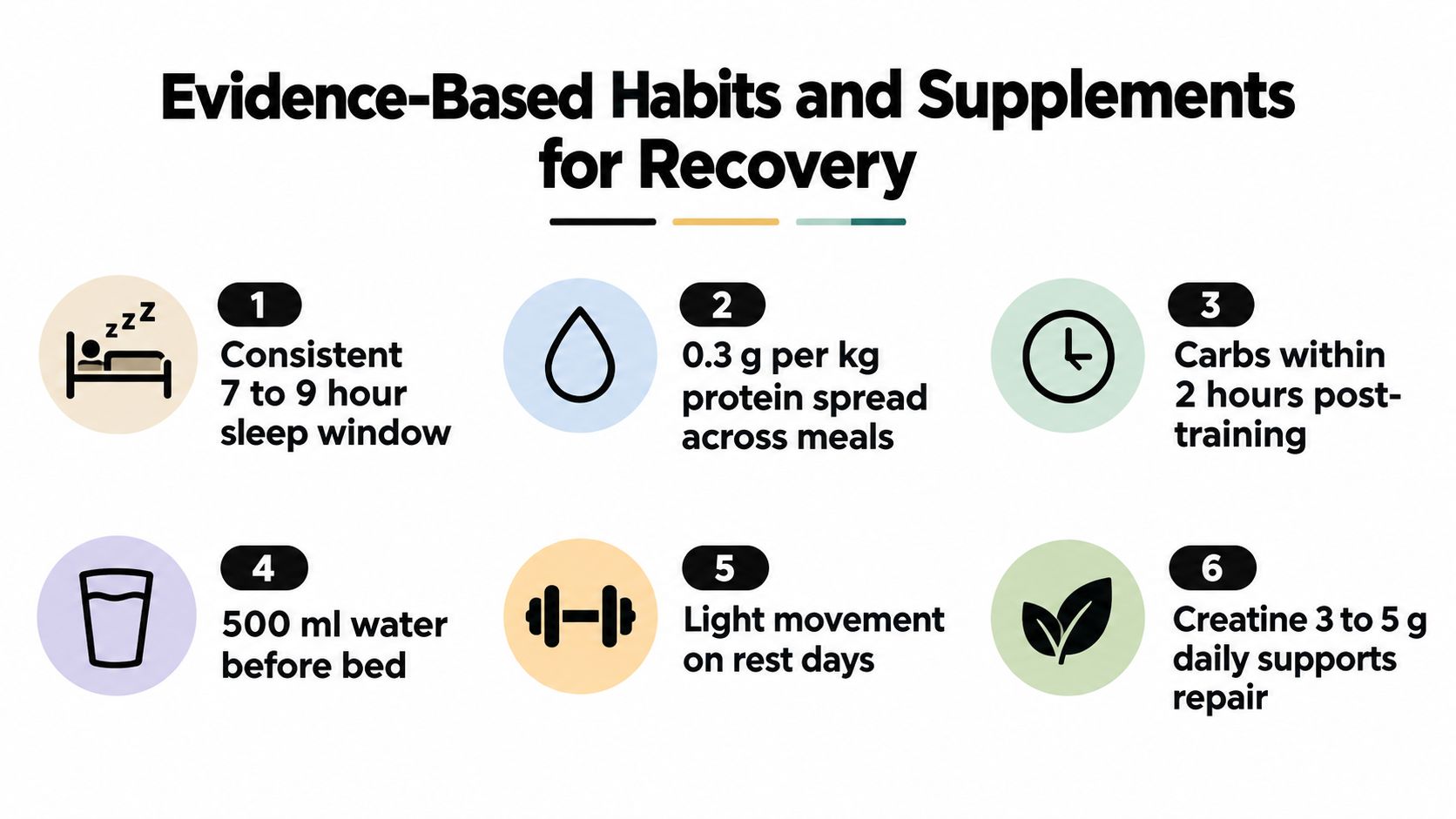
The best recovery habits don't feel flashy. They're the boring basics done consistently, because those habits support the clocks that matter most. Sleep, carbohydrate intake, protein distribution, hydration, and light movement all help in different ways.
Build the routine before adding the extras
Start with sleep. A steady sleep window supports tissue repair, hormone balance, and next-day energy better than occasional catch-up sleep. Then spread protein across the day instead of treating one post-workout shake like the whole answer. A helpful deep dive is amino acids for faster recovery, especially if you're trying to understand why total daily intake matters.
Carbohydrate timing matters after harder sessions, because fuel restoration is one of the three clocks. Water matters too, especially if you've trained hard, sweated a lot, or eaten lightly. On rest days, gentle movement like walking or easy cycling can make the body feel less stiff without adding much extra damage.
Where supplements fit
Creatine is the most straightforward fit for strength and repeated-bout performance, because it supports high-quality work across sessions. Magnesium can be useful when sleep quality, muscle relaxation, or dietary intake is a concern. Omega-3 is often used to support inflammation balance, while ashwagandha is commonly chosen by people trying to manage stress and perceived recovery.
A curated option like VitzAi's supplement recovery guide can help you compare those choices against your goals. The key is to treat supplements as support, not rescue. If sleep, food, and training load are off, no capsule fixes the whole problem.
Common Misconceptions and When to Seek Help
Soreness is not a scoreboard. You can be less sore and still not be ready for hard work, and you can be a bit sore while still moving well enough for a lighter session. That's why the key question is readiness, not whether you feel perfectly fresh.
Use performance, not soreness alone, as the test
Check how you move in the warm-up. Watch whether your range of motion feels normal, whether the first working sets match usual output, and whether fatigue shows up earlier than expected. If load, repetitions, or movement quality are clearly down, the smart move is to reduce the session or switch targets.
A few myths cause the most trouble. No soreness doesn't mean nothing happened. Soreness doesn't prove that recovery is complete. And more supplements don't automatically mean better recovery.
What matters most is whether your body can repeat comparable training quality. If today's session looks much worse than usual, the body is telling you something useful. Listen to that signal instead of forcing the plan.
Know when it's more than routine soreness
Persistent sharp pain, marked swelling, weakness that doesn't improve, or dark urine after extreme training deserves medical attention. Pain that interferes with daily movement is also a reason to stop trying to self-manage it. Those signs point away from normal training soreness and toward something that needs a professional look.
Building Your Personal Recovery Plan
A better recovery plan starts with a simple habit, checking the three clocks separately. Ask whether soreness is fading, whether fuel is back, and whether strength or movement quality is really there yet. When those answers don't match, use the slowest one to guide the session.
A practical week might look like this. Hard lower-body work on Monday, upper-body or light cardio on Wednesday, another demanding session on Friday if movement quality is back, and easier days in between. If you're carrying extra fatigue, use the same plan but trim the volume before you trim the habit of training itself.
If you want a more personalised way to line up goals, sleep, stress, and supplement choices, VitzAi's personalised nutrition plan and an adaptive tool like GrabGains's muscle-building app can help narrow the options. Recovery is individual, and the best plan is the one that matches your training age, schedule, and how your body responds. For a next step, visit VitzAi.com and use its personalised supplement quiz to see which recovery-focused habits and supplements fit your routine.
This article is for informational purposes only and is not medical advice. Always consult a qualified health professional before starting any new supplement or major lifestyle change