

Probiotics for Gut Health: Strains, CFU, and Smart Choices
You're standing in front of a shelf of probiotic bottles, or scrolling through an online store, trying to decide between one billion, ten billion, or one hundred billion CFU. One label lists Lactobacillus, another lists Bifidobacterium, and a third combines several strains with prebiotic fibre. Some products need refrigeration, while others promise shelf stability. Every bottle says “gut health,” but none makes the choice feel simple.
The confusion isn't your fault. “Probiotic” describes a broad category, not one standard treatment with predictable effects. The useful question isn't which bottle has the biggest number. It's which specific strain has human evidence for your goal, whether the dose resembles the studied dose, and whether a defined trial is sensible for you. This guide builds that decision from the ground up. For broader nutrition context, you can also explore supplements for gut health.
Why Picking a Probiotic Feels So Confusing
A shopper might begin with a clear intention, such as supporting regularity after a disruptive period, then quickly face a wall of unfamiliar choices. One capsule contains a single strain, another contains several. Gummies look convenient, sachets can be mixed into food, and some labels emphasise storage conditions rather than the outcome they studied. The product with the largest CFU number can appear persuasive even when the label doesn't explain what those organisms were tested for.
That matters because CFU means colony-forming units, not guaranteed effectiveness. It indicates the number of viable organisms claimed in a serving, but it doesn't tell you whether the product matches constipation, antibiotic-associated diarrhoea, bloating, or an IBS-related concern. Dose, formulation, survivability, strain identity, study population, and measured outcome all affect relevance.
The practical shift: stop asking which probiotic is strongest and ask which one has evidence for the job you want it to do.
A product can contain familiar genera such as Lactobacillus or Bifidobacterium and still differ meaningfully from another product in the same category. The exact strain may behave differently, and evidence for one strain can't automatically be transferred to every other strain or blend.
That's why a thoughtful choice starts with three questions: What am I trying to change? Which strain was studied for that outcome? How will I know whether it helped? Once those questions are answered, the crowded shelf becomes easier to interpret. You're no longer comparing marketing claims in isolation. You're evaluating a tool against a defined purpose.
How Probiotics and Gut Health Actually Work
Think of the gut microbiome as a garden. The soil represents the intestinal environment, while the plants represent many different microorganisms living and working there. Adding one seed packet doesn't redesign the whole garden overnight. A particular strain may influence the soil around it, interact with existing organisms, or produce compounds that affect the surrounding environment, but its effect depends on the strain and the conditions already present.
The gut microbiome is involved in digestion, intestinal barrier function and immune signalling. Probiotics are live microorganisms taken with the intention of providing a health benefit, while prebiotics are fibres that humans don't fully digest and that can feed microorganisms already living in the gut. Products sometimes combine both, which is why labels may describe a probiotic and prebiotic formula.

Four ideas that prevent confusion
- A strain is more specific than a species. Two products can list the same species but use different strains with different evidence.
- A probiotic is not a permanent replacement. Many products act through temporary, functional interactions rather than permanently recolonising the gut.
- A prebiotic feeds what's already there. Fibre-rich foods and prebiotic ingredients can support existing microorganisms, although increasing them too quickly may worsen digestive discomfort for some people.
- The baseline matters. A person with constipation, someone recovering from antibiotics, and someone with no digestive symptoms aren't starting from the same place.
The probiotic and prebiotic education from NZ Supps offers useful background on this distinction. The key point is simple: a probiotic supplies selected live organisms, while a prebiotic supplies fermentable material that existing gut microorganisms can use.
This garden analogy also explains why broad promises are unreliable. The same seed won't thrive in every soil, and the same probiotic strain won't produce the same practical result for every person. Probiotics for gut health should therefore be chosen by strain, goal, dose and duration, not by a generic promise of balance.
What Probiotics Do Inside Your Digestive System
Probiotics can interact with the digestive system through several distinct pathways. None should be reduced to the vague idea that they “clean up” or “reset” the microbiome.
Colonisation resistance is one pathway. A probiotic strain may compete with potentially harmful organisms for nutrients or attachment sites, making the local environment less favourable to them. This doesn't mean the probiotic permanently occupies the gut. It means the strain may influence competition while it remains active.
A second pathway involves intestinal transit. Some strains and formulations may affect how quickly material moves through the digestive tract. That mechanism could be relevant to bowel regularity, but the outcome still depends on the tested strain and the person's underlying concern.
Probiotic microorganisms can also produce antimicrobial compounds and bioactive metabolites, including short-chain fatty acids. These compounds may influence the local environment, support communication between gut cells and microorganisms, and contribute to barrier function. Some activity can also reduce colonic pH, which may make conditions less comfortable for certain unwanted organisms.

The gut barrier and immune signalling
The intestinal barrier helps regulate what passes between the digestive tract and the wider body. Certain probiotic strains may support barrier integrity through interactions with intestinal cells and their surrounding environment. Other effects involve strain-specific immune signalling, meaning the immune system may respond differently depending on the organism and its molecular features.
These mechanisms explain why a probiotic isn't a generic digestive tonic. A product studied for one endpoint may not influence another endpoint, even if both products contain organisms from the same broad genus.
You might also encounter food-based approaches alongside supplements. For example, a fibre-containing food such as Good Gut Hummus 150g can fit into a varied eating pattern, but a food containing fibre or fermented ingredients shouldn't automatically be treated as a clinically tested probiotic product.
A useful way to evaluate the label is to connect the proposed mechanism to your goal. If the goal is regularity, look for evidence on bowel outcomes. If the concern follows antibiotics, look for evidence in antibiotic-associated diarrhoea. A larger CFU number can't compensate for a missing strain-to-outcome connection.
Strain-Specific Evidence for Common Gut Concerns
Evidence becomes more useful when the concern is named precisely. “Gut health” is too broad to function as a meaningful endpoint on its own. Stool consistency, abdominal pain, bloating and antibiotic-associated diarrhoea are different outcomes, so they shouldn't be treated as interchangeable.
For constipation-predominant IBS, a 2022 systematic review and meta-analysis of 10 randomised controlled trials involving 757 people found that probiotics significantly improved stool consistency and increased faecal Bifidobacteria and Lactobacillus levels compared with placebo. The same analysis found no significant improvement in abdominal pain, bloating or quality-of-life scores. These findings support a cautious interpretation: a product may help one measurable feature without improving every symptom.
Broader IBS evidence remains mixed. A 2020 review of 35 randomised controlled trials involving 3,452 participants reported improvements in persistent symptoms and some global IBS outcomes, including abdominal pain, bloating and flatulence, while a separate 2019 review of 11 studies found significant symptom improvements in seven studies and no meaningful benefit in four. The U.S. National Center for Complementary and Integrative Health describes the benefits for IBS as inconclusive, and American College of Gastroenterology guidelines issued in 2021 recommended against probiotics for global IBS symptoms. These sources are summarised in the NCCIH clinical overview of probiotics and IBS.
Antibiotic-associated diarrhoea
The evidence is more specific when the setting is antibiotic use. A Cochrane review covering 6,352 children found diarrhoea in 8% of children receiving probiotics alongside antibiotics, compared with 19% in the control group. Effects depended on the organism, dose, antibiotic and the child's baseline risk. Saccharomyces boulardii and Lactobacillus rhamnosus were among the more beneficial options in the analysis, at roughly 5 to 40 billion CFU daily. See the Cochrane evidence on probiotics for children.
In adults, a review of 42 randomised controlled trials involving 11,305 adults reported diarrhoea in 13.7% of participants receiving probiotics compared with 18.8% receiving control treatment. That was an absolute reduction of 5.1 percentage points, with a relative risk of 0.63 and a number needed to treat of about 20. Lactobacillus and Saccharomyces boulardii each had a relative risk of approximately 0.63, but those findings can't be applied automatically to every blend. The figures are reported in this American Family Physician evidence summary.
| Concern | Strength of evidence | Example trial context |
|---|---|---|
| Stool consistency in constipation-predominant IBS | Specific but limited | A 2022 analysis of 10 trials found improved stool consistency, without significant improvement in abdominal pain or bloating |
| Global IBS symptoms | Inconclusive and heterogeneous | American College of Gastroenterology guidance issued in 2021 recommended against probiotics for global IBS symptoms |
| Antibiotic-associated diarrhoea in children | More defined, but organism and dose matter | A Cochrane review found diarrhoea in 8% with probiotics versus 19% in controls |
| Antibiotic-associated diarrhoea in adults | Moderate, not universal | A review of 42 trials found an absolute reduction of 5.1 percentage points |
How to Choose a Probiotic That Fits Your Goal
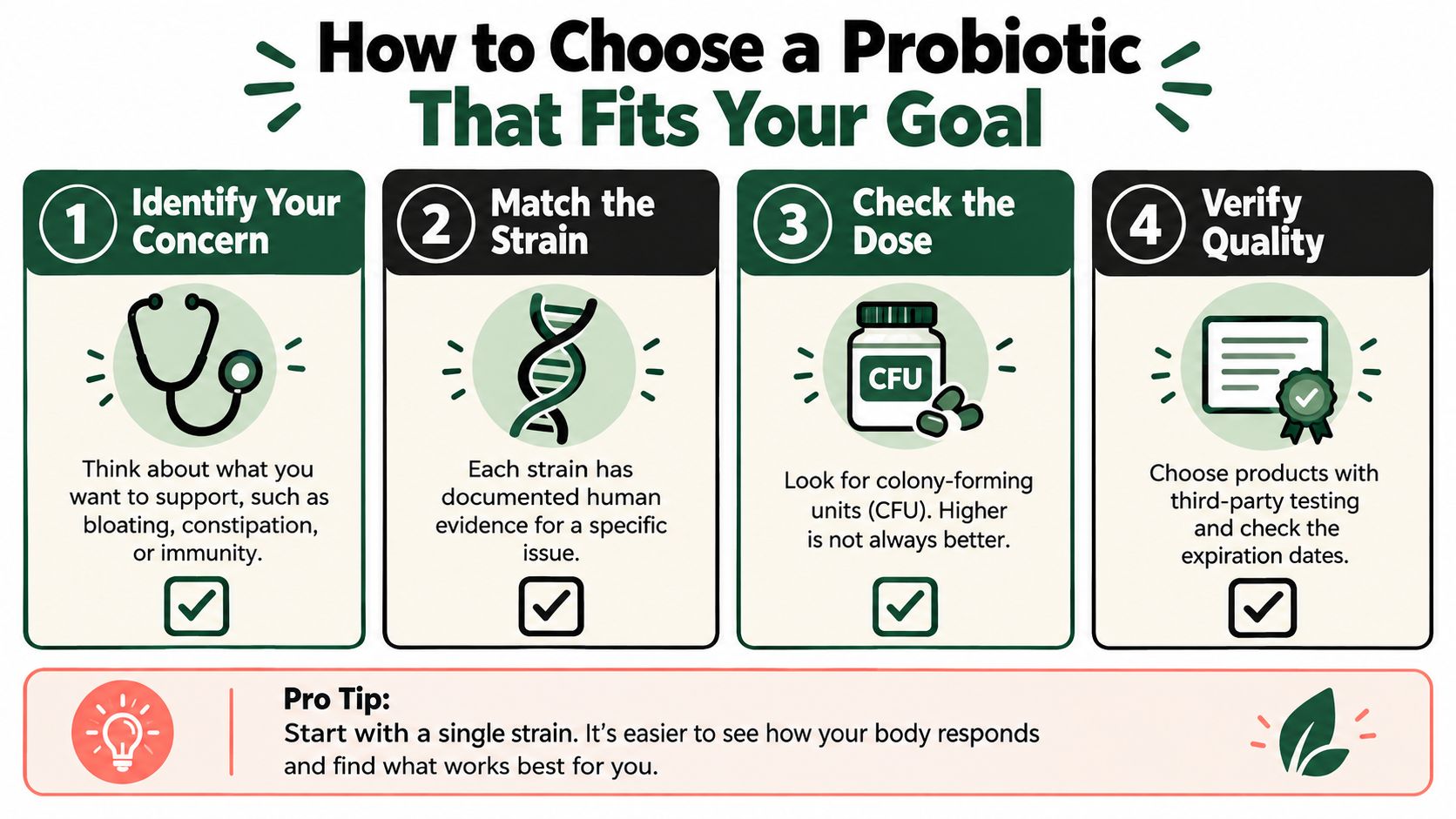
Start with the outcome, not the bottle. “I want better gut health” is a reasonable intention, but it needs refinement before it can guide a purchase. Are you focused on bowel regularity, a specific symptom pattern, or disruption associated with antibiotics? If you can't define the desired change, you can't judge whether a product worked.
A practical order of priority
First, match the strain to the goal. Look for the complete strain designation where available, not just Lactobacillus or Bifidobacterium. Human evidence should relate to the same strain, formulation and outcome you care about.
Second, compare the dose with the research. The World Gastroenterology Organisation notes that many over-the-counter products provide 1 to 10 billion CFU per dose, while clinically effective doses vary widely. Bifidobacterium longum subsp. longum 35624 improved IBS symptoms at 100 million CFU per day, whereas some other products required 300 to 450 billion CFU taken three times daily. These examples are reported in the World Gastroenterology Organisation global guideline. A high number isn't automatically better.
Third, inspect the formulation. Consider survivability technology, moisture control, prebiotic pairing and refrigeration requirements. A product that arrives with viable organisms and clear storage instructions is easier to evaluate than one that obscures those details.
Finally, assess transparency. Check the expiry date, strain names, dose per serving and any available third-party testing. A long ingredient list isn't a substitute for clear evidence.
Before buying, ask:
- What is my defined goal? Can I describe the outcome in plain language?
- What exact strain is included? Is the full designation visible?
- What dose was studied? Does the serving resemble the human evidence?
- How is it stored? Does the label explain refrigeration or shelf stability?
- When will I reassess? Have I chosen a fair trial period and a stopping point?
The best choice may be a single-strain product rather than the most crowded formula. Specific evidence beats impressive packaging.
When and How to Take a Probiotic
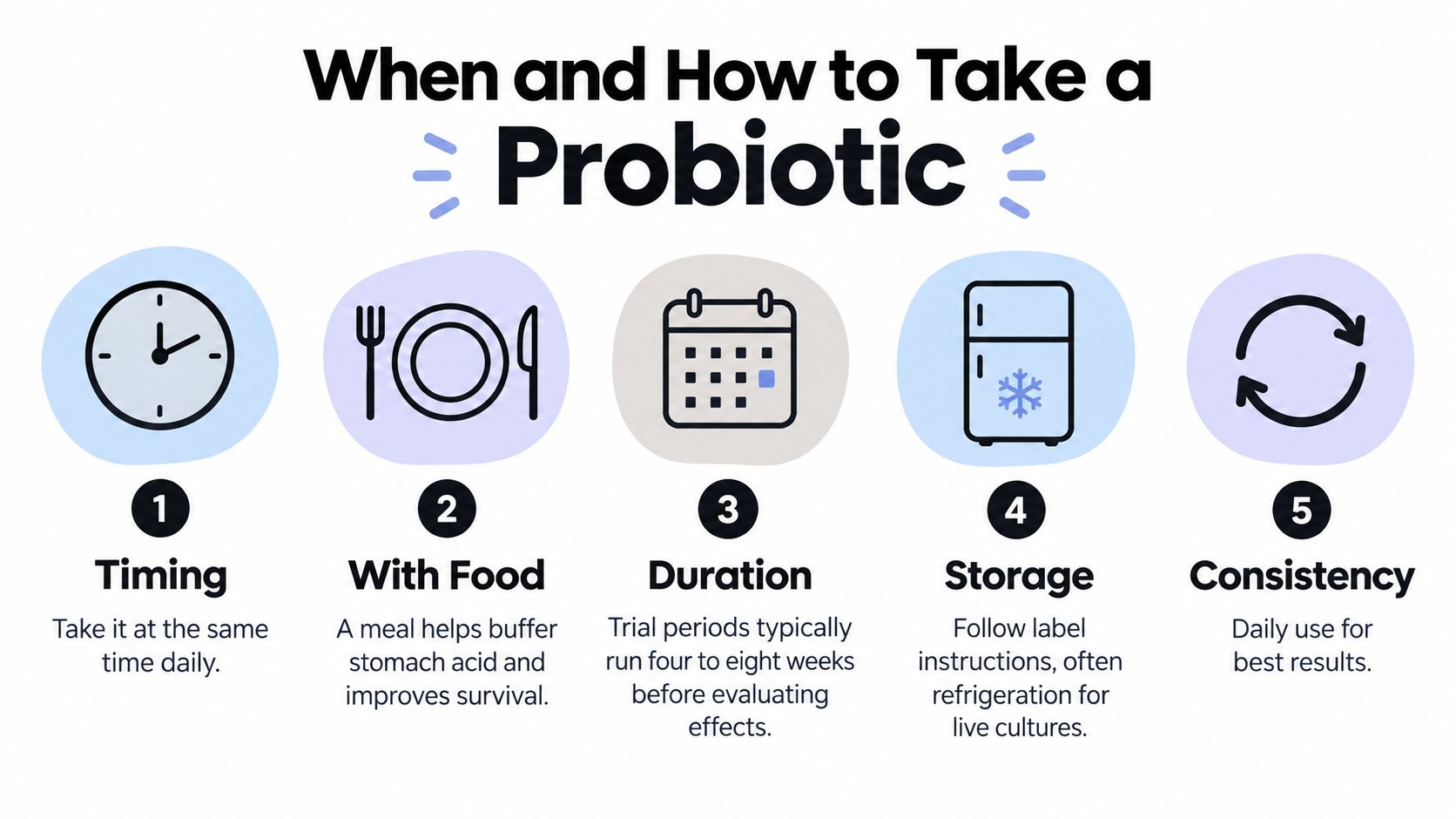
A good product still needs a consistent routine. Take it at the same time each day so you can tell whether changes in symptoms relate to the supplement rather than an unpredictable schedule. Many people use a morning dose on an empty stomach as a practical default, although strain-specific evidence for timing is limited and the product label should take priority.
Food can matter because a meal may buffer stomach conditions and affect survival through the upper digestive tract. Other products are designed with moisture-controlled capsules or delivery technology intended to support shelf stability. Some live-culture products require refrigeration, while others don't. Storage instructions are part of the dose, because poor storage can reduce viability before the expiry date.
Give the trial a clear boundary
A practical trial period typically runs four to twelve weeks, depending on the product, goal and evidence behind it. If you notice no meaningful change after a fair trial, that's useful information rather than a personal failure. Continuing indefinitely can make it harder to judge whether the product is doing anything.
Dietary context matters too. A very low-fibre diet may provide less support for microorganisms that use fermentable material, while adding prebiotic-rich foods can support a broader gut routine. Increase fibre gradually, especially if you're prone to bloating, and don't change several supplements and foods at once if you want to identify what helped.
If you're comparing a formula such as Probiotic 40 Billion with Prebiotics, read the label for strain identity, serving instructions, storage requirements and the intended use. The product's CFU figure alone won't tell you whether it matches your concern.
Safety, Side Effects and Who Should Be Cautious
“Natural” doesn't mean suitable for everyone. In generally healthy people, commonly used Bifidobacterium and Lactobacillaceae products usually cause mild, self-limited effects such as gas. A change in bowel habits can also occur when you begin, but persistent or worsening symptoms shouldn't be dismissed as a normal adjustment.
Serious bloodstream or fungal infections have been reported rarely, mainly in people who are severely ill or immunocompromised. The NIH Office of Dietary Supplements fact sheet for health professionals explains why safety depends on the person, strain and clinical context.
Ask before you start
Speak with a clinician before taking a probiotic if you're:
- Immunocompromised or severely ill: Your risk profile may differ from that of a healthy adult.
- Taking medication: A professional can consider the full treatment context.
- Recovering from surgery: Recent procedures may change what's appropriate.
- Undergoing cancer treatment: Don't add live microorganisms without medical guidance.
- Living with a chronic digestive condition: Symptoms may need assessment rather than self-treatment.
The NHS also advises people with weakened immune systems or existing health conditions to consult a doctor before taking probiotics. You can find additional practical context in this guide to probiotics for women, but the same safety principle applies across adults.
Probiotics may help some people with some symptoms. They aren't a universal microbiome reset, and they don't replace diagnosis or treatment for a digestive disease. If a defined trial produces no meaningful improvement, stopping is a sensible response. If symptoms are severe, persistent or changing, seek medical advice rather than escalating the dose.
Personalising Your Decision With the VitzAI Quiz
A strain-and-goal framework is useful, but many readers would rather not memorise strain codes, trial designs and dose comparisons. A short questionnaire can make the process more manageable by collecting the context that affects whether a probiotic is appropriate in the first place.
The VitzAI quiz asks about factors such as age, diet, digestion, recent antibiotic use, stress, sleep, exercise and wellness goals. Those answers can help create a more focused starting point instead of treating every adult as though each has the same symptoms, diet and supplement needs. The result isn't a diagnosis, and it shouldn't override advice from a clinician, but it can help organise the decision.
The VitzAI Probiotic 40 Billion with Prebiotics is one example of a multi-strain formula designed for general digestive support. It includes Lactobacillus Acidophilus, Bifidobacterium Lactis, Lactobacillus Plantarum and Lactobacillus Paracasei. Whether a probiotic belongs in someone's plan at all should be considered alongside other supplements they may use, such as omega-3, multivitamins or magnesium glycinate.
Personalisation is most valuable when it can also recommend restraint. Someone with a specific digestive condition, significant symptoms or a complex medication list may need professional assessment rather than a supplement recommendation. The goal is a clearer starting point, not a promise that every product will work.
This article is for informational purposes only and is not medical advice. Always consult a qualified health professional before starting any new supplement or major lifestyle change
VitzAi.com offers a personalised supplement quiz that uses your goals, diet, lifestyle and digestion context to suggest a more focused starting point. Visit VitzAi.com to explore supplement guidance, including whether probiotic support fits alongside your wider routine.