

Your Guide to Daily Vitamin Supplements for Better Energy
Daily vitamin supplements are compounds designed to fill nutritional gaps in your diet, supporting overall health and wellbeing. While many people see them as a daily health insurance policy, their effectiveness depends entirely on choosing the right nutrients for your specific needs, not just taking a generic one-size-fits-all pill.
A Practical Guide to Daily Supplements

Let's be honest, navigating the world of daily vitamins can feel completely overwhelming. With endless aisles of options and a sea of conflicting advice, it's easy to wonder if you're making the right choices for your health.
The reality is that modern diets, even healthy ones, often fall short of providing optimal levels of every essential nutrient. This is where a smart, targeted supplement strategy becomes a powerful tool.
Think of a generic multivitamin like an off-the-rack suit—it might technically fit, but it’s certainly not designed just for you. A personalised supplement plan, on the other hand, is like a tailored outfit, crafted to support your unique body and goals. This approach helps you move beyond guesswork and start targeting specific areas like energy, cognitive performance, or long-term wellness.
Why a Personalised Approach Matters
A one-size-fits-all approach often misses the mark because our nutritional needs are anything but universal. They’re shaped by a whole host of personal factors that a generic tablet simply can't account for.
Key factors that influence your unique needs include:
- Age and Sex: Men and women have different requirements for nutrients like iron and folate, and these needs can change significantly after the age of 40. This impacts everything from hormone health to longevity.
- Lifestyle: A high-stress job, an intense fitness routine, or limited sun exposure can ramp up your need for specific vitamins and minerals, such as magnesium, creatine, and vitamin D.
- Health Goals: Whether you want to sharpen your focus, support hormone balance, or improve gut health, your supplement plan should directly reflect your objectives.
Understanding the Supplement Landscape
Taking a daily vitamin supplement is now a firm part of mainstream health behaviour in the UK. For many busy adults, it’s that easy “insurance policy.” A 2025 analysis reports that 76% of UK adults take supplements, and a surprising 17% of users take four or more a day.
Despite this widespread use, the knowledge gaps are striking. 52% of people say they find supplement information confusing, and only 35% always read the labels. You can discover more about this trend in IBISWorld's industry report.
A smart supplement plan isn’t about taking more; it’s about taking what your body truly needs. By moving from a generic to a personalised strategy, you can ensure every supplement is working to support your specific health journey with precision and confidence.
This guide is here to help you cut through the confusion, providing a clear path to building an effective daily routine that actually works for you.
Why Personalised Supplements Beat Generic Multivitamins Every Time
Personalised nutrition isn't just for elite athletes anymore—it's become essential for anyone who wants to see real results from their daily vitamin supplements. A generic multivitamin off the supermarket shelf gives you a standard blend of nutrients, but our bodies are anything but standard. Your unique biology, lifestyle, and goals create a specific set of needs that a one-size-fits-all pill just can't meet.
Think of your body as a high-performance engine. A generic multivitamin is like using standard-grade fuel; sure, it'll get you from A to B, but it won’t unlock your engine's true potential. A personalised supplement plan is the premium, custom-formulated fuel designed specifically for your engine's demands, making sure it runs smoothly and powerfully.
This all comes down to a concept called bio-individuality. It's the simple yet powerful idea that your body has its own distinct nutritional blueprint, shaped by a bunch of factors that a single pill for everyone will always miss.
Your Unique Nutritional Blueprint
Your body's demand for certain vitamins and minerals is always changing, depending on your life stage, habits, and what you’re trying to achieve. A generic daily supplement often falls short because it completely ignores this dynamic reality.
Here are the main things that define your personal nutrient requirements:
- Age and Sex: A woman in her 30s focused on hormone balance has totally different needs to a man over 40 working on his heart health. Her plan might prioritise iron and B vitamins, while his could be built around CoQ10 and omega-3s.
- Lifestyle Factors: Got a high-stress job? Your body is likely burning through magnesium and B vitamins much faster. Are you a regular at the gym? You’ll probably need extra support from things like creatine for muscle recovery and electrolytes for proper hydration.
- Specific Health Goals: If you're aiming for better focus and cognitive performance, a generic multi is unlikely to have effective doses of nootropics like mushroom blends or ashwagandha. To truly optimise, you need targeted support.
A generic formula often gives you too little of what you really need, or sometimes, too much of what you don’t. At best, it's a waste of money. At worst, it could lead to nutrient imbalances.
The Problem with One-Size-Fits-All Formulas
The main issue with generic multivitamins is that they try to be everything to everyone, which means they end up being optimised for no one. They're designed to prevent serious deficiencies in the "average" person, not to help you thrive.
A data-driven approach turns supplement guesswork into a precise daily routine. It ensures every capsule you take is there for a reason, working with your body to get you closer to your health goals.
This precision is what makes a personalised plan so much more effective. For example, a 25-year-old male athlete and a 55-year-old woman going through menopause need fundamentally different support systems.
| Factor | Male Athlete (25) | Woman in Menopause (55) |
|---|---|---|
| Primary Goal | Muscle recovery, energy | Bone health, hormone balance |
| Key Nutrients | Creatine, Magnesium, Zinc | Calcium, Vitamin D, Vitamin K2 |
| Why Generic Fails | Lacks performance ingredients | Not enough bone support minerals |
This comparison really shows why a generic multivitamin is often a poor choice. It might have a sprinkle of calcium, but nowhere near enough to support the bone density of a woman over 50. Likewise, you won't find performance-focused ingredients like creatine in there.
By moving away from the generic aisle and toward a plan built around your bio-individuality, you make sure your investment in daily supplements actually delivers tangible, meaningful benefits. It's about making smart, targeted choices that align with your body’s unique and ever-changing needs.
Building Your Foundational Daily Supplement Plan
Before you start chasing specific health goals like sharper focus or deeper sleep, you’ve got to get the basics right. Think of it like building a house – you need a solid foundation before you can even think about putting up the walls. An effective daily vitamin supplements routine is no different. It starts with the core nutrients your body absolutely relies on every single day just to function properly.
This approach is all about covering the most common nutritional gaps first, which sets you up for much better results down the line.
Many of us, especially here in the UK, are running low on a few key vitamins and minerals. We’re not talking about obscure compounds, but everyday essentials that have a massive impact on your energy, mood, and ability to bounce back from stress. Let's focus on the big three that form the bedrock of any smart supplement plan.
This diagram shows how you can move from a generic, one-size-fits-all approach to a truly personalised plan that considers your age, sex, and individual health goals.
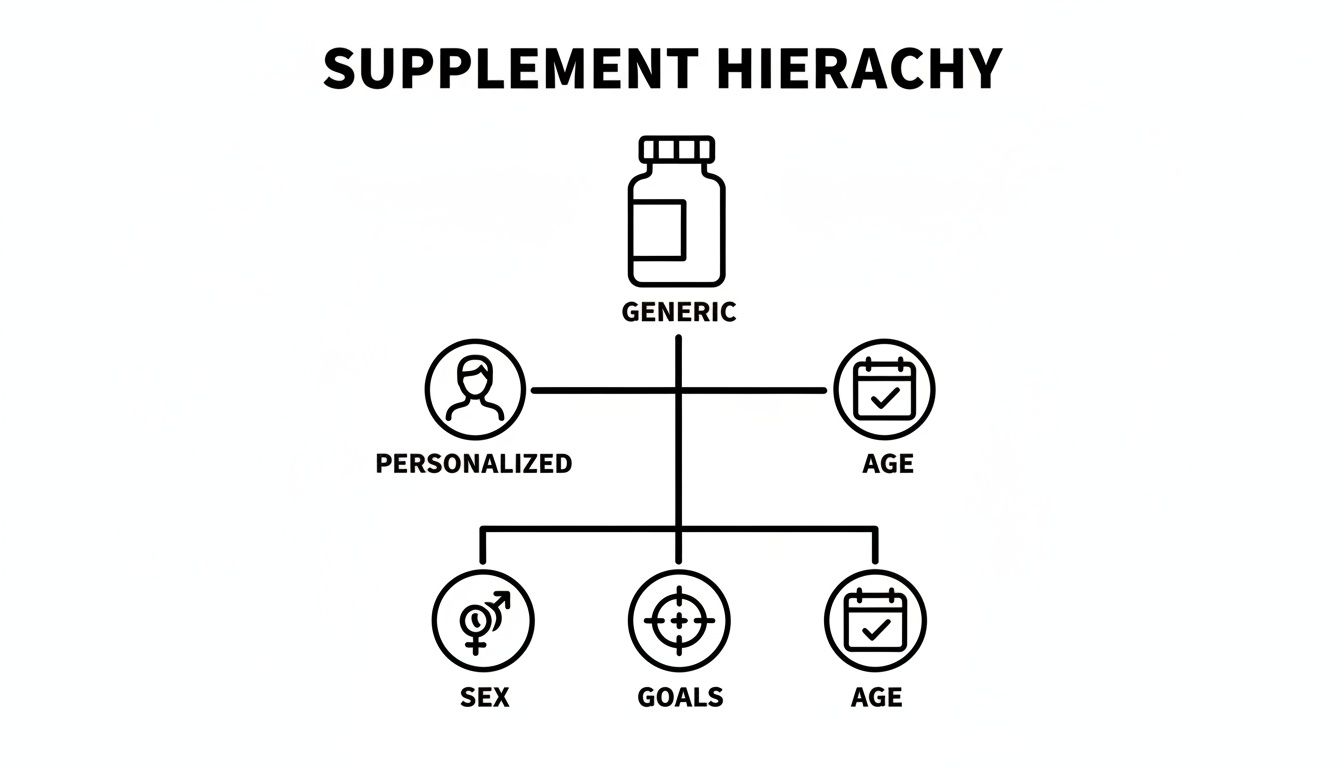
The real takeaway here is that the best supplement strategy is one that's built for you. It’s about moving beyond the generic and getting specific to your unique biology.
The Core Three Foundational Nutrients
For most adults, a brilliant starting point involves three critical nutrients: Vitamin D, Omega-3s, and Magnesium. These are often missing from modern diets, yet they're absolutely vital for everything from brain health to muscle function.
- Vitamin D (The Sunshine Vitamin): This one’s a non-negotiable for a strong immune system, balanced mood, and healthy bones. Thanks to our limited sun exposure in the UK (especially in autumn and winter), it's one of the most widespread deficiencies.
- Omega-3 Fatty Acids (Brain and Heart Fuel): These healthy fats, particularly EPA and DHA, are crucial for keeping your brain sharp, supporting your heart, and keeping inflammation in check.
- Magnesium (The Relaxation Mineral): Involved in over 300 biochemical reactions in the body, magnesium is a true multi-tasker. It helps manage stress, eases muscle tension, and is a game-changer for restful sleep.
This trio works together to support your body's major systems, creating a powerful baseline for your health. For a closer look at what you might need, check out our guide on what vitamins you should take daily.
Why the Form of Your Supplement Matters
Ever stood in the supplement aisle and wondered why there are five different types of magnesium? It’s not just clever marketing. The chemical form of a nutrient drastically changes how well your body can actually absorb and use it—a concept known as bioavailability.
Taking a supplement with poor bioavailability is like trying to fill a leaky bucket. You might be pouring a lot in, but only a tiny amount is actually getting to where it needs to go. That's why understanding the different forms is so important if you want to see real results.
Choosing a highly bioavailable supplement form ensures your body gets the maximum benefit from each dose. It's the difference between merely taking a supplement and your body actually absorbing and utilising it.
For instance, Magnesium Glycinate is a fantastic form that's easy on the stomach and especially good for promoting relaxation and sleep. In contrast, Magnesium Oxide is cheaper but isn't absorbed well and is more likely to cause an upset stomach. It's a classic case of getting what you pay for.
Similarly, some of us have genetic quirks that make it hard to convert standard B vitamins into their active forms. For these people, choosing methylated B vitamins (like methylfolate and methylcobalamin) is a game-changer. They provide the nutrient in its ready-to-use state, so the body can put it to work immediately without any extra steps.
This table breaks down a few foundational supplements and why their form is so important for getting the job done.
Key Foundational Supplements and Their Benefits
| Supplement | Primary Benefit | Why Form Matters (Bioavailability) |
|---|---|---|
| Vitamin D3 | Immune function, bone health, mood regulation. | D3 (cholecalciferol) is the natural, more absorbable form your skin produces from sunlight, far superior to the less effective D2. |
| Omega-3 (EPA & DHA) | Brain health, reduced inflammation, heart support. | Look for triglyceride form, which is more stable and better absorbed than the cheaper ethyl ester form often found in lower-quality fish oils. |
| Magnesium | Stress reduction, sleep quality, muscle relaxation. | Magnesium Glycinate or Citrate are highly bioavailable and gentle on the gut. Steer clear of Magnesium Oxide, which has very poor absorption. |
| B-Complex | Energy production, nerve function, hormonal balance. | Methylated forms (like Methylcobalamin for B12 and Methylfolate for B9) are body-ready, bypassing conversion steps for immediate use. |
Paying attention to bioavailability is what separates a so-so supplement plan from a truly effective one. It ensures you're giving your body nutrients it can actually use to thrive.
Targeted Supplements for Your Specific Health Goals
Once you’ve got your foundational nutrients sorted, the real fun begins. This is where you can start layering in targeted daily vitamin supplements to really zero in on your specific goals, whether that’s smashing a new PB at the gym, finding hormonal balance, or simply future-proofing your health. Instead of just throwing random nutrients at the wall to see what sticks, a curated approach means every single supplement has a clear job to do.
This strategic layering makes your routine simpler and, frankly, gets you more noticeable results. Below, we’ve laid out a few practical examples for common needs, broken down by demographic, to show you how this personalised thinking works in the real world.
For Men Under 40
If you're a man in your 20s or 30s, life is probably a balancing act between building a career, staying physically sharp, and juggling daily pressures. The right supplements can give you a genuine edge, boosting both performance and resilience.
Two game-changers to add to your foundation are:
- Creatine for Physical Performance: Forget the old myth that this is just for bodybuilders. Creatine is one of the most heavily researched supplements out there for improving strength, power, and muscle recovery. It works by fuelling your muscles during intense exercise, letting you push that little bit harder and see results faster.
- Ashwagandha for Stress Management: In a world that never seems to switch off, getting a handle on cortisol (your main stress hormone) is non-negotiable. Ashwagandha is a brilliant adaptogen that helps your body roll with the punches, promoting a sense of calm and mental clarity without making you feel drowsy.
This duo is a powerhouse for supporting both body and mind, helping you stay on top of your game.
For Women Under 40
Women under 40 are often dealing with complex hormonal cycles, demanding careers, and the desire for radiant skin and boundless energy. Targeted supplements can offer crucial support for these unique biological needs.
Key nutrients to bring into the mix include:
- Hormone Balance Support: A high-quality B-Complex, especially one with methylated B vitamins, is fundamental for producing hormones and regulating your mood. Magnesium is another hero, playing a massive role in easing PMS symptoms and supporting overall hormonal harmony.
- Vibrant Skin and Energy: The classic combination of Vitamin C and Zinc is fantastic for supporting collagen production, which is key for clear, healthy skin. To keep your energy levels consistent, make sure your iron is topped up, particularly if you have heavier periods. If you're looking to really boost your daily drive, you can learn more about key vitamins for energy and tiredness in our detailed guide.
A well-structured supplement plan for women under 40 isn't just about general health; it's about providing the specific building blocks needed to support hormonal harmony, vibrant energy, and graceful resilience through every phase of life.
For Men Over 40
As men hit their 40s and beyond, the focus naturally shifts towards longevity, protecting heart health, and holding onto vitality. A proactive supplement strategy can make a huge difference in preserving strength and wellness for the long haul. And when it comes to optimising things like cognitive performance, exploring essential energy and focus vitamins can point you towards supplements that actually move the needle.
Consider adding these to your daily line-up:
- Omega-3s for Heart Health: High-potency Omega-3 fatty acids (specifically EPA and DHA) are vital for maintaining healthy blood pressure, supporting cardiovascular function, and taming inflammation throughout the body.
- CoQ10 for Cellular Energy: Think of Coenzyme Q10 as the spark plug for your cells. It's a powerful antioxidant that supports energy production, especially in the heart. Our natural levels decline with age, so topping them up is a smart play for long-term vitality.
- Mushroom Blends for Immunity: Functional mushrooms like Reishi and Lion's Mane can help build a robust immune system and sharpen cognitive performance, ticking two major boxes for healthy ageing.
For Women Over 40
For women over 40, the conversation turns to navigating perimenopause and menopause with grace, while protecting bone density and keeping energy levels steady.
A targeted supplement stack can offer incredible support during this transition:
- Menopause and Hormone Support: Ashwagandha can help take the edge off mood swings and stress. Magnesium is fantastic for improving sleep quality, which can often take a nosedive during this phase of life.
- Bone Health Essentials: As oestrogen levels decline, bone density becomes a top priority. Vitamin D3 and Vitamin K2 are the perfect partners; they work together to make sure calcium gets delivered to your bones where it belongs, instead of building up in your arteries.
- Sustained Energy: B vitamins are absolutely crucial for converting the food you eat into energy you can actually use. A good energy powder with a balanced B-complex can help fight off the fatigue that often comes with hormonal shifts.
By matching your daily vitamin supplements to your specific age, sex, and goals, you stop guessing and start building a precise strategy designed for meaningful, noticeable results.
How to Read Supplement Labels and Avoid Common Pitfalls

Walking down the supplement aisle can feel like learning a new language. Labels are a minefield of scientific jargon, confusing numbers, and flashy marketing claims. To get real value from your daily vitamin supplements, you need to learn how to see past the hype and understand what's really inside the bottle.
Becoming a smart supplement shopper starts with knowing your way around the label. It’s your best tool for making an informed choice, ensuring you get the good stuff you need without any of the fillers you don't. This skill is just as important as picking the right nutrients in the first place.
And this doesn't just stop at supplements. It's a great idea to learn how to read food labels effectively too, since the principles of checking ingredients and serving sizes are pretty much the same.
Decoding the Supplement Facts Panel
The most important real estate on any supplement label is the "Supplement Facts" panel. This is where the truth lives, far from the bold promises on the front of the packaging. Think of it as the product's instruction manual and ingredient list, all rolled into one.
Here’s what you need to zero in on:
- Serving Size: This is the manufacturer's suggested dose. It's often not what you'd expect—for instance, a serving might be two or three capsules, not just one.
- Amount Per Serving: This column tells you the exact dose of each active ingredient you get in a single serving.
- % Daily Value (%DV): This shows you how much a nutrient in one serving contributes to a standard 2,000-calorie diet. It's a useful guide, but remember, your personal needs could be completely different.
Pay close attention to that serving size. If a bottle has 60 capsules but the serving size is two, you've only got a 30-day supply, not a two-month one. It’s a common mistake that can instantly double the real cost of your supplement plan.
Spotting Red Flags and Ensuring Quality
Not all supplements are created equal, and the label can tell you a lot about a product's quality and honesty. Knowing what to look for—and what to run from—is the key to choosing safe and effective daily vitamin supplements.
One of the biggest red flags to watch out for is a "proprietary blend." This is a mix of ingredients listed under a catchy, branded name, but the exact amount of each one isn't disclosed. While it might sound fancy, it's often a way to hide tiny, ineffective doses of the most valuable ingredients.
Another place to check is the "Other Ingredients" list. This section contains all the non-active bits and pieces, like fillers, binders, artificial colours, or flavours. A long list of unpronounceable additives can be a sign that you're looking at a lower-quality product.
Finally, keep an eye out for stamps from third-party testing organisations. Certifications from groups like NSF International or Informed-Sport confirm that the product actually contains what the label says it does and is free from nasty contaminants. This is your best guarantee of quality and safety.
Avoiding Nutrient Overlap and Waste
A common mistake is accidentally doubling or even tripling up on certain nutrients, especially if you take a few different products. For example, your daily multivitamin, a separate B-complex, and an energy drink might all contain hefty doses of B vitamins. This kind of overlap is not only a waste of money but can sometimes lead to unwanted side effects.
A well-coordinated supplement plan prevents this by making sure everything you take works together. By reading each label carefully, you can build a streamlined routine where every single ingredient has a purpose, without any expensive or potentially harmful redundancy. It's a strategic approach that ensures you get exactly what your body needs—no more, no less.
When and How to Take Your Supplements for Best Results
So you’ve found the right daily vitamin supplements for your goals. Great stuff. But the journey doesn't end there. Getting the most out of them isn't just about what you take, but also when and how you take it.
A bit of strategic scheduling can turn a random handful of pills into a powerful daily ritual, one that works in harmony with your body’s natural rhythms. The first step? Understanding the fundamental difference between fat-soluble and water-soluble vitamins. This one piece of knowledge can change the game for absorption and effectiveness.
Fat-Soluble vs Water-Soluble Vitamins
Think of fat-soluble vitamins like a key that needs a little oil to turn smoothly in a lock. These vitamins—A, D, E, and K—need dietary fat to be absorbed properly into your system.
That's why it's always best to take them with a meal that contains healthy fats, like avocado, nuts, or a drizzle of olive oil. If you take them on an empty stomach, you’re simply not going to get the full benefits.
Water-soluble vitamins, on the other hand, are a different story. This group includes Vitamin C and the entire B-complex family. They don't need fat for absorption and can be taken with just a glass of water. However, your body doesn't store them, which means you need to top them up regularly.
Timing Your Supplements for Maximum Impact
You wouldn't down a strong coffee right before trying to sleep, would you? The same logic applies to your supplements. Taking certain nutrients at specific times of the day helps align them with your body's needs and your personal health goals. A little planning here goes a long way.
- Morning Kick-Start: Supplements that fire up your metabolism and support energy, like B vitamins or certain energy powders, are perfect for your morning routine to help you power through the day.
- Evening Wind-Down: Nutrients known for their calming properties are best saved for the evening. Magnesium is a perfect example, helping to promote relaxation and support a good night's sleep.
Strategic timing ensures you're giving your body the right support precisely when it needs it most. This simple tweak helps you feel the full effects of your supplements, from a burst of morning energy to a calm, restorative evening.
Want to go deeper on this? Check out our complete guide on the best time of day to take vitamins.
Smart Stacking for Better Synergy
"Stacking" is just a simple way of saying you're combining supplements that work better together, creating a synergistic effect. For example, Vitamin D, Vitamin K2, and magnesium are a dream team for bone health, working in concert to help guide calcium to your bones where it belongs.
On the flip side, some nutrients can actually compete for absorption in your body. Iron and calcium are a classic example—it’s much better to take them at different times of the day to make sure your body can fully absorb and use both. Understanding these little interactions is key to building a truly effective daily plan.
Got Questions About Daily Supplements?
Stepping into the world of daily vitamin supplements can feel a bit overwhelming, so let's tackle some of the most common questions that pop up. This should give you a clearer picture as you start building your routine.
How Long Until I See Results?
This is where patience and consistency really pay off. While some people might feel a welcome lift in energy or notice they’re sleeping better within a few weeks, it generally takes about three to six months of daily use for your body’s nutrient levels to truly optimise. That’s the point where you’ll start to notice more tangible, lasting changes in how you feel day-to-day.
Can’t I Just Get Everything From Food?
A balanced, whole-food diet is non-negotiable—it's the absolute foundation of good health, and supplements are never a substitute for that. But modern life throws a few spanners in the works. Things like soil depletion, food processing, and our own unique health situations can create nutritional gaps that are surprisingly hard to fill, even with the best dietary intentions.
Think of daily vitamin supplements as a bridge. They’re designed to fill in those specific gaps, making sure your body has every tool it needs to function at its peak. They work with a healthy diet, not instead of it.
Are There Any Risks Involved?
Absolutely. It’s definitely possible to have too much of a good thing. Taking massive doses of certain vitamins—especially the fat-soluble ones like A, D, E, and K—can be harmful. The same goes for mixing supplements that don’t play well together.
The golden rule is to stick to the recommended dosages on the label and, ideally, have a chat with a healthcare professional about your plan. This is especially important if you have any pre-existing health conditions or are taking prescription medications, as they can help you steer clear of any potential issues or contraindications.
This article is for informational purposes only and is not medical advice. Always consult a qualified health professional before starting any new supplement or major lifestyle change.