

100 Mg Coenzyme Q10: Dosing, Forms, and Absorption
You're standing in front of a supplement shelf, comparing bottles that all seem to promise the same thing: 100 mg of CoQ10. One contains ubiquinone, another contains ubiquinol, and a third advertises a softgel, liposomal delivery, or a “high-absorption” formula. The labels show the same milligram amount, but they may not produce the same blood levels.
That's the central question with 100 mg coenzyme Q10. The dose matters, but so do the chemical form, carrier ingredients, meal timing, and whether you take the full amount at once. Understanding those details makes it easier to choose a product sensibly and set realistic expectations.
Why 100 mg Became the Standard CoQ10 Baseline
A 100 mg CoQ10 capsule became common because early clinical research found a clearer rise in blood levels at that amount than at a lower daily dose. 30 mg per day raised median serum CoQ10 to 1.81 mg/L, while 100 mg per day raised it to 2.62 mg/L. Researchers therefore concluded that 100 mg or more was indicated for future trials, as described in this historical review of CoQ10 research.
That history gave 100 mg a practical role. It is a reference point, not a universal maximum or guaranteed therapeutic dose. The milligram figure tells you how much CoQ10 is in the capsule, while the formulation and dosing schedule influence how much reaches the bloodstream.
A familiar shopping decision
Two adults may choose very different products from the same shelf. One wants general nutritional support and selects a 100 mg capsule because it is a familiar single-unit strength. The other chooses a much larger daily amount, assuming that more milligrams must produce a better result.
The label requires closer reading. Authoritative reviews describe capsule strengths from 30 mg to 600 mg, including 60 mg, 100 mg, 200 mg, 300 mg, and 400 mg options. They also commonly place oral supplementation within the broader range of 100 mg to 300 mg per day. This review of CoQ10 capsule strengths and dosing ranges supports treating 100 mg as a practical starting reference rather than a fixed endpoint.
How you take the dose can change exposure as well. One review reports blood levels of about 2.33 µg/mL after a single 100 mg dose, compared with 3.47 µg/mL when the same amount was divided. A 100 mg capsule taken with a meal containing fat may behave differently from one swallowed without food, particularly when the product uses a different carrier system.
Practical rule: Treat 100 mg as a meaningful starting reference, not proof that every product delivers the same amount to your bloodstream.
The baseline helps compare labels without reducing the decision to milligrams alone. Check the chemical form, carrier lipids, meal instructions, and whether dividing the daily amount could suit the product and your routine. Increasing the dose is only one way to change CoQ10 exposure.
Ubiquinone vs Ubiquinol at the 100 mg Mark
The two names on CoQ10 labels refer to related forms of the same nutrient. Ubiquinone is the oxidized form, while ubiquinol is the reduced form. Your body naturally interconverts them as part of CoQ10's role in cellular energy production and antioxidant activity.
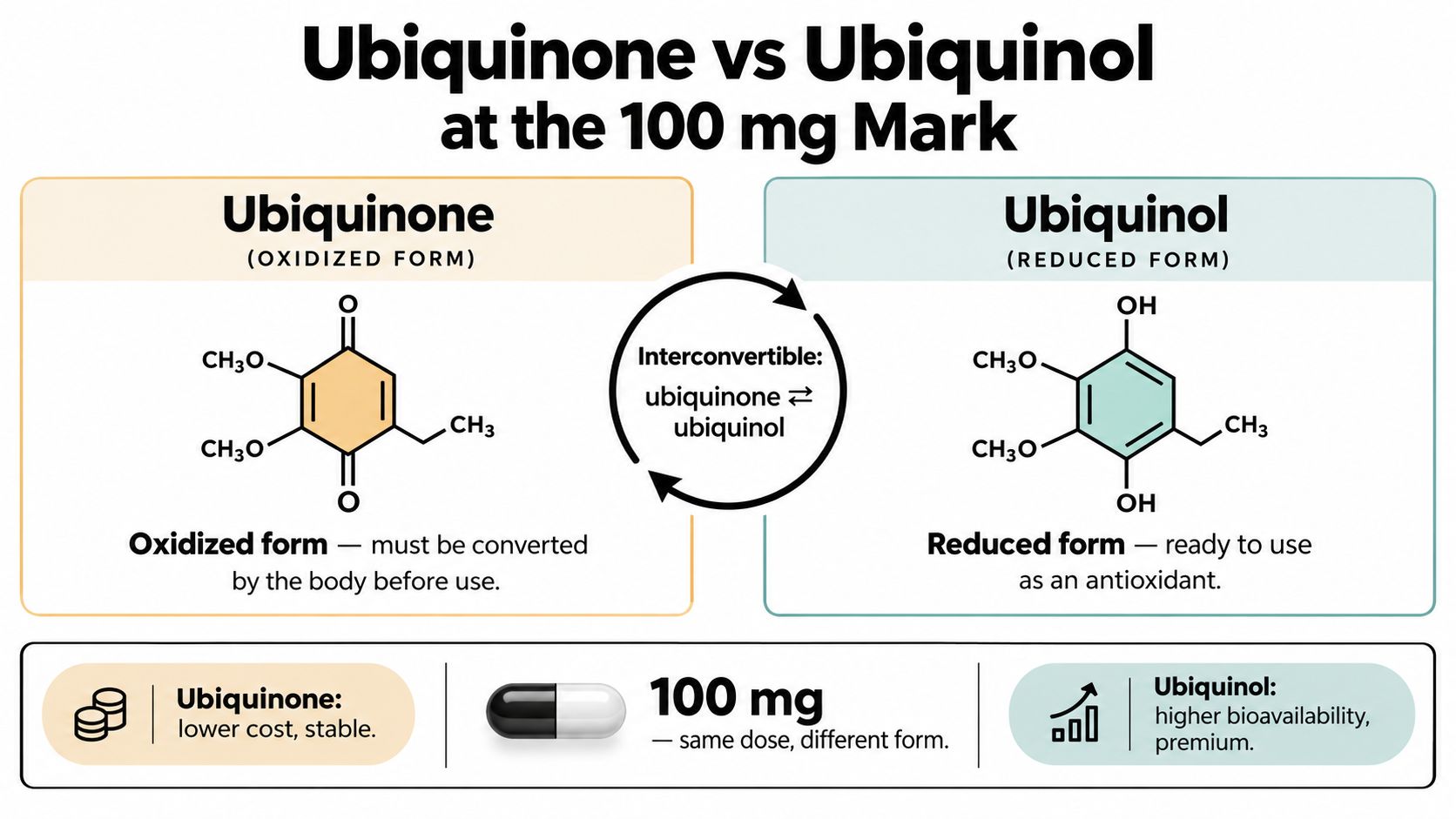
The practical comparison
| Feature | Ubiquinone | Ubiquinol |
|---|---|---|
| Chemical description | Oxidized form | Reduced form |
| Body relationship | Can be converted to ubiquinol | Can be converted back to ubiquinone |
| Common positioning | Often more economical and stable | Often marketed for higher bioavailability |
| At 100 mg | May work well with a suitable delivery system | May offer a practical option when absorption is a concern |
Ubiquinol is frequently marketed as the more absorbable choice, and its reduced chemical state makes that positioning understandable. But “more bioavailable” doesn't mean it's automatically the right choice for everyone. A well-made ubiquinone softgel may be a sensible and cost-efficient option, especially when taken with food containing fat.
The product's entire delivery system matters. A 100 mg ubiquinone capsule with an effective lipid carrier may outperform a poorly designed product using the same nominal amount. Conversely, a ubiquinol product can still be disappointing if storage, formulation, or serving instructions don't support good absorption.
How to choose between them
Age, diet, medication use, digestive factors, and personal response can all influence the decision. Some adults prefer ubiquinol because they want a reduced form that's ready to participate in antioxidant processes. Others choose ubiquinone because it's widely available, stable, and often less expensive.
You shouldn't treat the two forms as completely unrelated products, nor should you assume they're interchangeable in every formula. Compare the actual form, the oil or carrier ingredients, the serving instructions, and the manufacturer's quality controls.
For a closer explanation of the two forms, see this ubiquinone versus ubiquinol comparison.
The video below offers another visual explanation of the distinction.
A useful conclusion is simple: 100 mg tells you how much CoQ10 is present by label, while ubiquinone or ubiquinol tells you which form you're buying. Neither label replaces attention to the formulation.
How Formulation and Timing Change Absorption
CoQ10 is lipophilic, which means it dissolves better in fat than in water. That property creates a basic absorption challenge. A capsule can contain 100 mg, yet the amount that reaches circulation depends on the carrier lipid, the solubilization process, the physical form of the ingredient, and what you eat with it.
A double-blind crossover study in 14 healthy volunteers compared seven products, each containing 100 mg of CoQ10. The products produced statistically significant differences in plasma exposure over 48 hours, and the strongest soft-gel formulations, including both ubiquinone and ubiquinol products, outperformed other options. The findings are detailed in this comparative CoQ10 bioavailability study.
Why the meal matters
Taking CoQ10 with a meal containing fat gives the compound a more suitable environment for digestion and uptake. A dry capsule taken with only water, particularly when fasting, may not behave like an oil-based softgel taken with a meal.
Choose an ordinary meal that includes a source of fat. You don't need a complicated protocol. The important point is consistency and pairing the supplement with food rather than treating the capsule as though it were a water-soluble vitamin.
For a broader explanation of supplement delivery systems, explore this guide to increasing supplement bioavailability.
Why divided dosing can help
A single 100 mg dose has been reported to raise blood levels to about 2.33 µg/mL. When the same total daily amount was divided into two 100 mg doses, levels reached about 3.47 µg/mL, according to this review of CoQ10 pharmacokinetics.
The result illustrates an important principle, although it shouldn't be treated as a guarantee for every person. Divided dosing may create steadier exposure and can be useful when a clinician recommends a larger daily intake. It also gives the digestive system more than one opportunity to process a fat-soluble nutrient.
Product design can create a similar difference. A microencapsulated 100 mg formula produced about 1.8 times, 2.4 times, and 1.9 times higher bioavailability than standard CoQ10 at 6, 12, and 24 hours, respectively, in the research summarized by the NCBI clinical reference.
The label gives you the amount. The formulation and meal help determine the exposure.
Clinical Uses and Efficacy of a 100 mg Dose
CoQ10 participates in mitochondrial energy production, where cells convert nutrients into usable energy. It also functions within the body's antioxidant systems. That makes it relevant to tissues with substantial energy demands, including the heart and skeletal muscle, although a supplement shouldn't be presented as a universal treatment for fatigue or disease.
For everyday use, 100 mg may serve as a straightforward maintenance amount for an adult who wants to try CoQ10 without immediately choosing a larger regimen. The result is more likely to be gradual and foundational than dramatic. CoQ10 isn't a caffeine substitute, and a person who feels persistently tired should investigate sleep, diet, medication effects, and possible medical causes rather than relying on a supplement alone.
Cardiovascular research uses more than 100 mg
Clinical research also shows why a 100 mg capsule shouldn't automatically be viewed as a complete trial-level protocol. In the Q-SYMBIO trial, 420 patients received 100 mg of CoQ10 three times daily for two years, and the CoQ10 group experienced fewer primary endpoint events than the placebo group. The study is available in this review of Q-SYMBIO heart-failure research.
That regimen totals more than a single 100 mg daily capsule. It was also used in a defined clinical research setting involving patients with heart failure, so it shouldn't be copied without medical supervision.
Statins and individual decisions
People taking cholesterol-lowering statins often ask about CoQ10 because statin therapy may affect CoQ10 production and because muscle symptoms can complicate treatment decisions. CoQ10 may be discussed as part of that conversation, but it isn't a replacement for prescribed medication and shouldn't be used to alter a statin regimen independently.
The practical question is whether a person needs general nutritional support, is investigating a medication-related concern, or is managing a diagnosed condition. Those situations call for different levels of supervision. This overview of CoQ10 benefits and uses can provide background, but a clinician should guide decisions involving heart disease, statins, or persistent symptoms.
Who Benefits Most from CoQ10 Supplementation
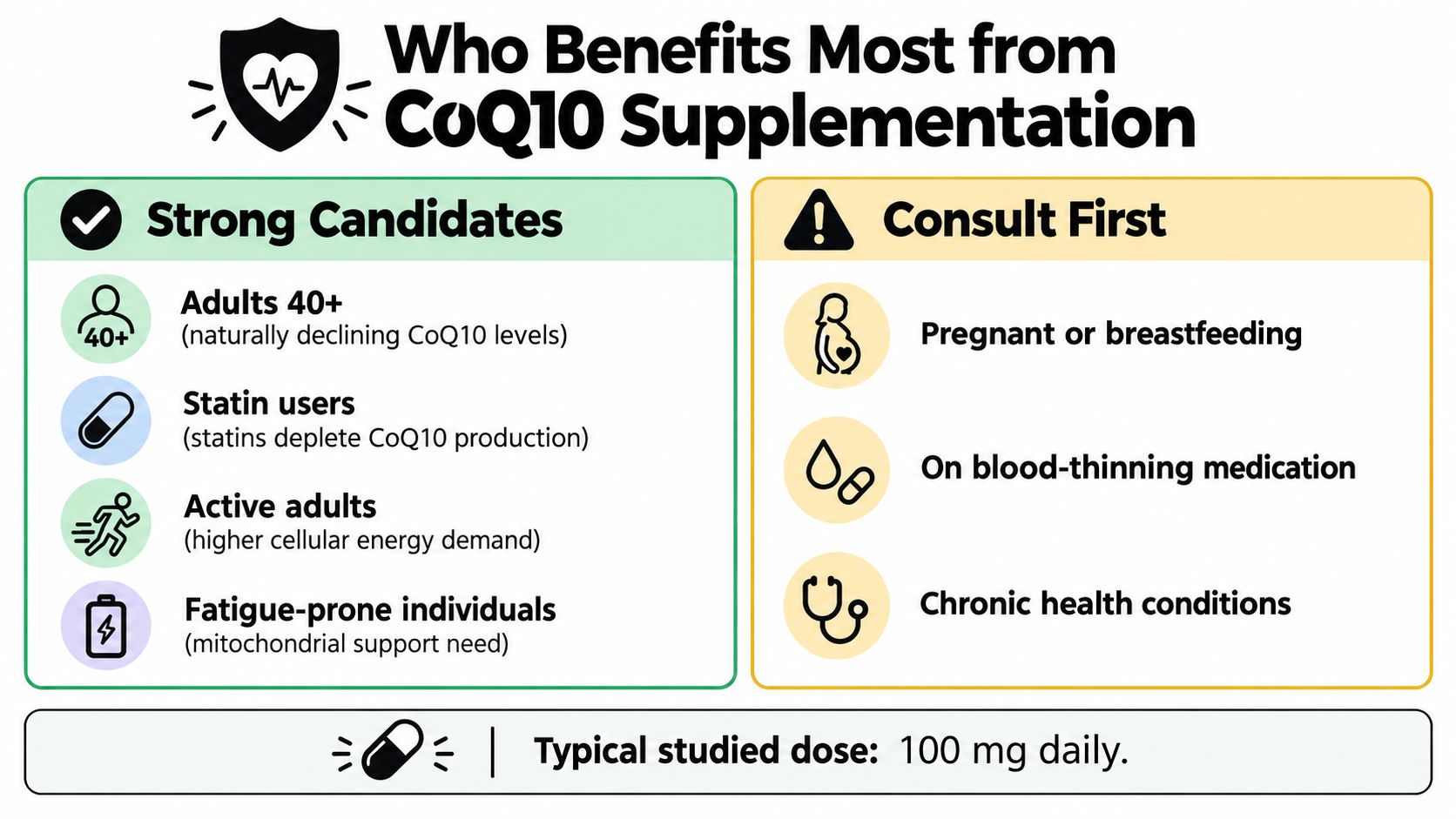
CoQ10 may be worth discussing when a person's goals and circumstances make mitochondrial support relevant. That doesn't mean everyone needs it. A useful decision starts with context rather than with the supplement shelf.
Start with your age and goals
CoQ10 production and tissue levels can change with age, which is why adults interested in healthy ageing often consider supplementation. Someone over 40 who wants to support long-term vitality may reasonably compare a 100 mg product with other foundational choices, particularly if their diet and sleep habits are already in order.
Active adults may also be interested because exercise places repeated demands on energy production and recovery. That doesn't make CoQ10 a guaranteed performance enhancer. It provides fitness-focused people a reason to evaluate whether it fits alongside adequate food, hydration, training, and rest.
Review medication and health context
Statin users should raise the subject with their prescriber, especially if they have new muscle symptoms or are considering changing treatment. A clinician can distinguish a supplement question from a medication-management problem.
Use extra care if you:
- Take blood-thinning medication: Ask a qualified clinician about possible interactions before starting.
- Have a chronic condition: Get advice on whether CoQ10 fits your treatment plan.
- Are pregnant or breastfeeding: Consult a healthcare professional rather than selecting a product independently.
- Have persistent fatigue: Investigate the underlying cause instead of assuming low CoQ10 is responsible.
The most appropriate candidate isn't just the person who feels tired. It's the person who has a clear goal, understands that effects may be subtle, and can review medication or health considerations before adding a new supplement.
Common CoQ10 Misconceptions to Avoid
The first misconception is that 100 mg is 100 mg, regardless of the product. A double-blind crossover study found meaningful differences in plasma exposure among seven 100 mg products, demonstrating that the label amount doesn't fully describe real-world absorption. Carrier lipids, softgel design, solubilization, and the difference between a crystalline and a more absorbable form can all matter.
A head-to-head analysis found that a crystal-free formulation absorbed significantly better than crystalline and dry-powder versions after a 100 mg dose. Another analysis reported that a water-soluble CoQ10 syrup had 2.4-fold higher bioavailability than standard ubiquinone capsules, as described in this formulation review.
CoQ10 isn't a stimulant
CoQ10 supports processes involved in cellular energy production, but it doesn't act like caffeine. You shouldn't expect an immediate surge in alertness after taking a capsule. Any perceived benefit may develop gradually, and some people may notice no obvious sensation at all.
That doesn't make the supplement ineffective. It means the goal is different. CoQ10 is better understood as nutritional support for energy-related cellular processes than as an instant energy drink.
Timing isn't a magic switch
Morning and evening can both be practical choices. The strongest habit is the one you can maintain, provided you take the supplement with a meal that supports absorption. If a product seems to feel activating for you, take it earlier. If it doesn't, a later meal may be equally convenient.
Finally, a more expensive bottle isn't automatically superior. Judge the formula by its chemical form, carrier, serving instructions, testing information, storage guidance, and whether the product suits your budget well enough to use consistently.
Building Your Personalized Supplement Strategy
A sensible CoQ10 plan can be built from a few decisions rather than from label hype.
1. Define the reason
Are you looking for general healthy-ageing support, considering mitochondrial support alongside exercise, or asking about statin-related concerns? A clear purpose helps you decide whether a 100 mg trial is reasonable or whether you need clinical advice first.
2. Compare the entire formula
Check whether the product contains ubiquinone or ubiquinol. Then look for a softgel or another delivery system designed for a fat-soluble ingredient, and plan to take it with a meal containing fat. Don't compare products by milligrams alone.
3. Choose a routine you can maintain
Take the capsule with a consistent meal. If a clinician recommends a larger daily amount, divided dosing may be considered because research shows that splitting intake can produce higher measured blood levels than taking the same amount in one administration.
4. Review safety before starting
Discuss CoQ10 with a qualified professional if you're pregnant, breastfeeding, taking blood-thinning medication, using prescription medicines, or managing a chronic condition. Stop treating ongoing fatigue as a supplement-selection problem if you haven't considered sleep, diet, medication effects, and medical causes.
For adults who want help narrowing supplement choices across energy, sleep, stress, exercise, and healthy ageing goals, VitzAi.com uses a questionnaire about lifestyle and wellness priorities to provide a curated supplement plan with explanations for the recommendations.
This article is for informational purposes only and is not medical advice. Always consult a qualified health professional before starting any new supplement or major lifestyle change
VitzAi.com offers a personalised supplement quiz and curated products, including CoQ10, to help match choices with your goals, diet, and lifestyle. Visit VitzAi.com to explore your options and create a more focused supplement routine.