

Ubiquinone vs Ubiquinol CoQ10: Which Form Should You Take?
When it comes to CoQ10, the difference between ubiquinone and ubiquinol is pretty straightforward: ubiquinone is the oxidised form, which your body has to convert before it can use it. On the other hand, ubiquinol is the reduced, 'active' antioxidant form, ready to get to work immediately. Your choice boils down to whether you’re looking for cost-effectiveness or need the enhanced bioavailability, especially if you're over 40.
Breaking Down the Two Forms of CoQ10
Coenzyme Q10 (CoQ10) is a powerhouse compound found in almost every cell in your body. It’s absolutely vital for producing cellular energy and providing antioxidant protection. But when you look at supplements, you’ll see two names pop up: ubiquinone and ubiquinol. They're both CoQ10, just different states in the same cycle.
A simple way to think about it is like a rechargeable battery. Ubiquinone is the "depleted" battery; your body needs to charge it up (convert it) before it can do its job. Ubiquinol is the "fully charged" battery, primed to power your cells and fight off free radicals from the get-go.
For most young, healthy people, the body is pretty slick at converting ubiquinone into the active ubiquinol form. That efficiency can start to drop as we age or if certain health conditions come into play, which is when supplementing directly with ubiquinol can be a much smarter move.
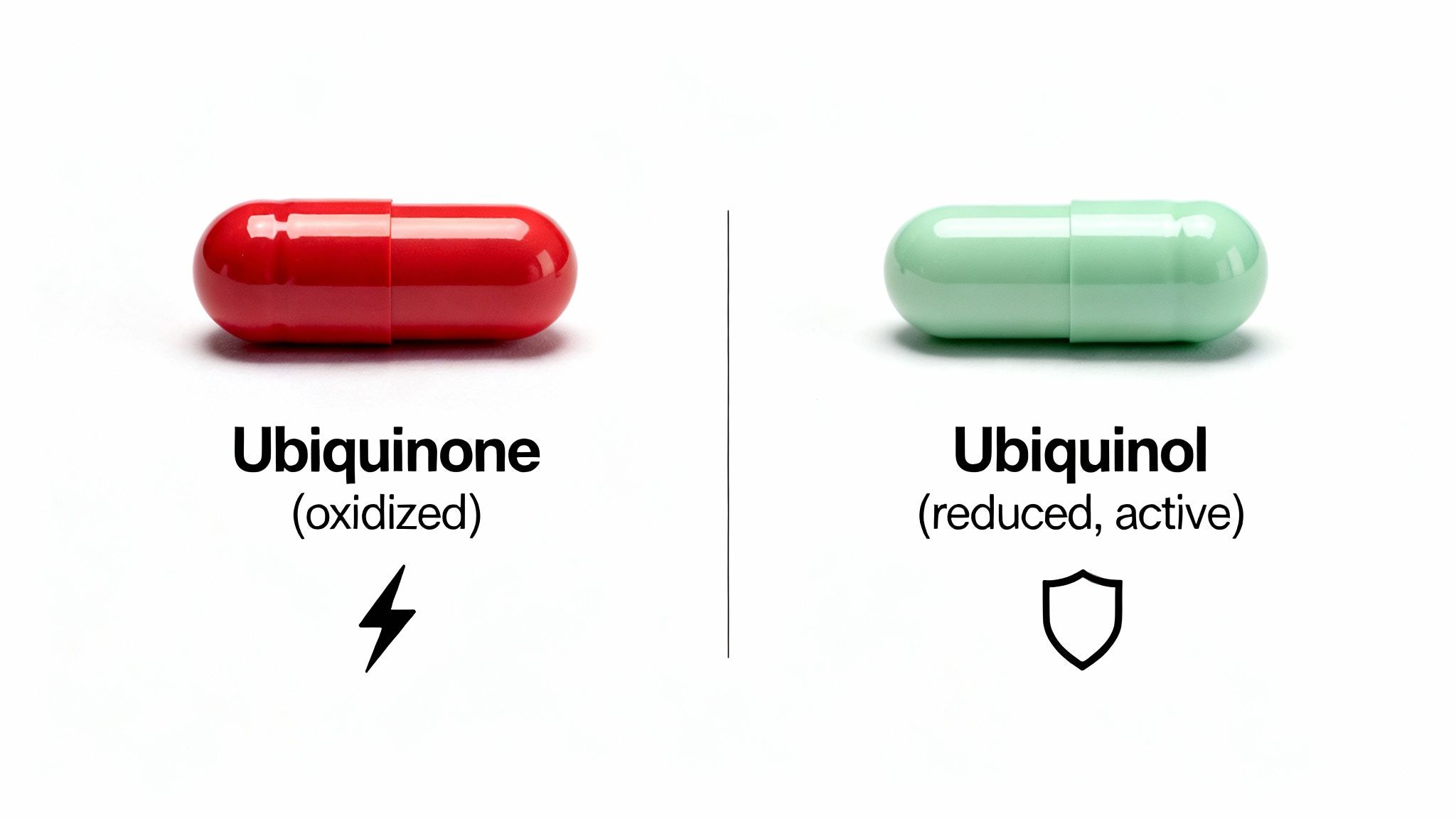
Quick Comparison: Ubiquinone vs Ubiquinol
To help you figure out which is right for you, here’s a quick rundown of the key distinctions between ubiquinone and ubiquinol. This table breaks it down at a glance.
| Attribute | Ubiquinone | Ubiquinol |
|---|---|---|
| Form | Oxidised (needs conversion) | Reduced ('active' form) |
| Primary Function | A key part of cellular energy production in mitochondria | A powerful, fat-soluble antioxidant in the blood and lymph |
| Bioavailability | Generally lower, requires bodily conversion | Generally higher, more readily absorbed by the body |
| Stability | More stable and less prone to oxidation | Less stable, requires careful manufacturing to protect it |
| Cost | More affordable | Typically more expensive |
Getting a handle on these differences is the first step in picking the right CoQ10 supplement for your health goals and stage of life.
The core of the ubiquinone vs ubiquinol debate comes down to a single metabolic step. Your body must convert ubiquinone to ubiquinol to use it. If that conversion process is efficient, ubiquinone works well. If not, ubiquinol provides a direct, active source.
Here in the United Kingdom, market data reveals a clear preference for ubiquinone, which captured over 65% of the market share in 2023. This is largely thanks to its stability and long-standing presence on shelves. However, ubiquinol is catching up fast, now holding about 30-35% of the share and seeing rapid growth, especially among older adults who are after its superior bioavailability. You can learn more about CoQ10 market trends and see how preferences are shifting.
Understanding CoQ10: The Body's Cellular Energy Source
Before we jump into the ubiquinone vs. ubiquinol debate, it’s worth getting to grips with what Coenzyme Q10 actually is and why it's so fundamental to your health. Found in almost every cell in your body, CoQ10 is a vitamin-like compound that plays two absolutely critical roles in keeping you going.
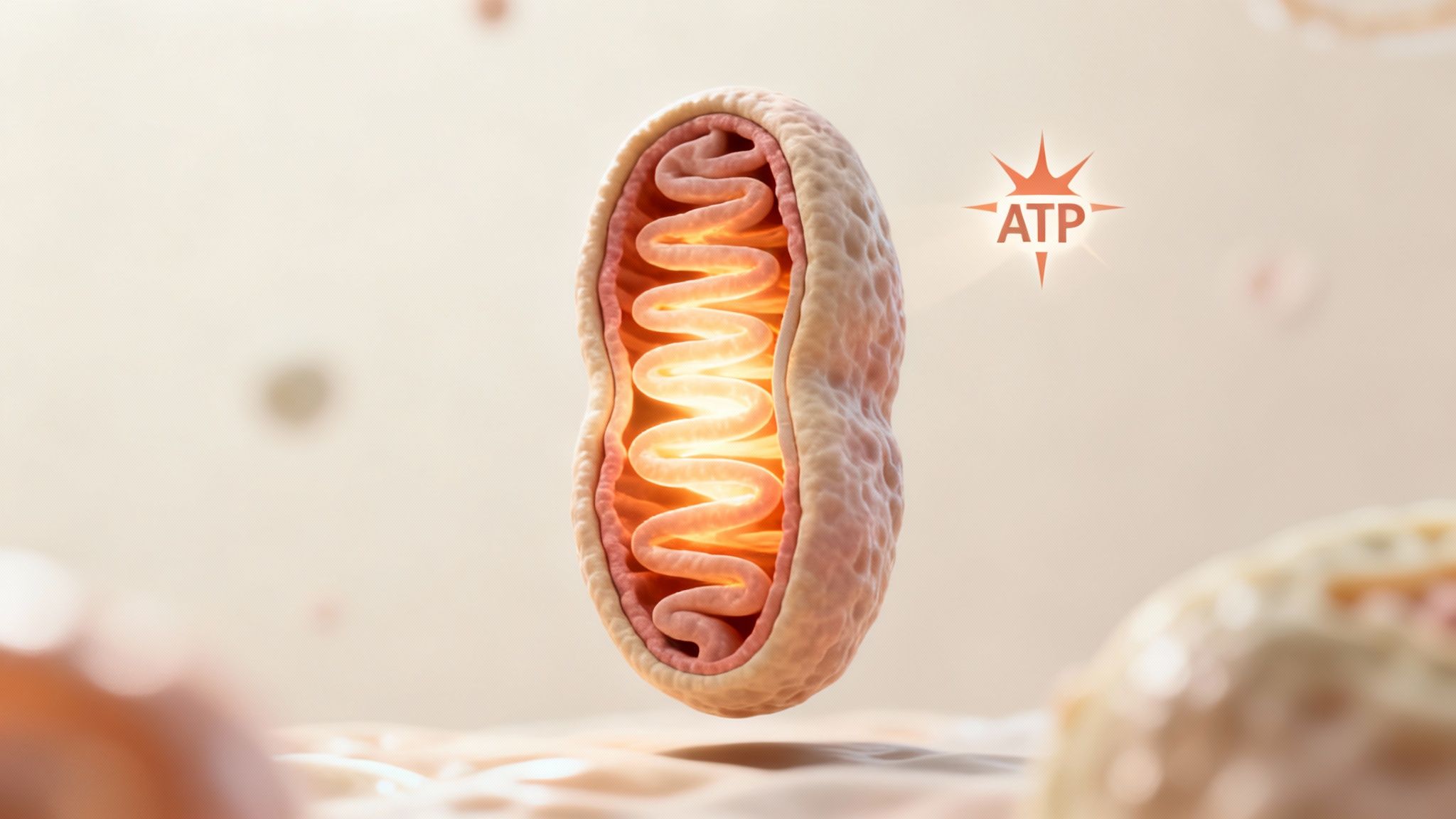
Its main job happens deep inside your mitochondria, the tiny "power plants" inside our cells. Here, CoQ10 is a vital link in the chain that creates adenosine triphosphate (ATP)—the high-energy molecule that fuels everything from muscle movement to brain activity.
Think of it like this: your cellular engines need a specific spark plug to ignite fuel and generate power. CoQ10 is that spark plug. Without enough of it, the whole energy production line grinds to a halt, which can leave you feeling completely drained. This is a big reason why healthy CoQ10 levels are so closely tied to fighting fatigue, a topic you can explore further in our detailed guide on the best supplements for fatigue.
CoQ10 As A Master Antioxidant
But energy production is only half the story. CoQ10 is also a powerful, fat-soluble antioxidant. Antioxidants are your body's personal defence force against oxidative stress, which is damage caused by rogue molecules called free radicals. These unstable molecules can wreak havoc on cells, proteins, and even your DNA, contributing to the ageing process and a host of health issues.
CoQ10 gets to work neutralising these threats right where they matter most: within cell membranes and in the bloodstream. Its unique position inside the mitochondria means it's perfectly placed to mop up the very free radicals that are generated during ATP production, protecting these vital energy factories from damage.
This dual function is what makes CoQ10 so remarkable:
- Energy Production: It’s indispensable for turning food into cellular energy (ATP).
- Cellular Protection: It shields cells from oxidative damage, supporting their overall health and longevity.
CoQ10 isn't just an energy booster; it's a fundamental operator in cellular maintenance. It both powers the cell and protects it from the by-products of that same power generation, making it a cornerstone of metabolic health.
Why Your CoQ10 Levels Matter
While our bodies are clever enough to produce CoQ10, production peaks in our early twenties and then starts a slow, steady decline as we get older. Certain lifestyle factors and health conditions can also speed up this depletion. When levels drop, cellular energy can falter and antioxidant defences weaken, impacting everything from your heart health to your skin.
This natural decline is precisely why understanding the different forms of supplemental CoQ10—ubiquinone and ubiquinol—is so important. Topping up your levels can help support your body’s energy demands and protective mechanisms. The form you choose really boils down to how easily your body can absorb and use this crucial nutrient, which is the key difference we'll explore next. Grasping CoQ10’s foundational role is the first step in making an informed decision about which supplement is right for your unique health journey.
The Real Difference? It's All in the Conversion Cycle
When you get down to it, the distinction between ubiquinone and ubiquinol isn't just about different names on a label. It all comes down to a dynamic, constant process happening inside your body called the redox cycle. This is where CoQ10 does its heavy lifting, flicking back and forth between its two forms to generate energy and mop up damaging free radicals. Grasping this cycle is the secret to figuring out which form is right for you.
Think of it like this: Ubiquinone is an empty lorry, ready to be loaded up. Ubiquinol is that same lorry, but now it’s fully loaded with valuable cargo—in this case, electrons.
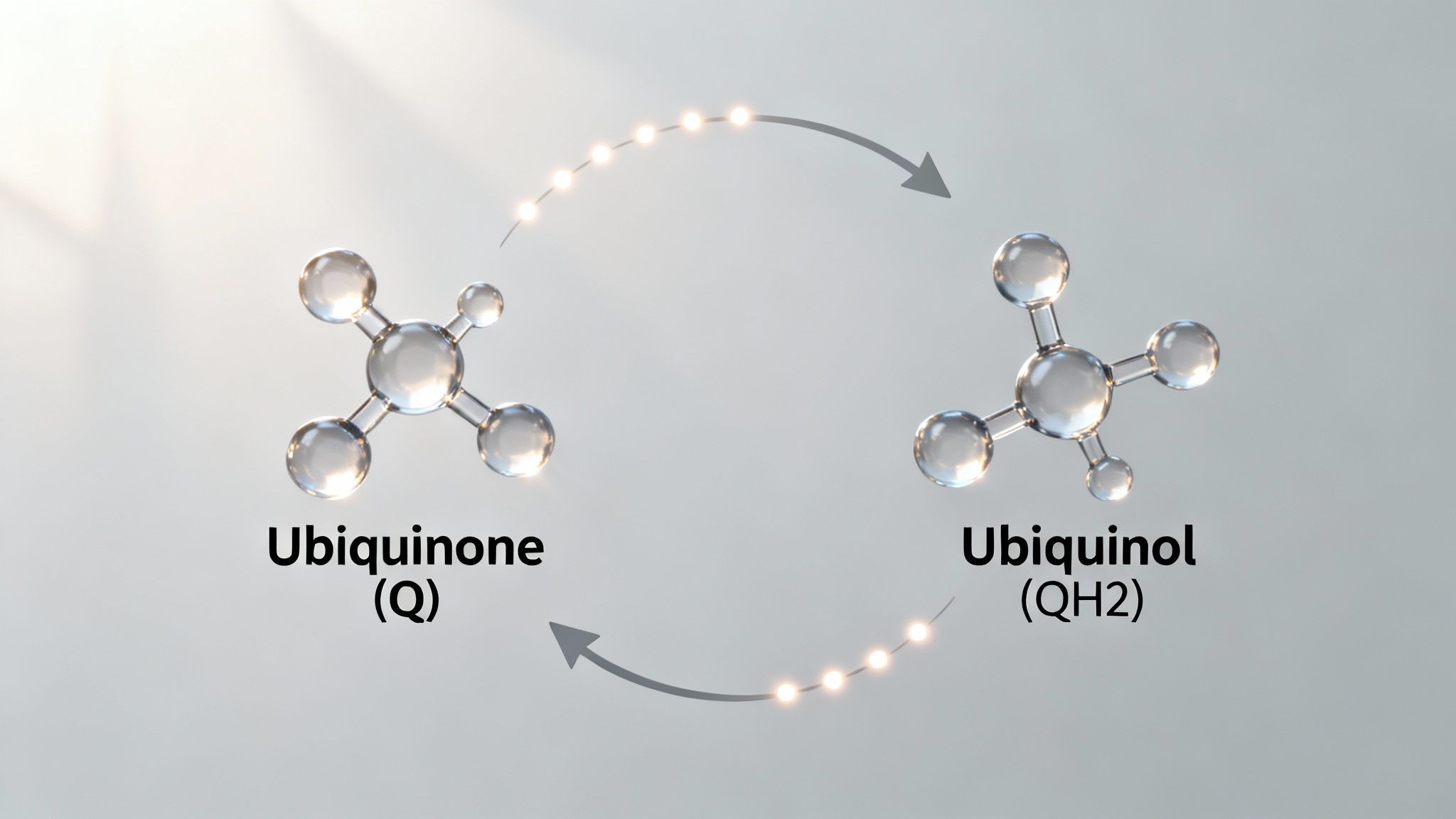
This constant back-and-forth is essential. Ubiquinol (the loaded lorry) generously donates its electrons to neutralise free radicals, turning back into ubiquinone in the process. Then, to get back to its job of producing energy inside our mitochondria, that ubiquinone has to be "recharged" by accepting more electrons, converting it back into the active ubiquinol form.
Why This Conversion Step is So Important
When you take a ubiquinone supplement, you're giving your body the 'empty lorry'. It's then up to your cells to do the work, using special enzymes to load it with electrons and activate it into ubiquinol. For a lot of people, especially if you're young and healthy, this process happens pretty smoothly in the background.
But—and this is a big but—that internal conversion isn't always firing on all cylinders. A few things can throw a spanner in the works:
- Age: As we get older, our body's knack for producing CoQ10 naturally declines. So does the efficiency of the enzymes needed to convert ubiquinone into ubiquinol.
- Oxidative Stress: High levels of oxidative stress from illness, intense workouts, or environmental factors can drain your ubiquinol stores faster than your body can replenish them.
- Specific Health Conditions: Certain health issues can directly impair the body's ability to manage this conversion, ramping up the need for a more direct, active form.
This metabolic step is the heart of the ubiquinone vs ubiquinol debate. It's the hurdle your body has to clear to get any benefit from a ubiquinone supplement. If that hurdle is a bit too high because of age or health, giving your body pre-converted ubiquinol is like getting a VIP pass that lets you skip the queue entirely.
The effectiveness of a CoQ10 supplement really boils down to one question: can your body efficiently convert the oxidised form (ubiquinone) into the active, electron-rich form (ubiquinol)? If the answer is a confident yes, ubiquinone is a solid, cost-effective choice. If not, ubiquinol offers a direct route to the benefits.
From Lab Discovery to Your Supplement Shelf
The history of these two forms in the UK market tells a story of evolving science and health awareness. For years, ubiquinone was the only game in town, mainly because it was more stable to manufacture. But as studies began to reveal ubiquinol's superior bioavailability—often cited as being two to three times more absorbable than ubiquinone—the market began to shift. You can dig deeper into the numbers in this comprehensive Coenzyme Q10 market report.
This shift acknowledges a simple truth: while the body can do the conversion, it's not always a given. By supplementing with ubiquinol, you’re delivering the active form directly. This ensures that even if your internal conversion processes are a bit sluggish, you’re still getting the full antioxidant and energy-boosting power of CoQ10. This makes the choice between them a strategic one, based entirely on your personal biology and health goals.
How Your Body Absorbs Each Form of CoQ10
The single biggest factor in the ubiquinone vs ubiquinol debate comes down to one simple concept: bioavailability. It’s just a fancy word for how much of a supplement your body can actually absorb and put to good use. After all, what’s the point in taking something if it can’t get into your bloodstream and reach your cells?
When you swallow a CoQ10 supplement, it travels down to your small intestine. From there, it gets absorbed into the lymphatic system before it finally makes its way into your circulation. The catch is that CoQ10 is a large, fat-soluble molecule, which makes it naturally tricky for our bodies to handle.
This is where the difference between ubiquinone and ubiquinol becomes crystal clear. Ubiquinol, being the active form and more water-soluble, generally has an edge. Your body gets to skip the extra step of converting it, making it more readily available, especially for certain people.
Why Age and Health Dictate Absorption
A young, healthy person’s body is usually quite efficient at converting ubiquinone into its active ubiquinol form. Their internal chemistry is running smoothly, so they can absorb and use the standard form without much fuss. For this group, ubiquinone can be a perfectly good and budget-friendly choice.
However, things change as we get older. Research shows that our natural ability to both produce CoQ10 and convert ubiquinone to ubiquinol starts to decline. This means an older adult taking a standard ubiquinone supplement might not be getting the full benefit because their body is struggling to make that crucial conversion.
But it’s not just about age. Several other factors can get in the way of this vital process:
- High Oxidative Stress: If your body is dealing with illness, intense exercise, or chronic stress, your demand for active ubiquinol shoots right up.
- Certain Medications: Statins, which are commonly used to manage cholesterol, are well-known for depleting the body’s CoQ10 levels and can also interfere with the conversion process.
- Specific Health Conditions: Metabolic or cardiovascular health issues can reduce the efficiency of the enzymes responsible for converting ubiquinone.
In these situations, supplementing directly with ubiquinol bypasses the compromised conversion step entirely, delivering the active form straight where it’s needed.
Countless studies have compared blood plasma levels after taking both forms. The results are pretty consistent: ubiquinol often leads to significantly higher circulating levels of CoQ10 than an equivalent dose of ubiquinone, particularly in people over 40.
The Mealtime Factor: Maximising Your Intake
Because CoQ10 is fat-soluble, how you take it makes a huge difference. Taking either form on an empty stomach is far from ideal—your body will struggle to absorb it properly.
To get the most out of your CoQ10, it's essential to take it with a meal that contains some healthy fats. Think avocado and eggs for breakfast or salmon with a drizzle of olive oil for dinner. These fats trigger the release of bile, which helps emulsify the CoQ10 and get it ready for absorption. For more tips on optimising your supplement routine, check out our guide on the best time of day to take vitamins.
This is exactly why you'll find many high-quality CoQ10 supplements come in oil-based softgels. This smart formulation pre-packages the CoQ10 with a carrier oil (like sunflower or olive oil) to give its bioavailability a head start.
The UK market reflects this growing understanding. Forecasts suggest that by 2025, ubiquinol could make up around 54.7% of the CoQ10 market in some parts of Europe. This shift is driven by people wanting more effective, easily absorbed forms. You can explore more about this shift in Coenzyme Q10 market trends to see why absorption is becoming so important.
Ultimately, while a healthy individual under 40 might absorb ubiquinone just fine with a fatty meal, those facing absorption challenges due to age or health status stand to gain much more from the superior bioavailability of ubiquinol.
How To Choose The Right CoQ10 For Your Goals
https://www.youtube.com/embed/iTqsoRMsRBY
Trying to decide between ubiquinone and ubiquinol doesn't have to be a headache. The right choice for you boils down to your age, lifestyle, and what you’re hoping to achieve with your health. If you match the right form to your personal needs, you can feel confident you're giving your body the most effective support for its energy and antioxidant systems.
This quick decision tree helps visualise the most common recommendation based on age.
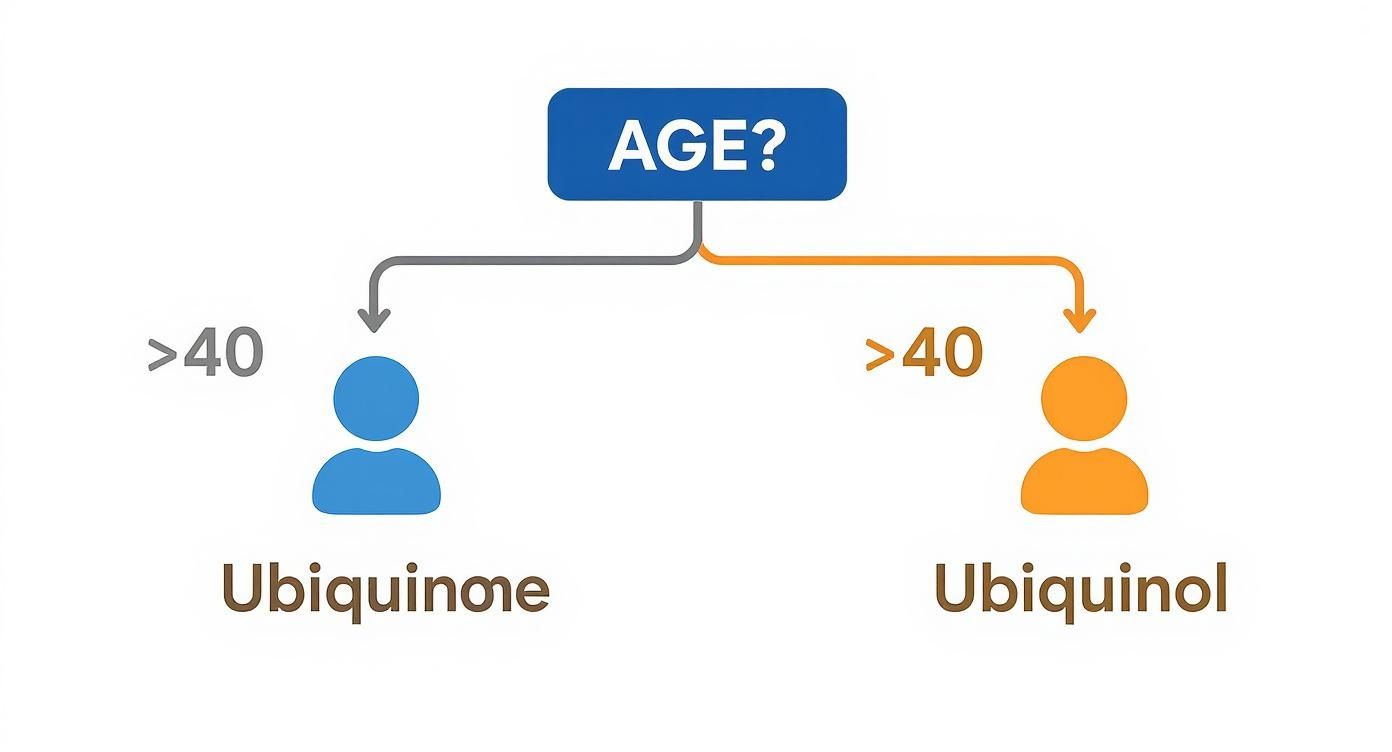
As the infographic shows, age is a massive factor in choosing your CoQ10. It all comes down to how efficiently your body can handle the conversion.
For General Wellness Under 40
If you're a healthy adult under 40, your body is generally a pro at converting ubiquinone into its active ubiquinol form. Your natural enzymatic processes are likely firing on all cylinders.
For this reason, ubiquinone is usually the most practical and wallet-friendly option. It gives your body the raw materials it needs, and you can trust your internal chemistry to do the heavy lifting. Dosages for general wellness typically fall between 30–100 mg per day.
For Supporting Health Over 40
Once we hit our 40s, things start to change. Our body's natural CoQ10 production slows down, and more importantly, the enzymes that convert ubiquinone into ubiquinol become less efficient.
This is where ubiquinol really shines. By taking the pre-converted, active form, you get to bypass that sluggish conversion step entirely. This ensures your body gets a direct, ready-to-use source of CoQ10 to support your heart, cells, and antioxidant defences. Doses often begin around 100 mg per day.
When considering CoQ10 for specific health goals, it's also worth looking into other supplements tailored for men over 40, which address many of the common wellness concerns for this age group.
For Individuals Taking Statins
Statins are incredibly common for managing cholesterol, but they work by inhibiting an enzyme (HMG-CoA reductase) that’s also critical for making CoQ10. This can cause the body's natural levels to plummet, often leading to muscle-related side effects.
If you’re on statins, ubiquinol is strongly recommended. Its direct bioavailability helps top up CoQ10 stores far more effectively than ubiquinone, which your body may struggle to process under these circumstances. Doses of 100–200 mg per day are often used in studies for this purpose, but it's vital to have a chat with your doctor first.
Taking statins creates a unique metabolic situation where CoQ10 production is directly impacted. Supplementing with the active ubiquinol form helps to directly address this medication-induced depletion, supporting both muscle comfort and cellular energy.
For Athletes And Active Lifestyles
Intense exercise creates a huge amount of oxidative stress and puts a massive strain on cellular energy production. This can rapidly drain your body's reserves of active ubiquinol—the form that doubles as a primary antioxidant.
Athletes and anyone with a highly active lifestyle can really benefit from ubiquinol. Its superior absorption helps meet the higher demand for both energy and antioxidant protection, which can in turn support performance and speed up recovery. A typical dose for this group could be anywhere from 100–300 mg daily, depending on training intensity.
Ultimately, choosing your CoQ10 is a personal decision. To make it a bit easier, this table breaks down the key recommendations.
Which CoQ10 Form Is Best for You?
This guide provides a detailed recommendation based on age, health status, and specific lifestyle factors.
| User Profile | Primary Goal | Recommended Form | Reasoning |
|---|---|---|---|
| Healthy Adult Under 40 | General wellness and energy maintenance | Ubiquinone | Your body's conversion process is typically efficient, making this a cost-effective choice. |
| Adult Over 40 | Heart health, longevity, and fighting age-related energy decline | Ubiquinol | Bypasses the less efficient conversion process common with ageing, ensuring better absorption. |
| Statin User | Counteracting medication-induced CoQ10 depletion | Ubiquinol | Directly replenishes the active form of CoQ10 that statins can reduce. |
| Athlete/Active Person | Enhancing performance, reducing oxidative stress, and aiding recovery | Ubiquinol | Meets the high metabolic demands of intense exercise with a more bioavailable form. |
No matter which form you land on, remember that consistency is everything. Taking your CoQ10 supplement daily, preferably with a meal containing some healthy fat, will maximise its absorption and help you get the full benefits.
Getting Practical: Cost, Safety, and Making Your CoQ10 Count
So, you've got the science down, but how does the ubiquinone vs. ubiquinol debate play out in the real world? Deciding which form of CoQ10 is right for you means looking at some practical factors like your budget, safety considerations, and how to actually use the supplement for the best results.
Let's talk cost first, because it's often the first thing people notice. There's no getting around it: ubiquinol is almost always more expensive than ubiquinone. The reason is simple chemistry. Ubiquinol is the more fragile, 'active' form, and keeping it stable and protected from oxygen during manufacturing is a more complex and costly process.
This is where you need to weigh up the price tag against the potential for better absorption. If you're someone whose body might struggle with the conversion process, paying a bit more for ubiquinol could be a smart investment to ensure you're getting the full benefit. For many others, the more budget-friendly ubiquinone works perfectly well.
Safety and Potential Drug Interactions
The good news is that CoQ10, in either form, has an excellent safety record. Most people tolerate it extremely well. When side effects do occur, they are typically very mild, like a bit of digestive upset.
That said, it's crucial to be aware of how it might interact with certain medications. CoQ10 can have a mild blood-thinning effect, so if you're taking anticoagulant drugs like warfarin, it is absolutely essential to speak with your doctor before adding it to your routine. It could also potentially interact with some blood pressure medications and insulin.
Always keep your doctor or healthcare provider in the loop about any supplements you're taking. Full transparency is the key to a safe, coordinated health plan and helps you avoid any unwanted surprises.
While CoQ10 is a fantastic nutrient for the heart, it's just one piece of the puzzle. If you're looking to build a comprehensive approach to cardiovascular wellness, you might find it useful to explore other supplements for heart health.
How to Get the Most Out of Your Supplement
A few simple habits can make a huge difference in how well your body absorbs and uses CoQ10, ensuring you're not wasting your money.
- Take it with a meal containing fat. CoQ10 is fat-soluble. This means your body absorbs it much more effectively when it's taken with fats. Think avocado, a handful of nuts, or a drizzle of olive oil on your salad. It's a small change that can seriously boost absorption.
- Stick to reputable brands. The supplement world can be a bit wild. Look for brands that invest in third-party testing to verify the purity and potency of their products. This gives you confidence that what's on the label is actually what's in the bottle.
- Pay attention to the dose. Supplement labels can be confusing. To get a better grasp of how the amounts listed relate to your overall daily needs, check out our guide on what the Nutrient Reference Value means.
By keeping cost, safety, and smart usage in mind, you can confidently pick the right form of CoQ10 and make it a valuable part of your health strategy.
Ready to find the right supplements for your unique biology? Take the VitzAI quiz today and receive a personalised supplement report designed to help you reach your health and performance goals. Get your free recommendation now.
This article is for informational purposes only and is not medical advice. Always consult a qualified health professional before starting any new supplement or major lifestyle change.