

ADHD and Supplements A Practical Guide for 2026
You’ve probably done some version of this already. The medication helps, but not in every way you hoped. Focus improves in one part of the day and falls apart in another. Appetite changes. Sleep gets patchy. Or maybe you’re not on medication and you’re trying to work out whether food, supplements, sleep, stress, and routine can move the needle enough to matter.
That’s where many individuals search for adhd and supplements. Not because they want a miracle. Because they want fewer rough edges. Better concentration in the morning. Less mental static in the afternoon. Fewer crashes, fewer missed tasks, less friction at work and at home.
The problem is that most supplement guides are just lists. They lump everyone together, skip over medication interactions, and rarely tell you what’s worth testing before you buy anything. That’s not good enough for a condition that already makes decision-making harder.
A more useful approach starts with the basics. Confirm what you’re dealing with, especially if you’re still at the questioning stage. If you haven’t been formally assessed, taking an ADHD test can be a sensible first step before you start changing multiple variables at once.
Medication still sits at the centre of treatment for many people. Supplements aren’t a replacement for a proper diagnosis, good prescribing, sleep, movement, and structure. But in the right person, used carefully, they can act more like tuning tools. They help correct nutrient gaps, support brain chemistry, and smooth out some of the practical day-to-day strain that ADHD can create.
The Search for Focus Beyond Medication
One of the most common mistakes I see is treating supplements like a shopping problem rather than a clinical one. People buy five products in one order, start them all on Monday, and by Friday they don’t know what helped, what caused nausea, or what made them more wired.
That approach usually fails for a simple reason. ADHD isn’t one single biology problem. Two people can share the same diagnosis and need completely different support. One may have a clear nutrient deficiency. Another may be under-slept and over-caffeinated. Another may be on stimulant medication and adding poorly chosen supplements on top.
Why “natural” doesn’t automatically mean useful
Supplements can be helpful. They can also be irrelevant, expensive, or badly timed.
A magnesium product may be sensible if someone is low in magnesium. A broad multivitamin may help cover gaps in a restrictive diet. Omega-3s may make sense for someone who rarely eats oily fish. But a random “brain booster” with a long ingredient list often creates more guesswork than benefit.
Supplements work best when they solve a real problem. They work poorly when they’re used as a substitute for testing, sleep, food quality, and medication review.
What people are often really trying to fix
When someone says they want better focus, they may mean several different things:
- Task initiation problems where starting feels harder than doing
- Inconsistent attention with good and bad windows across the day
- Mental fatigue that looks like poor concentration
- Mood and irritability that worsen executive function
- Sleep disruption that makes every symptom louder
That’s why a personalised plan matters. If the issue is low magnesium, one strategy fits. If the issue is winter low mood, poor sleep, and stimulant timing, a different one fits.
The practical mindset that helps
A useful supplement plan for ADHD should answer four questions first:
- What symptom am I trying to improve?
- Could a deficiency be involved?
- Am I taking medication or other supplements that could interact?
- How will I judge whether this is helping?
If you can’t answer those, don’t start stacking products yet.
Understanding Your Brain on Nutrients
The ADHD brain is often explained in terms of neurotransmitters, especially dopamine and norepinephrine. That can sound abstract, so I prefer a simpler picture. Think of the brain as an orchestra.
Dopamine helps cue motivation, reward, and task engagement. Norepinephrine helps with alertness, prioritising, and staying with the task in front of you. When the orchestra is well supplied and well timed, attention is more stable. When key players are missing or out of sync, things feel noisy, scattered, or flat.
Nutrients as support crew, not star performers
Supplements don’t “cure” ADHD. What they can do is support the systems the brain relies on.
Minerals and vitamins act more like the backstage crew. They help enzymes work, support neurotransmitter production, affect nerve signalling, and influence energy availability. If one of those support roles is weak, the whole performance can suffer.
That’s why deficiencies matter more than hype. A person who is low in a key nutrient may notice a meaningful shift once that gap is corrected. A person with no deficiency may notice very little.
Why deficiency symptoms can overlap with ADHD
This overlap catches people out all the time. Poor concentration, irritability, fatigue, nervousness, and low stress tolerance can all be interpreted as “my ADHD is worse”. Sometimes that’s true. Sometimes the brain is running with missing raw materials.
In the UK, the ADHD Centre notes that 72% of children with ADHD exhibit magnesium deficiency, linking that gap to fatigue, mood swings, lack of concentration, and nervousness. That’s a useful reminder that symptoms don’t always point to medication dose alone.
The engine analogy matters too
If the orchestra image feels too soft, use a car engine instead. Neurotransmitters are part of the ignition and fuel-delivery system. Nutrients are the spark plugs, filters, and oil. If one piece is underperforming, the engine can still run, but not smoothly.
That doesn’t mean every symptom comes from nutrition. It means nutrition can alter how hard the brain has to work.
What this means in practice
When I explain adhd and supplements to clients, I usually frame it like this:
- Medication can change signalling quickly. It often works at the level of neurotransmitter availability or reuptake.
- Supplements tend to work more slowly. They support the conditions the brain needs to function well.
- Lifestyle sets the background noise. Poor sleep, skipped meals, chronic stress, and alcohol can undermine both medication and supplements.
Practical rule: Build from the ground up. Sleep, food, hydration, routine, and deficiency checks first. Targeted supplements second. Exotic nootropics last, if at all.
Why one-size-fits-all stacks disappoint
A generic “focus stack” often ignores three things that change outcomes:
-
Baseline diet
Someone who eats fish, nuts, seeds, eggs, and leafy greens regularly has different needs from someone living on convenience food. -
Medication status
A person on methylphenidate needs a different safety conversation from someone who isn’t taking stimulants. -
Life stage
Hormonal shifts, stress load, and sleep quality change what support is most relevant.
That’s the core principle. Nutrients support brain function best when the plan matches the person.
The Evidence-Backed Toolkit for ADHD Support
A client has tried three “focus” products from social media, spent a fair amount, and still feels scattered by 3 p.m. That pattern is common. The problem usually is not lack of effort. It is that supplement choices were made as if every ADHD brain, diet, and medication plan were the same.
A better approach is to build a short list of options with the best practical support, then match them to the person in front of you. In clinic-style terms, the first tier usually includes omega-3s, zinc, iron, and magnesium. These are not a default stack. They are the nutrients most likely to be useful when diet, symptoms, medication response, or lab results point in that direction.
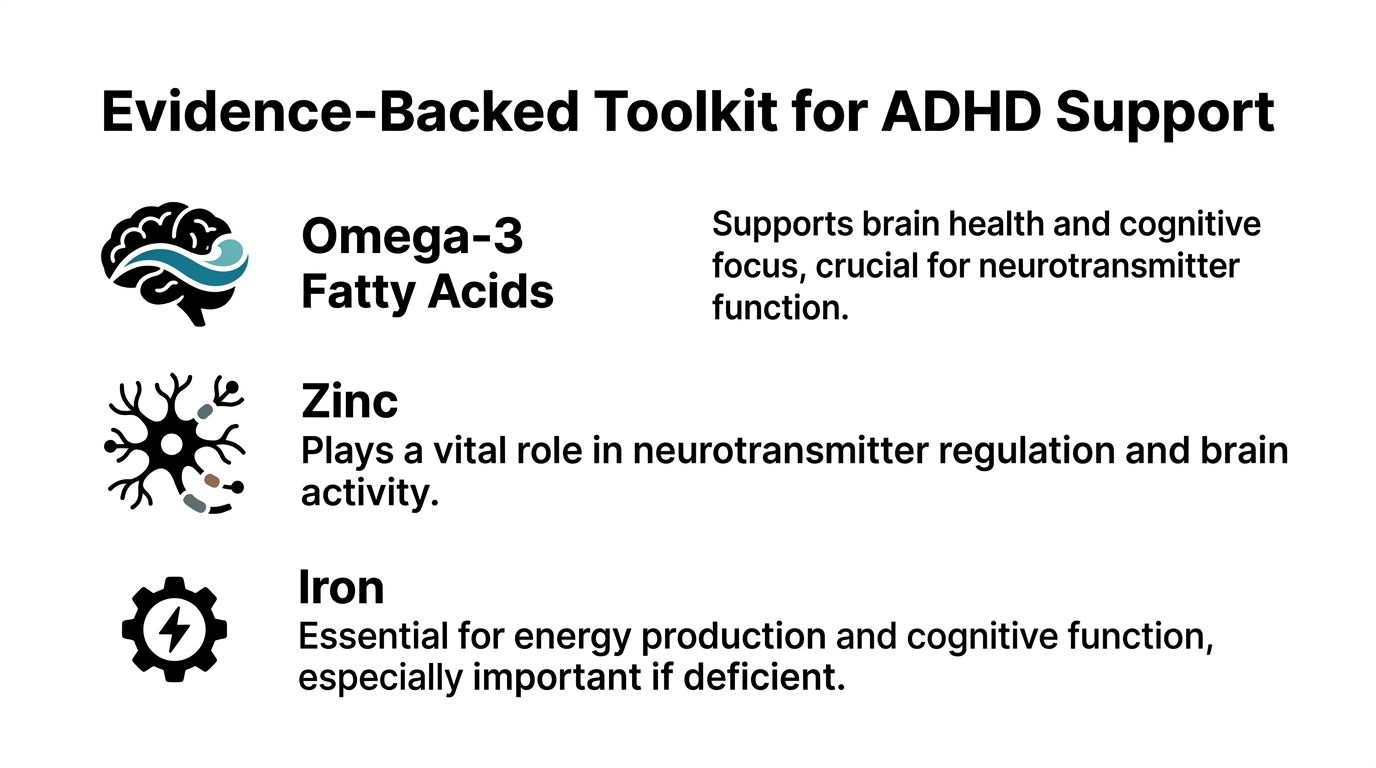
Summary of Core Supplements for ADHD
| Supplement | Evidence Strength | Primary Role in ADHD | Typical Daily Dose (Adults) |
|---|---|---|---|
| Omega-3 fatty acids | Supportive, often used as an adjunct | Supports brain health and neurotransmitter function | Use product label and clinician guidance |
| Zinc | Strongest when deficiency is present | Dopamine regulation and executive function support | 15 to 30 mg elemental zinc daily |
| Iron | Context-dependent, best guided by testing | Cognitive function and energy support if deficient | Test first, dose should be clinician-guided |
| Magnesium | Useful where deficiency is present | Nervous system calming and cognitive support | Use product label and clinician guidance |
Omega-3 fatty acids
Omega-3s are often the easiest place to start if someone rarely eats oily fish and wants a low-friction, generally well-tolerated option. In ADHD care, I treat them as supportive background help, not a dramatic fix. They are more appealing when attention problems sit alongside mood variability, inflammation risk, or a fairly limited diet.
They also make more sense in a plan than in isolation. Earlier research summaries in this article noted that omega-3s may work better alongside other targeted nutrients in some people, which fits what clinicians often see in practice. A personalised stack usually outperforms a random single supplement because it reflects diet quality, symptom pattern, and medication use.
Supplements also cannot organise your day for you. Pairing nutrition support with behavioural systems usually produces a better result than either one alone. These ADHD time management strategies are useful because they reduce the daily friction that can make any supplement feel disappointing.
Zinc
Zinc deserves attention because it supports dopamine-related processes, and that matters for impulse control, attention, and task initiation. It is one of the more plausible options when diet is poor, appetite is low, or there are signs that stimulant response is inconsistent.
Research summaries cited earlier in the article reported that zinc supplementation in deficient individuals was associated with lower hyperactivity and impulsivity scores, using doses in the 15 to 30 mg elemental zinc daily range. The practical message is straightforward. Zinc is most useful when there is a reason to suspect low status.
A few points matter here:
- Best fit: suspected or confirmed deficiency
- Common forms used: picolinate or gluconate
- Upper caution point: long-term intake above 40 mg/day can disturb copper balance
- Smart safeguard: test where possible, especially if someone already takes a multivitamin or several mineral products
If zinc helps, it usually helps because it corrected a shortfall.
Iron
Iron can be highly relevant, but it belongs firmly in the test-first category. Low iron can show up as poor concentration, low stamina, irritability, and mental fatigue. Those symptoms overlap with ADHD so closely that people often guess wrong.
I do not recommend casual iron use for “brain fog” or focus. If iron is low, correcting it can improve how someone feels and functions. If iron is normal, extra iron can cause constipation, nausea, and unnecessary risk. This is one of the clearest examples of why a personalised plan beats a one-size-fits-all stack.
Testing is especially sensible when there is heavy menstruation, a restrictive diet, known anaemia risk, persistent tiredness, or shortness of breath.
Magnesium
Magnesium is often useful for a different reason. It tends to matter most in people who feel tense, restless, wired at night, or mentally tired but unable to settle. In other words, it may support the ADHD pattern that comes with poor sleep quality and an overactive stress response.
The ADHD Centre has reported that magnesium deficiency is common in children with ADHD and has described research linking magnesium, sometimes paired with vitamin B6, to symptom relief and improved cognitive performance. That does not make magnesium a universal answer. It makes it a reasonable option when the symptom picture includes tension, sleep disruption, or a diet low in magnesium-rich foods.
Form matters. One person may do well with magnesium glycinate, while another tolerates citrate or malate better. Loose stools often signal a form or dose issue, not that magnesium is off the table.
For readers comparing broader ingredient options for concentration and stamina, this guide to supplements for energy and focus is a useful companion.
Common mistakes that waste money
The same problems come up repeatedly in supplement plans that fail:
- Starting five products at once, which makes it impossible to tell what helped or caused side effects
- Buying proprietary “focus blends” with small, unclear doses
- Using minerals without a reason, especially iron and zinc
- Expecting supplements to compensate for poor sleep or skipped meals
- Ignoring medication context, including appetite suppression, blood pressure changes, or timing effects
A practical order for building your stack
Use a simple sequence.
- Choose the main problem first. Attention, impulsivity, afternoon crashes, poor sleep, and tension do not all point to the same supplement.
- Check for likely gaps. Diet history, symptoms, and blood work often narrow the field quickly.
- Start with one core supplement. This gives you a cleaner read on benefit and tolerance.
- Keep the dose boring and consistent. Steady use beats constant product switching.
- Review the result after a fair trial. Then decide whether to continue, stop, or add the next layer.
That process is less exciting than buying a big stack on day one. It is also far more likely to produce a safe plan that fits your biology.
Exploring Vitamins and Emerging Nootropics
A common pattern looks like this. Someone has already covered the basics, then starts wondering whether the next answer is vitamin D, a B-complex, ashwagandha, lion’s mane, or a glossy nootropic blend with ten ingredients on the label.
That question is reasonable. It also trips people up because this category is broader, less predictable, and far more sensitive to context. The right choice depends on what is driving the struggle. Low mood in winter, poor diet, stress-driven insomnia, medication side effects, and genuine curiosity about cognitive support do not call for the same product.

Vitamin D and B vitamins
Vitamin D matters more in the UK than many people realise because low sunlight exposure can drag on for months. In practice, low vitamin D often travels with fatigue, flatter mood, and lower resilience. Those issues do not cause ADHD, but they can lower the threshold for feeling scattered, unmotivated, and mentally slower.
B vitamins serve a different role. They support energy production and nervous system function, but they are not a direct ADHD treatment. A basic multivitamin can be reasonable when meals are inconsistent or food variety is poor. It is a support tool, not a substitute for checking whether there is a meaningful deficiency or another medical issue in the background.
Zinc as a clue, not an automatic prescription
As noted earlier, zinc status can be relevant in ADHD. The more useful clinical point is broader than one mineral. Nutrient patterns matter. If someone has a restricted diet, low appetite from stimulant medication, or signs of poor intake overall, zinc may be one piece of a bigger picture rather than a stand-alone fix.
This is why I rarely view vitamins and minerals as a shopping list. They work better as clues that help build a stack around the person’s biology.
Ashwagandha and calming formulas
Ashwagandha gets attention for a simple reason. Many adults with ADHD are not only fighting inattention. They are also carrying stress, physical tension, poor sleep, and that wired-but-tired feeling that makes concentration worse.
In that setting, a calming formula may be useful. The benefit is usually indirect. Better sleep and a quieter stress response can make focus easier the next day. That is different from claiming it treats ADHD itself.
Trade-offs matter here. Some people feel steadier with ashwagandha. Others feel flat, sleepy, or notice stomach upset. If stimulant medication is already covering daytime focus, adding a calming supplement may help at night or make the daytime feel duller. The response is personal.
Mushroom blends and nootropics
Mushroom products and nootropic stacks appeal to adults who want mental stamina without relying on more caffeine. That goal makes sense, but the label can distract from the essential question. What problem needs solving?
If the issue is poor sleep, these products will not replace sleep. If the issue is low iron or a medication timing problem, they will not correct that either. They fit best after the obvious causes have been checked and the target is clear. Readers comparing options in this category may find this guide to nootropic supplements in the UK useful for separating focused formulations from overhyped blends.
One practical rule helps a lot. The longer the ingredient list, the harder it is to predict the effect.
Creatine and cognition
Creatine deserves a brief mention because it sits in an unusual middle ground. It is well known in sport, but it also has a plausible place in a wider brain-health plan, especially for adults who want support for training, recovery, and mental stamina at the same time.
I would still rank it behind fixing a likely deficiency, improving sleep, or addressing medication-related appetite issues. Creatine makes more sense as part of a personalised plan than as a first move for attention problems.
The advanced options are not automatically better. The better option is the one that fits your symptoms, your diet, and your medication picture without creating a new problem.
Creating a Safe and Effective Supplement Plan
The safest supplement plan is usually the least exciting one. It starts small, matches the person, and respects medication.
That matters because many adults with ADHD don’t take this careful route. The verified data notes that a 2023 UK survey found 62% of adults self-supplement without doctor advice, and 34% reported worsened anxiety from unmonitored combinations. Those numbers fit what many practitioners see in real life. People mix stimulants, caffeine, pre-workouts, adaptogens, sleep aids, and minerals, then can’t tell what’s driving the problem.
The main safety issues to watch
If you take ADHD medication, especially stimulants, think in terms of load rather than single ingredients. A supplement may be harmless on its own but unhelpful in combination.
Common trouble spots include:
-
Too much stimulation
Caffeine-heavy powders, focus blends, and stimulant medication can push anxiety, palpitations, and sleep disruption in the same direction. -
Overlapping ingredients
A multivitamin, nootropic blend, and mineral product may duplicate the same nutrients. -
Poor timing
Even a useful supplement can become a problem if it worsens nausea, suppresses appetite further, or affects sleep. -
Blind stacking
Starting several products together removes your ability to identify the culprit.
A safer way to build your stack
I advise people to use a simple rule set.
First, introduce one product at a time. Give it a fair trial before you add another. Second, write down the exact symptom you’re targeting. Third, check your full ingredient list across all products, including protein powders, greens powders, and sleep formulas.
That sounds obvious, but many people don’t do it.
Safety first: “More support” isn’t always more support. In ADHD, too many inputs can create more noise than clarity.
Quality and bioavailability matter
Not all supplement forms behave the same way. Some minerals are gentler and better tolerated than others. Some B-vitamin products use forms that suit certain people better. Some blends hide tiny doses behind attractive labels.
That’s one reason I prefer simpler products over flashy “all-in-one” formulas when someone is trying to identify what helps. Better ingredients and thoughtful forms often beat a kitchen-sink label.
If you’re not sure whether your current routine is becoming excessive, this article on https://vitzai.com/blogs/learn/can-you-take-too-many-supplements is worth reading before you add anything new.
Use video guidance carefully
Some people learn better by watching a clinician talk through principles rather than reading labels and lists. This overview can be a helpful companion to the written advice above, especially if you’re trying to think through stacking and daily routine in a more practical way.
When to pause and ask for help
Speak to a qualified professional before adding supplements if any of these apply:
- You take prescription ADHD medication
- You’re pregnant, breastfeeding, or trying to conceive
- You have thyroid, kidney, liver, or gastrointestinal conditions
- You’ve had anxiety worsen with supplements before
- You suspect iron deficiency or other deficiency that needs testing
Much online advice about ADHD and supplements falls short. It talks about benefits and skips the practical safeguards. Those safeguards are what make the plan usable.
How to Tailor Supplements to Your Unique Needs
Generic supplement advice tends to fail for the same reason generic productivity advice fails in ADHD. It ignores context.
A stack that suits a university student living on convenience meals may be completely wrong for a woman in her forties dealing with hormonal shifts, poor sleep, and a stimulant prescription. A gym-focused man using creatine and energy powders has different considerations from someone with a restrictive diet and a history of anxiety.
Start with the person, not the product
A personalised plan should take account of:
- Age and life stage
- Sex and hormonal context
- Medication status
- Diet pattern
- Sleep quality
- Stress load
- Training volume
- Digestive tolerance
- Known deficiencies
That list matters because a supplement doesn’t work in a vacuum. It works inside a real routine, with real meals, real symptoms, and real trade-offs.
Adults over 40 often need a different lens
One of the more overlooked groups in adhd and supplements discussions is adults over 40, particularly women navigating peri-menopause or menopause. Attention changes in that stage may be shaped by hormones, sleep disruption, stress, and nutrient status all at once.
The verified data highlights this clearly. A UK Biobank 2024 analysis of 500,000 participants linked low vitamin D, defined there as below 30 nmol/L, to 35% higher inattention scores, with low vitamin D described as prevalent in 40% of northern UK ADHD adults. That’s a strong reminder that “my ADHD is worse lately” may also be a seasonal, hormonal, or deficiency-linked story.
Why testing changes everything
Testing doesn’t make supplement planning perfect, but it makes it far more intelligent. It helps answer whether you’re correcting a plausible problem or guessing.
Useful conversations with a GP or clinician may include questions about:
- Iron status if fatigue and brain fog are prominent
- Vitamin D if mood, winter symptoms, or indoor lifestyle are part of the picture
- Zinc or magnesium when diet quality is poor or symptoms fit the pattern
- Medication review if symptoms changed after starting or changing a prescription
That doesn’t mean every person needs extensive testing. It means the more targeted the question, the better the supplement decision.
Build around symptom clusters
Rather than asking “What’s the best ADHD supplement?”, ask:
- Is the main issue focus?
- Is the issue tension and poor sleep?**
- Is afternoon fatigue the problem?
- Is low mood making attention worse?
- Is appetite suppression from medication affecting overall nutrition?
Those answers shape the plan more than marketing claims ever will.
A practical personalisation framework
Use this quick filter before buying anything:
- Pick one priority symptom
- List all current medication and supplements
- Review diet
- Check whether testing would clarify the picture
- Choose the simplest product that matches the need
- Track response in writing
Personalisation isn’t about taking more products. It’s about taking fewer, better-matched ones.
That’s the shift people need. Less random stacking. More pattern recognition. Better timing. Better questions.
Your Next Steps Toward Enhanced Focus
If you remember one thing from this guide, let it be this. The best ADHD supplement plan is personalised, conservative, and built around a real need.
Some supplements can help. Magnesium may matter when deficiency is present. Zinc can be relevant, especially when status is low. Omega-3s may support a broader brain-health strategy. Vitamin D deserves attention in the UK, particularly for adults whose symptoms worsen with season, stress, or hormonal change. Iron should be guided by testing, not guesswork.
The wrong approach is easy to spot. Buying a large stack, mixing it with medication, and hoping for clarity. The better approach is slower and far more effective. Pick the symptom. Check the context. Start one thing at a time. Review what changes.
That process won’t feel flashy. It will feel organised, and that’s usually what works.
This article is for informational purposes only and is not medical advice. Always consult a qualified health professional before starting any new supplement or major lifestyle change
If you want a simpler way to sort through the noise, VitzAI offers a personalised approach to supplement planning based on your age, sex, lifestyle, and goals. Visit VitzAi.com to explore specific recommendations and build a smarter stack without relying on guesswork.