

Unlocking the Benefits of B-Complex Vitamins for Energy and Mood
If you're constantly fighting fatigue, the real power of B-complex vitamins lies in their ability to unlock energy at a cellular level, sharpen your focus, and help keep your mood steady. This group of eight essential nutrients acts as the spark plugs for your body's engine, turning the food you eat into the fuel you need to power through a demanding day.
Tired of Feeling Tired? Here’s Why B Vitamins Could Be Your Answer
Juggling work, family, fitness, and a social life can feel like a constant drain on your energy. If you find yourself reaching for another coffee just to survive the afternoon slump, you're not alone. It's a common complaint, but what if the answer isn't another stimulant, but something more fundamental?
This is where the B-complex family comes in. Think of your body as a high-performance engine. The food you eat—carbs, fats, and proteins—is the fuel. But fuel on its own is useless without something to ignite it. B vitamins are those crucial spark plugs, working deep within your cells to kickstart the metabolic reactions that turn food into usable energy.
The Team of Eight Energy Boosters
A "B-complex" isn't just one vitamin. It’s a team of eight distinct, water-soluble nutrients that work together, each with its own special job. Their combined effort is vital for everything from making red blood cells to ensuring your brain functions correctly.
Before we dive deep, let's get a quick snapshot of the whole team.
The B Vitamin Family at a Glance
This table gives you a quick summary of the eight essential B vitamins and their primary functions. Think of it as a high-level overview before we get into what each one does for you.
| B Vitamin (Name) | Core Function | Key Benefit |
|---|---|---|
| B1 (Thiamine) | Nutrient-to-energy conversion | Powers cellular energy |
| B2 (Riboflavin) | Energy production & antioxidant | Fights oxidative stress |
| B3 (Niacin) | Cellular signalling & metabolism | Supports DNA repair |
| B5 (Pantothenic Acid) | Hormone & fatty acid creation | Aids stress management |
| B6 (Pyridoxine) | Neurotransmitter production | Crucial for mood regulation |
| B7 (Biotin) | Macronutrient metabolism | Supports healthy hair & skin |
| B9 (Folate) | Cell growth & DNA synthesis | Essential for cell renewal |
| B12 (Cobalamin) | Red blood cell & nerve function | Prevents fatigue & brain fog |
This coordinated teamwork is why a shortfall in even one of these vitamins can throw your energy levels, mood, and mental clarity out of whack.
Sadly, this is a more common problem than you might think. In the UK, a shocking 48% of the population is deficient in B-complex vitamins, which is a major contributor to widespread chronic fatigue. With over 13% of Brits saying they feel exhausted all the time, it points to a serious nutritional gap that's holding people back.
Of course, nutrition is just one piece of the puzzle. It’s also worth exploring some practical, in-the-moment strategies to wake yourself up when tired at work. This guide will give you a clear roadmap to understanding how to harness the powerful benefits of B-complex vitamins to get your vitality back.
Meet the Eight Essential Energy Nutrients
It's easy to hear "B complex" and think it's a single thing. But in reality, it's a powerhouse team of eight distinct, water-soluble vitamins, each with its own vital job. Think of them like a highly specialised crew, where every member brings a unique skill to the table to make sure your body runs like a well-oiled machine.
Getting to know what each one does is the key to understanding the wide-ranging benefits of a B-complex. From turning your lunch into usable energy to keeping your nerves firing correctly, this team works together seamlessly. If even one member is out of action, the whole operation can be disrupted, affecting everything from your mood to your metabolism.
This map gives you a great visual of how the B vitamin team collaborates to support your energy, focus, and mood.
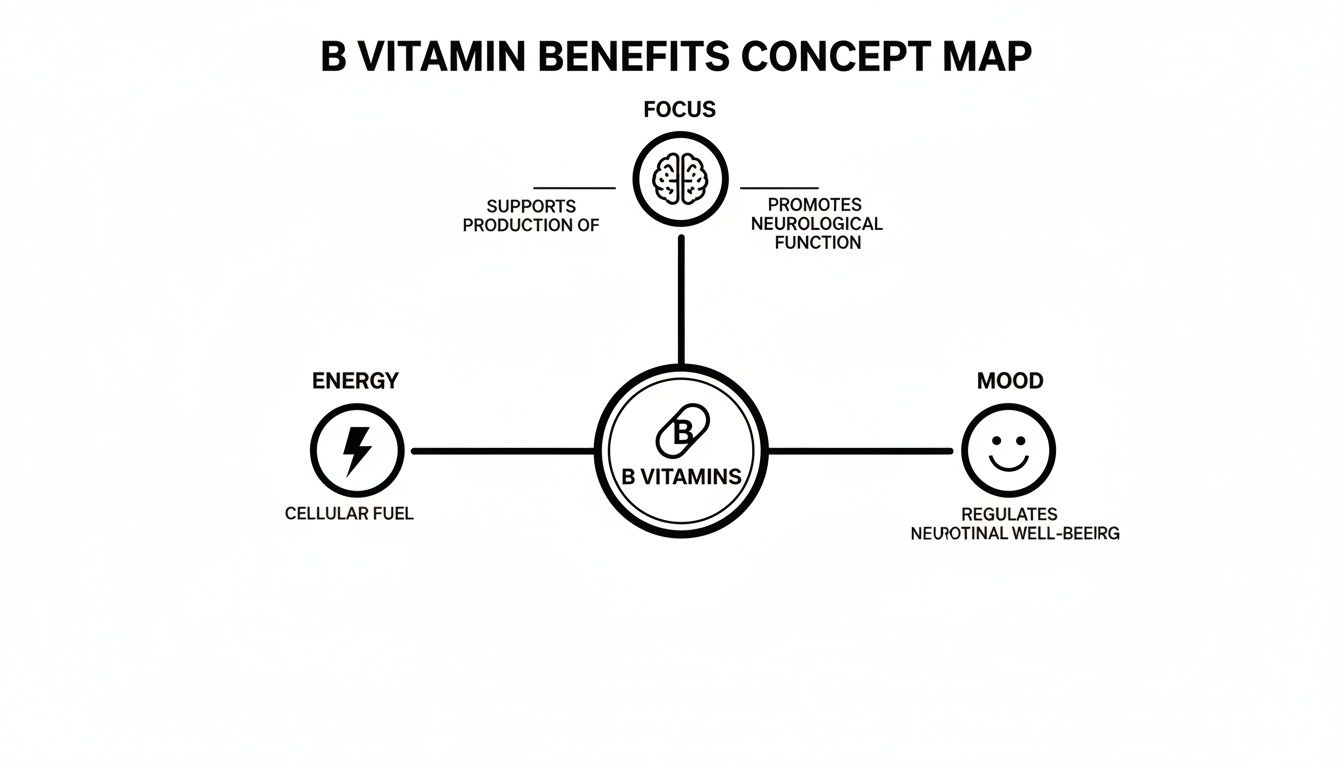
As you can see, these three core areas—energy, focus, and mood—are all deeply interconnected and directly underpinned by the work of the B vitamin family.
The Energy and Nerve Specialists
Several B vitamins are front and centre when it comes to producing energy and maintaining a healthy nervous system. They are the frontline workers converting the food you eat into fuel.
-
B1 (Thiamine): The Original Energiser. Thiamine is the crucial first step in glucose metabolism, kicking off the process that turns carbohydrates into energy for your cells—especially those in your brain and nervous system.
-
B2 (Riboflavin): The Cellular Antioxidant. Not only does riboflavin help convert food into energy, but it also moonlights as an antioxidant, shielding your cells from the oxidative stress that's a natural byproduct of energy production.
-
B3 (Niacin): The Metabolic Maestro. Niacin is a key player in over 400 enzymatic reactions in the body, most of which are tied to metabolism. It helps release energy from food and is also vital for cellular communication and repairing DNA.
-
B5 (Pantothenic Acid): The Stress and Hormone Supporter. This vitamin is essential for making coenzyme A, a molecule that helps build fatty acids. It also has a role in producing stress-related hormones in the adrenal glands.
These four are the core of your body's energy-producing machinery.
The Brain and Blood Builders
The next group of B vitamins takes on more specialised jobs, focusing on building crucial components for your brain, blood, and DNA. Their work is fundamental to your long-term cognitive and physical health.
Think of these B vitamins as the architects and engineers of your body. While the first group provides the raw energy, this second group uses that energy to build and maintain the complex structures that keep you healthy and sharp.
B6 (Pyridoxine): The Mood Regulator Pyridoxine is deeply involved in how your brain works. It’s a necessary helper for creating neurotransmitters like serotonin (which governs mood), dopamine (linked to pleasure and motivation), and GABA (which has a calming effect). A shortage of B6 can directly throw your mental wellbeing and cognitive clarity off balance.
B12 (Cobalamin): The Nerve Protector and Blood Builder Vitamin B12 is absolutely essential for two critical jobs. First, it helps form and maintain the myelin sheath, a protective layer that insulates your nerve fibres, ensuring messages travel quickly and efficiently throughout your nervous system. Second, it partners with folate to produce red blood cells, which are tasked with carrying oxygen to every part of your body. Without enough B12, you can be left feeling fatigued, weak, and dealing with neurological issues like brain fog or tingling in your hands and feet.
The Growth and Maintenance Crew
Finally, we have two B vitamins that focus on the foundational processes of cell growth, division, and maintenance. They make sure your body can repair itself and create new, healthy cells when needed.
-
B7 (Biotin): The Beauty Vitamin. Famous for supporting healthy hair, skin, and nails, biotin’s main job is actually to help metabolise carbohydrates, fats, and proteins. It's a key regulator in turning the food you eat into the building blocks your body needs.
-
B9 (Folate): The Cell Growth Architect. Folate (or its synthetic form, folic acid) is vital for making and repairing DNA. This makes it non-negotiable for any process involving cell division and growth, from producing new red blood cells to supporting healthy foetal development during pregnancy. It works in lockstep with B12 to keep these processes running smoothly.
Each of these eight nutrients has a distinct job description, yet they all work in perfect harmony. This synergy is precisely why a B-complex supplement is often more effective than taking individual B vitamins—it provides the complete team your body needs to perform at its best.
How B Vitamins Supercharge Your Energy, Mood, and Focus
You've met the individual players. Now, let's get into what happens when this family of vitamins works together. The benefits of a B-complex start at the most fundamental level, right inside your cells, where these vitamins act as the spark plugs for sustained energy, a balanced mood, and sharp mental clarity.
Forget the temporary jolt you get from a double espresso. B vitamins give your body the tools it needs to generate its own authentic energy. They don't just paper over the cracks of fatigue; they help fix the problem at its source.

Fuelling Your Body From the Cells Out
Picture your body's energy production line—known as the Krebs cycle—whirring away inside the mitochondria of your cells. The food you eat provides the raw materials, but it's the B vitamins that are the skilled workers and machinery keeping that line moving smoothly.
Without them, the whole operation grinds to a halt. B1, B2, B3, and B5 are especially crucial here. They act as coenzymes that help break down the carbs, fats, and proteins you eat and convert them into ATP (adenosine triphosphate). Think of ATP as the energy currency your body spends to power every single thing you do, from blinking to lifting heavy weights.
This is why having enough B vitamins is non-negotiable for feeling good. A shortfall slows down your internal energy factory, leaving you feeling sluggish, weak, and just not on your game. To dive deeper into how specific nutrients power your vitality, check out our guide on the best vitamins for energy.
The Architects of a Positive Mood
Beyond just physical energy, B vitamins have a massive impact on your mental and emotional wellbeing. They're absolutely essential for creating neurotransmitters—the chemical messengers that literally shape how you think and feel.
Vitamins B6, B9 (folate), and B12 are the real stars of the show here.
- Vitamin B6 (Pyridoxine) is needed to create serotonin (the 'feel-good' chemical) and dopamine (which governs motivation and pleasure).
- Vitamin B12 and B9 (Folate) work as a team in a process called the methylation cycle. This cycle is critical for producing SAM-e (S-adenosylmethionine), a compound that influences almost all of your key neurotransmitters.
When B vitamin levels are low, neurotransmitter production can falter. This imbalance can show up as a low mood, being more irritable, or just finding it harder to cope with everyday stress. It's like leaving your brain without the chemical toolkit it needs to stay balanced.
This link is rock-solid. For example, a UK study that ran for 33 days found that healthy men taking high-dose B vitamins reported significant improvements in their mental health, felt less stressed, and had a noticeable boost in vigour. Research like this just reinforces that a B-complex can be a powerful ally for navigating the pressures of modern life.
Sharpening Your Cognitive Edge
Feeling sharp, focused, and mentally clear is directly tied to the health of your nervous system, and B vitamins are its primary caretakers. Vitamin B12 is especially important for maintaining the myelin sheath, a fatty, protective layer that insulates your nerve cells.
Think of the myelin sheath as the rubber coating on an electrical wire. A healthy sheath ensures that nerve signals zip around your brain and body quickly and efficiently.
When you're low on B12, this protective coating can degrade, which slows down nerve communication. The result? You might experience symptoms like brain fog, a fuzzy memory, and difficulty concentrating. In the same way, vitamin B1 is essential for fuelling brain cells, while B6 supports cognitive development and function.
By supporting energy metabolism, neurotransmitter balance, and nerve health, the B vitamin family works together to power your mind. This makes a complete B-complex a foundational supplement for anyone looking to perform at their best, manage stress, and live a vibrant, energetic life.
Protecting Your Long Term Heart and Brain Health
While the immediate benefits of B vitamins, like more energy and a brighter mood, are fantastic, some of their most important work happens behind the scenes for long-term health. Think of these nutrients as a crucial investment in your future, acting as silent protectors for two of your most vital organs: your heart and your brain.
This isn't just a vague wellness claim; it's grounded in real biochemistry. By looking after your cardiovascular system and supporting brain longevity, B vitamins are a cornerstone of any smart, proactive health strategy.
Guarding Your Cardiovascular System
One of the most critical, yet often overlooked, jobs of the B vitamin family is managing an amino acid in your blood called homocysteine. Homocysteine is a natural byproduct of your body processing protein. In healthy amounts, it’s completely harmless.
But when levels get too high, it can start to damage the delicate lining of your arteries, encouraging inflammation and raising the risk of blood clots. This makes elevated homocysteine a serious risk factor for cardiovascular disease.
This is where the B vitamin trio—B6, B9 (folate), and B12—steps in. They’re essentially the clean-up crew, working together to convert excess homocysteine into other useful compounds your body needs.
- Vitamin B6 helps turn homocysteine into cysteine, an antioxidant.
- Vitamins B12 and B9 team up to recycle homocysteine back into methionine, another essential amino acid.
By keeping homocysteine levels in a healthy range, these B vitamins help maintain the flexibility of your blood vessels, supporting your heart for the long run.
Fortifying Your Brain for the Future
The same homocysteine-lowering magic that protects your heart is also incredibly important for your brain. In fact, elevated homocysteine is a known red flag for brain atrophy—the gradual shrinkage of the brain that’s linked to ageing and cognitive decline. Studies have shown that key B vitamins like B6, B12, and folate can effectively bring these levels down.
The groundbreaking VITACOG trial, for example, showed that B vitamin supplements could slow brain shrinkage and even improve cognitive function in older adults. It was a huge moment that really highlighted their protective power. You can read more about these kinds of findings on news-medical.net.
But it's not all about homocysteine. B vitamins are also vital for the physical structure and function of your brain. Vitamin B12, in particular, is absolutely essential for maintaining the myelin sheath.
You can think of the myelin sheath as the insulation around the electrical wiring in your brain. A thick, healthy sheath lets nerve signals travel quickly and efficiently, which translates to sharp, clear thinking.
When B12 levels are low, this protective coating can wear thin, disrupting communication between your brain cells. Over time, this can show up as brain fog, memory lapses, and a general slide in cognitive performance. By making sure you have a steady supply of these crucial nutrients, you’re not just boosting today’s focus—you're actively preserving the physical hardware of your brain for years to come.
This makes a good B-complex a powerful tool for anyone serious about not only their immediate performance but also keeping their mind sharp well into the future.
Getting B Vitamins From Food Vs. Supplements
So, how do you make sure you're getting a steady supply of these crucial nutrients? The best place to start is always with a balanced, whole-food diet. It’s the foundation of good health for a reason.
Eating a wide variety of whole foods is your first and best line of defence against running low on B vitamins. From leafy greens and legumes to lean meats and fish, this hardworking vitamin family is scattered across almost every food group. Prioritising these not only tops up your B vitamin levels but also delivers the fibre, minerals, and other vital nutrients your body needs to truly thrive.

Top Food Sources For Each B Vitamin
To give you a head start, here’s a quick-reference table showing which foods are packed with each of the eight B vitamins. Aiming for a colourful mix of these throughout the week will go a long way towards meeting your daily requirements.
| B Vitamin | Excellent Food Sources |
|---|---|
| B1 (Thiamine) | Whole grains, pork, sunflower seeds, beans, and peas. |
| B2 (Riboflavin) | Dairy products, eggs, lean beef, almonds, and mushrooms. |
| B3 (Niacin) | Chicken, tuna, turkey, avocados, and brown rice. |
| B5 (Pantothenic Acid) | Shiitake mushrooms, sunflower seeds, chicken, tuna, and avocados. |
| B6 (Pyridoxine) | Chickpeas, salmon, tuna, potatoes, and bananas. |
| B7 (Biotin) | Eggs (cooked yolk), salmon, pork, beef liver, and avocado. |
| B9 (Folate) | Leafy greens (spinach, kale), lentils, beans, asparagus, and broccoli. |
| B12 (Cobalamin) | Animal products like meat, fish, poultry, eggs, and dairy. |
Making sure your plate is consistently filled with these nutrient-dense options is the ideal strategy for maintaining healthy B vitamin levels naturally.
When Your Diet Might Not Be Enough
While a "food-first" approach is always best, the realities of modern life can make it tricky to get everything you need from diet alone. Certain factors can ramp up your body's demand for B vitamins or simply get in the way of you absorbing enough from your food.
- Food Processing: Modern food production often strips B vitamins from foods, especially grains. Think about white flour versus whole-grain flour—the difference in nutrient content is significant.
- Increased Needs: If you’re going through a period of high stress, engaging in intense physical activity, or recovering from an illness, your body can burn through its B vitamin stores much faster. For example, understanding the best fueling strategies for marathon runners is so important because it highlights just how much nutrient demand skyrockets during sustained performance.
- Dietary Choices: Anyone following a vegan or vegetarian diet might find it challenging to get enough B12, simply because it’s found almost exclusively in animal products.
In these situations, a high-quality B-complex supplement can be a reliable and effective way to fill any nutritional gaps and keep your levels where they need to be.
Why ‘Body-Ready’ Forms Are A Game-Changer
It’s important to realise that not all supplements are created equal, and this is especially true when it comes to B vitamins. For your body to actually use a nutrient, it has to be in a "bioavailable" or "body-ready" form. If it isn't, your body has to do the hard work of converting it first, a process that can be surprisingly inefficient for a lot of people.
Think of it like a key and a lock. A bioavailable B vitamin is a key that fits the lock perfectly, opening the door to cellular energy straight away. A non-bioavailable form is like a blank key that your body first has to cut into the right shape—a step that doesn't always go to plan.
Two of the most important examples of this are folate and B12.
- Methylfolate (for B9): Many supplements contain folic acid, a synthetic version of folate. The problem is, a huge portion of the population has a genetic variation that makes it difficult to convert folic acid into its active form, L-methylfolate. Choosing a supplement with L-methylfolate already in this active form means your body can use it immediately, no conversion needed.
- Methylcobalamin (for B12): It’s a similar story with B12. Methylcobalamin is the active, coenzyme form of B12. It’s far better absorbed and put to use by the body than the cheaper, more common cyanocobalamin form you’ll find in many off-the-shelf products.
Opting for a B-complex with these methylated, body-ready forms ensures you’re getting the maximum bang for your buck from every single dose. It’s a smarter way to supplement—one that works with your body’s natural biochemistry, not against it. To make sure you’re maximising absorption, it's also worth knowing the best time to take vitamin B-complex.
Are You Getting Enough? Spotting the Signs of a Shortfall
Understanding how brilliant B vitamins are is one thing, but figuring out if you're actually getting enough of them is what really counts. Since they're water-soluble, your body doesn't keep a stash of them. This means you need a fresh supply every single day to keep the engine running smoothly.
So, how can you tell if your tank is running a bit low? Your body has its ways of sending out signals when it’s not getting what it needs. Learning to recognise these whispers is the first step toward taking control and building a health plan that genuinely works for you.
Common Signs of B Vitamin Deficiency
A dip in B vitamins can show up in ways that are all too easy to shrug off as just 'being busy' or 'a bit run down'. But if these issues stick around, it's worth paying closer attention. They could be pointing to a deeper nutritional gap.
Common warning signs include:
- Persistent Fatigue: That constant, bone-deep tiredness that a good night's sleep just doesn't seem to fix.
- Mood Swings or Irritability: Feeling unusually down, anxious, or snapping at the smallest things? It could be a lack of the B vitamins needed for mood-regulating neurotransmitters.
- Brain Fog or Poor Concentration: If you're struggling to focus, your memory feels fuzzy, or you just feel mentally sluggish, a B vitamin shortfall might be to blame.
- Skin Issues: Problems like rashes, cracks at the corners of your mouth, or a swollen tongue can sometimes be linked to low levels of B2, B3, or B6.
- Tingling or Numbness: Strange 'pins and needles' feelings, especially in your hands and feet, can be a neurological red flag for a serious B12 deficiency.
If any of this sounds familiar, it’s a good moment to take a look at your diet and lifestyle. B12 is one of the most common deficiencies, so if you want to dig a bit deeper, you can learn more about the specific signs of a vitamin B12 deficiency and what they mean for your health.
Who Needs More B Vitamins?
Everyone needs B vitamins, but some of us need a whole lot more depending on our age, lifestyle, or diet. Think of it like a car: a high-performance racing car is going to burn through fuel and need more maintenance than a city runaround. Your body is no different.
Certain life stages and daily habits can dramatically increase your body's demand for B vitamins. Identifying if you fall into one of these groups is key to proactive health management, ensuring you provide your body with the extra support it requires.
You might have higher B vitamin needs if you are:
- An Athlete or Highly Active: Pushing your body with intense exercise revs up your energy metabolism, which burns through B vitamins much faster.
- An Older Adult: As we get older, our ability to absorb certain nutrients—especially vitamin B12—naturally declines due to changes in stomach acid.
- Following a Vegan or Vegetarian Diet: Vitamin B12 is found almost exclusively in animal products. This means anyone on a plant-based diet is at a very high risk of deficiency without topping up with a supplement.
- Under Chronic Stress: The body’s stress-response system leans heavily on B vitamins, particularly B5, to produce stress hormones. Long periods of stress can seriously deplete your reserves.
- Pregnant or Breastfeeding: The demand for folate (B9) and other B vitamins skyrockets during pregnancy to support the healthy development of the baby.
If you tick one or more of these boxes, it’s a strong sign you could benefit from a targeted B-complex supplement to make sure you're meeting your body's extra demands.
Answering Your Questions About B Complex
Diving into the world of supplements can definitely bring up a few questions. To help you feel completely confident, we’ve put together some straightforward answers to the queries we hear most often about B complex vitamins.
Can You Take Too Much B Complex?
Honestly, it’s very difficult to overdo it with a B complex. All eight B vitamins are water-soluble, which is just a technical way of saying your body doesn’t store them for very long. Whatever you don't use gets flushed out, usually in your urine.
That said, extremely high doses of certain individual B vitamins (like B6) taken over a long period can cause issues. The golden rule is to always stick to the recommended dosage on the product label unless a healthcare professional has specifically told you otherwise.
When Is the Best Time to Take B Vitamins?
For most people, the ideal time to take a B-complex supplement is in the morning with breakfast. Think of them as the spark plugs for your energy metabolism; taking them at the start of your day helps to fuel your body and brain for whatever lies ahead.
Taking them late in the evening isn't a great idea for some people as it could potentially interfere with sleep. A morning routine just makes more sense—it aligns with your body’s natural energy cycle and helps you get the most out of the benefits.
How Long Until I Feel the Benefits?
This really varies from person to person. If you’re coming from a place of significant deficiency, you might notice a real lift in your energy and mood within just a few weeks. For others, the b complex vitamins benefits are more of a slow burn, building up subtly over time.
Consistency is everything. It's best to think of it as a long-term investment in your cellular health, nerve function, and overall vitality, where the positive effects stack up day after day.
Is a B Complex Better Than My Multivitamin?
It really depends on what your body needs. A standard multivitamin gives you a good, broad baseline of many nutrients, including some B vitamins. The thing is, the doses are usually much lower than what you’d find in a dedicated B-complex supplement.
If you fall into a category with higher needs—maybe you're an athlete, an older adult, or someone dealing with chronic stress—then a separate B-complex is often a far more effective strategy. It gives you higher, more targeted doses and often uses more bioavailable forms that your body can actually use.
Ready to figure out your personalised supplement strategy? Take the free VitzAI.com health questionnaire today and get a tailored report designed to help you unlock your full potential. Start your journey at https://vitzai.com.
This article is for informational purposes only and is not medical advice. Always consult a qualified health professional before starting any new supplement or major lifestyle change.