

Best Vitamins for Me: How to Choose What to Take
The most popular advice about the best vitamins for me is usually wrong. A universal ranking assumes your body, diet, sunlight, age, medications and goals match everyone else's. They don't.
The best choice may be no routine supplement at all. UK public-health guidance says the general population should get nutrients from a varied, balanced diet, with targeted exceptions such as diagnosed deficiency, pregnancy-related needs and specific public-health recommendations (UK food supplement guidance).
A vegan over 50, an office worker with little winter sunlight, a person taking acid-reducing medication and a resistance-training enthusiast could all answer the same quiz question differently. The sensible answer starts with whether supplementation is needed, then identifies the smallest, most defensible addition.
Why There Is No Single Best Vitamin for Everyone
A supplement can be useful because it fills a genuine nutritional gap. It can also be irrelevant, poorly matched to your needs or risky when stacked with another product. Treating every bottle as harmless “insurance” is how people end up taking overlapping ingredients without knowing what they're correcting.
The strongest reasons to supplement are usually concrete:
- A restricted diet: Vegan and vegetarian diets can make B12 review particularly important.
- A life-stage need: Pregnancy, older age and menopause-related concerns can change priorities.
- A predictable exposure gap: Limited winter sunlight can make vitamin D more relevant.
- A medical or medication issue: Absorption disorders and some medicines can change nutritional status.
- A defined goal: Creatine may make sense for someone training for strength, while it has no obvious role for someone seeking a general wellness product.
A multivitamin doesn't automatically solve any of these. The U.S. Preventive Services Task Force reviewed 84 randomised controlled trials and 6 cohort studies and concluded that evidence was insufficient to determine whether multivitamins prevent cardiovascular disease or cancer. It also recommended against beta-carotene or vitamin E supplements for those purposes (USPSTF recommendation on vitamin supplementation).
The practical rule: Don't ask which supplement ranks first. Ask which gap, if any, you can explain.
That distinction matters for energy, sleep, stress, hormones, gut health, cognitive performance and healthy ageing. A supplement may support a nutritional need, but it can't diagnose fatigue, replace sleep or guarantee disease prevention.
Your working mental model should be simple: food first, risk second, product third. Start with what you eat and how you live. Then consider age, sex, pregnancy potential, sun exposure, medication and symptoms. Only after that should you choose a product, dose and schedule.
The Four Questions That Decide What You Actually Need
A useful supplement decision doesn't begin with a product page. It begins with four questions that expose the reasons a nutrient might be relevant.
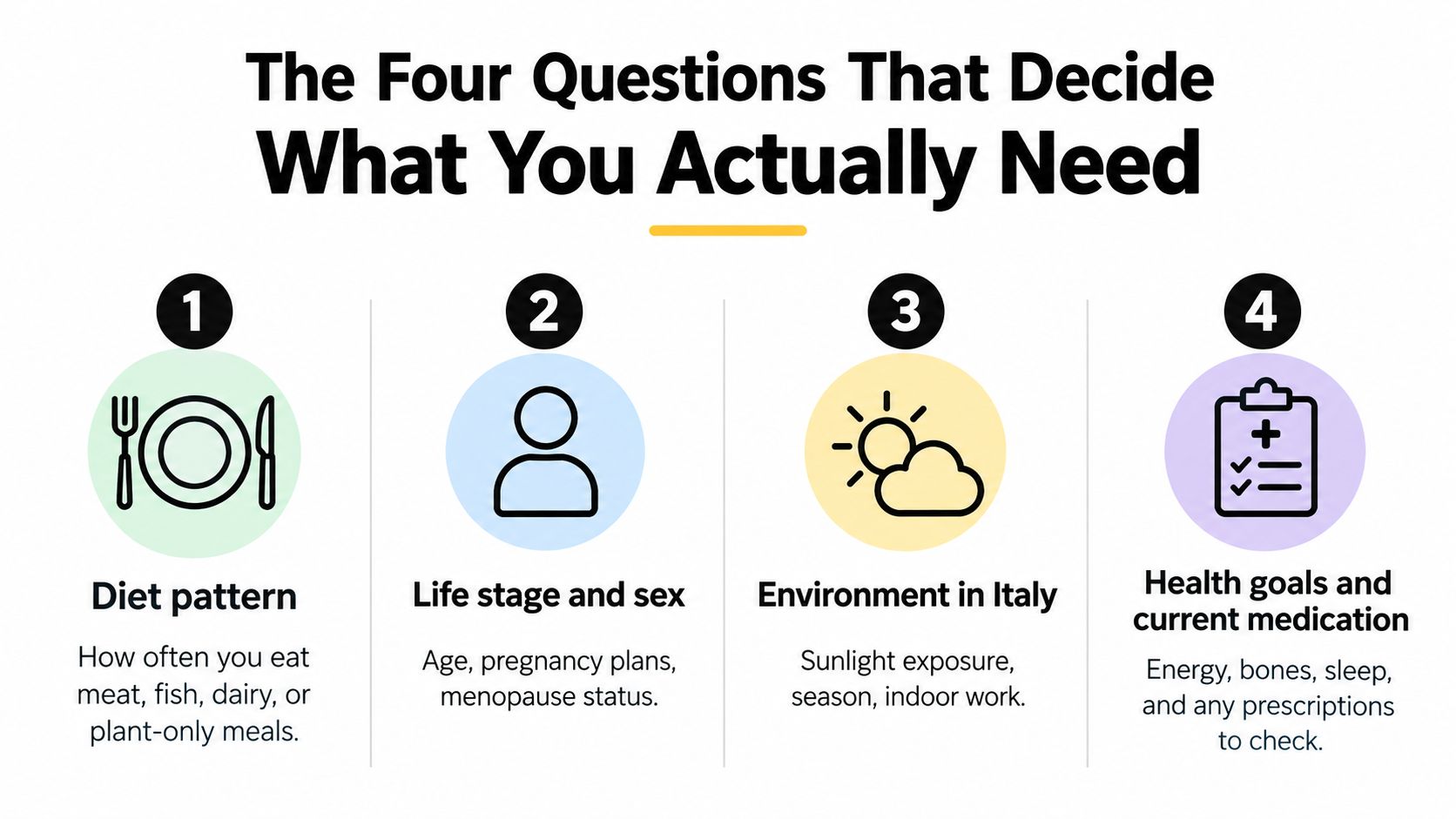
What does your diet regularly provide
Count patterns, not perfect meals. Do you eat meat, fish, eggs and dairy? Are you vegan, vegetarian, dairy-free or frequently skipping meals? Someone who eats no animal products should put B12 near the top of the review, while someone who rarely eats oily fish may have a different reason to consider omega-3.
B12 deserves particular attention with age and absorption concerns. NIH sources report that B12 deficiency affects approximately 3% to 43% of older adults, depending on the diagnostic definition and population. For adults over 50, crystalline B12 from fortified foods or supplements is generally absorbed more reliably than naturally protein-bound B12 (NIH vitamin B12 fact sheet).
What life stage are you in
Age and sex influence the questions, but they don't dictate a fixed supplement bundle. Pregnancy plans, breastfeeding, menstruation, menopause status and older age can all change what deserves professional review. Iron is a clear example. It may be relevant in some people, but taking it only because fatigue is present is poor practice.
What does your environment make difficult
A person working indoors, covering most skin outdoors or living through a dark winter has a different vitamin D context from someone with regular sunlight exposure. Location matters, and so does season. Your country, latitude, clothing, skin pigmentation and outdoor routine are more useful inputs than a generic “daily vitamins” label.
What are your goals and medical constraints
Separate a goal from a symptom. Wanting better training recovery may support a creatine discussion. Persistent fatigue, numbness, balance problems, digestive symptoms or poor concentration need medical assessment rather than a random energy powder.
List prescriptions, over-the-counter medicines and existing supplements before adding anything. A person taking a proton pump inhibitor, metformin, thyroid medicine, anticoagulant or sedative needs a medication-aware review, not a blind stack.
Write down your answers before shopping. If you can't explain why a product matches your diet, life stage, environment or health context, it probably hasn't earned a place in your routine.
The Vitamins People Ask About Most
People usually start with the wrong question. They ask which vitamin is best, when they should ask whether they need one at all, and whether they need dietary insurance, deficiency correction, or a clinician.
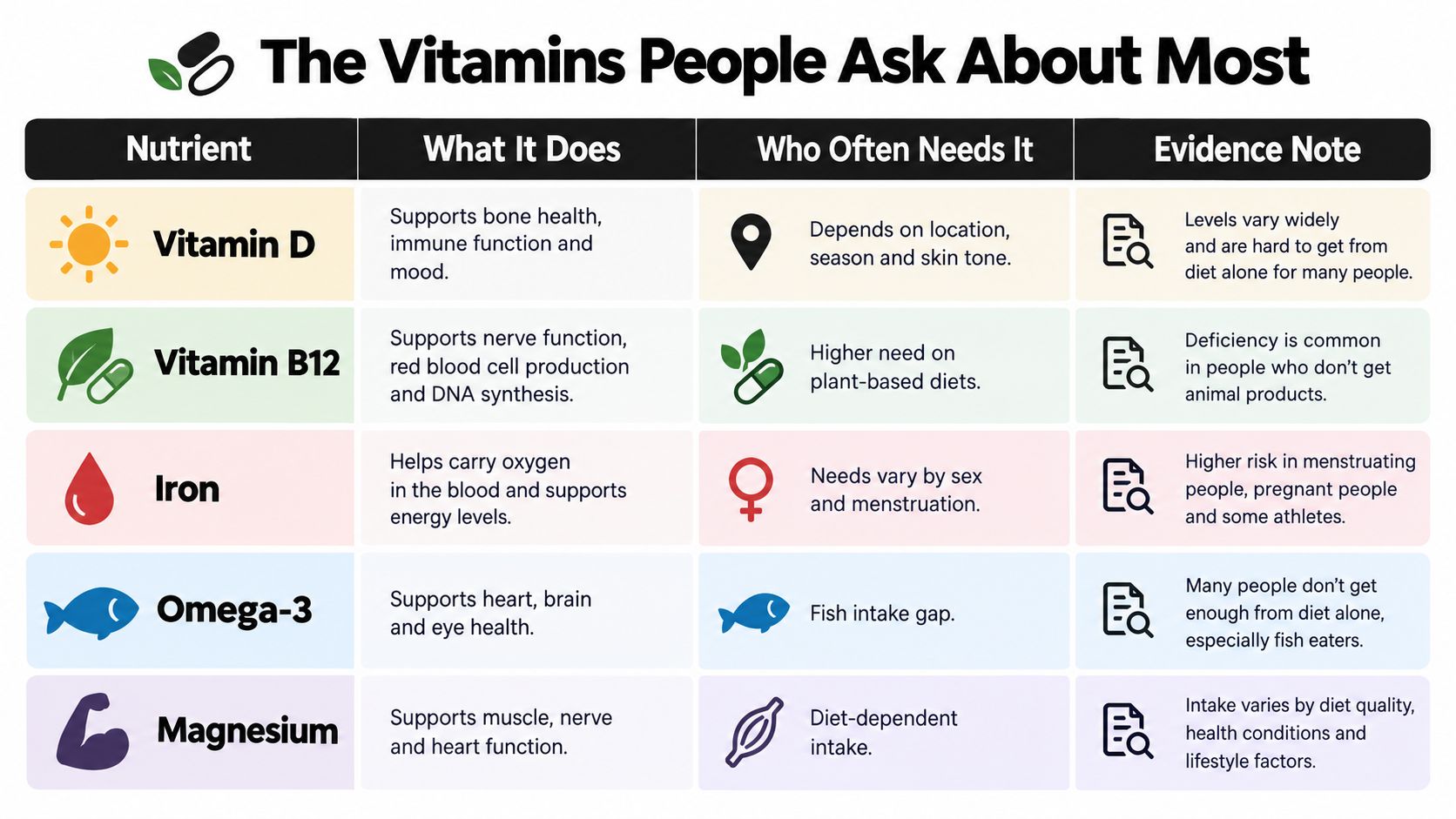
The conditional shortlist
| Nutrient | Who is most likely to benefit | Main trigger to consider it | Key caution |
|---|---|---|---|
| Vitamin D | People with limited sunlight exposure or other risk factors | Season, location, skin coverage or measured status | High-dose use isn't automatically safer |
| Vitamin B12 | Vegans, vegetarians, adults over 50 and people with absorption concerns | Low intake, age, digestive conditions or relevant medicines | Symptoms require assessment, not self-treatment alone |
| Magnesium | People whose intake is low or who have a specific reason to review it | Diet, cramps or a targeted sleep discussion | Supplemental magnesium has an adult upper limit |
| Omega-3 | People who rarely eat fish or have a clinician-identified reason | Low dietary intake, high triglycerides or coronary disease context | Supplements aren't universal cardiovascular protection |
| Iron | People with diagnosed deficiency or a clear risk pattern | Blood results, heavy menstrual losses or clinician advice | Unnecessary iron can be harmful |
Vitamin D belongs near the top of the list because context changes need fast. In the UK, the National Diet and Nutrition Survey for 2019 to 2023 found that 18% of adults aged 19 to 64 had serum 25-hydroxyvitamin D below 25 nmol/L, the threshold linked to deficiency for bone health. It also found deficiency in 34% of adults in the most deprived income-equivalent group, compared with 9% to 17% in the other four groups (UK National Diet and Nutrition Survey). That supports targeted use based on sun exposure, season, skin coverage, and measured status. It does not support handing every adult the same bottle and calling it personalised.
B12 is different. The main drivers are diet pattern, age, and absorption. If you eat little or no animal food, or you have a condition or medicine that affects absorption, B12 deserves a proper look. If you have numbness, balance problems, or persistent fatigue, don't treat that like a shopping prompt.
Magnesium gets oversold because people blur food intake with supplement dosing. Those are not the same thing. For adults, the tolerable upper intake level from supplements and medicines is 350 mg per day, excluding food. Higher supplemental intake can cause diarrhea, nausea, and abdominal cramping, and extremely high intake can cause irregular heartbeat (NIH magnesium fact sheet).
Omega-3 is worth considering if fish rarely appears in your diet or if a clinician has given you a clear reason. Skip the blanket promise that every capsule protects the heart. Evidence summarised by NIH includes a trial using 1 g per day of omega-3s for about six years that lowered triglycerides but did not reduce myocardial infarction, stroke, or cardiovascular death compared with placebo (NIH omega-3 evidence summary).
Iron is the one to treat with the most restraint. It fits diagnosed deficiency or an obvious risk pattern. It does not belong in a routine stack just because you're tired.
If anxiety, fatigue, or poor sleep is pushing you toward supplements, read this PA guide on vitamin deficiency and anxiety. Use it to separate a possible nutrient issue from symptoms that need medical assessment. Sometimes the right answer is testing. Sometimes it is food. Sometimes it is no routine vitamin at all.
How to Prioritise Supplements Without Overloading
Order matters. If you start with a pile of pills for energy, sleep, focus, hormones, recovery and longevity, you create confusion fast and usually solve nothing.
Start with the boring stuff first. Meals, sunlight, training, sleep, alcohol, and any obvious diet gap beat a bigger supplement stack every time. Then cover the predictable gap that fits your life. In the UK, that often means vitamin D during autumn and winter, when guidance says adults and children over four should consider 10 micrograms, or 400 IU, daily. People with limited sun exposure or other deficiency risks may need it year round (NHS vitamin D guidance).
That is the first filter. Ask whether you need dietary insurance or correction of a likely deficiency. Those are different jobs.
A multivitamin has one sensible role. It can cover an inconsistent or restrictive diet. It does not replace food, and it should not sit on top of a separate vitamin D, B12, or mineral product unless you have checked the overlap and have a clear reason for each item.
Next, add only targeted support. A targeted supplement answers a specific problem you can name. B12 fits a vegan diet or an older adult with an absorption issue. Omega-3 fits someone who rarely eats fish. Iron fits confirmed deficiency or a strong risk pattern. Tiredness alone is not a reason to add iron.
Read labels side by side before you buy anything else. The overlap is where stacks get silly. A multivitamin, energy drink mix, greens powder, and immune gummy can all contain the same vitamins and minerals, so your “simple routine” becomes four versions of the same dose.
Keep situational products in a narrow lane. Creatine monohydrate is for strength, sprint, or resistance training goals. The International Society of Sports Nutrition describes a loading approach of about 0.3 g per kilogram of body weight per day for at least three days, followed by 3 to 5 g per day for maintenance. For an 80 kg adult, that works out to about 24 g daily during loading, then 3 to 5 g daily (International Society of Sports Nutrition creatine position stand).
Ashwagandha belongs in a short-term, goal-specific discussion about stress or sleep. Magnesium may make sense for a clear intake gap or symptom pattern. More is not better.
Keep the stack small. Start with the smallest defensible plan, then reassess after 8 to 12 weeks. If you add three products at once, you lose the ability to tell what helped, what did nothing, and what caused the new symptom.
Two Readers, Two Different Plans
The same supplement quiz should give different answers to different people. If it does not, it is pushing products, not solving a problem.

Profile A
A 34-year-old woman in the UK eats a Mediterranean-style diet, trains three times a week, rarely eats oily fish, gets little midday sunlight in winter and sleeps poorly. Her plan should match those facts. A generic women's stack does not.
Start with vitamin D. Winter sun exposure is limited, and UK survey analysis found deficiency in adults aged 19 to 64 climbed to about 31% during January to March, consistent with the broader annual picture noted earlier. Next, look at omega-3 because she rarely eats oily fish. That is a clear diet gap, not a vague wellness goal.
Creatine also makes sense because it matches her training. Magnesium glycinate is only a situational option if sleep problems or muscle symptoms justify trying one change at a time.
Do not add iron by default. Menstrual history, diet quality and blood results should decide that.
Profile B
A 52-year-old man in the United States eats a convenience-heavy diet, feels stressed, takes a statin and a proton pump inhibitor for reflux, and wants to support healthy ageing. His first step is not a “men's performance” formula. It is a review of food quality, medications and any symptom pattern that points to a real deficiency.
A multinutrient may work as dietary insurance if his meals are consistently poor. The proton pump inhibitor makes B12 worth checking with a clinician or pharmacist because absorption can become the issue. Vitamin D depends on sun exposure and personal risk. Omega-3 depends on fish intake and cardiovascular context.
If he is tired or struggling with focus, that is a reason to assess the cause, not stack stimulants and hope for the best.
That is what personalisation means. Different life stage, different diet, different sun exposure, different medicines, different plan. Sometimes the right answer is one supplement. Sometimes it is none.
Safety First Interactions Limits and When to See a Clinician
Bad supplement decisions usually start here. People treat over-the-counter products as low-risk, then stack them without checking dose overlaps, medications or the reason they are taking them in the first place.
Keep the distinction clear. A recommended intake is not the same thing as a tolerable upper intake level, and “natural” does not mean safe for daily use. Vitamin D is a good example. 10 micrograms, or 400 IU, is a routine autumn and winter consideration for many adults and children over four, as noted earlier, but the adult upper limit is 100 micrograms, or 4,000 IU, per day from all sources. Confirmed deficiency is a different situation and may need a clinician-led regimen. Casual high-dose use is a poor substitute for assessment.
Review every supplement before surgery and any time you use prescription medicines. Get professional input if you are pregnant, breastfeeding, have kidney disease, malabsorption, autoimmune disease, thyroid disorders, liver problems, or signs of a deficiency. Those are not quiz problems. They are clinical-review problems.
Some products deserve extra caution because they complicate medication decisions fast. Vitamin K, iron, St John's wort, and supplements sold for hormones or energy belong in that category. If you are combining a multivitamin with single nutrients, read which vitamins should not be taken together before you buy anything else.
Ashwagandha is another one to treat seriously, not casually. The NCCIH says available safety information supports short-term use up to three months, while long-term safety is still uncertain. Reported side effects include drowsiness, stomach upset, diarrhea and vomiting, and rare cases have linked supplements to liver injury. It should be avoided during pregnancy and breastfeeding, before surgery, and by people with autoimmune or thyroid disorders unless a clinician has reviewed it. It can also interact with thyroid medicines, sedatives, anticonvulsants, immunosuppressants, and some diabetes or blood-pressure medicines (NCCIH ashwagandha guidance).
Stop and get advice if a supplement triggers new symptoms, or if you are using one to self-treat unexplained fatigue, numbness, balance problems, persistent digestive symptoms or cognitive changes. Sometimes the right next step is not another vitamin. It is an appointment.
How a Short Personalised Quiz Replaces Guesswork
A useful quiz asks about age, sex, diet, fish intake, digestion, exercise, sleep, stress, energy, goals, medications and existing supplements. Those questions matter because they expose the difference between a dietary gap, a performance goal and a symptom that needs medical evaluation.
The output should be a shortlist with a reason for each suggestion. It should let you remove products you already take or nutrients your diet supplies, show potential overlaps and identify when professional review matters. That is closer to a decision aid than a generic “top ten vitamins” article.
The VitzAI personalised supplement quiz can organise those inputs into a curated starting plan, while this customized wellness approach offers useful context on why individual health factors should shape recommendations. VitzAI.com is one option that combines questionnaire-based guidance with supplement selection, but no quiz can diagnose deficiency or replace a blood test when a clinician thinks testing is appropriate.
NIH data indicate that almost one in four people in the United States have vitamin D levels inadequate for bone and overall health, yet routine vitamin D screening isn't recommended for healthy, asymptomatic adults (NIH vitamin D fact sheet). That supports risk-based personalisation, not automatic testing or automatic supplementation.
Use the personalised supplement quiz as a structured first pass. If you're pregnant, taking medication, living with chronic illness or worried about deficiency, take the result to a qualified professional.
Your First Two Weeks With a Personalised Plan
Your first two weeks should feel almost boring. If a plan starts with five capsules, a new breakfast routine and a training overhaul, it is a bad plan. Start with no more than two or three supplements, attach them to habits that already exist, and keep food, sleep and exercise as stable as you can.
Use a simple process that makes cause and effect easier to spot:
- Record your baseline: Write down your usual energy, sleep, mood, training and any symptoms before you start.
- Check the label: Compare each product against your multivitamin, fortified foods and current medicines so you do not stack the same ingredient by accident.
- Use one routine: Take supplements at a consistent time with breakfast, lunch or your evening wind-down.
- Review once a week: Check tolerance, missed doses, new symptoms and whether each product still has a clear purpose.
- Stop when the reason disappears: If a supplement no longer matches a real need, drop it.
Creatine is a separate call because it only makes sense when it matches your goal. If you train for strength or power, use the loading and maintenance approach already cited earlier. An 80 kg adult would use about 24 g daily during loading, then 3 to 5 g daily during maintenance, as noted earlier. If creatine does not fit your training, skip it. You do not need to force every popular supplement into your plan.
Get clinical advice promptly if you are pregnant, taking prescriptions, have kidney or liver concerns, develop unexpected symptoms or think you may have a deficiency. The point of a personalised plan is not a fuller cupboard. It is a short list with a reason behind every product.
Complete the VitzAI personalised supplement quiz to turn your diet, lifestyle and goals into a focused starting point rather than another generic shopping list.
VitzAi.com offers a short questionnaire that matches your goals, diet, lifestyle and existing routine with a curated supplement plan. Visit VitzAi.com to identify which products may be relevant to you and start with a simpler, more defensible routine.
This article is for informational purposes only and is not medical advice. Always consult a qualified health professional before starting any new supplement or major lifestyle change