

Discover high strength vitamin d3: Safe dosing, benefits, and who should take it
When you see 'high strength vitamin D3' on a label, it's signalling a specific job. This isn't your standard daily top-up; think of it as a strategic tool designed to quickly fix a significant vitamin D shortfall. Doses are usually much higher than the everyday recommendation, often starting at 4,000 IU (International Units) or more. It's typically meant for short-term use, ideally with professional guidance, to get your levels back into a healthy range.
This is especially important for anyone diagnosed with a deficiency or those in high-risk groups.
What High Strength Vitamin D3 Actually Means for You
Let's cut through the noise. A 'high strength' supplement isn't just about a bigger number on the bottle; it’s about a completely different purpose.
Think of it like this: a standard dose, like the 400 IU the NHS suggests for daily maintenance, is like sipping water throughout the day to stay hydrated. It’s about keeping your levels steady.
A high strength vitamin D3 dose, on the other hand, is like the big bottle of water with electrolytes you’d drink to recover from proper dehydration. It’s a powerful, corrective measure, designed to rapidly replenish your body’s reserves when they’ve dropped to a critical low. And for those of us in the UK, this difference is crucial.
Let’s quickly compare what we’re talking about.
Comparing Standard vs High Strength Vitamin D3 Doses
This table gives you a quick snapshot of the key differences between your everyday vitamin D and a high strength formula.
| Feature | Standard Strength (e.g., 400-1000 IU) | High Strength (e.g., 4000 IU+) |
|---|---|---|
| Primary Use | Daily maintenance, preventing gradual decline. | Correcting a diagnosed deficiency or insufficiency. |
| Dosage | Lower, safe for long-term daily use without supervision. | Higher, intended for short-term, targeted use. |
| Target User | The general population, especially during winter months. | Individuals with confirmed low levels or specific health risks. |
| Analogy | Like sipping water all day to stay hydrated. | A rehydration solution to recover from being dehydrated. |
As you can see, they serve very different needs. A high strength dose is a specific tool for a specific problem, not a one-size-fits-all solution.
The UK's Unique Need for Higher Doses
Living in the UK throws a real spanner in the works for our vitamin D levels. Between October and March, the sun just isn't strong enough for our skin to synthesise this vital nutrient. That's why it's famously called "the sunshine vitamin"—and why so many of us are at risk of deficiency.
During these long, grey months, our natural vitamin D production grinds to a halt. This makes supplementation a non-negotiable for staying healthy.
A high strength dose acts as a bridge, helping your body get through the long, sunless winter and restoring the levels that a healthy dose of sunshine would normally provide. It’s a targeted fix for a specific environmental challenge.
This is exactly why understanding the role of a high strength dose is so important. It's not for casual, long-term use without a clear reason. It’s a powerful tool for those who've had a blood test confirming low levels or fall into a high-risk category.
Why 'High Strength' is Personal
The "right" high dose isn't a magic number that works for everyone. Its safety and effectiveness boil down to your unique situation. Several key factors come into play:
- Your Baseline Levels: This is the most critical piece of the puzzle. A simple blood test will tell you your starting point—whether you're deficient, insufficient, or already in a good place.
- Your Lifestyle: Do you work indoors most of the day? Do you live up north in Scotland, where the sun is even less effective? These details have a massive impact on your natural D3 production.
- Your Health Status: Some medical conditions can mess with how your body absorbs and uses vitamin D, meaning you might need a higher intake to see results.
Ultimately, using a high strength vitamin D3 supplement is a personalised health strategy. It’s all about figuring out your body's specific needs and using a targeted dose to get your levels back into a healthy, functional range. This ensures your body has what it needs to support everything from your bones to your immune system.
How Vitamin D3 Works Its Magic in Your Body
Ever wondered what actually happens after you pop a high-strength vitamin D3 supplement? It’s not just about swallowing a capsule. That’s the starting whistle for a fascinating journey where this simple nutrient transforms into one of your body’s most powerful chemical messengers, influencing everything from your skeleton to your immune response.
It all kicks off in your small intestine. Because vitamin D3 is fat-soluble, it gets absorbed right alongside the fats from your last meal. From there, it hitches a ride to your liver for its first big transformation. Here, it’s converted into a storage form called calcifediol—this is the very substance doctors look for in a blood test to see where your vitamin D levels are at.
But the journey isn't over. This stored form then travels to your kidneys to be converted into its final, active state: calcitriol. Now, this is the powerhouse version. Think of it as a fully-fledged hormone, ready to get to work.
Unlocking Your Body's Potential
Picture your body's cells having millions of tiny, specific locks on their surface. These are known as Vitamin D Receptors (VDR). Calcitriol, the active D3, is the master key that fits these locks perfectly.
When this key turns the lock, it sends a direct signal to the cell's nucleus, telling specific genes to switch on or off. This is how vitamin D3 wields such incredible influence over so many different bodily functions. It’s not just floating around passively; it’s actively directing how your cells behave from the inside out.
Calcitriol’s ability to interact with Vitamin D Receptors is what makes it so critical. It unlocks the genetic blueprints for bone mineralisation, immune cell production, and even muscle fibre maintenance, turning potential into action.
This "lock and key" system is why keeping your vitamin D levels optimal is so fundamental to your overall health and well-being.
Moving from a deficient state to an optimal one with a high-strength dose is a targeted process, as you can see in the diagram below.
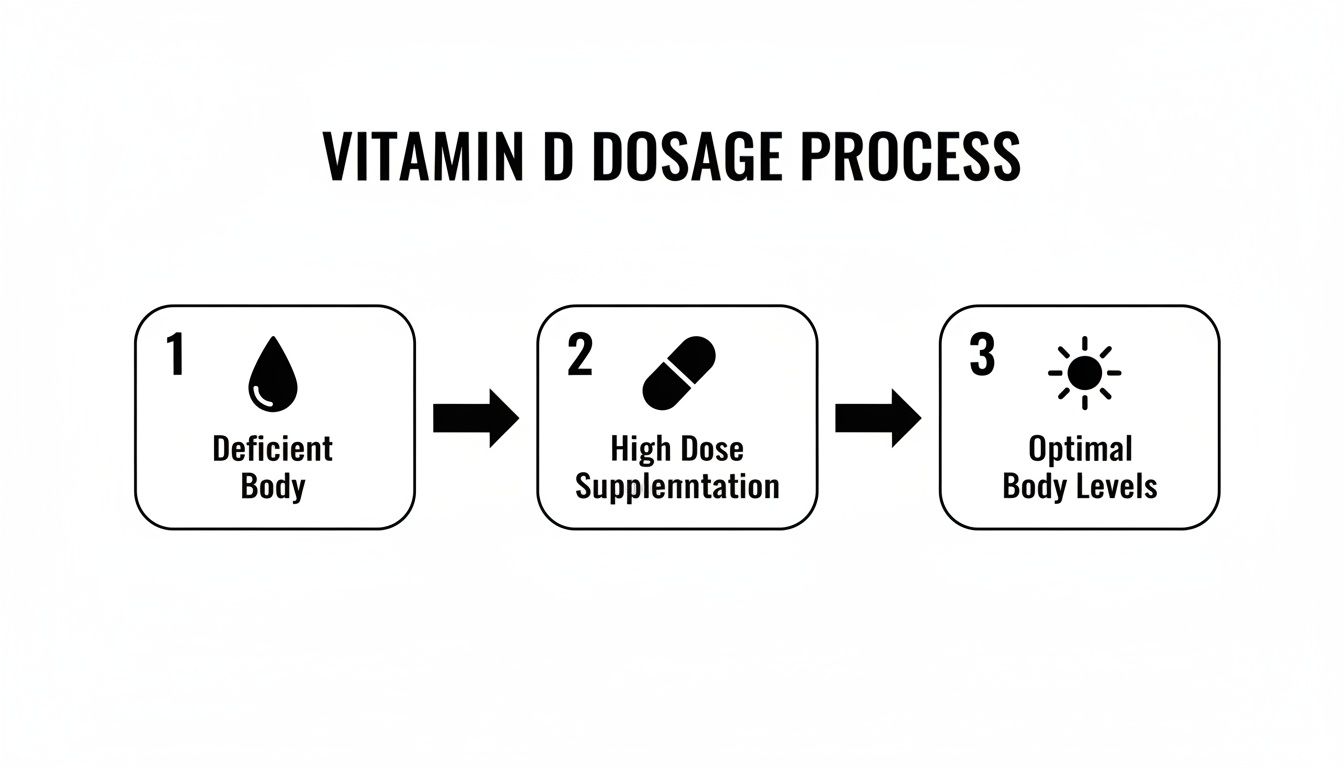
It really highlights how a targeted high dose can bridge the gap, helping your body get from a state of deficiency back to one of functional wellness.
Its Starring Role in Bone Health
Vitamin D3’s most famous job is managing calcium, the main building block of your skeleton. It's a game-changer. Without enough active vitamin D, your body can only absorb about 10-15% of the calcium you get from your diet. That’s not much.
But when your vitamin D levels are where they should be, that absorption rate skyrockets to 30-40%.
It basically acts as the gatekeeper, making sure your body can actually pull enough calcium from your food to keep your bones dense and strong. This is precisely why a deficiency can lead to conditions like osteoporosis over time—your body simply can't get its hands on the raw materials it needs to maintain its own structure.
Beyond the Bones: The Wider Impact
While bone health gets all the headlines, vitamin D3’s influence stretches far beyond your skeleton. Its role is surprisingly diverse and touches on so many aspects of your daily health.
- Immune System Modulation: Vitamin D is a key regulator of your immune response. It helps calm an overactive system while also strengthening its ability to fight off infections. To dive deeper, check out our guide on the best vitamins for immune support.
- Mood and Mental Wellbeing: Those important Vitamin D Receptors are also found in the areas of your brain that regulate mood. Keeping your levels topped up is linked to better mental health, while low levels are often associated with mood swings and feelings of depression.
- Muscle Function: Your muscles are covered in vitamin D receptors, too. Proper levels are essential for muscle strength, balance, and recovery—which is just as important for athletes as it is for preventing falls in older adults.
For those of us in the UK, getting enough vitamin D from the sun is a real challenge. Research makes it clear that sun exposure is far more important than diet for our vitamin D status, but during the winter months, getting enough becomes nearly impossible. This is what makes supplementation so essential.
To round out the immune-supporting benefits of high-strength Vitamin D3, it’s worth exploring broader strategies on how to boost immunity naturally all year round.
Identifying Who Truly Needs a Higher Dose in the UK
Not everyone needs to reach for a high strength vitamin D3 supplement. Let's be clear about that. This is a targeted tool, best reserved for specific groups whose circumstances put them at a much greater risk of deficiency. For these people, a higher dose isn't a wellness trend; it's often a crucial step to get their levels back where they need to be.
Here in the UK, a perfect storm of geography, lifestyle, and genetics means certain people are far more likely to have low vitamin D. It's time to move beyond generic advice and look at the real-world situations that demand a more robust top-up strategy.

People With Limited Sun Exposure
This is probably the biggest and most obvious group at risk. If your daily life keeps you indoors for long stretches, your skin simply doesn’t get the chance to make vitamin D from sunlight.
Think about the typical office worker. They commute early, spend eight hours inside, and head home as the sun is setting. Even on a bright summer day, their actual sun exposure might be next to nothing. The same goes for shift workers, people who are housebound, or anyone who consistently covers their skin for personal or religious reasons. Without direct UVB rays hitting the skin, natural vitamin D production grinds to a halt.
Those With Darker Skin Tones
Melanin, the pigment that gives skin its colour, is a fantastic natural sunblock. While this is great for protecting against UV damage, it also dramatically slows down the skin's ability to produce vitamin D. The more melanin you have, the longer you need to be in the sun to make the same amount of vitamin D as someone with paler skin.
In the UK's already weak sunlight—especially from autumn through to spring—this creates a major disadvantage. It means people of Black, Asian, and Minority Ethnic (BAME) heritage living in the UK are at a much higher risk of deficiency. They are prime candidates for needing a high strength vitamin D3 supplement all year round to stay on top of their levels.
Low vitamin D is a widespread issue in the UK, with studies showing that nearly half of all adults have sub-optimal levels. According to the National Diet and Nutrition Survey, 18% of adults are deficient, and that number skyrockets to a shocking 31% in winter. This problem hits BAME communities hardest, as they face significantly higher deficiency rates. You can find more insights on the UK's vitamin requirements in this detailed study from Nutraceutical Business Review.
People Living in Northern Latitudes
Geography plays a huge part. If you live in the northern parts of the UK, like Scotland or the north of England, the sun's rays are weaker and hit the earth at a lower angle for much of the year. The window for making any meaningful amount of vitamin D is even shorter than for someone living down in Cornwall.
For anyone in these northern regions, the "vitamin D winter" drags on for longer. Supplementation stops being a suggestion and becomes a basic necessity for staying healthy.
For someone living in Glasgow or Aberdeen, the sun is simply not strong enough to trigger vitamin D production between October and April. This extended period of no natural synthesis makes them particularly vulnerable to deficiency.
Individuals With Certain Health Conditions
Some medical conditions can directly interfere with how your body absorbs or uses vitamin D, making a higher dose essential just to keep up.
- Digestive Disorders: Conditions like Crohn's disease, coeliac disease, and cystic fibrosis can damage the lining of the small intestine. This makes it much harder to absorb fat-soluble vitamins, including D3.
- Obesity: Vitamin D gets stored in fat tissue. For people with a higher body mass index (BMI), more of the vitamin gets locked away in fat cells, meaning less is available in the bloodstream where it's needed. They often require a larger dose to achieve the same blood levels as someone with a lower BMI.
- Kidney or Liver Disease: The liver and kidneys are responsible for converting vitamin D into its active form. If their function is impaired, this critical process can be disrupted, leading to a functional deficiency even if your intake seems adequate.
Figuring out if you fall into one of these categories is the first step toward taking control of your vitamin D status.
Finding Your Optimal Dose Without the Guesswork
Taking a high dose of vitamin D3 isn't a shot in the dark. To get the benefits without the risks, you need a smart, safe approach, and that always starts with getting some real data about what’s going on inside your body.
The single most important first step is working with a healthcare professional to get a 25-hydroxyvitamin D blood test. This is the gold standard. It cuts through all the speculation and gives you a clear, precise starting point for any supplementation plan.
Demystifying Your Blood Test Results
Once you get your results, you'll see terms like 'deficient', 'insufficient', or 'sufficient'. These aren't just arbitrary labels; they're clinical classifications that tell your doctor exactly what your body needs.
- Deficient: This means you have a significant shortfall, and your levels are too low to support basic bodily functions properly. A deficiency often calls for a more aggressive, short-term strategy to bring your levels back up to where they need to be.
- Insufficient: This is the grey area. Your levels aren't dangerously low, but they're still below the sweet spot for optimal health. Your body is getting by, but it’s not thriving.
- Sufficient/Optimal: This is the goal. Your levels are high enough to effectively support everything from your immune system to your bone health.
Knowing where you land on this spectrum is the key to creating a truly personalised and effective dosing strategy.
To give you a clearer picture, the table below breaks down these classifications and offers a general idea of how different levels might be approached. Of course, this is just for informational purposes—always follow the guidance of a qualified professional.
UK Vitamin D Status and General Dosing Guidelines
| Blood Level (nmol/L) | Status Classification | Potential Dosing Strategy (Consult a Professional) |
|---|---|---|
| Below 25 nmol/L | Severely Deficient | A short-term, very high "loading dose" followed by a lower maintenance dose. |
| 25–50 nmol/L | Deficient/Insufficient | A higher-than-standard dose for several weeks or months to build up levels. |
| 50–75 nmol/L | Sub-Optimal | A moderate daily dose to gently increase levels into the optimal range. |
| Above 75 nmol/L | Sufficient/Optimal | A standard maintenance dose, especially during UK winter months, to stay in range. |
As you can see, the strategy changes depending on your starting point, which is why that initial blood test is so non-negotiable for anyone considering high-strength supplementation.
Loading Dose vs. Maintenance Dose
Based on your results, your healthcare provider will likely talk to you about one of two approaches.
A loading dose is a short-term, high-strength course of vitamin D3 designed to rapidly correct a serious deficiency. Think of it like refilling a critically low reservoir to get it back to a functional level quickly. Once your levels are healthy again, you’ll switch to a much lower maintenance dose.
This maintenance dose is what you stick with for the long haul. It’s designed to keep your levels stable and prevent them from dipping again, which is particularly important during the UK's long, dark autumn and winter months.
The Essential Partners: Magnesium and Vitamin K2
Here’s something that gets overlooked all too often: vitamin D3 doesn't work in a vacuum. To get the most out of it, it needs a supporting cast, and its two most critical co-stars are magnesium and vitamin K2.
Taking high-strength vitamin D3 without its key partners is like having a powerful engine without a steering wheel. Magnesium and K2 help direct the benefits of vitamin D exactly where your body needs them most.
Here’s a quick breakdown of why they're so important:
- Magnesium: This mineral is essential for converting vitamin D from its storage form into its active, usable form. If you're low on magnesium—and many of us are—your body simply can't make proper use of the vitamin D you're taking, no matter how high the dose.
- Vitamin K2: Vitamin D3 is fantastic at increasing your body's ability to absorb calcium. But that calcium needs to go to the right places. Vitamin K2 acts like a traffic controller, directing calcium into your bones and teeth while keeping it out of soft tissues like your arteries.
Together, this trio ensures that a high strength vitamin D3 regimen supports both skeletal strength and cardiovascular health. It's the smart way to supplement. It’s also worth remembering that some nutrients need careful planning when taken together. You can learn more in our guide on taking vitamin D and iron together.
How to Choose a High Quality Vitamin D3 Supplement
Walking down the supplement aisle can be a bit of a headache. With so many bottles shouting for your attention, it’s tough to know which one is actually worth your money. To make a smart choice, you have to look past the marketing noise and get to grips with what really makes a high strength vitamin D3 supplement effective and pure.
First things first, let's clear up the D2 versus D3 debate. While both will raise vitamin D levels in your blood, study after study shows that D3 (cholecalciferol) is far more effective and stable than its counterpart, D2 (ergocalciferol). Bottom line? For fixing a deficiency or just keeping your levels topped up, D3 is the clear winner.
Decoding the Different Formats
Once you've settled on D3, you'll see it comes in a few different forms. Each has its own pros and cons, which usually boil down to how well your body can absorb it and what fits best with your lifestyle.
-
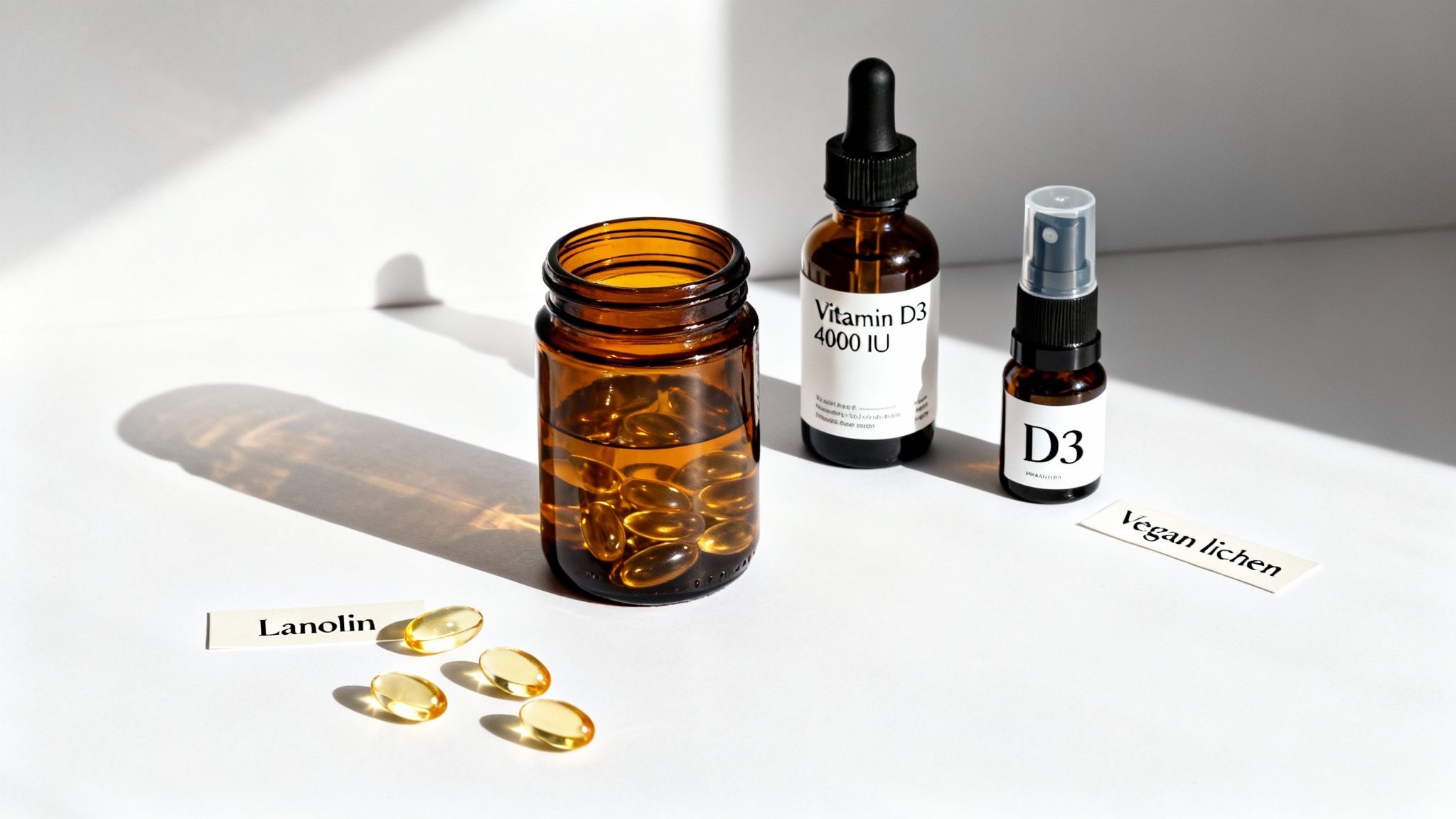
Oil-Based Softgels: This is the format you’ll see most often. Since vitamin D is fat-soluble, suspending it in an oil like olive or coconut oil gives its absorption a serious boost. Softgels are simple to take and give you a precise, pre-measured dose every time.
-
Liquid Drops: If you need a bit more control over your dose, drops are fantastic. You can easily dial your intake up or down, and they're perfect for anyone who struggles with swallowing pills. They usually come mixed with a carrier oil.
-
Oral Sprays: Sprays deliver a super-fine mist of vitamin D straight into your mouth. This lets it absorb through the lining of your cheek, completely bypassing the digestive system – a potential game-changer for people with gut absorption issues.
Honestly, the best format is often just down to what works for you. But for most people, a good quality, oil-based softgel is a solid and reliable place to start.
What to Look for on the Label
Think of the label as your guide to a supplement's quality. A brand you can trust will be completely transparent, making it easy to see exactly what you’re putting into your body.
Here’s what you should be checking for:
- Clear Dosage in IU: Make sure the dose is clearly stated in International Units (IU). A proper high strength vitamin D3 product will usually start at 4,000 IU and go up from there.
- Source of D3: The main sources are either lanolin (from sheep’s wool) or lichen (a great vegan-friendly option). Both work really well, so this choice just comes down to your dietary preferences.
- Third-Party Testing: This one is non-negotiable. Look for seals from independent organisations that verify the supplement’s purity and potency. This is your proof that it’s free from nasty contaminants and actually contains the amount of D3 it claims to.
A key indicator of a trustworthy product is finding it is Supplements GMP Certified, ensuring it meets rigorous quality standards for manufacturing, purity, and potency.
This certification tells you the brand is serious about safety and quality. And remember, vitamin D3 often works best when it has a little help from its friends. To learn more about this, you can explore the synergistic benefits of vitamin D3 and K2 in our detailed guide. Making an informed choice means you can feel confident you're investing in a supplement that will actually get the job done.
Got Questions About High Strength Vitamin D3?
Let’s be honest, diving into the world of high strength vitamin D3 can leave you with a few lingering questions. It's completely normal. To help clear things up, here are some straight-talking answers to the queries we hear most often.
Can I Just Get All the Vitamin D I Need From My Diet?
It’s a great question, and while eating vitamin D-rich foods is always a smart move, it's incredibly tough to get everything you need from your plate alone. Things like fatty fish, egg yolks, and fortified foods definitely give you a helpful boost.
But the reality is, the amounts are usually too small to fix a proper deficiency, especially for those of us in the UK where reliable sunshine is more of a hope than a guarantee.
What’s the Best Time of Day to Take Vitamin D3?
Timing can make a surprising difference. Since vitamin D is a fat-soluble vitamin, your body absorbs it much better when you take it with a meal that contains some healthy fats.
For most people, the easiest way to make this a habit is to take their supplement with breakfast or lunch. Tying it to a meal you never skip is a simple trick to ensure you’re getting the most out of every single dose.
Do I Really Need to Take Vitamin K2 With a High Dose of D3?
While it’s not a strict requirement, taking vitamin K2 alongside high dose D3 is something we strongly recommend for getting the best results. Think of them as a dynamic duo.
Vitamin D3 is brilliant at increasing calcium absorption, but you need that calcium to go to the right places. That’s where K2 comes in—it acts like a traffic controller, directing calcium into your bones and teeth, and away from your arteries where it could cause problems.
This partnership is a game-changer for supporting both your skeletal and cardiovascular health. They work together to make sure the calcium you absorb is used safely and effectively.
How Long Does It Take to Fix a Vitamin D Deficiency?
There’s no one-size-fits-all answer here, as the timeline really varies from person to person. It all depends on your starting blood level, the high strength vitamin D3 dose you’re taking, and individual factors like your metabolism and even your gut health.
Generally speaking, you’re looking at anywhere from several weeks to a few months of consistent supplementation to get your levels into a healthy range. A follow-up blood test after three months is the best way to see how you’re progressing.
It’s surprising, but despite all the public health messages, most people in the UK still aren't getting enough. The NHS recommends 400 IU daily for all adults during autumn and winter, yet survey data revealed that only 26% of Brits actually take a vitamin D supplement daily. You can read more about these findings on the HSIS website.
Ready to stop guessing and start optimising? Let VitzAI build a personalised supplement plan based on your unique goals and lifestyle. Take our free quiz today to get your customised recommendations!
This article is for informational purposes only and is not medical advice. Always consult a qualified health professional before starting any new supplement or major lifestyle change.