
Menopause Bone Health: A Practical Guide to Protection
If you're in your late forties or early fifties, you've probably noticed that bone health suddenly shows up everywhere. You search for sleep changes, hot flushes, strength training, or supplements after menopause, and somehow every road leads back to osteoporosis. It can feel like advice meant for someone much older.
That framing misses the issue. For many women, menopause bone health becomes urgent before they ever feel fragile, before they break anything, and before a scan shows outright osteoporosis. Bone loss often speeds up around the menopausal transition, which means timing matters as much as the supplement list.
A lot of advice gets muddy. One article tells you to take calcium. Another says lift weights. Another says ask about hormone therapy. All of those can matter, but not in the same way for every woman at every stage.
What helps most is a stage-based view. A woman in perimenopause, a woman two years past her final period, and a woman fifteen years past menopause are not dealing with the same bone biology, the same pace of change, or the same decision points.
Why Menopause Changes the Bone Health Conversation
You can be 49, still going to the gym, still walking the dog, still carrying groceries upstairs without a second thought, and still be entering the years when bone loss speeds up. That is why menopause changes this conversation. The issue is not whether you feel fragile. The issue is whether your skeleton has entered a phase where change happens faster than you expect.
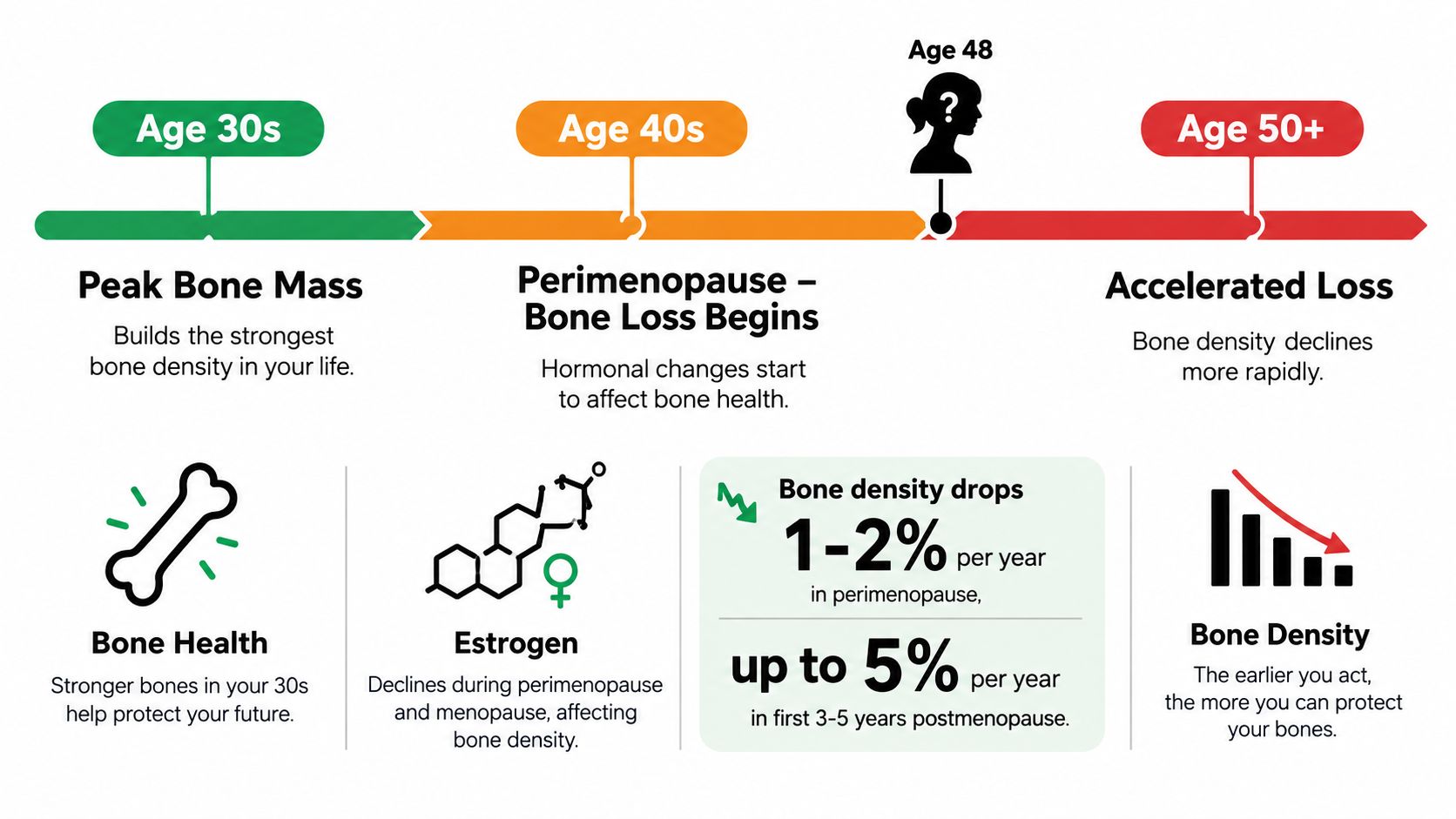
A longitudinal study found that average annual bone mineral density decline was -0.79% in premenopausal women, -2.35% in perimenopausal women, and -1.24% in postmenopausal women, with losses staying around -2.34% to -1.9% per year within 1 to 3 years after menopause (longitudinal menopause bone loss data).
Why this window matters
Bone in midlife works a bit like a bank account with a sudden jump in withdrawals. For years, deposits and withdrawals may stay close enough that your balance looks stable. Around the menopausal transition, the withdrawals can rise quickly. If you wait for a fracture or a very low T-score before paying attention, you may be reacting late rather than acting early.
This is why timing matters more than building the perfect supplement stack.
A major review reports that one in three women after age 50 will experience an osteoporotic fracture, and that osteoporosis affects about 200 million women worldwide (global review of postmenopausal osteoporosis burden). Bone loss is also silent. You do not feel your hip, spine, or wrist getting weaker in real time.
What makes menopause different is that the right response depends on stage. In perimenopause, the question may be whether risk factors, symptoms, or menstrual changes mean you should start paying closer attention. In the first few years after the final period, the focus shifts to whether rapid loss is likely enough that screening, structured exercise, or medical treatment deserves a real discussion. Fifteen years later, the pace, priorities, and treatment trade-offs are different.
That stage-based view clears up a lot of confusion. Calcium, vitamin D, protein, lifting, hormone therapy, and osteoporosis medications are not competing teams. They do different jobs. Lifestyle helps maintain the bone you still have and supports muscle, balance, and fall prevention. Supplements fill nutritional gaps when food intake is not enough. Medication can slow the accelerated bone loss that some women face in this early postmenopausal window, or reduce fracture risk once bone strength has already fallen.
Practical rule: Treat menopause bone health as a timed decision problem. The first three to seven years after menopause often matter more than people realize.
If you are sorting through broad wellness advice and wondering where pills fit compared with food, exercise, and treatment, a guide to supplements after menopause can help you place them in the right role instead of turning them into the whole plan.
How Falling Estrogen Reshapes Your Skeleton
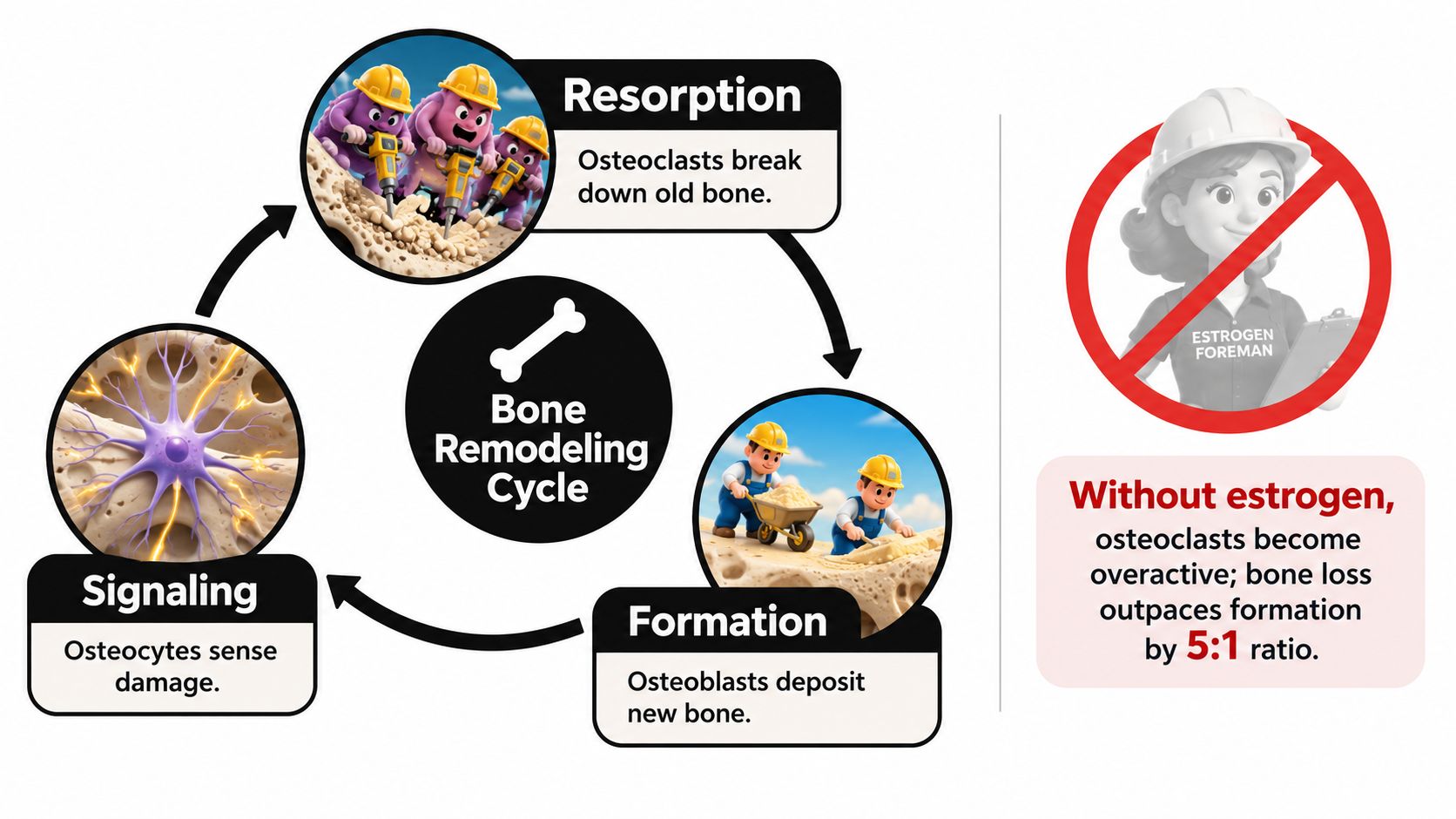
Bone sounds solid and fixed, but it isn't. It's living tissue. Your skeleton stores minerals, houses marrow, and constantly repairs tiny areas of wear. The easiest way to picture it is as a renovation site that never closes.
The demolition crew and the builders
Three cell types do most of the work:
- Osteoclasts break down older bone. Think demolition crew.
- Osteoblasts lay down new bone. They're the builders.
- Osteocytes sit inside bone and sense strain or microdamage. They're the site managers.
Estrogen acts a bit like the foreman. It keeps the demolition side from getting too aggressive, supports the builders, and helps the signaling system stay coordinated.
When estrogen falls, that balance tips. Bone remodeling shifts toward net resorption, meaning more bone gets removed than replaced. One review describes a critical about 3-year window around the final menstrual period when rapid losses in bone mass and strength occur, driven by estrogen deficiency and higher bone turnover (review on menopause-related skeletal loss and timing).
Why some bones are hit first
Trabecular bone is the light, mesh-like bone found in places like the spine and parts of the hip and wrist. It has a large surface area, so it turns over faster than denser cortical bone. That makes it more vulnerable early.
This helps explain why the first major warning signs may show up as:
- Vertebral compression fractures
- Wrist fractures
- Loss of height
- A stooped posture over time
Here's a short visual if you want to see the remodeling cycle in a different format.
Bone isn't a calcium bank that simply empties with age. It's a living structure that responds to hormones, loading, nutrition, and treatment.
That biology is also why the conversation about hormones isn't cosmetic or optional for everyone. If you're trying to understand the role of treatment, a practical place to start is learning how to find safe HRT prescriptions and what questions to bring to a clinician.
The Two Phases of Postmenopausal Bone Decline
A useful way to picture postmenopausal bone loss is to separate it into two jobs your body is trying to do under different conditions.
In the first phase, which usually covers the first several years after menopause, bone is changing in a hurry. In the second, the pace slows, but loss can keep accumulating over time. Those phases matter because the same plan does not fit both.
One guideline review describes average bone loss of about 1% to 2% per year, with reported rates ranging from 1% to 5% yearly, most noticeably in the first 5 to 7 years after menopause (guideline review on postmenopausal bone loss). That early window is the part many women underestimate. If bone loss is front-loaded, timing matters more than building the perfect supplement routine.
A simple analogy helps here. Early after menopause, bone remodeling works like a home that has suddenly switched to a larger demolition crew and a smaller repair crew. Later, the imbalance is less dramatic, but the house still needs upkeep, and small deficits add up year after year.
Early rapid phase versus late chronic phase
| Feature | Early Rapid Phase (Years 0–7) | Late Chronic Phase (Years 8+) |
|---|---|---|
| Pace of loss | Faster, often heaviest in the first few years | Slower, but still cumulative |
| Main driver | Sharp hormone shift and high bone turnover | Aging, persistent low estrogen, muscle loss, and fall risk |
| What matters most | Catching risk early and deciding whether lifestyle alone is enough | Preventing fractures, preserving mobility, and tracking change over time |
| Typical strategy | Resistance and impact exercise, adequate protein and calcium intake, vitamin D if needed, earlier testing in higher-risk women, and treatment discussion if risk is high | Ongoing strength work, balance training, fall prevention, repeat bone-density monitoring, and medication when fracture risk justifies it |
This stage-based view changes practical decisions.
For a healthy woman in her early fifties who has just gone through menopause, the key question is often, "Am I in that fast-loss window, and do I have reasons to act sooner?" For a woman fifteen years past menopause, the question is more often, "What is my fracture risk now, and what will best protect function and independence?"
Those are related questions, but they are not the same.
Who should pay closer attention during the early window
Bone loss in the early phase deserves more urgency when risk is already stacked against you. That includes women with:
- Early menopause
- Low body weight
- Prior fracture
- Smoking
- Glucocorticoid use
- Surgical menopause or other abrupt estrogen loss
Trade-offs become real. Supplements can support the basic materials for bone, and exercise gives bone a reason to stay strong. Neither can fully counter high-turnover bone loss in every woman during the early postmenopausal years. For some, especially those with major risk factors or already low bone density, medication or hormone therapy belongs in the conversation earlier rather than later.
So the main takeaway is simple. The first three to seven years after menopause are not just "the same bone health advice, but sooner." They are a distinct biological window. During that window, timing often matters more than the length of your supplement list.
DEXA Scans, T-Scores and When to Start Screening
A DEXA scan is the main test clinicians use to measure bone mineral density. If you've seen a report and felt lost, that's normal. Many patients get handed a number and no useful translation.
What a T-score actually means
A T-score compares your bone density with that of a healthy young adult reference population. The widely used diagnostic cutoff for osteoporosis in postmenopausal women is a DEXA T-score of -2.5 or lower at the lumbar spine, femoral neck, or total hip (AAFP summary of WHO and ISCD criteria).
A simple way to read the categories is this:
| T-score range | WHO category | Typical clinical interpretation |
|---|---|---|
| -1.0 and above | Normal | Bone density is not in the osteopenia or osteoporosis range |
| Between -1.0 and -2.5 | Osteopenia | Lower than ideal bone density, but not osteoporosis |
| -2.5 and below | Osteoporosis | Bone density is low enough to meet the diagnostic threshold |
A Z-score is different. It compares you with people your own age and is often more useful when someone is younger than expected for this conversation or when a clinician is looking for causes beyond usual menopausal bone loss.
When screening starts to make sense
ACOG guidance summarized by AAFP recommends bone-density screening for all postmenopausal women aged 65 and older, and also for younger postmenopausal women whose estimated fracture risk is greater than 8.4% using FRAX (AAFP summary of ACOG osteoporosis screening guidance).
That still leaves room for judgment in the years before 65. In practice, a baseline conversation is reasonable sooner if you have risk factors such as family history, low body weight, glucocorticoid use, early menopause, or a prior fracture.
Clinical takeaway: Symptoms don't reliably tell you what your bones are doing. A woman can feel fine while losing bone quickly.
A few practical points help:
- Scan sites matter. The lumbar spine and hip are especially useful because they capture common fracture-risk areas.
- Trend matters more than one isolated number. A stable result means something different from a falling one.
- Machine differences can confuse comparisons. If possible, repeat testing on the same system or at least in the same network.
- Testing lives alongside other information. Clinicians combine DEXA results with history, risk tools, and sometimes lab work.
If you're sorting through whether support from diet or supplements is even relevant, a plain-language guide to vitamin D benefits can help connect one common deficiency question to the bigger screening picture.
Exercise That Actually Builds Bone After Menopause
A common scenario goes like this. A woman starts walking more, adds a light dumbbell class, and assumes she has checked the "bone health exercise" box. Months later, her routine is better for fitness than it is for bone.
Bone is selective. It does not respond much to movement it has already adapted to. A useful comparison is sunscreen and rain boots. Both are protective, but they solve different problems. Exercise works the same way after menopause. Walking helps one part of the picture. Heavier lifting, impact, and balance training each cover a different need.
The first few years after menopause matter here. During that window, falling estrogen can speed bone loss enough that timing matters more than building a perfect routine on paper. A woman in early postmenopause often needs a stronger "keep this bone" signal than a woman whose bone loss has already slowed years later. That does not mean everyone should jump into hard training. It means exercise should match stage, joints, skill, and fracture risk.
Match the exercise type to the job
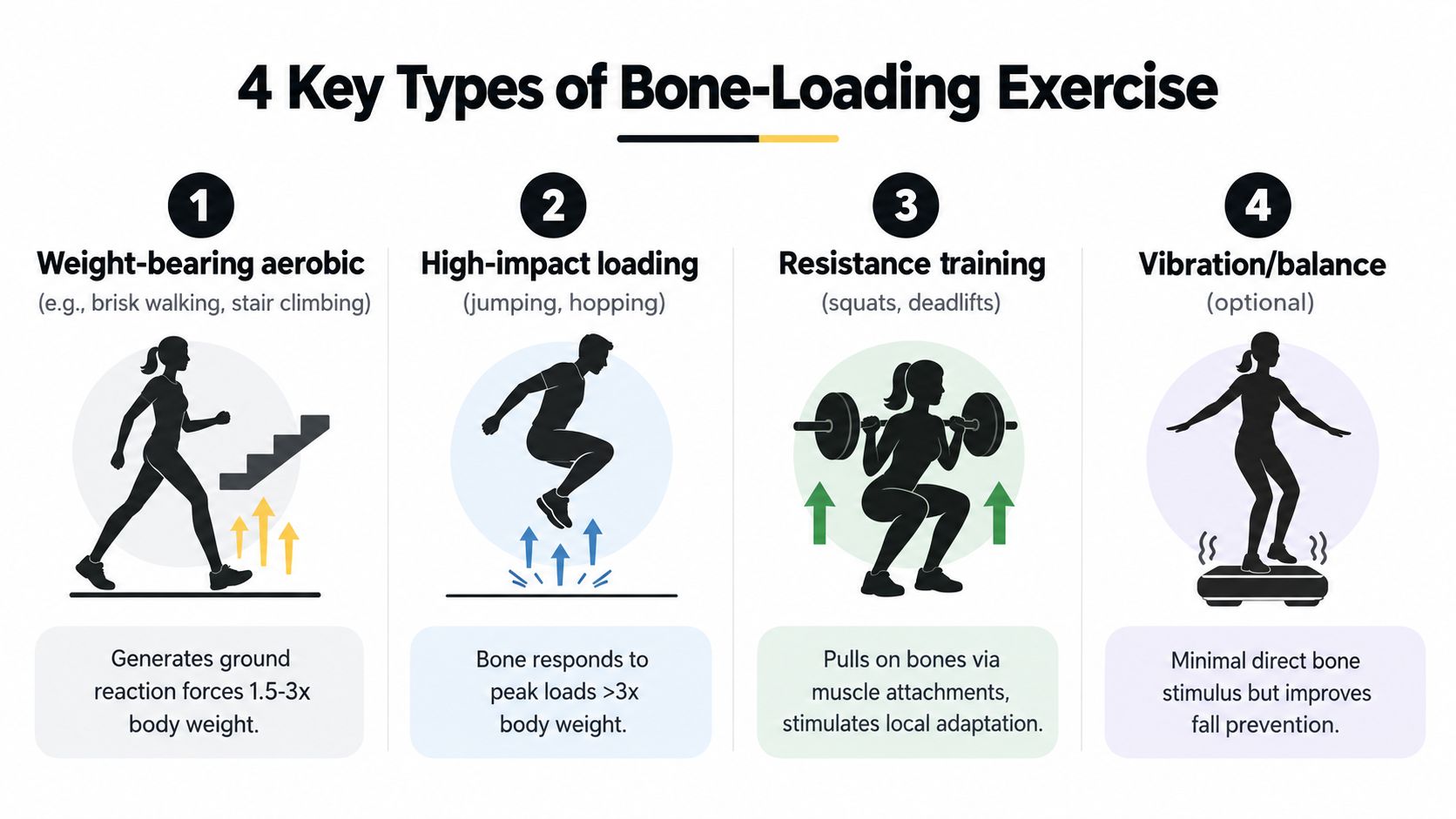
Walking, hiking, stairs, and dancing are useful weight-bearing activities. They load the hips and legs through ground contact and support heart health, mood, and consistency. For bone, though, the signal is usually modest once your body gets used to it. Walking is a base layer, not the whole treatment plan.
Resistance training is the part many women underuse. Muscles pull on bone like cables tugging on a mast. That pull is one of the clearest signals bone receives to maintain or add strength. Squats, deadlifts, rows, presses, carries, and step-ups can all do that if the load progresses over time. Clinical research on postmenopausal women with low bone mass has shown that supervised high-intensity resistance and impact training can improve bone density and function when done with proper technique and screening (LIFTMOR trial report in the Journal of Bone and Mineral Research).
Impact work gives bone a sharper message. Hops, jumps, skipping, or step drops create brief forces that differ from the steady rhythm of walking. Bone tends to respond to novelty and rate of loading, not just time spent moving. But impact is not a starting point for everyone. If you have vertebral fractures, significant osteoporosis, major joint pain, or poor balance, this needs clinical judgment.
Balance and posture training do not build much bone directly, but they reduce the chance of the event that causes the fracture. That matters just as much in real life. Single-leg standing, heel-to-toe walking, tai chi, and hip-strengthening drills are practical choices.
What this looks like at different menopause stages
Early after menopause, especially in the first three to seven years, the goal is often to send a clear mechanical signal before bone loss gains speed. That usually means learning strength movements well, then progressing load, and adding some impact if it is safe.
Later postmenopause often shifts the priority. The goal may be to preserve bone, improve strength for daily life, and lower fall risk, especially if arthritis, pain, or prior fractures limit impact options.
A simple way to sort it:
- Early postmenopause, lower fracture risk: build a progressive strength program, keep regular weight-bearing cardio, consider supervised impact
- Early postmenopause, higher fracture risk or known low bone density: prioritize coached resistance training and balance work, with impact chosen carefully or avoided
- Later postmenopause: maintain resistance training, keep daily weight-bearing activity, and give balance and fall prevention more attention
If you want examples of how to scale that around energy swings, recovery, and changing joints, this roundup of perimenopause training advice for women is a useful companion.
A week that is realistic and bone-focused
For a beginner, a useful week often looks less glamorous than people expect.
Two strength sessions. One or two sessions that include hills, stairs, or another weight-bearing challenge. Short balance practice most days. Walking for general activity.
The key is progression. If you always use the same light weights for the same easy sets, your bones have little reason to adapt. Many women get stuck there because it feels safe and familiar. Bone usually needs a gradually increasing challenge, delivered with good form, enough recovery, and exercises you can keep doing for months.
That is the trade-off to be honest about. Exercise is powerful, but it is not interchangeable with medication for a woman at high fracture risk, and supplements cannot substitute for loading. In early menopause, training can be a major part of the plan. In established osteoporosis, it is still part of the plan, but the program often needs tighter guardrails and sometimes medical therapy alongside it.
Calcium, Vitamin D, K2 and Protein What the Evidence Shows
A common pattern goes like this. A woman reaches menopause, buys calcium, adds vitamin D, maybe hears that K2 is the missing piece, and assumes the supplement stack is now handling bone health.
Sometimes that helps. Sometimes it delays the more important question, which is, "What stage am I in, and what problem am I trying to solve?"
The first few years after menopause are not the same as twenty years later. In that earlier window, timing often matters more than the size of the supplement shelf. Nutrients support the plan, but they do not erase rapid estrogen-related bone turnover, and they do not replace bone-loading exercise or, for some women, medication.
A simple way to organize this is to treat supplements like building materials. If the house is missing bricks, calcium and protein matter. If the workers cannot do their job, vitamin D status matters. But if the remodeling crew is tearing down bone faster than usual in early postmenopause, supplies alone may not keep up.
Start with the gaps that are real
For calcium, food usually comes first. Many clinical guidelines aim for about 1200 mg per day for women over 50, with supplements used to fill a shortfall rather than as the automatic starting point. That approach lowers the odds of taking more than you need and keeps the plan tied to what you eat.
Vitamin D is different. It works more like a gatekeeper for calcium absorption than a raw material for bone. If your level is low, calcium from food or pills is less useful. If your level is adequate, taking more is not automatically better.
K2 gets a lot of attention online because it sounds like the advanced move. In practice, it sits behind the basics. If calcium intake is low, protein is inconsistent, and vitamin D status is unknown, K2 is not the first lever to pull. A plain-language review of vitamin D3 and K2 for bone support can help if you are deciding whether a combined product fits after those basics are covered.
Protein belongs in this conversation more than many women realize.
Bone is not just mineral. It is living tissue built on a protein framework, and muscle strongly affects fracture risk because stronger muscle improves balance, training capacity, and the forces that help maintain bone. If meals are light, appetite is down, or breakfast is mostly coffee and toast, protein can be the limiting factor long before K2 enters the picture. If you want a practical refresher, this guide on protein needs for muscle gain is a helpful place to start.
What matters most at different menopause stages
In perimenopause or very early postmenopause, the priority is often identifying weak links. Are you under-eating protein? Avoiding dairy without replacing calcium elsewhere? Rarely outside, or never tested for vitamin D deficiency? This is also the stage where women can waste time chasing niche supplements while missing the short biological window where overall strategy matters most.
A few years later, if osteopenia or osteoporosis is already on the table, supplements become more clearly supportive. They still matter, but the job changes. The question is no longer "Which capsule is best?" It is "Have I covered the basics well enough that the rest of my plan can work?"
Here is the practical hierarchy:
- Calcium: useful when diet falls short
- Vitamin D: useful when status is low or intake is poor
- Protein: often underappreciated, especially if strength, appetite, or muscle mass is slipping
- K2: optional adjunct for some women, not a foundation
- Magnesium, omega-3s, creatine, powders: context-dependent tools that may support training, recovery, or general health more than bone directly
That last group still has value. A woman who sleeps poorly, recovers badly, and skips strength training because she feels wrung out may benefit more from fixing recovery and protein intake than from adding one more bone-branded supplement.
The honest trade-off is simple. Supplements can close gaps. They cannot, by themselves, match the fracture-risk reduction needed in a woman with established osteoporosis, and they should be chosen based on menopausal stage, diet pattern, and measured risk rather than treated like a one-size-fits-all checklist.
Beyond Supplements When Medication Becomes the Right Call
A common scenario goes like this. A woman in her mid-50s has been faithfully taking calcium and vitamin D for years, then a scan comes back showing osteoporosis or she has a wrist fracture after a simple fall. At that point, the question changes. It is no longer about building the perfect supplement stack. It is about choosing a treatment plan that matches how much bone has already been lost and how fast future loss could happen.
That timing matters in menopause. The first several years after the final period are a biologically active window, almost like a period of accelerated remodeling on a house that has lost its head contractor. If risk is still modest, lifestyle work and correcting nutrition gaps may be enough. If bone density is already in the osteoporosis range, or a fragility fracture has already happened, supplements play a supporting role while medication does the heavier lifting.
Medication enters for different reasons at different stages.
Early after menopause, especially in women who are also dealing with hot flashes, sleep disruption, or other menopausal symptoms, menopausal hormone therapy can serve two jobs at once. It can treat symptoms and help protect bone. A review of fracture outcomes with menopausal hormone therapy found lower hip, vertebral, and overall fracture rates in appropriate candidates (fracture outcomes with menopausal hormone therapy and related evidence).
Later, or in women whose fracture risk is already high, the conversation often shifts away from hormone therapy and toward osteoporosis drugs chosen specifically for bone strength. Bisphosphonates are often the first antiresorptive option because they slow the cells that remove bone. If you picture bone as a bank account, these drugs reduce the rate of withdrawal. For women with very low bone density, multiple fragility fractures, or a vertebral fracture pattern that suggests more aggressive disease, anabolic medicines may be considered because they stimulate new bone formation more directly.
Here is the practical way to sort the options:
| Situation | Treatment discussion usually centers on | Why |
|---|---|---|
| Perimenopause or very early postmenopause, symptoms present, fracture risk not yet high | Menopausal hormone therapy, if medically appropriate | Bone protection may be paired with symptom relief during the fast-loss window |
| Postmenopause with osteoporosis on DEXA or a prior fragility fracture | Bisphosphonates or another osteoporosis medication | Fracture-risk reduction usually requires more than supplements and exercise alone |
| Severe osteoporosis, multiple fragility fractures, or very high risk | Specialist-guided anabolic therapy, often followed by an antiresorptive plan | Higher-risk bone loss may need a stronger sequence of treatment |
A T-score of -2.5 or lower, or a low-trauma fracture after age 50, usually deserves a medical treatment discussion rather than a longer trial of self-directed supplements.
A few warning signs should speed that appointment up: new back pain, measurable height loss, a fracture from a minor fall, very early menopause, or abrupt surgical menopause. Those clues can signal that the "wait and see" approach is no longer the right fit.
Supplements still matter here. They help medication work on a better foundation, especially if calcium intake is low, vitamin D status is poor, or protein intake is lagging. Guidance from the Bone Health and Osteoporosis Foundation keeps calcium and vitamin D in the support role they belong in, alongside proven osteoporosis treatment rather than instead of it (Bone Health and Osteoporosis Foundation guidance on treatment support basics).
One practical option for people who want help narrowing supplement decisions without turning that into self-treatment is VitzAi.com, which offers a personalised supplement quiz that matches products such as multivitamins, magnesium, omega-3, creatine, and other support options to your goals, diet, energy, sleep, and training habits. That can help with the lifestyle side of the plan. It does not replace a clinical evaluation when fracture risk is already high.
Your 12-Month Menopause Bone Health Action Plan
A lot of women hit this stage the same way. Periods have stopped, sleep may be different, workouts do not feel as effective, and a supplement list starts to grow. Calcium. Vitamin D. Maybe collagen. Maybe K2. What often gets missed is the clock. The first few years after the final period are not just "postmenopause." They are a faster bone-change window, and the plan should reflect that.
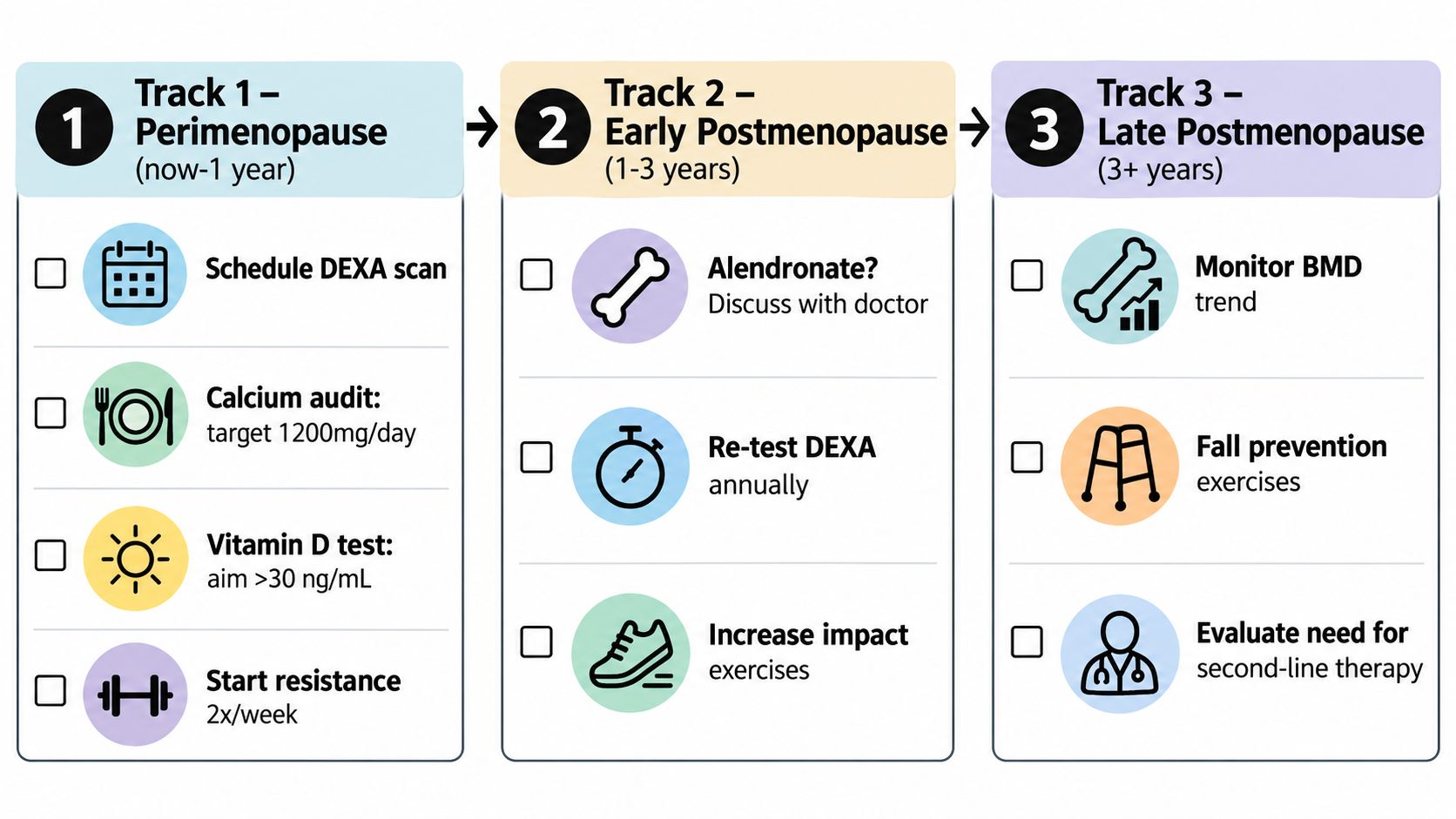
A useful action plan matches the stage you are in. Lifestyle habits matter in every stage. Supplements can fill gaps. Medication enters the picture sooner for some women, especially during the early postmenopausal years when bone loss can move faster than it looks from the outside.
Track 1 for perimenopause
If periods are irregular but not fully gone, your job is to build a strong starting position before estrogen drops further.
- Month 1: Review your risk factors. Early menopause, low body weight, prior fracture, a strong family history, smoking, heavy alcohol use, steroid use, and certain medical conditions all raise concern. If any apply, book a clinician visit and ask whether earlier screening makes sense.
- Month 3: Check your foundation. Aim to get enough calcium from food first, keep protein intake up, and ask whether vitamin D testing fits your situation instead of guessing.
- Month 6: Begin or progress resistance training at least twice a week. Add brief balance work on most days. Bone responds to load the way muscle responds to challenge. It needs a reason to stay strong.
- Month 12: Reassess. If symptoms are increasing, cycles have stopped, or risk factors have changed, revisit whether a DEXA or hormone therapy discussion belongs on the table.
Track 2 for early postmenopause
This is the stage where timing matters most. If you are in the first several years after your final period, the goal is not to collect more supplements. It is to decide, early, whether lifestyle support is enough or whether you need medical therapy added on top.
- Month 1: If you have not had a bone risk review, do it now. Ask about DEXA timing, fracture risk, and whether your menopause timing changes the plan.
- Month 3: Tighten exercise, not just step count. Keep walking if you enjoy it, but add progressive strength work and, if appropriate, supervised impact training. Walking helps general health, but it is often too gentle to push bone to adapt.
- Month 6: Audit the support pieces. Are you meeting calcium needs from diet plus supplements if needed? Are you getting enough vitamin D if levels are low or sun exposure is limited? Is protein intake high enough to support muscle and bone? If bone density is low, falling, or fracture risk is high, discuss medication rather than extending a supplement trial that is not changing the main problem.
- Month 12: Recheck the plan with your clinician. If treatment started, review tolerance, adherence, and next steps. If treatment did not start, confirm that watchful waiting still makes sense.
For some women in this window, estrogen-based therapy with regimen adjusted to uterus status and symptoms may help the broader menopause picture and support bone. For others, a non-estrogen osteoporosis medication is the more appropriate tool. The right choice depends on symptoms, age, timing since menopause, fracture risk, and personal medical history.
Track 3 for late postmenopause
If you are many years past menopause, the job shifts from catching rapid change to preserving function and preventing fractures.
- Month 1: Review fall risk at home and outside it. Check lighting, rugs, stairs, footwear, vision, and any medications that affect balance or blood pressure.
- Month 3: Keep strength training in the routine. Add balance practice if it has slipped. Lower-body strength and steadiness often matter as much as scan numbers in day-to-day fracture prevention.
- Month 6: If you are on osteoporosis medication, review how long you have been taking it, whether it is working, and whether a pause or switch is appropriate. Those decisions should be based on fracture history, scan trend, and overall risk, not habit.
- Month 12: Reassess the full picture. Bone density, falls, mobility, grip strength, back pain, and height change all add context.
A better plan beats a bigger supplement shelf.
Short FAQ
What should I do first if I do not know my risk?
Start with a clinician review of menopause stage, fracture history, medications, family history, body weight, and training habits. That gives context for everything else.
Are supplements enough in the early postmenopausal years?
Sometimes, if bone risk is low and your basics are solid. Often, they are support tools rather than the main treatment. They help build the floor. They do not always stop fast bone loss on their own.
Does collagen belong in the plan?
It can be part of a broader routine for some women, but it should stay in the minor-support category. The bigger levers are loading exercise, enough protein, adequate calcium, vitamin D when needed, and medication when fracture risk is high.
If you want help sorting the supplement side without guessing, VitzAi.com offers personalised guidance based on your age, diet, exercise, sleep, stress, and health goals. That can help you figure out where products like magnesium, creatine, omega-3, multivitamins, or vitamin D may fit into a sensible menopause bone health routine instead of building a random stack.
This article is for informational purposes only and is not medical advice. Always consult a qualified health professional before starting any new supplement or major lifestyle change