

Menopause Supplements UK: An Evidence-Based Guide
The most popular advice about menopause supplements in the UK is also some of the least useful: buy an expensive all-in-one blend labelled for menopause, and trust the premium price to do the thinking for you. I wouldn't. A glossy bottle can contain a long list of herbs while leaving out the two nutrients with the clearest rationale for post-menopausal bone health, calcium and vitamin D.
The sensible approach is more boring and more effective. Start with your diet, symptoms, medications, and long-term priorities. Then choose transparent, targeted supplements where there's a clear reason, rather than paying for a proprietary formula that uses vague claims and token doses.
What the UK Menopause Supplement Market Actually Sells
Menopause supplements have moved well beyond a small wellness niche. A European industry report estimated the UK women's health market at US$2.1 billion in 2024, with menopause relief identified as the fastest-growing segment and the market projected to reach US$3.1 billion by 2030 (European women's health market report). More spending has created more products, but testing discussed later shows that bigger choice does not guarantee better formulations.
The central mistake is assuming that a product designed specifically for menopause must outperform a basic vitamin or a small group of targeted nutrients. UK menopause products vary widely in ingredients, doses, format, and value. A bottle may list ten botanicals on its front label while giving little useful information about the amount of each one. It may also omit calcium and vitamin D, despite their clearer role in supporting bone health after menopause.
Premium packaging is not clinical quality
The market includes straightforward nutritional products, herbal formulas, powders, capsules, and expensive “complete” blends. Some suit a particular person and purpose. Others are ordinary multivitamins with a menopause-themed label, plus fashionable plant extracts added to justify a higher price.
Judge the formulation, not the category name. Check whether the label identifies every active ingredient, gives a meaningful dose, and addresses your actual priority. “Hormone balance” is a marketing phrase, not a dose, diagnosis, or purchasing criterion. A long botanical list can create the appearance of sophistication while contributing little practical value.
Practical rule: A menopause label is a marketing description. It isn't proof that the product matches your nutritional needs.
A specialist menopause collection from Momotaro Apotheca can provide a useful starting point, but apply the same scrutiny to every product page. Compare ingredients, serving information, and dose before buying. Attractive branding should never replace a label check.
The market will keep expanding as awareness grows. That can help women find suitable support, but it also gives companies more opportunities to turn symptom anxiety into sales. The sensible purchase is rarely the bottle with the longest ingredient list. Choose the product that addresses a defined need, states what it contains, and does not charge a premium for weak-evidence botanicals while leaving out nutrients with a clearer nutritional rationale.
Why Bone Health Nutrients Outweigh Botanical Blends
Oestrogen helps protect the skeleton. As oestrogen declines during and after menopause, bone loss can accelerate, which makes long-term bone support more important than chasing a short-lived promise about “balance” or “wellbeing”. This is why I'd put calcium and vitamin D near the centre of a menopause nutrition conversation, especially for women who aren't using HRT.
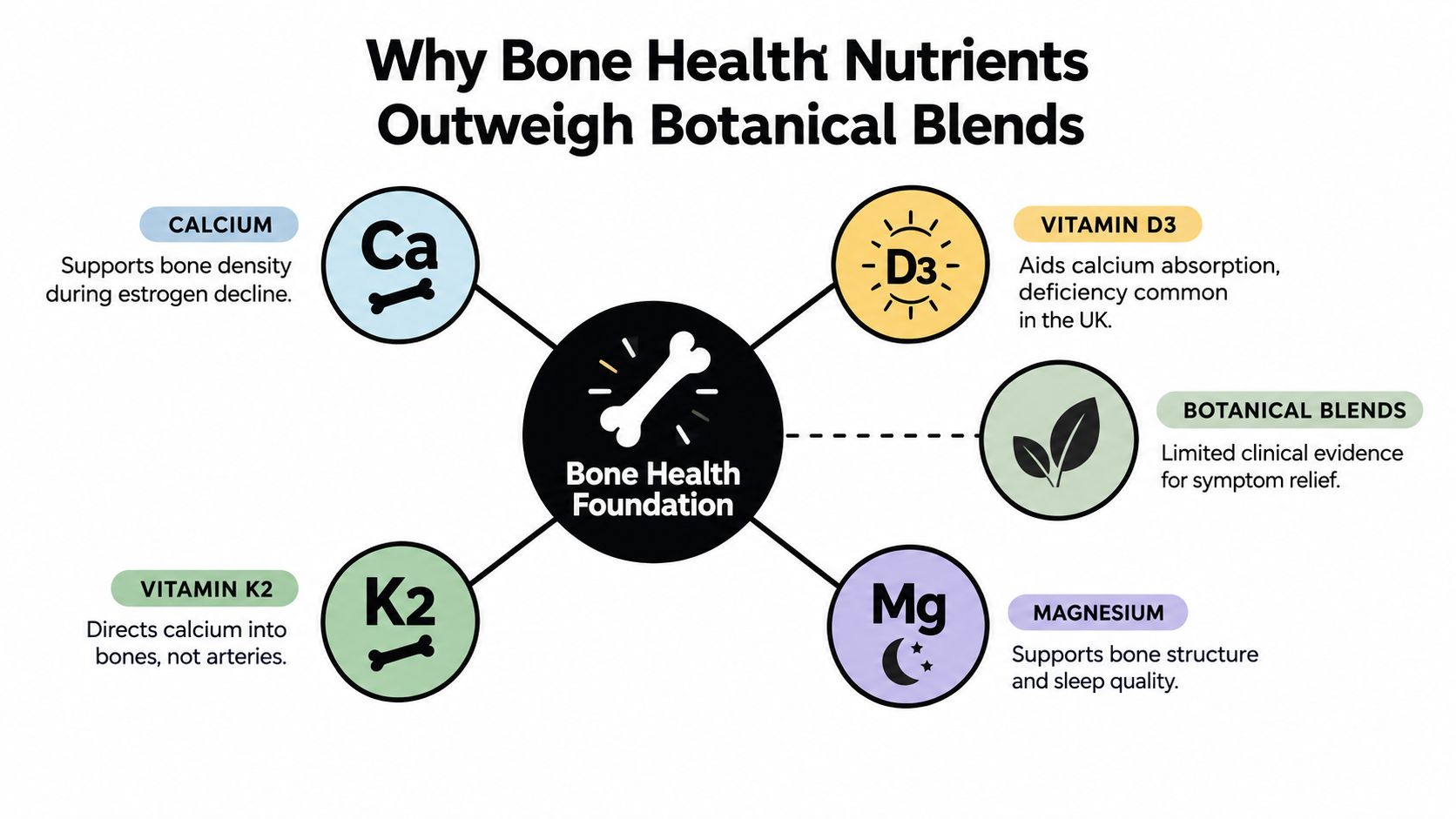
Vitamin D helps the body use calcium, while calcium supplies a structural mineral required by bone. Neither nutrient is a magic fix, and supplements shouldn't compensate for a poor diet or replace resistance exercise, but their physiological role is considerably clearer than the evidence behind many broad symptom blends.
The uncomfortable formulation gap
In 2026, UCL reported that half of menopause supplements tested didn't contain vitamin D, while only 23.9% contained calcium, despite both nutrients being highlighted in British Menopause Society and International Menopause Society guidance for bone health after menopause (UCL review of menopause supplements). That's a serious mismatch between what many products sell and what many women may reasonably want from a menopause formula.
The problem isn't omission. A product can include calcium or vitamin D in a quantity that looks reassuring on the label but contributes little to a person's overall intake. You need to assess the amount per serving, your dietary intake, and whether another supplement or fortified food is already providing the same nutrient.
The menopause bone health guide is useful background for understanding why this deserves separate attention. Commercially, it also supports a better product architecture: one clearly labelled bone-support product, plus optional symptom-focused products, is easier to evaluate than one opaque all-in-one capsule.
Separate foundations from experiments
Botanicals may be relevant for some symptoms, but they shouldn't displace the nutritional foundations. UK guidance says there isn't enough evidence to make strong recommendations for soy or isoflavones to reduce hot flushes or night sweats (British Nutrition Foundation menopause nutrition guidance). That doesn't prove every botanical is useless. It does mean the marketing should be more modest than the packaging often suggests.
A nutrient-led plan is especially sensible when the main objective is preserving skeletal health. If you want to trial a botanical for hot flushes, mood, or sleep, treat it as a separate, time-limited experiment. Keep the label transparent, avoid stacking several similar blends, and stop if there's no noticeable benefit or if a clinician advises against it.
Evaluating Popular Ingredients and Their Clinical Evidence
Ingredients deserve separate verdicts. A formula can contain something plausible without proving that the finished product works, particularly when it combines several substances and doesn't disclose their individual amounts.
Omega-3 is reasonable, but not a menopause cure
Omega-3 is heavily marketed for mood, cardiovascular health, cognition, and hot flushes. The menopause-specific evidence is much less impressive than the general wellness messaging. A systematic review of three randomised controlled trials involving 483 women found no overall improvement in hot flushes, insomnia severity, sleep quality, quality of life, or adverse effects compared with placebo. It did report lower night-sweat frequency by 1.82 and night-sweat severity by 0.89 compared with placebo (omega-3 systematic review).
My view is simple: take omega-3 because you have a dietary reason, such as low oily-fish intake, not because you expect it to eliminate menopause symptoms. Another menopause-focused review described the evidence for hot flashes, depressive symptoms, and cognitive symptoms as far from conclusive (review of omega-3 during the menopausal transition).
Magnesium has a more practical role
Magnesium is often included in sleep and stress formulas. The evidence is not a licence to claim that magnesium alone fixes insomnia, but it's a more plausible targeted option when sleep disruption, dietary insufficiency, or muscle tension is the concern. A 2024 systematic review found that nutritional interventions for menopause-related sleep problems generally helped subjective sleep more than objective sleep measures. One included 24-week trial used a combination containing magnesium 50 mg, soy isoflavones, calcium, vitamin D3, and magnolia bark extract, which shows that magnesium is often studied inside a multi-ingredient formula rather than by itself (systematic review of nutritional interventions and menopause sleep).
That distinction matters. If a product claims that magnesium is responsible for the whole result, the study may not support that conclusion. Choose a transparent product and judge it against your actual sleep experience, not against a promise of hormonal transformation.
Botanicals need stricter scrutiny
Herbs and phytoestrogens are common in this category, but popularity isn't the same as dependable evidence. The sensible questions are: which exact extract is used, what amount is provided, what outcomes have been studied, and could the ingredient interact with medication?
| Ingredient | Primary claim | Clinical reality |
|---|---|---|
| Calcium | Supports bone structure after oestrogen decline | A foundational nutrient with a clear post-menopausal rationale, but intake should be considered alongside diet and professional guidance. |
| Vitamin D | Supports calcium use and bone health | A key foundation that many tested menopause products omitted, according to the UCL review. |
| Magnesium | Supports sleep and relaxation | Promising for targeted use, but menopause sleep studies often assess it in combination formulas. |
| Omega-3 | Reduces hot flushes and improves mood | Evidence is mixed, with no overall improvement in hot flushes or sleep quality in the cited review. |
| Soy and other phytoestrogens | Reduces vasomotor symptoms | UK nutrition guidance says evidence isn't strong enough for firm recommendations for hot flushes or night sweats. |
The best formula isn't the one with the most botanicals. It's the one that makes a defensible claim, discloses its dose, and doesn't force you to buy unrelated ingredients.
Navigating Safety and HRT Interactions
Supplements aren't automatically harmless because they're sold without a prescription. A capsule containing several herbs can have more interaction potential than a straightforward vitamin or mineral, and the risk increases when you take prescription medicines.
UK consumer guidance states that supplements aren't a substitute for HRT, can be used alongside HRT only after checking for interactions, and may interact with medicines when they contain herbal or botanical ingredients (UK guidance on menopause supplements and HRT).
Use a short safety process
First, list everything you take. Include HRT, prescription medicines, painkillers, vitamins, herbal teas, powders, and occasional products. A pharmacist or doctor can only assess the combination if you give them the complete list.
Next, separate nutritional support from hormone claims. Calcium, vitamin D, or magnesium may fill a dietary gap, but they don't perform the same role as HRT. Don't stop prescribed treatment because a supplement advertises itself as a “natural alternative”.
Then, question complex blends. If a product hides doses inside a proprietary blend, you can't properly assess duplication or interaction risk. This is a good reason to prefer single nutrients or clearly itemised products when you're taking HRT or other medication.
Women researching hormonal treatment may also encounter information about BioTe pellet treatment benefits. That material concerns a hormone treatment approach, not a supplement, so it shouldn't be evaluated using the same assumptions as an over-the-counter vitamin.
Finally, review the full combination before adding another product. The practical guidance in can you take too many supplements is relevant here because stacking a multivitamin, menopause blend, bone product, and sleep formula can create unnecessary overlap.
Safety check: Take the product label, your medication list, and your intended dose to a pharmacist before starting a botanical-heavy formula.
How to Read Labels and Avoid Overpriced Marketing
Price tells you almost nothing about quality. A UK product review found costs ranging from 5p to £3.17 per day, equivalent to £1.50 to £95 for a 30-day supply (Scottish Health Survey menopause and perimenopause data). That range is too wide to ignore, especially when an expensive product may still omit calcium or vitamin D.
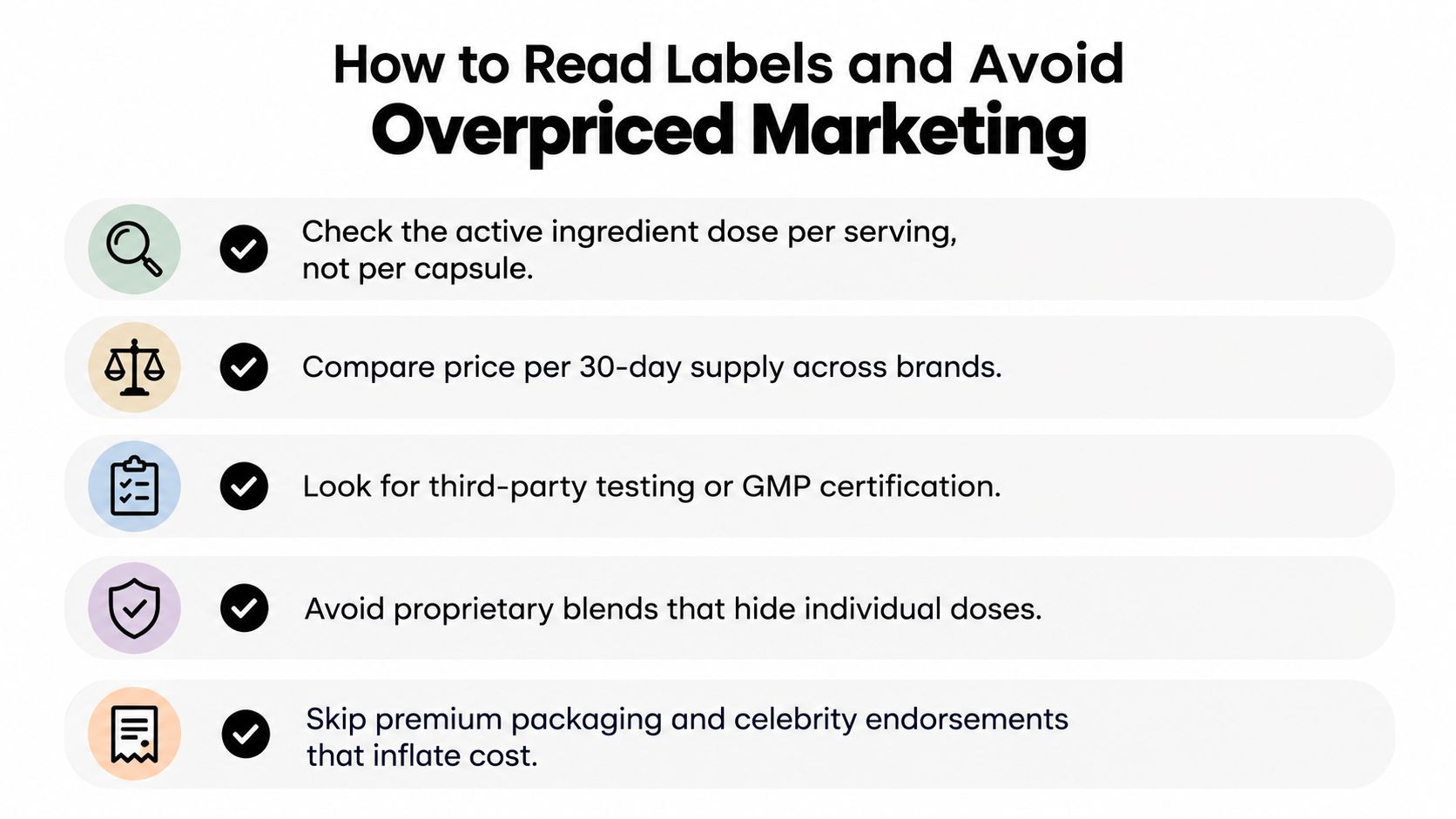
Start at the back of the pack, not the front. The front tells you what the brand wants you to notice. The nutrition panel tells you what you're buying.
Five label checks worth your time
- Check the serving dose: A capsule count can be misleading. Look for the amount of each active ingredient in the full daily serving.
- Compare the 30-day cost: Convert subscriptions and large tubs into a monthly figure so premium packaging doesn't disguise the actual price.
- Reject hidden blends: “Proprietary blend” language prevents you from seeing whether a fashionable botanical is present at a useful amount.
- Look for quality information: Manufacturing standards and independent testing can add useful reassurance, although they don't prove that an ingredient will relieve your symptom.
- Ignore celebrity signals: Endorsements, pastel packaging, and words such as “complete” don't establish nutritional value.
A token dose is an ingredient included in name rather than at a meaningful amount. You can't identify token dosing from the ingredient name alone. You need the quantity per serving and, for botanicals, enough information about the extract to understand what the product contains.
Reference values can sometimes confuse shoppers. The guide to what nutrient reference value means can help you distinguish a label's reference percentage from a personalised assessment of what you need.
For a practical label-reading demonstration, use the video below as a supplement to the written checks.
My preferred buying strategy is modular. Consider a basic multivitamin only if it fills a genuine dietary gap, then add a clearly justified nutrient rather than buying a large blend that duplicates everything. The cheaper option isn't automatically better, but a transparent low-cost product often gives you more control over what you take.
Building a Personalised Strategy for Your Symptoms
Menopause doesn't produce one standard symptom pattern, so a single universal supplement makes little sense. Start by identifying the problem that affects your day most, then decide whether nutrition is the right tool.
Match the product to the problem
For long-term bone support, review dietary calcium, vitamin D exposure, exercise, HRT status, and personal risk factors with a qualified professional. This is the area where I'd be least impressed by an expensive botanical stack that provides neither of the foundational nutrients discussed above.
For disrupted sleep, start with the basics: a consistent bedtime, a cooler bedroom, reduced evening stimulation, and a review of hot flushes or night sweats. Magnesium may be worth discussing if your diet and circumstances make it relevant, but don't assume a sleep blend has proven every ingredient inside it.
A 2025 clinical trial in peri- and postmenopausal women tested a nonhormonal sleep supplement taken 60 minutes before bedtime for three weeks. It reported total sleep time increases of +21.6 minutes in week two and +40.9 minutes in week three (2025 clinical trial on a nonhormonal sleep supplement). That's an example of a defined product, timing, duration, and outcome. It isn't proof that every sleep capsule will produce the same result.
For fatigue or poor concentration, don't jump straight to an energy powder or a large B-vitamin formula. Check sleep, food intake, medication effects, stress, and possible medical causes first. A supplement should address a plausible gap, not disguise a problem that needs assessment.
For night sweats, practical changes can matter alongside any treatment plan. A best breathable mattress protector may help manage the physical disruption of sweating, but it won't treat the underlying symptom.
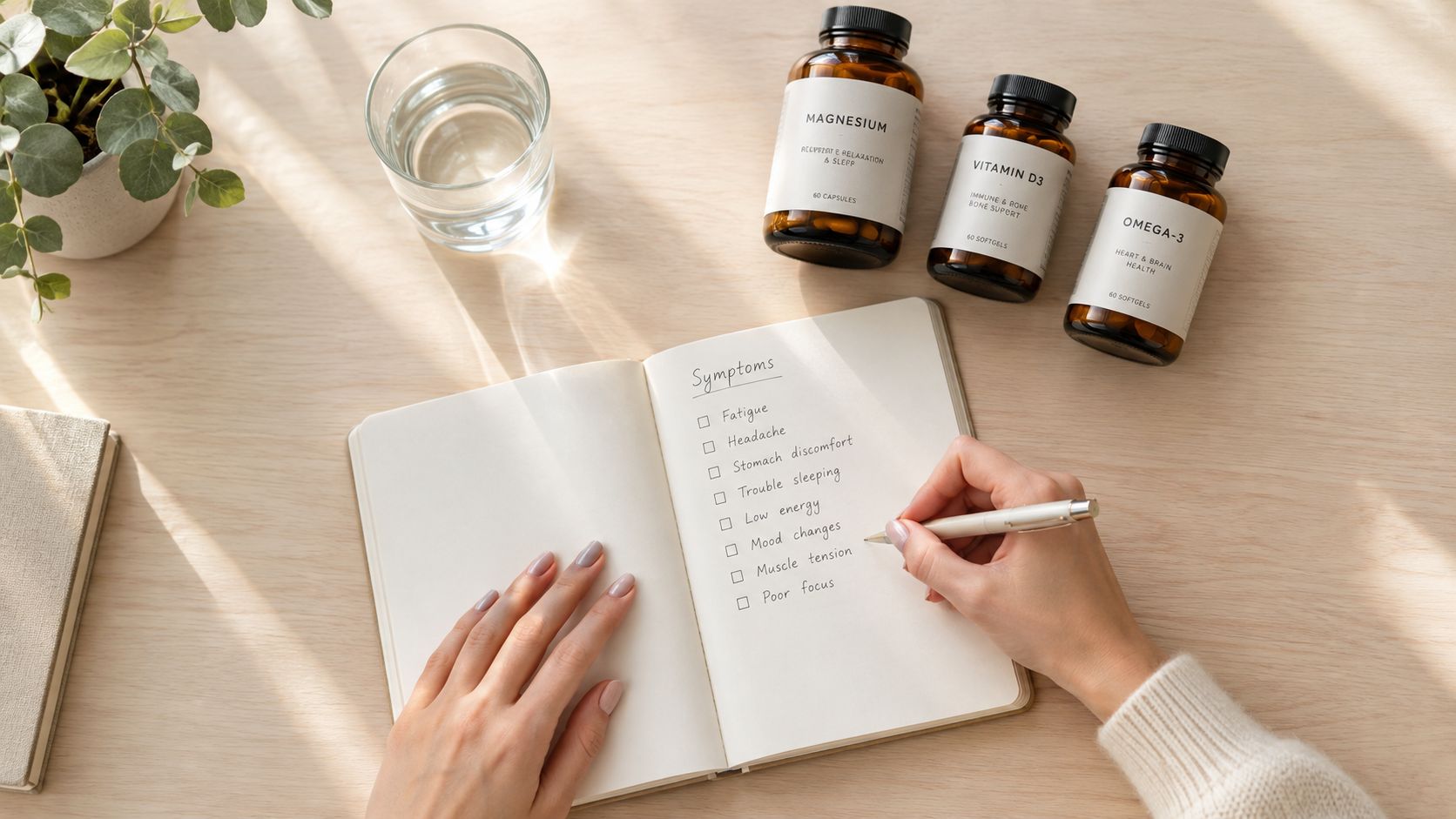
Keep a short symptom record before and after changing a product. Change one meaningful thing at a time, give the trial a defined review point, and stop buying products that produce no clear benefit. That approach costs less and tells you more than rotating through several blends simultaneously.
Final Thoughts on Evidence-Based Menopause Nutrition
The smartest approach to menopause supplements in the UK isn't the most fashionable one. Put bone health first, assess calcium and vitamin D rather than assuming a menopause blend covers them, and treat botanicals as optional experiments with variable evidence.
Omega-3 may suit someone with a dietary reason to use it, but it shouldn't be sold as a reliable hot-flush solution. Magnesium may be relevant to sleep for some people, while the research often tests it inside combinations rather than alone. HRT remains a treatment option that supplements can't replace, and every herbal product deserves an interaction check if you take medication.
Your shopping list should be built around your symptoms, diet, treatment, and budget. Read the full label, reject hidden doses, compare the actual monthly cost, and don't pay extra for a promise that the ingredients can't support.
If you're unsure where to begin, use a personalised quiz to narrow the options rather than collecting more bottles. The aim isn't to take everything. It's to take only what has a clear place in your routine.
This article is for informational purposes only and is not medical advice. Always consult a qualified health professional before starting any new supplement or major lifestyle change
VitzAi.com offers a personalised supplement quiz that uses information about your goals, diet, sleep, stress, exercise, and lifestyle to suggest a curated plan. Visit the site to compare relevant options and create a simpler routine for your menopause nutrition needs.