

Running with Back Problems: A Safe Return to Training Guide
Most runners are told to stop the moment their back starts grumbling. That advice is too blunt. For non-specific low back pain, running isn't automatically the enemy, and for some people it's part of the fix, not the problem.
The first question is not, “Can I run with back pain?” It's, “What kind of back pain is this, and what does it do when I move?” That distinction matters because a stiff, manageable ache behaves very differently from nerve symptoms, bladder changes, or pain that keeps escalating with each step.
Why Running Might Help Your Back
The reflex to stop running at the first sign of back pain comes from a fear that impact always means harm. The evidence does not support that blanket response. In the UK, lifetime low back pain prevalence has been estimated at 58% to 62% in the general population, while running-specific research has found low back pain prevalence among runners ranging from 0.7% to 20.2% and incidence from 0.3% to 22% (systematic review, BMC Musculoskeletal Disorders review). That does not mean runners never get back pain, it means running is not automatically a high-back-pain activity.
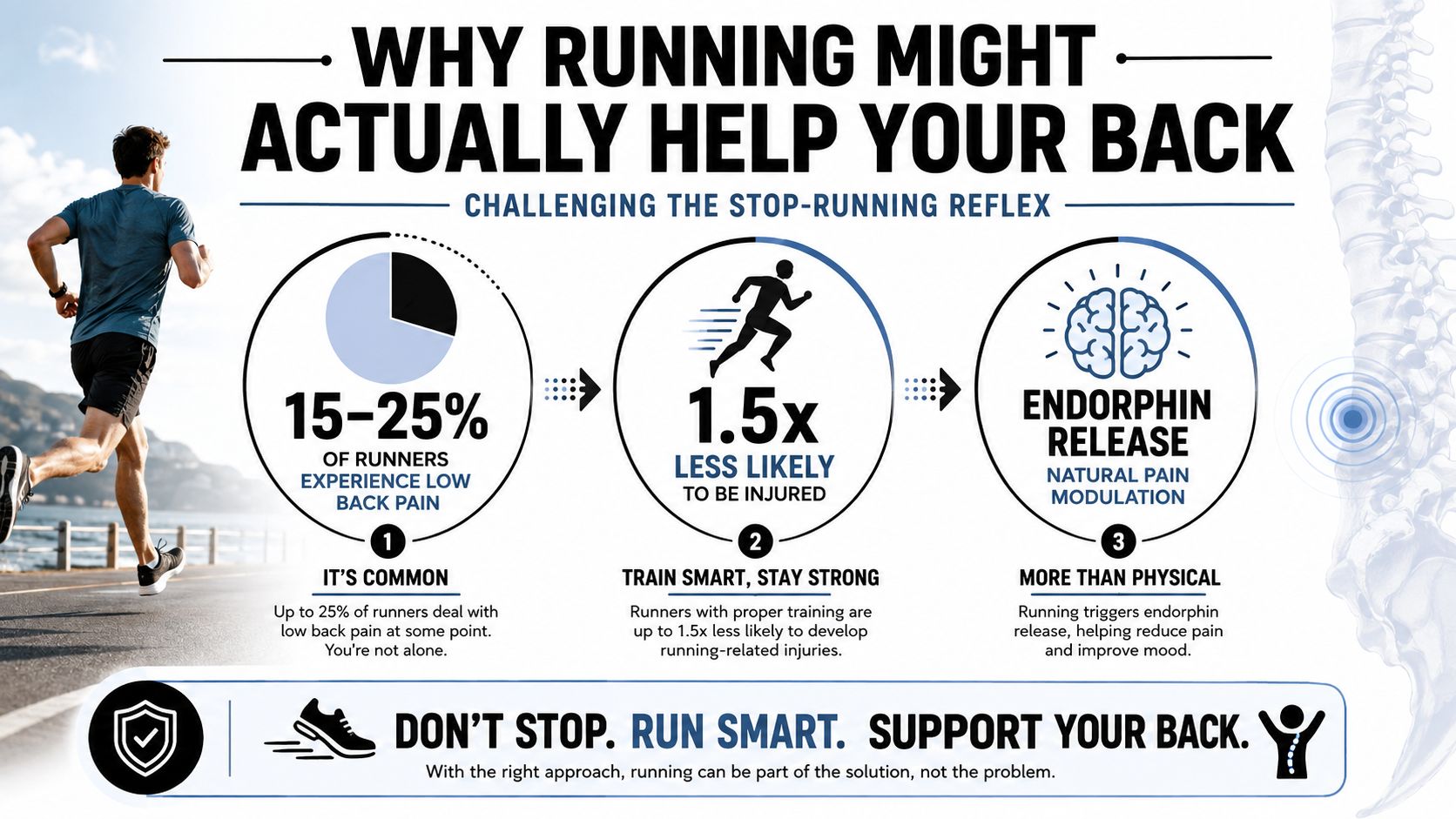
Non-specific back pain is the key distinction
Non-specific low back pain is the common, frustrating type that does not come with a clear structural disaster behind it. For that pattern, movement often helps more than rest, and running can fit into a sensible load plan. The same logic applies to broader joint pain relief, where the right dose of movement often matters more than shutting activity down completely. That is very different from red-flag problems such as cauda equina symptoms, progressive numbness, or severe irritable pain, where running is the wrong call.
The strongest UK-specific evidence here is the ASTEROID randomised controlled trial, which concluded that running was acceptable and efficacious for adults with non-specific chronic low back pain (ASTEROID trial). A separate study of runners with back pain found that 54.1% had a history of back pain, and among those runners 49% said running improved their pain versus 27% who said it worsened (runner back-pain study). That is the practical point clinicians care about, because it shows a large subgroup does better by staying active, not by abandoning the sport.
Practical rule: if your pain is mild, localised, and settles with warm-up, you usually modify rather than stop. If the pain is sharp, spreading, or paired with neurological symptoms, you pause and get assessed.
Who should keep running, who should modify, and who should stop
Keep running if the pain is mild, predictable, and does not change your mechanics much. Modify if the discomfort builds during runs but stays within a sensible range and settles later. Stop and seek assessment if you have leg weakness, numbness, bladder or bowel changes, severe night pain, or anything that makes the symptoms feel unsafe.
That is the framework I use with recreational runners all the time. Running with back problems is rarely a binary yes or no. It is a load-management question.
Self-Screening Before You Lace Up
A sensible self-check beats guesswork. The cleanest UK physiotherapy approach is a 2-minute test run, used as a quick screen before you commit to a full session (Running Physio guidance). The point is straightforward, give your back a small dose of impact, then judge whether today suits a run, a walk, or a rest day.
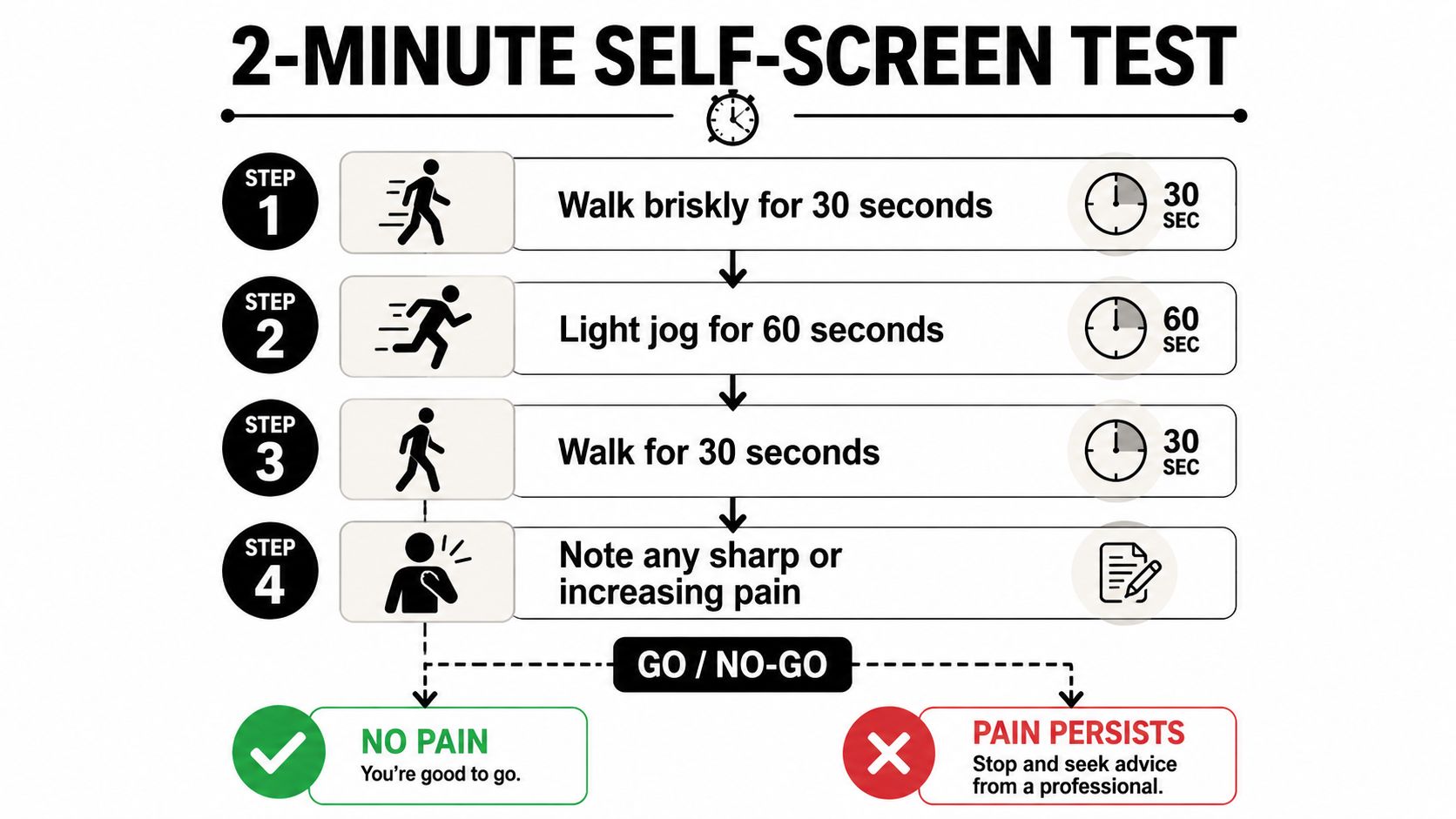
Use the 2-minute test run properly
Start with a brisk walk for 30 seconds. Then jog lightly for 60 seconds. Walk again for 30 seconds, and pay close attention to what the back does during and immediately after the jog. If symptoms stay mild, localised, and do not ramp up, that usually supports a cautious continuation. If pain clearly increases, spreads, or changes your stride, the session needs to be modified or stopped.
The test only works if you are honest with yourself. A little stiffness at the start that eases once you are moving is a different message from pain that sharpens every time the foot hits the ground.
A useful traffic-light rule looks like this:
- Green: mild discomfort, no change in gait, symptoms settle quickly.
- Amber: noticeable ache, but still controlled, shorten the session or switch to run-walk.
- Red: increasing pain, leg symptoms, numbness, weakness, or any bladder or bowel change.
Red flags deserve immediate attention
Cauda equina indicators are not something to monitor casually. Bladder changes, saddle numbness, major leg weakness, or symptoms down both legs need urgent clinical assessment. Severe, highly irritable pain that does not calm with rest also deserves proper review.
If you are unsure, err on the side of caution. The goal is to spot the difference between ordinary training noise and a genuine warning, while avoiding the habit of medicalising every twinge. For runners who are also trying to manage fatigue alongside back pain, the guidance in this supplement support guide for tired runners can help you separate recovery choices from simple overcooking.
Building a Pacing Plan That Protects Your Spine
The biggest mistake I see is enthusiastic runners jumping straight back to their old mileage because the first test run felt fine. That is usually where flare-ups begin. UK pacing guidance for mild-to-moderate non-specific low back pain recommends finding a baseline at a comfortable conversational pace, then reducing that distance or time by 10% to 20% and building only inside the range your back is tolerating.
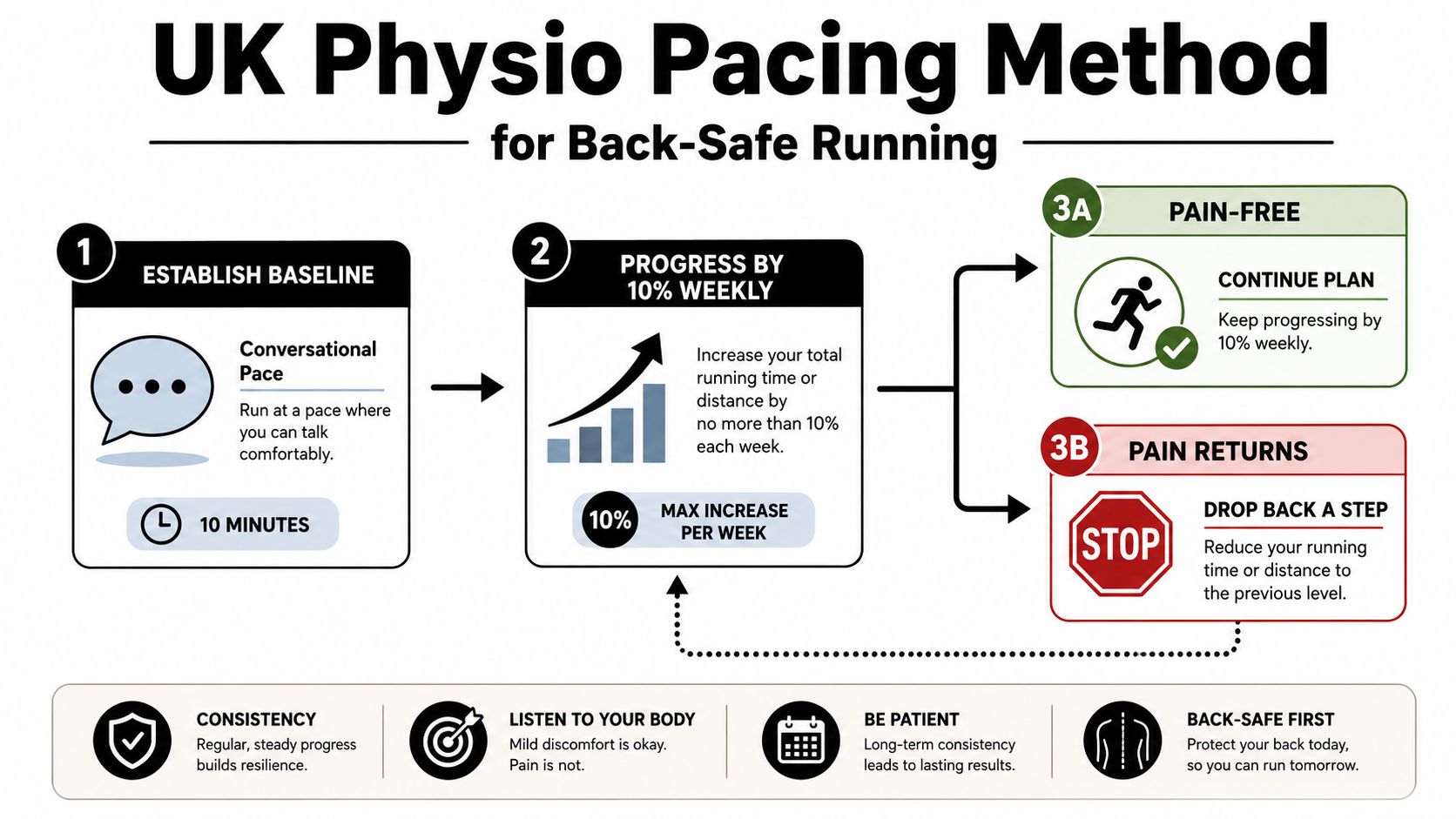
Start from the baseline, not from your ego
If your back tolerates 10 minutes of easy running before symptoms appear, that 10 minutes is your reference point, not your target. Trim it back by the recommended margin and repeat that level until it feels boringly manageable. The aim is to create a load your spine can recover from, one that feels manageable rather than merely survivable.
A simple progression can look like this. Begin with 1 minute run, 2 minutes walk, repeated for the total time you can tolerate. If that stays calm for several sessions, move to 2 minutes run, 2 minutes walk, then 3 minutes run, 1 minute walk, and only later to continuous easy running.
Build the plan around the back that shows up on Tuesday, not the runner who felt heroic on Saturday.
Keep progression conservative
Back problems punish impatience. A weekly cap that feels almost annoyingly modest is often the right choice because recurrence can be part of the story, especially once symptoms have shown up before. Return-to-running plans need space for step-backs when the back becomes reactive.
Use one of three rules when progress stalls:
- If symptoms stay stable, hold the current dose for another week.
- If symptoms rise during the session, cut the next run back.
- If the back stays irritated the next day, deload before progressing again.
That approach is less exciting than a comeback story, but it is far more reliable in real training. Runners who also need to sort out general fatigue while protecting recovery can use the supplement support guide for tired runners to separate sensible support from simple overcooking.
Use recovery notes, not memory
Write down how the back feels at the start, halfway through, and the following morning. Small trends are easier to spot in notes than in hindsight. A good run-log matters more than a heroic mindset, because the body tells the truth in patterns.
Form Tweaks That Reduce Lumbar Load
Running is repetitive by design, and the lumbar spine feels that repetition every time the foot meets the ground. Heel strike impact forces can reach 1.5 to 6 times bodyweight, so small biomechanical mistakes can turn a normal run into an irritable one (risk-factor paper). The aim isn't perfect form, it's removing the obvious load multipliers.
Shorter steps usually beat bigger corrections
The fastest win is often slightly higher cadence and shorter stride length. When the foot lands too far ahead of the body, the lower back takes more braking force and the pelvis tends to drift into positions that feel unstable. A modest cadence increase of 5% to 10% usually works better than forcing a dramatic makeover mid-run.
Before-and-after matters here. In the old pattern, the runner reaches forward, the heel lands out front, and the trunk stiffens. In the corrected pattern, the foot lands closer under the centre of mass, the step feels quicker, and the back has less to brace against.
Posture and pelvis matter more than people think
An excessive anterior pelvic tilt can make the lower back work harder than it should. A more neutral spine doesn't mean rigid, it means stacked and efficient. Think of the ribs sitting over the pelvis, not flaring and collapsing with every stride.
Footwear and terrain matter too. Worn-out shoes often worsen the same problem by giving you less shock absorption, while hard tarmac increases the need for good mechanics. Treadmills can feel kinder for some runners because the surface is consistent, though the belt can tempt people into overstriding if they're not paying attention. Hills, especially climbs, ask for shorter steps and a steadier trunk, which is why they're useful when controlled and irritating when attacked.
Mid-run cue checklist
Use a short reset list when you feel the back tightening:
- Quiet shoulders: release the tension before it spreads into the trunk.
- Quick feet: shorten the step rather than forcing more speed.
- Tall torso: avoid slumping or leaning back.
- Ribs over pelvis: keep the trunk stacked, not arched.
- Small stride, steady breath: control the effort before the back starts compensating.
These cues work because they're simple enough to remember while running. If you need six instructions to survive one easy jog, the session is too hard.
Core Work Mobility and Supplement Support
Running with back problems gets easier when the surrounding system is working well. That means a bit of core work, a bit of mobility, and recovery support that helps the body tolerate repeated training. None of this needs to be complicated, but it does need to be consistent.
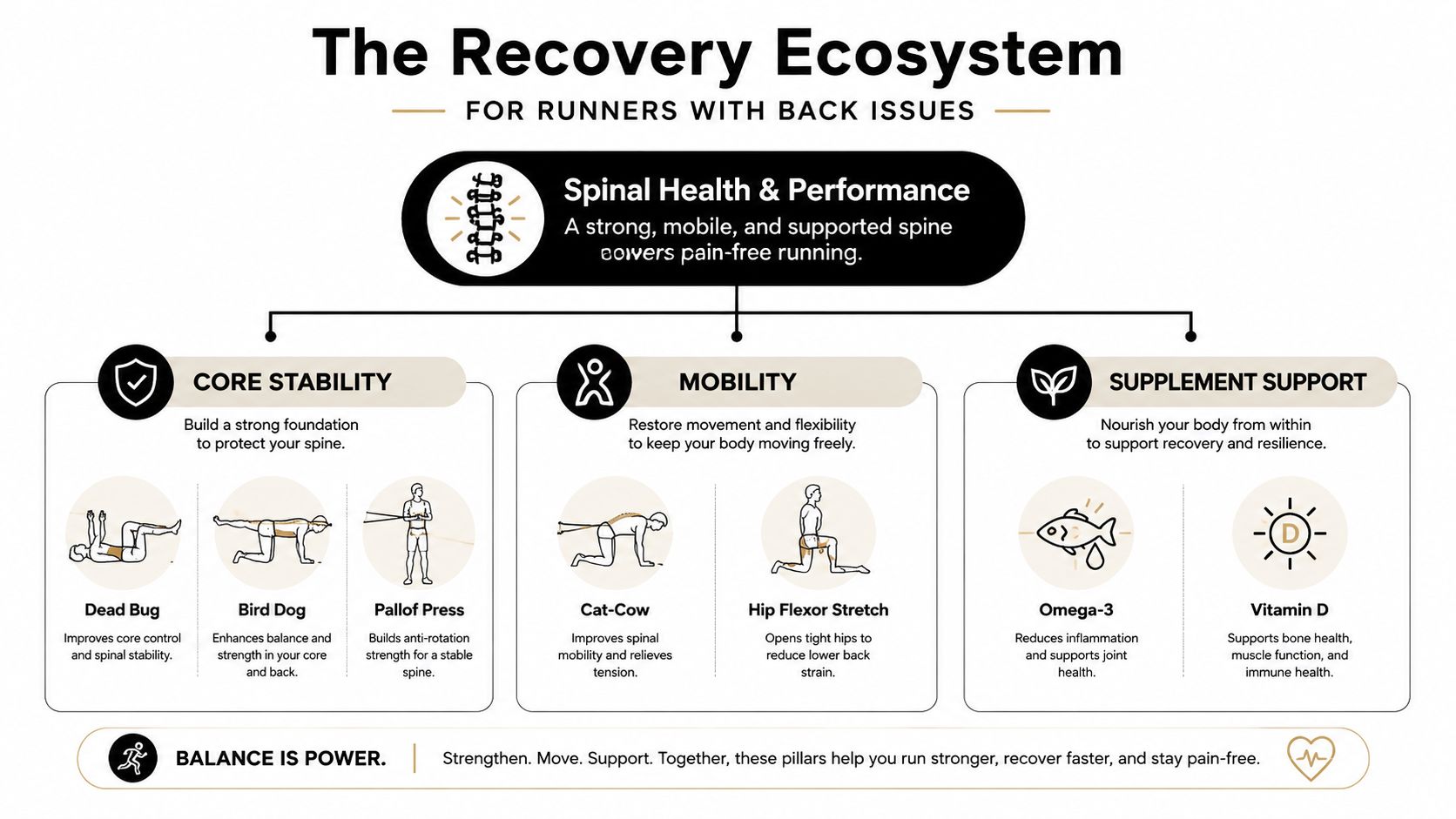
Keep the strength work short and specific
Dead bugs, bird dogs, and Pallof presses are useful because they train trunk control without loading the spine heavily. Pair them with hip flexor mobility and thoracic spine movement, since stiff hips and a locked upper back often force the lower back to compensate. I'd rather see 15 focused minutes twice a week than a vague hour of “core” once a month.
A simple weekly rhythm works well for most recreational runners:
- Monday: easy run plus 15 minutes of core work.
- Wednesday: mobility session, especially hips and thoracic spine.
- Friday: run-walk or easy run, then brief trunk control.
- Weekend: longer easy run if the back stayed settled.
Supplements can support recovery, not replace good load management
Magnesium is often useful for muscle relaxation and sleep quality, especially when stress is already pushing pain sensitivity higher. Omega-3 fatty acids are commonly used to support inflammation management, which can be relevant when training leaves the back feeling reactive. Creatine can support training recovery and general performance without adding spinal load, which is why it's such a sensible add-on for active runners.
For people comparing stacks, I'd keep the logic clean. Men under 40 often care most about energy, focus, and recovery. Men over 40 usually need more attention on joint support, longevity, and maintaining training consistency. Women under 40 often benefit from energy and stress balance, while women over 40 may need extra focus on bone health, vitality, and menopause-related changes. A personalised approach, like the one outlined in recommended supplements for runners, is far better than buying a random pile of capsules.
Recovery rule: if sleep is poor and stress is high, the back often feels worse even when the training hasn't changed.
Sleep and stress change pain tolerance
Sleep debt makes normal training feel harder. Stress does the same by tightening the system and reducing tolerance to load. If you want your back to behave, the boring basics matter, regular sleep, enough food, and enough downtime between runs.
When to Push Through and When to See a Clinician
Some back pain during running is normal training chatter. Some of it isn't. The job is to tell them apart quickly, because the wrong decision either wastes training time or delays care that should happen sooner.
Yellow flags can often be managed
A mild local ache, stiffness that eases with movement, or soreness that settles after a run usually fits the self-management category. In those cases, pacing, lighter run-walk sessions, and the recovery work above are the right tools. If the pain is staying local and predictable, I'd rather adjust the load than ban running outright.
Red flags mean get assessed
Numbness, bilateral leg symptoms, bladder changes, night pain that's waking you, or weakness that changes your stride need professional review. Pain that keeps escalating run after run also deserves an exam, even if it starts out feeling manageable. Don't try to “train through” neurological symptoms.
If morning stiffness is part of the problem, it can be worth checking the sleep setup too. A useful outside resource on how mattress issues can trigger or worsen morning back pain is fix morning back pain from your bed, because recovery doesn't start and end with the run itself.
A good physiotherapist won't just tell you to rest. They'll assess movement, help you find the right baseline, and build a return-to-run plan that respects your symptoms rather than guessing at them. If nutrition may be slowing recovery, a structured questionnaire can also help identify gaps that make training feel harder than it should.
If you're trying to keep running without making your back worse, VitzAi.com gives you a smarter way to think about recovery, supplements, and day-to-day performance. Visit VitzAi.com to explore personalised guidance that fits your age, goals, and training life, not a one-size-fits-all supplement shelf.
This article is for informational purposes only and is not medical advice. Always consult a qualified health professional before starting any new supplement or major lifestyle change