

The Ultimate Guide to Turmeric Curcumin Supplement Benefits
It's a common question: what's the real difference between turmeric and curcumin? The answer is actually pretty straightforward. Turmeric is the whole spice, the golden root you can grate or find powdered. Curcumin is the superstar active compound found inside turmeric.
Think of turmeric as an orange and curcumin as its Vitamin C. You get the benefits of Vitamin C from the orange, but it's the Vitamin C itself that's doing the heavy lifting. A well-designed turmeric curcumin supplement is all about concentrating that powerhouse compound for a real impact.
Unlocking The Power Of Turmeric Curcumin
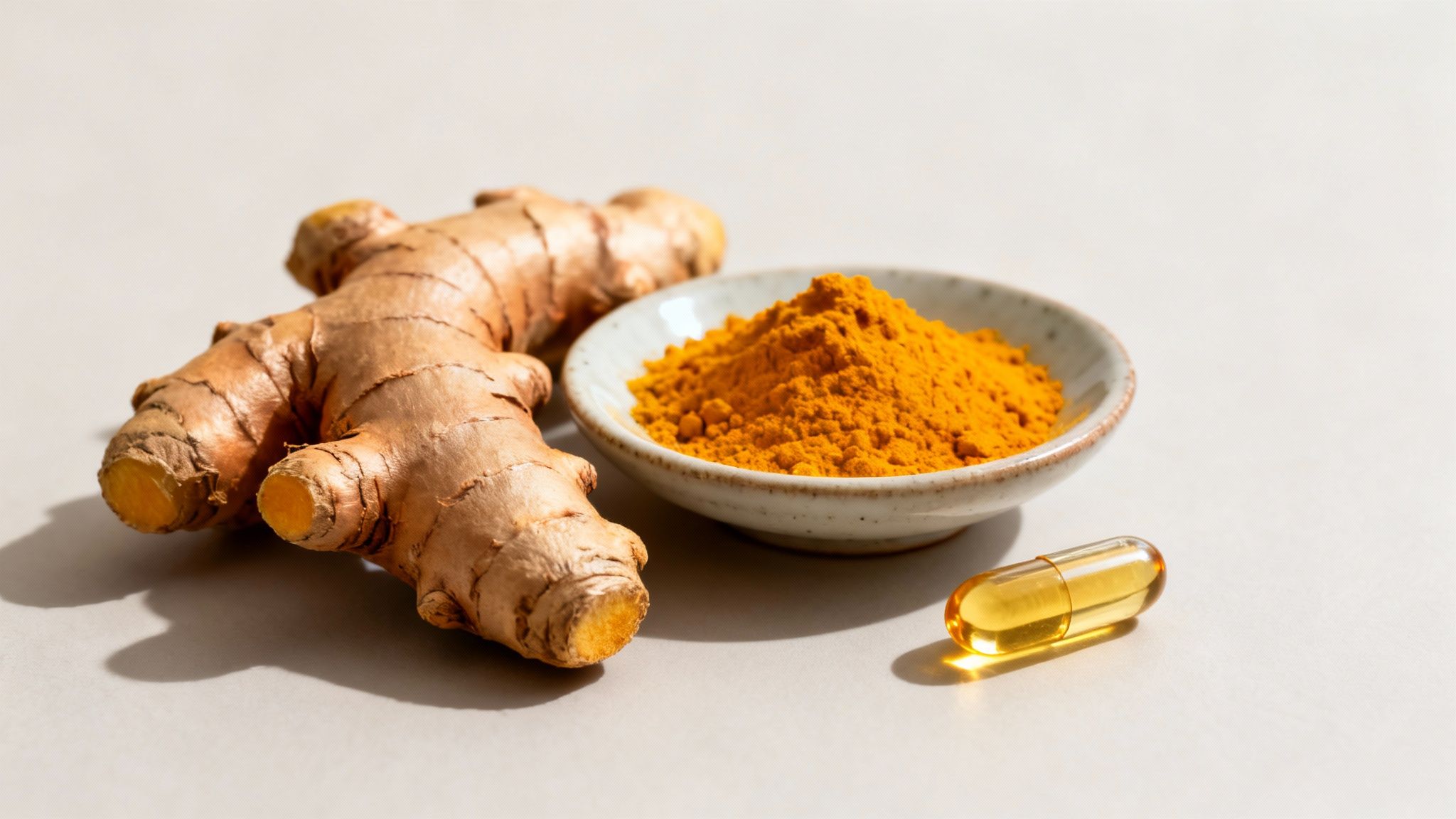
This naturally leads to another question: can't I just pile more turmeric onto my curry? While adding this delicious spice to your meals is fantastic for flavour and general wellness, relying on it alone for targeted benefits is, frankly, a non-starter.
The problem comes down to two major roadblocks: concentration and absorption.
Why Concentration Matters
First off, raw turmeric root is surprisingly low in the good stuff. It contains only about 2-5% curcuminoids (the family of active compounds curcumin belongs to) by weight. You'd have to eat an impractical amount of the spice every single day just to get a dose that comes close to what's used in scientific studies.
For context, a single teaspoon of turmeric powder has roughly 200 mg of curcuminoids. That's a tiny fraction of the therapeutic doses, and trying to eat enough could easily lead to an upset stomach. Supplements get around this by packing in a highly concentrated, standardised extract.
This is why you'll often see "standardised to 95% curcuminoids" on a quality supplement label. It's your guarantee that you're getting a potent and consistent dose of the active ingredients, not just powdered-down turmeric root.
The Bioavailability Barrier
Even if you could stomach all that turmeric, you'd run headfirst into a much bigger issue: bioavailability. It's a bit of a technical term, but it simply means how much of a substance your body can actually absorb and put to use.
Curcumin, on its own, is famously bad at this. Your body breaks it down and gets rid of it so quickly that it barely has a chance to work its magic.
Think of it like trying to water your garden with a leaky hose. Most of the water—or in this case, the beneficial compound—is lost before it ever reaches the plants.
This is the real reason why simply eating more turmeric won't move the needle much for specific health goals like joint support or cognitive performance. A properly formulated turmeric curcumin supplement is specifically engineered to overcome this absorption problem, ensuring the active compounds actually get into your bloodstream where they can do their job. For comprehensive insights into Curcumin itself, including its origins and core properties, it's worth a read. We'll get into exactly how these advanced supplements solve this critical problem a little later on.
How Curcumin Works Inside Your Body

To really get what a high-quality turmeric supplement can do, it helps to peek behind the curtain at what this incredible compound is actually doing. We can skip the dense scientific jargon. At its core, curcumin plays two key roles in your body: it's a master regulator of inflammation and a vigilant cellular bodyguard.
Picture an "inflammation dial" inside your body. A bit of inflammation is perfectly normal and even healthy—it’s your body’s way of healing a cut or fighting off a bug. The problems start when that dial gets cranked up and stuck on high, leading to the kind of chronic, low-grade inflammation that contributes to everything from achy joints to bigger health worries.
This is where curcumin comes in, acting like a smart dimmer switch for that dial. It works right down at the molecular level, interacting with the signalling pathways that control your inflammatory response and helping to dial things back to a healthy, balanced state.
A Master Regulator Of Inflammation
One of the most critical pathways curcumin gets to work on is called NF-kB. You can think of NF-kB as a master switch that, when flipped, tells your cells to pump out a flood of pro-inflammatory proteins. In situations like osteoarthritis or after a really tough gym session, this switch can get stuck in the 'on' position, leading to that nagging pain, stiffness, and swelling.
A potent turmeric supplement delivers a concentrated dose of curcumin that can gently persuade this NF-kB switch to turn off. By doing this, it helps to quieten down the signals that are screaming "inflammation!", allowing your body to find its natural balance again. This is precisely why so many people reach for a curcumin supplement for joint support and to speed up their recovery.
By influencing key inflammatory pathways, curcumin doesn't just mask symptoms. It addresses the underlying biochemical processes that contribute to chronic discomfort, helping to restore balance from within.
This targeted action is a huge reason why curcumin is so widely studied for its potential benefits across a whole host of inflammation-related conditions. It’s not about shutting down a necessary bodily process entirely; it's about restoring intelligent control.
A Potent Antioxidant Bodyguard
Beyond its role in managing inflammation, curcumin is also a seriously impressive antioxidant. Every single day, your body is under attack from unstable molecules called free radicals. These are just unavoidable by-products of your metabolism and exposure to everyday toxins in our environment.
Think of free radicals as tiny, chaotic troublemakers bouncing around inside your cells, damaging your DNA, proteins, and cell membranes. This pile-up of damage, known as oxidative stress, is a massive factor in ageing and many chronic health problems.
Curcumin acts as your cellular bodyguard in two clever ways:
- Direct Neutralisation: It can directly hunt down and neutralise free radicals, stopping them in their tracks before they can cause any harm.
- Boosting Your Body’s Defences: Perhaps even more importantly, it stimulates your body’s own antioxidant enzymes. This strengthens your natural, built-in defence system against oxidative stress.
This two-pronged antioxidant power makes curcumin an incredible ally in protecting your cells from daily wear and tear. By helping to mop up free radicals and bolstering your body's natural defences, it supports long-term cellular health and longevity.
Understanding these mechanisms is key. When you take a high-quality turmeric curcumin supplement, you're not just taking an old spice. You're delivering a smart, multi-faceted compound that works intelligently with your body’s own systems to calm inflammation and fight oxidative stress. This foundational support is what leads to real-world benefits like better joint mobility, quicker recovery, and a greater sense of well-being.
The Proven Health Benefits Of Curcumin
Now that we've lifted the hood on how curcumin works its magic—as a master inflammation regulator and a potent antioxidant—we can link that science to real-world results. A high-quality turmeric curcumin supplement isn't just a theoretical health booster; the benefits have shown up time and again in studies, translating into tangible improvements in daily life.
By calming down inflammation and fighting cellular damage, curcumin offers a helping hand for some of the most common health concerns we face, from creaky joints to keeping a sharp mind. The trick is consistency. These benefits are cumulative, building over time as you make the supplement a regular part of your wellness routine.
Soothing Stiff And Aching Joints
One of the most celebrated and well-researched perks of curcumin is its profound impact on joint health. If you struggle with the stiffness, discomfort, and reduced mobility that comes with conditions like osteoarthritis, curcumin's powerful anti-inflammatory action can be a real game-changer.
Remember that NF-kB pathway we talked about? That's the 'master switch' for inflammation that often gets stuck in the 'on' position in achy joints. Curcumin helps to gently turn the dial back down.
This means it can help:
- Reduce joint pain and stiffness, making everyday movements like climbing stairs or getting out of a chair feel much more comfortable.
- Improve overall joint function and mobility, allowing you to stay active and enjoy the things you love.
- Lessen reliance on traditional pain relievers, offering a more natural way to manage chronic discomfort.
Many studies have shown that taking a bioavailable curcumin extract consistently can lead to significant improvements in pain scores and physical function for people with osteoarthritis. For anyone looking to support their joints from all angles, it's worth exploring all the options. You can discover more in our guide to the best supplements for bones and joints.
Supporting Cognitive Function And Brain Health
The benefits of a turmeric curcumin supplement extend far beyond the joints. Your brain is also highly susceptible to the wear and tear of inflammation and oxidative stress, both of which are linked to age-related cognitive decline. Curcumin's dual action makes it a powerful ally for brain health and cognitive performance.
Think of curcumin as a bodyguard for your brain cells. By helping to quell inflammation and neutralise damaging free radicals, it creates a healthier environment for your neurons to thrive.
What's more, emerging research suggests curcumin may play a role in boosting Brain-Derived Neurotrophic Factor (BDNF). BDNF is a crucial protein that acts like a fertiliser for your brain, encouraging the growth of new neurons and strengthening the ones you already have. Healthy BDNF levels are vital for learning, memory, and overall mental sharpness.
Aiding Exercise Recovery And Performance
For anyone who hits the gym, goes for a run, or just pushes their body physically, muscle soreness is a familiar feeling. That post-workout ache is largely driven by tiny tears in muscle fibres and the inflammatory response that follows. A quality turmeric curcumin supplement can help manage this whole process more effectively.
By modulating inflammation, curcumin can help:
- Lessen the severity of delayed onset muscle soreness (DOMS). This means you feel less achy in the days following a tough workout.
- Speed up muscle recovery, allowing you to get back to your training routine sooner and with more consistency.
- Reduce exercise-induced oxidative stress, protecting your cells from the damage that can occur during intense physical activity.
This makes it a brilliant addition to the routine of athletes and fitness enthusiasts who want to get the most out of their recovery and maintain peak performance.
Promoting A Healthy Heart
Finally, looking after your cardiovascular health is a cornerstone of longevity, and curcumin offers multifaceted support here, too. Its ability to combat inflammation and oxidative stress—two key players in cardiovascular issues—is hugely beneficial.
Specifically, curcumin supports heart health by improving the function of the endothelium, which is the thin lining of your blood vessels. A healthy endothelium is absolutely crucial for regulating blood pressure and ensuring proper blood flow. By helping to protect this delicate lining from damage, curcumin helps keep your entire cardiovascular system running smoothly, contributing to long-term wellbeing.
Solving The Bioavailability Problem
So, we've established that curcumin is the powerhouse compound hiding inside turmeric, but there’s a big catch. Simply taking standard curcumin, even if it’s a concentrated extract, is a bit like having a key that doesn't quite fit the lock. Your body really struggles to absorb it, a problem known in the science world as poor bioavailability.
This means that without a proper delivery system, most of the curcumin you swallow just passes right through you. It gets metabolised and shown the door before it ever has a chance to enter your bloodstream and get to work. This is the single biggest reason why not all turmeric supplements are created equal, and why some people feel amazing benefits while others feel nothing at all.
Fortunately, science has come up with some clever ways to solve this puzzle. Think of these methods as a VIP escort service, safely guiding curcumin past your body's metabolic gatekeepers and making sure it reaches its destination. Getting this part right is crucial if you want the benefits you’re paying for.
The Black Pepper Boost: Piperine
The classic, most well-known solution is pairing curcumin with piperine, the active compound that gives black pepper its kick. Piperine’s main job here is to inhibit certain enzymes in your liver and intestinal wall that would normally break down curcumin before it can be absorbed.
It’s a bit like piperine distracting the security guards (your enzymes) so that curcumin can sneak past them and get into the party (your bloodstream). Studies have shown this simple combination can increase curcumin's bioavailability by a staggering 2,000%. It's an effective and time-tested method, but it's really just the starting point for modern supplement formulas.
This is a big deal, because once curcumin gets into your system, it can really start to offer support where it's needed most.
As you can see, ensuring curcumin gets absorbed properly unlocks its potential to support joint health, cardiovascular function, and even physical recovery after exercise.
Advanced Delivery: Phytosomes
While piperine is a great start, newer technologies offer even better absorption. One of the gold standards in the supplement world today is the phytosome delivery system. This technology is a total game-changer for any turmeric curcumin supplement.
Here's how it works: a phytosome binds curcumin molecules to a phospholipid (like phosphatidylcholine), which is a natural part of plant cells. Because your own cell membranes are also made of phospholipids, your body sees this curcumin-phospholipid complex as a friend, not a foreign invader.
This molecular "disguise" allows the curcumin to be transported across the intestinal wall far more easily. It's like giving curcumin a special keycard that grants it seamless access to the entire building.
One of the most researched curcumin phytosome formulas, Meriva®, has been shown to have a bioavailability up to 29 times greater than standard curcumin. This superior absorption means more of the active compound gets to where it needs to go, allowing for more potent effects at a lower dose.
The Future Is Small: Nanoparticles
Pushing the boundaries of bioavailability even further is the use of nanotechnology. This process breaks down curcumin into incredibly tiny, water-soluble particles. Normally, curcumin is fat-soluble, which makes it difficult for our water-based bodies to absorb efficiently.
By making the curcumin particles microscopic and water-friendly, they can slip through the gut lining much more easily and dissolve directly into the bloodstream. This method cleverly bypasses many of the usual metabolic hurdles that limit curcumin's effectiveness.
Let's break down how these different forms stack up.
Comparing Curcumin Bioavailability
Understanding the different options helps you see why the formulation of a supplement matters just as much as the ingredient itself. This table gives a quick overview.
| Formulation Type | Mechanism | Relative Bioavailability | Best For |
|---|---|---|---|
| Standard Curcumin | No enhancement | Very Low | Not recommended for supplemental use. |
| + Piperine | Inhibits metabolic enzymes | Up to 2,000% increase | A good, cost-effective starting point. |
| Phytosome | Binds to phospholipids for easy cell entry | Up to 29x higher | Excellent absorption for targeted, potent effects. |
| Nanoparticles | Creates tiny, water-soluble particles | Potentially highest | Advanced formulations for maximum, rapid absorption. |
Ultimately, choosing a turmeric curcumin supplement with one of these advanced delivery systems—be it piperine, phytosomes, or nanoparticles—is non-negotiable. It’s what ensures this powerful compound can overcome its natural limitations and deliver the health benefits you’re after. The timing of when you take it can also play a role, and you can learn more about optimising your schedule by reading about the best time of day to take vitamins in our detailed guide.
How To Choose A High-Quality Supplement
Walking down the supplement aisle can be a dizzying experience. Dozens of bottles, all shouting similar promises from their labels. When it comes to finding a turmeric curcumin supplement that actually works, knowing what to look for is the only way to separate the genuinely potent products from the duds.
A few key details on the label can help you see past the marketing hype and choose a supplement that will deliver real results.
First thing’s first: check the standardisation. You’re looking for a product that is standardised to 95% curcuminoids. This is non-negotiable. It’s your guarantee that you're getting a concentrated, powerful dose of the active compounds, not just ground-up turmeric root, which might only contain 2-5% curcuminoids. Without this, the product simply won't have the punch needed for any real therapeutic benefit.
Decoding The Label
Once you've confirmed the curcuminoid content, the next critical feature is a bioavailability enhancer. As we've covered, your body finds it incredibly difficult to absorb curcumin on its own. A top-tier supplement will have a solution for this built right into the formula.
You should find one of these key ingredients on the list:
- Piperine (or Black Pepper Extract): This is the classic, time-tested choice that can dramatically boost absorption.
- Phytosomes (like Meriva®): A more advanced delivery system that cleverly binds curcumin to phospholipids, making it much easier for your cells to welcome it in.
- Nanoparticles or Water-Soluble Formulations: These modern techniques shrink curcumin particles down to a size that your body can absorb far more easily.
If a supplement has standardised curcumin but is missing one of these helpers, your body just won’t be able to put it to good use. It’s as simple as that.
The Importance Of Third-Party Testing
In the world of supplements, trust is everything. The industry isn’t as tightly regulated as pharmaceuticals, which is why an independent seal of approval is so important. This is where third-party testing comes in.
Think of third-party certifications as an unbiased inspection. An independent organisation has tested the product to verify that what's on the label is actually what's in the bottle, and that it's free from harmful contaminants.
Keep an eye out for logos from reputable organisations like NSF International, USP (United States Pharmacopeia), or Informed-Sport. These certifications are your best bet for confirming purity, potency, and quality. A company willing to invest in this rigorous process is showing a real commitment to making a safe and effective product, giving you confidence in what you’re taking.
The demand for high-quality, transparently-made supplements is growing fast. In the United Kingdom, the curcumin market reflects a strong embrace of natural wellness solutions. Valued at over USD 2.6 billion, it's projected to soar to more than USD 13.7 billion by 2035. This boom is fuelled by UK consumers shifting towards clean-label, vegan supplements to support joint health, digestion, and overall vitality, highlighting the need for trusted, bioavailable options.
While we're focused on curcumin here, it's always useful to understand the broader principles of choosing good dietary aids. You can find more insights into selecting effective health supplements to build on your knowledge.
Personalising Your Dosage and Supplement Stacks
When it comes to supplements, a one-size-fits-all approach rarely gets you the best results. The same is absolutely true for turmeric. Figuring out the right amount of a turmeric curcumin supplement for you really boils down to your personal health goals. It’s all about tailoring your intake and pairing it with other smart compounds to move from general support to targeted outcomes.
For general wellness and a good antioxidant boost, a daily dose of around 500 mg of a bioavailable curcumin extract is a solid starting point for most people. However, if you're after more specific relief for joint discomfort or want to support your recovery after exercise, doses up to 1,000-1,500 mg per day are often more effective. A good tip is to split higher doses into two or three smaller ones throughout the day to keep absorption steady and maintain consistent levels in your body.
Creating Smart Supplement Stacks
Beyond just nailing the dosage, you can really amplify the benefits of curcumin by pairing it with other supplements that work in harmony with it. This is often called 'smart stacking', and it's based on creating a synergistic effect where the combined impact is greater than the sum of its parts.
A classic example is creating a powerful anti-inflammatory duo.
- For Joint Health: Stacking curcumin with Omega-3 fatty acids (from fish oil) can offer comprehensive support for joint comfort and mobility. Both compounds help manage inflammatory pathways, but they do so through different mechanisms, giving you broader coverage.
- For Stress and Recovery: Combining your turmeric curcumin supplement with an adaptogen like Ashwagandha can be a game-changer for managing both physical and mental stress. Curcumin helps with the physical inflammation from exercise, while Ashwagandha supports your body’s overall resilience to stress.
Stacking isn't about throwing random supplements together; it's about building an intelligent, personalised routine where each component complements the others, helping you achieve your unique health objectives more efficiently.
A Growing Trend in the UK
This shift towards personalised wellness is definitely catching on. The UK market for turmeric supplements is a standout in Europe, projected to have the fastest growth rate. This boom is largely driven by a demand for clean-label and vegan products, reflecting a cultural move towards science-backed, plant-based alternatives—especially among working professionals and gym-goers looking for immune support and joint health. If you're interested in the market dynamics, you can learn more about the UK's growing demand for turmeric supplements.
Building the right supplement routine can feel a bit complex, but it’s the most effective way to hit your goals. For a deeper look at creating a routine based on your own needs, check out our guide on building a personalized nutrition plan.
Got Questions About Turmeric Curcumin?
Alright, let's tackle some of the common questions that pop up. Think of this as a quick-fire round to make sure you feel confident and clued-up before adding a turmeric curcumin supplement to your routine.
Can I Just Eat More Turmeric Spice?
While adding turmeric to your curries and golden lattes is fantastic for flavour, it’s not really a strategy for getting those therapeutic benefits we’ve been talking about. The spice itself only contains about 2-5% active curcuminoids by weight, and what's worse, your body has a really tough time absorbing it.
A high-quality turmeric curcumin supplement is a different beast altogether. It gives you a concentrated, bioavailable dose that can be hundreds of times more potent than what you'd get from your spice rack.
How Long Until I Notice A Difference?
Patience is a virtue here. The benefits of curcumin are cumulative, meaning they build up in your system over time. While some people report feeling subtle improvements within a few weeks, you'll likely need to give it 4-8 weeks of consistent, daily use to really notice a significant shift in things like joint comfort or post-exercise recovery.
Think of it like watering a very dry plant; it takes time for the water to soak in and bring it back to life. The same principle applies here—consistent intake allows curcumin levels to build, supporting your body's natural balance.
Are There Any Side Effects?
For the vast majority of people, a good quality turmeric curcumin supplement is very safe when taken at the recommended doses. The most common grumbles are mild digestive issues like a bit of bloating or an upset stomach. Taking it with food usually sorts this out.
There is one important thing to be aware of, though. Curcumin can have a blood-thinning effect. It is absolutely crucial to speak with your doctor before starting if you take anticoagulant medications (like warfarin) or have any kind of blood clotting disorder.
Should I Take It With Food?
Yes, this is definitely the best approach. Curcumin is fat-soluble, which is just a sciencey way of saying your body absorbs it much better when you take it with a meal containing some healthy fats. Think avocado, nuts, or a drizzle of olive oil. Plus, it helps sidestep any potential stomach upset, making it easier to stick with it day in, day out.
Ready to experience the benefits of a smarter, personalised approach to your health? VitzAI uses AI-driven insights to create supplement stacks tailored to your unique goals.
Discover Your Personalised Stack at VitzAI.com
This article is for informational purposes only and is not medical advice. Always consult a qualified health professional before starting any new supplement or major lifestyle change.