

What Are Chelated Minerals? the Science of Better Absorption
You take a magnesium or zinc supplement because you want better sleep, steadier energy, or everyday immune support. Instead, you notice little difference, or you spend the next few hours dealing with stomach discomfort. The label may promise a high dose, but the form of the mineral can affect what happens after you swallow it.
That's why the question “what are chelated minerals?” matters. Chelation describes how a mineral is chemically attached to another compound, often an amino acid. This structure may help the mineral remain available during digestion, but it isn't a universal guarantee of superior absorption. The useful question isn't only whether a bottle says “chelated.” It's whether the specific mineral, ligand, elemental dose, evidence, and your digestive situation make sense together.
Why Your Minerals Might Not Be Working
Consider a familiar evening routine. You take a magnesium supplement with water, expecting it to support relaxation before bed. Instead, your stomach feels unsettled, or you notice no meaningful change after using it consistently. A similar problem can happen with zinc, iron, or calcium. The issue may not be that the mineral has no role in the body. The problem may be the compound carrying it, the dose, your food choices, or how your digestive system handles that particular form.
Minerals must pass through several stages before the body can use them. They need to be released from the supplement, remain soluble in the digestive tract, reach the intestinal surface, and interact with transport systems that move them into the body. A mineral that reacts with other compounds before reaching that point may be less available, even when the front of the bottle displays an impressive number.

The label doesn't tell the whole story
Many standard mineral supplements use inorganic salts. These compounds can be perfectly reasonable in some situations, but their behaviour changes as they move from the acidic stomach into the small intestine. Zinc and copper, for example, may form poorly soluble hydroxide compounds in the small intestine, reducing the amount available near absorption sites. An organic ligand may help keep the mineral soluble and reduce unwanted reactions, as described in this review of mineral absorption and chelation.
That doesn't mean every person needs a chelated mineral. It means chemical form is part of the decision, alongside dietary intake, existing supplements, medication use, and tolerance.
Practical rule: If a mineral causes digestive discomfort, don't automatically increase the dose. Check the form, the elemental amount, and whether you need that supplement in the first place.
A person eating a varied diet may respond well to a conventional mineral salt. Someone else may prefer a different form because a particular product is easier to tolerate. People with persistent fatigue, symptoms suggestive of deficiency, ongoing digestive problems, or a diagnosed condition should seek professional advice rather than using a chelate as a substitute for finding the cause.
Readers who want to understand the wider principles behind supplement absorption can also explore this guide to how to increase bioavailability. The central lesson is simple: a mineral's name on the label doesn't predict the entire journey through your digestive system.
The Science Behind Chelated Minerals
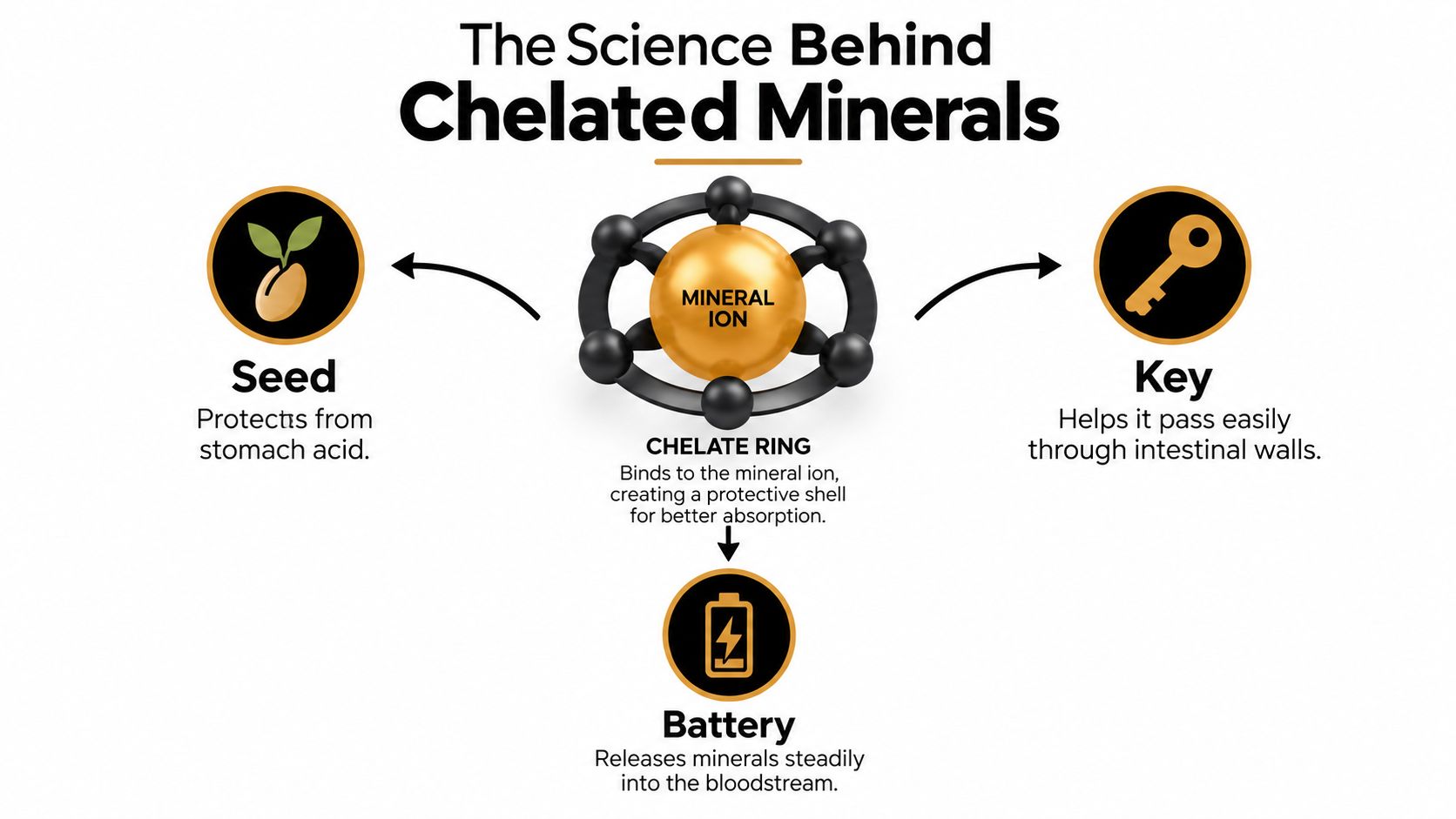
A chelated mineral is a metal ion bound to an organic ligand through coordination bonds. The ligand may be an amino acid, peptide, protein, citrate, or another compound. Think of the ligand as a temporary protective partner that can influence how the mineral behaves while digestion breaks down the supplement.
A useful analogy is a seed with a protective shell. The shell doesn't make the seed larger, and it doesn't guarantee that the seed will grow in every soil. It can, however, help protect the contents until the right conditions allow them to be released. A chelating ligand can play a comparable role by helping a mineral stay associated with a larger organic complex during digestion.
Why the ligand matters
Food contains compounds that can interact with minerals. These include phytates, phosphates, carbonates, oxalates, and hydroxides. Depending on the mineral and the conditions in the gut, these interactions can create poorly soluble complexes. A stable mineral-ligand structure may reduce some of those reactions and help keep the mineral available near the intestinal lining.
The bond still has to behave correctly. If it falls apart too early, the ligand may provide little protection. If it remains too stable, the mineral may not be released at the intestinal surface. Absorption depends on the mineral, ligand, dose, food matrix, gut conditions, and comparison compound, not on the word “chelated” alone.
The U.S. Department of Agriculture review of chelated mineral sources defines metal proteinates as products formed by chelating a soluble trace-mineral salt with amino acids or partially hydrolysed protein. That principle appears in familiar products such as magnesium glycinate, zinc bisglycinate, and iron amino-acid chelates. The same review also recognises mineral amino-acid chelates and related complexes within applicable feed regulations, showing that the concept extends beyond human supplements.
The chemistry can be compared with a lock and key, but the analogy has limits. The ligand may influence solubility and transport, yet the body still uses mineral-specific processes. A magnesium complex isn't automatically handled in the same way as an iron complex, and a promising structure doesn't prove a clinical benefit for every user.
For readers comparing nutritional strategies with other forms of delivery, this 2026 IV drip guide offers context on intravenous wellness services. It's important to keep the categories separate. A supplement taken by mouth depends on digestion and intestinal absorption, while an intravenous service follows a different route and requires appropriate professional oversight.
The word “chelated” describes the mineral's chemical form. It isn't a promise that the product will always work better for you.
Magnesium shoppers can use the same principle when comparing the most bioavailable form of magnesium. Look for the named compound and elemental magnesium amount rather than relying on a general claim about bioavailability.
Common Chelate Forms Compared
Supplement labels become easier to read when you separate the mineral from its attached compound. In magnesium glycinate, magnesium is the mineral and glycinate identifies the associated ligand. In zinc bisglycinate, zinc is attached to glycine-based compounds. The second word isn't decorative. It tells you something about the structure and helps you compare like with like.
A chelated mineral is a metal ion attached to an organic ligand, often an amino acid, peptide, or protein. “Organic mineral” is a broader description, and it shouldn't automatically be treated as synonymous with a true chelate. Some products may use “organic” language without containing the same kind of coordination bond as a defined mineral amino-acid chelate, as explained in this technical discussion of chelated and organic minerals.
Common names on the bottle
| Form | What the name indicates | How shoppers commonly evaluate it |
|---|---|---|
| Glycinate | The mineral is associated with glycine | Often considered when people prioritise a gentle, straightforward form, especially for magnesium |
| Bisglycinate | The mineral is associated with two glycine molecules in the named complex | Commonly selected for magnesium or iron when people want to examine a specific amino-acid form |
| Picolinate | The mineral is paired with picolinic acid | Seen in products such as zinc picolinate or manganese picolinate, where the exact label and elemental amount still matter |
| Citrate | The mineral is paired with citric acid | Common in products such as magnesium citrate and calcium citrate, though “citrate” alone doesn't establish that the product will suit every person |
The table helps with identification, not automatic ranking. Magnesium glycinate isn't universally better than magnesium citrate, and zinc picolinate isn't automatically preferable to every other zinc form. Tolerance, dose, food context, and the reason you're considering the mineral all influence the decision.
Reading familiar examples
Magnesium glycinate is often chosen by people looking for a form that fits an evening routine or feels comfortable in the digestive system. That doesn't prove it will improve sleep, and it shouldn't replace attention to caffeine, stress, sleep timing, or an underlying health issue.
Iron bisglycinate is another familiar label. People considering iron should be particularly careful because fatigue has many possible causes, and taking iron without a confirmed need can be inappropriate. A clinician can help determine whether testing or targeted treatment is warranted.
Zinc bisglycinate and zinc picolinate illustrate why the complete label matters. You need to know the elemental zinc amount, not just the weight of the zinc-ligand compound. Manganese picolinate may appear in a formula, but the same evaluation applies. A more complicated name doesn't automatically signal a more useful product.
Beyond the Hype and Managing Expectations
Chelation may support mineral utilisation, but “chelated” doesn't automatically mean better absorbed. The outcome depends on the named mineral, ligand, dose, food context, health status, and comparator. A form that performs well in one comparison may not outperform another form in a different person or study.
A systematic review searched PubMed, LILACS, and the Cochrane Library for studies published from 2007 through 2017. Of 446 initially identified papers, 24 met the review's screening criteria. The included evidence comprised 15 animal studies involving minerals such as manganese, zinc, copper, iron, chromium, cobalt, and selenium, alongside 9 human studies focused on iron and calcium. The review reported greater absorption, transport, or bioavailability for chelated minerals in the included evidence, while also stating that more human research was needed beyond iron and calcium and that dosing methods required standardisation. These details are reported in the systematic review of chelated mineral bioavailability.
Absorption isn't the same as benefit
Suppose a person absorbs more of a mineral from one form. That doesn't automatically mean the person will sleep better, recover faster, or experience a noticeable health change. If someone already meets their needs, extra absorption may add little value and could contribute to excessive intake or mineral imbalance.
The comparison compound matters, too. In one report involving 15 adults, chelated zinc forms were absorbed about 11% more effectively than zinc oxide, while a study involving 23 postmenopausal women found that calcium carbonate was absorbed more rapidly and raised blood calcium more effectively than calcium citrate. These findings, summarised in the review above, show why broad claims about every chelate being superior are too strong.
A premium label can justify closer inspection, not blind trust.
A sensible shopper should ask three questions:
- What is the elemental dose? This is the amount of the actual mineral, rather than the total weight of the mineral-ligand compound.
- What is the named ligand? Glycinate, bisglycinate, picolinate, citrate, and proteinates aren't interchangeable labels.
- What human evidence exists for this exact comparison? Evidence from animals or a different mineral may offer context, but it doesn't prove identical results for your product.
Standard forms can still be appropriate when they provide the needed mineral, fit the person's diet, and are well tolerated. Chelation is a tool for formulation and may be useful in particular circumstances. It isn't a universal upgrade that makes every expensive supplement a better choice.
Clinical Benefits and Real-World Applications
The practical value of a chelated mineral often comes down to tolerance and fit. Someone who stops using a mineral because it upsets their stomach receives no ongoing benefit from that product. A different form that fits their routine may be easier to continue, although tolerance varies and a gentler experience doesn't prove superior absorption.
Digestive context also deserves attention. A plant-heavy diet can contain phytates and other compounds that interact with minerals. Chelation may help limit some interactions, but the size of any advantage depends on the mineral and formulation. People with persistent digestive symptoms, suspected malabsorption, or medication-related concerns should discuss the issue with a qualified health professional rather than merely switching products.

Matching form to the situation
For evening routines, people often look at magnesium glycinate because of its association with glycine and its reputation for being comfortable to take. That makes it a candidate for consideration, not a promise of better sleep. If sleep disruption continues, review stress, alcohol, caffeine, sleep timing, medications, and possible medical causes.
For exercise and recovery, mineral needs depend on the individual's diet, training, sweat losses, and overall intake. A chelated product may be appealing when a person struggles with tolerance or wants a specific formulation, but it shouldn't replace adequate food, hydration, protein, and a properly designed training plan.
Iron requires extra caution. Feeling tired doesn't establish iron deficiency, and iron supplementation can be unsuitable when a person doesn't need it. Testing and professional guidance are more appropriate than choosing the most aggressively marketed iron form.
Calcium decisions also illustrate the need for nuance. The evidence described earlier found that calcium carbonate performed better than calcium citrate in a particular comparison, so a citrate label shouldn't be treated as proof of universal superiority. People concerned about bone health may find this resource on managing osteoporosis with house calls useful, especially when supplement decisions need to sit alongside broader medical care.
A better definition of “benefit”
A useful mineral product should provide an amount you can justify, a form you can tolerate, and a role that matches your needs. That could mean choosing a chelate, choosing a conventional salt, improving dietary intake, or deciding that supplementation isn't necessary. The strongest decision is the one based on the person and the formulation, not the most persuasive front-label phrase.
How to Choose the Right Supplements
Start with the nutrition label, not the marketing headline. Find the line that names the elemental mineral amount. This tells you how much magnesium, zinc, iron, calcium, or another mineral the product supplies as the mineral itself. The total weight of a compound can include the attached ligand, so comparing compound weights can create a misleading impression.
Use this checklist before buying:
- Identify the exact form. Look for names such as glycinate, bisglycinate, picolinate, citrate, or amino-acid chelate. Treat “organic mineral” as a broad description until the label explains the actual compound.
- Compare elemental amounts. A larger compound weight doesn't necessarily mean more usable mineral. Check the serving size and the elemental quantity.
- Match the form to your routine. Consider whether you're prioritising digestive tolerance, an evening schedule, dietary gaps, or a confirmed need.
- Review the full stack. Add up minerals from multivitamins, energy powders, sleep products, and individual supplements. Overlapping products can increase total intake without you realising it.
- Look for quality controls. Transparent labelling and credible third-party testing can provide more useful information than vague claims about “maximum absorption.”
- Ask for individual guidance when needed. Medication use, pregnancy, diagnosed conditions, ongoing digestive symptoms, and suspected deficiency all justify professional input.
Food remains central. A supplement can fill a gap, but it doesn't automatically compensate for an unbalanced diet, poor sleep, or an unexplained symptom. The right choice may be a chelated mineral, another form, or no added mineral at all.
For people who want help narrowing down options, a personalised supplement quiz can organise questions about diet, digestion, sleep, stress, exercise, and existing products. VitzAI offers a short quiz that uses those answers to suggest a curated supplement plan and explain why particular products may be relevant, rather than asking users to choose from an overwhelming list.
Your buying rule: Choose by need, elemental amount, exact form, evidence, and tolerance. Use the word “chelated” as a prompt to investigate, not as the final verdict.
VitzAI.com helps adults compare personalised supplement options according to goals, diet, lifestyle, sleep, stress, exercise, and digestion. Visit VitzAi.com to complete the quiz and explore a curated plan that may make your mineral choices easier to understand.
This article is for informational purposes only and is not medical advice. Always consult a qualified health professional before starting any new supplement or major lifestyle change.