

What Is Magnesium Bisglycinate? Benefits & Dosage Guide
Magnesium bisglycinate is magnesium bound to two glycine molecules, and the compound usually contains only about 10–14% elemental magnesium by weight. That's why a product labelled 1,000 mg magnesium bisglycinate may provide only 200 mg of elemental magnesium, rather than 1,000 mg of magnesium your body can use.
You're probably looking at a shelf or online product page with several nearly identical bottles. One says magnesium glycinate, another says magnesium bisglycinate, and a third advertises a much larger milligram figure. The biggest number looks tempting, but it may describe the weight of the whole compound, not the magnesium itself.
That label distinction is the key to understanding what is magnesium bisglycinate, how it compares with other forms, and how to choose a sensible dose in the UK.
What Magnesium Bisglycinate Is
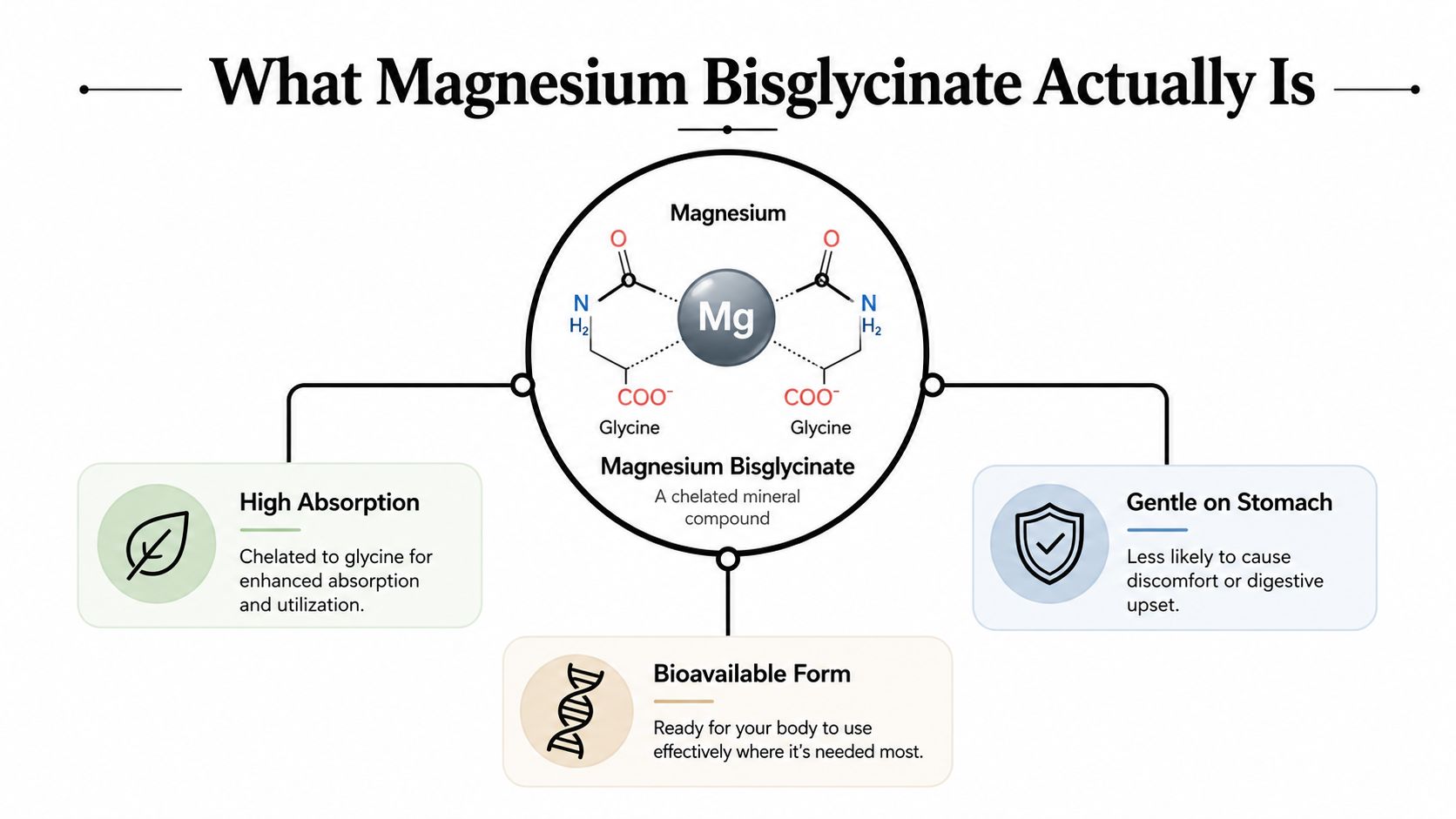
Magnesium bisglycinate is a chelated form of magnesium. One magnesium ion is paired with two molecules of glycine, an amino acid. This creates a compound suitable for use in supplement capsules or powders.
The chemistry has a practical meaning. Magnesium is the mineral you want to supply, while glycine is the accompanying molecule that packages it into this particular form. The name “bisglycinate” points to the two glycine molecules attached to one magnesium ion.
The number that matters most
A capsule contains the weight of the complete compound. Only part of that weight is elemental magnesium, the magnesium mineral the product contributes to your intake. UK-focused guidance places the elemental fraction of magnesium bisglycinate at roughly 10–14%. A serving containing 1,500 mg of the compound may therefore provide approximately 150–210 mg elemental magnesium (Bolt Pharmacy's explanation of magnesium bisglycinate).
That distinction explains why two bottles displaying similar large numbers can deliver different magnesium amounts. The compound weight describes the chelated ingredient as a whole. The elemental figure describes the magnesium itself.
A useful label-reading shortcut is to treat magnesium bisglycinate as the delivery form, while elemental magnesium is the active mineral amount. In UK products, check the elemental figure before comparing servings or deciding how much magnesium a capsule provides. Once those two figures are separated, the label is much easier to understand.
Why the Chelation Structure Matters for Absorption
Chelation describes the way magnesium is attached to another molecule. In bisglycinate, glycine can be thought of as a friendly courier travelling with magnesium through the digestive system. The analogy isn't a guarantee of superior absorption in every person, but it helps explain why supplement makers use this structure.
Bioavailability means how much of a swallowed nutrient becomes available for the body to use. A supplement can contain a large compound weight but still provide a modest elemental dose. It can also be poorly tolerated, meaning the person takes less consistently because of stomach discomfort or loose stools.
UK clinical and pharmacy sources describe chelated forms such as bisglycinate as well absorbed and less likely to cause loose stools than magnesium oxide (UK pharmacy guidance on magnesium forms). That makes bisglycinate appealing to people who want a regular daily supplement without the digestive effects associated with some alternatives.
Why oxide often feels different
Magnesium oxide is a common, inexpensive form. It supplies magnesium in a different chemical structure and is widely associated with a stronger laxative effect. That may be useful for someone specifically seeking bowel support, but it can be inconvenient if the aim is a gentle mineral top-up.
Magnesium bisglycinate is therefore often chosen for GI tolerance, not because it has been conclusively proven superior to every other form in every situation. Direct human comparisons across all magnesium products remain limited, and the quality of a product depends on its formulation, labelling and actual elemental content.
Practical rule: A gentler form only helps if you can take it consistently and the label clearly states the elemental magnesium amount.
The courier analogy also has limits. Glycine doesn't turn magnesium into a miracle ingredient, and “better absorbed” shouldn't be treated as proof that bisglycinate will solve sleep, stress or muscle problems on its own. It describes a plausible and practical formulation advantage, not a universal clinical outcome.
How to Read a Magnesium Bisglycinate Label
You are comparing two tubs. One front label says 1,000 mg, while another gives a smaller headline figure. The useful comparison starts inside the serving panel, where you can find elemental magnesium, or wording such as “providing” or “of which magnesium”. This is the amount of magnesium itself, rather than the weight of the full compound.
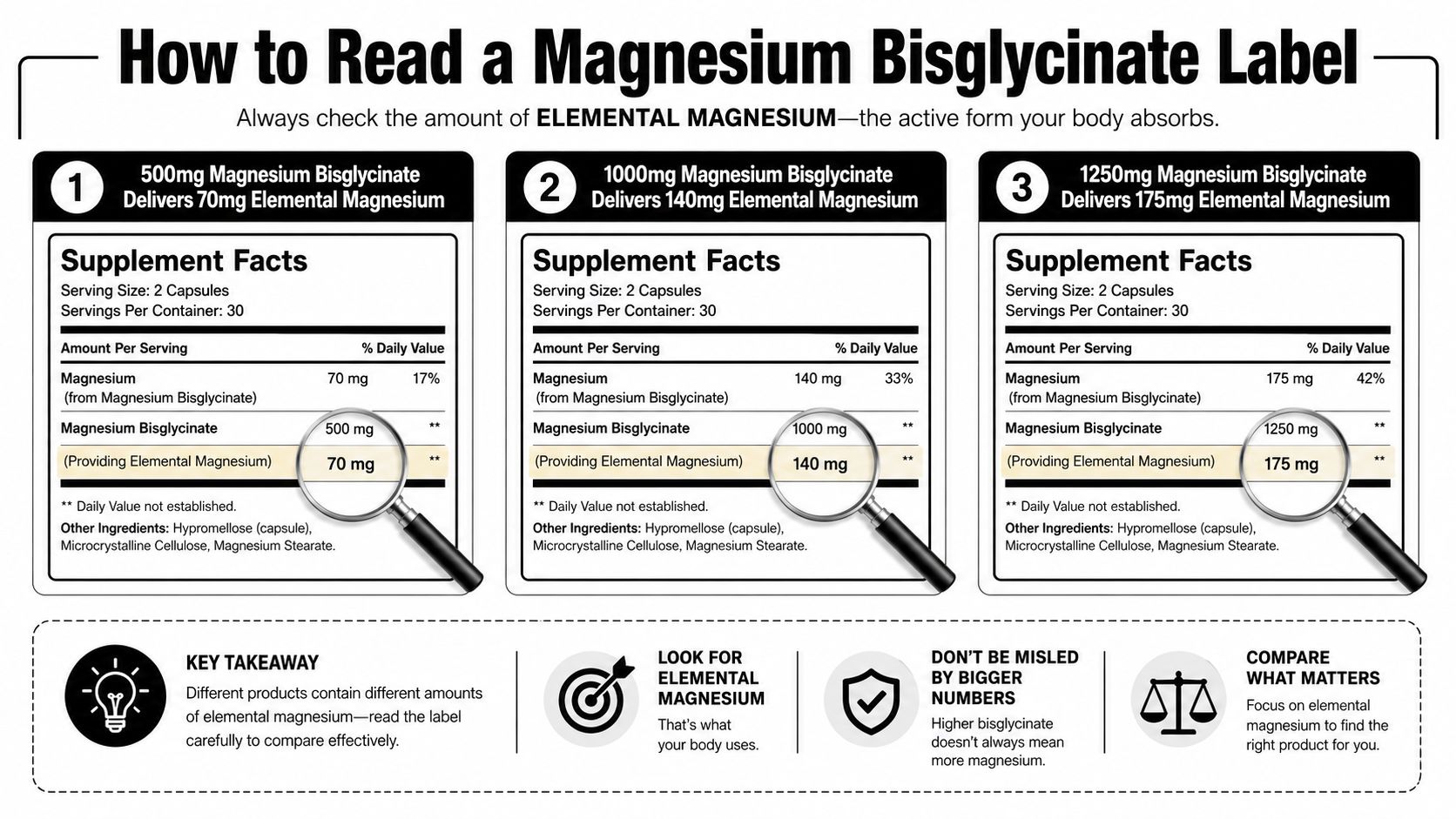
Magnesium bisglycinate commonly contains roughly 10–14% elemental magnesium by weight. A 1,500 mg serving may therefore provide approximately 150–210 mg elemental magnesium, rather than 1,500 mg of magnesium itself (label guidance from Bolt Pharmacy).
UK labels make the difference easy to see:
- One product lists 500 mg magnesium bisglycinate providing 100 mg elemental magnesium (UK product label examples).
- Another lists 750 mg magnesium bisglycinate providing 150 mg elemental magnesium (additional UK label guidance).
- A separate listing gives 1,000 mg magnesium bisglycinate providing 200 mg elemental magnesium, equal to 53% of the adult Reference Intake per serving (Holland & Barrett magnesium bisglycinate listing).
A two-step label check
First, find the elemental amount. Set the compound weight aside. If the serving provides 100 mg elemental magnesium, that is the figure you are taking, whether the front of the pack highlights 500 mg or a larger number.
Second, place it alongside your total intake. The NHS lists a Reference Nutrient Intake of 300 mg per day for men aged 19 to 64 and 270 mg per day for women aged 19 to 64. These figures cover magnesium from food, fortified products and supplements, so the label is only one part of the wider picture.
Watch for the term buffered bisglycinate. It may mean the product combines bisglycinate with another magnesium form, meaning the stated compound weight does not necessarily represent pure bisglycinate. The elemental magnesium line remains the clearest guide.
A product labelled 1,250 mg bisglycinate could provide 250 mg elemental magnesium, while another formulation may provide a different amount. The headline compound figure cannot tell you the dose by itself.
The embedded video below reinforces this label-reading habit.
Comparing Magnesium Bisglycinate to Other Forms
The best form depends on what you're trying to achieve and how your digestion responds. A person wanting a gentle daily top-up may make a different choice from someone looking for bowel support, while someone interested in cognitive performance may focus on a different formulation altogether.
The table below gives a practical overview. Exact elemental content varies by product, so treat the categories as general buying guidance rather than fixed specifications.
Magnesium forms at a glance
| Form | Typical elemental Mg | GI tolerance | Best for | Relative cost |
|---|---|---|---|---|
| Bisglycinate | Check the elemental figure, often a modest fraction of the compound weight | Often gentle | Daily top-up, evening use, sensitive digestion | Medium to high |
| Citrate | Check the elemental figure on the label | May be more laxative for some people | General supplementation, people who also want bowel support | Medium |
| Oxide | Check the elemental figure on the label | More likely to cause loose stools | Lower-cost products or bowel support | Low |
| Threonate | Check the elemental figure on the label | Product-dependent | People interested in cognitive-focused formulations | High |
| Malate | Check the elemental figure on the label | Product-dependent | People choosing a form for daytime or training routines | Medium to high |
Bisglycinate is usually the straightforward option for someone who values tolerance and wants a daily supplement that fits an evening routine. Citrate can be useful for general supplementation, although its digestive effect may be more noticeable. Oxide is often selected because it costs less, but it isn't automatically the best value if the person can't tolerate it.
Threonate and malate deserve careful label checking because their compound names can distract from the actual elemental magnesium supplied. For cognitive goals, compare the evidence and product formulation rather than assuming that a form associated with the brain will produce a guaranteed focus benefit. For training, magnesium supports normal physiological processes, but it shouldn't replace food, hydration, recovery or a properly designed exercise plan.
For a separate discussion of selecting magnesium for evening routines, see this guide to what type of magnesium is best for sleep. If you're also considering topical products, benefits of magnesium oil spray provides useful background on how spray products differ from oral capsules.
Evidence-Based Benefits and Where to Be Sceptical
Magnesium has legitimate roles in the body, but a supplement label can stretch those roles into promises the evidence doesn't support. Bisglycinate should be viewed as a way of delivering magnesium, not as proof that every claimed benefit belongs specifically to this form.
Sleep and relaxation
Magnesium is involved in nerve and muscle function, and glycine is one reason bisglycinate is commonly associated with calming evening routines. Some people choose it before bed because they find the routine relaxing, but that personal experience shouldn't be converted into a guaranteed sleep treatment.
The strongest practical position is modest. Magnesium may be relevant to sleep, especially when intake is inadequate, yet research using mixed magnesium forms can't automatically prove that bisglycinate is uniquely effective.
Muscles and recovery
Magnesium contributes to normal muscle function, so it makes sense that people interested in cramps, training and recovery often look at supplementation. A product may fit into a broader recovery plan, but it won't compensate for inadequate protein, poor sleep, insufficient fluids or excessive training load.
Marketing often suggests that bisglycinate directly accelerates recovery. That claim goes beyond what can be concluded from the form alone. The sensible question is whether the product provides an appropriate elemental dose and whether it supports a genuine dietary gap.
Mood, stress and bones
Magnesium is also discussed in relation to stress, mood and bone health. These areas are biologically plausible because magnesium participates in normal nerve function and broader mineral processes, but the specific benefit of bisglycinate remains less certain than promotional copy often suggests.
For a broader overview, you can read VitzAI's guide to magnesium benefits. Readers interested in the mineral's wider cardiovascular context may also find exploring magnesium with Qaly useful, while keeping the same distinction between magnesium's physiological role and claims about a particular supplement.
Wellness product or clinical treatment
In the UK, bisglycinate mainly belongs to the over-the-counter nutritional supplement category. NHS Specialist Pharmacy Service guidance for acute hypomagnesaemia lists licensed oral options such as magnesium aspartate, magnesium citrate and magnesium glycerophosphate, rather than positioning bisglycinate as the main prescription pathway (NHS-linked oral magnesium guidance).
That distinction matters. A wellness supplement may be appropriate for general nutritional support, but suspected deficiency or significant symptoms require clinical assessment rather than self-prescribing a high-dose product.
Dosing, Timing and Safety Essentials
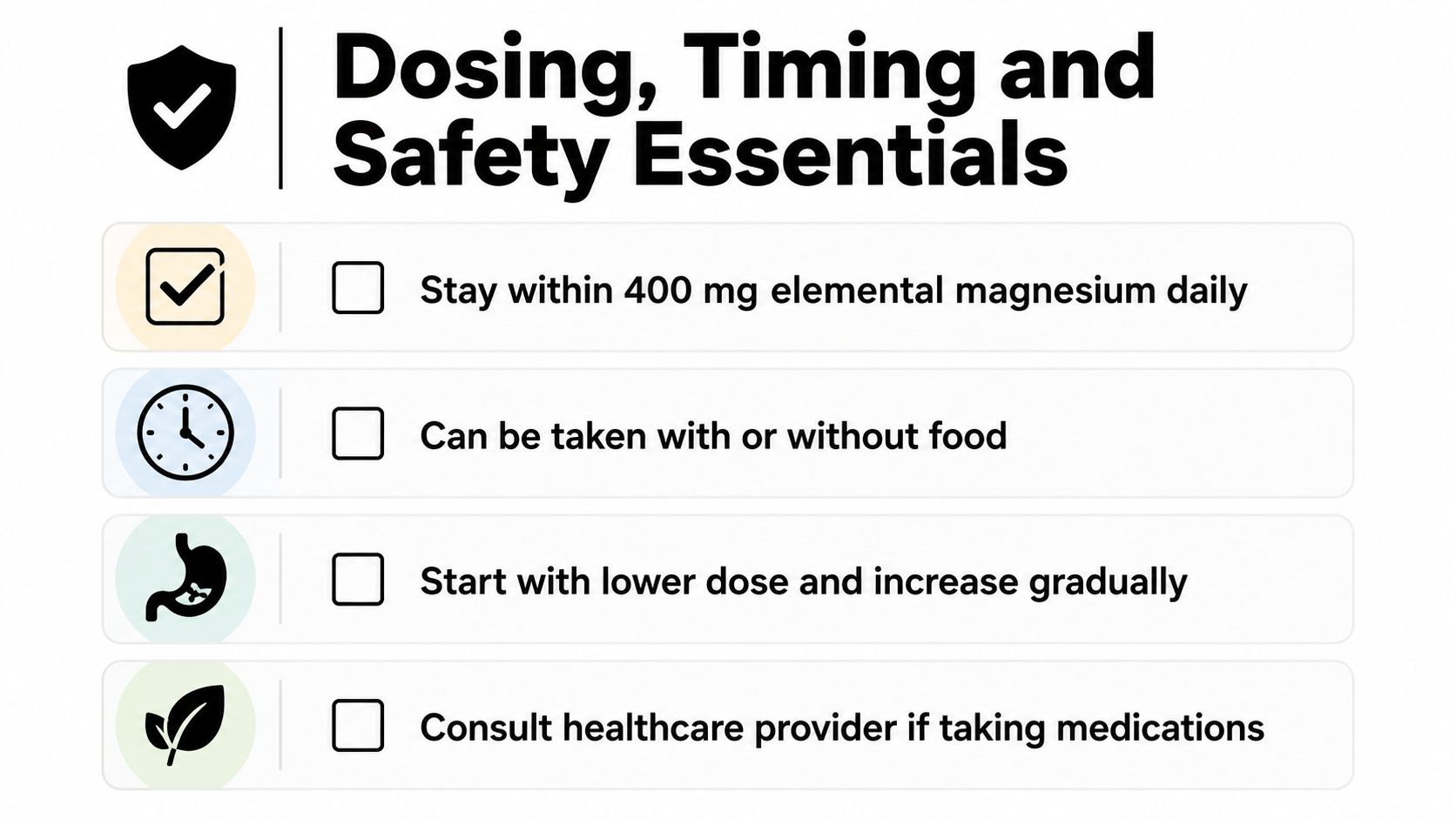
Use elemental magnesium for every dosing decision. The UK Expert Group on Vitamins and Minerals advises a supplemental upper limit of 400 mg elemental magnesium per day for healthy adults, while NHS-referenced daily intakes are 270 mg for women and 300 mg for men from all sources (UK magnesium dosage guidance).
Those figures aren't instructions to take the upper limit. They're boundaries that help you interpret a label. A product providing 100 mg elemental magnesium is very different from one providing 250 mg, even if both display a much larger bisglycinate compound weight.
A conservative routine
Take the serving stated on the product label, and consider starting with the lower end if you're new to magnesium or have a sensitive digestive system. If a daily amount feels uncomfortable, splitting it between two meals may improve tolerance, but don't increase the total just because the compound number looks large.
Many people prefer the evening because bisglycinate is associated with a calming routine. There's no hard rule that it must be taken at night, however. Consistency matters more than forcing a particular clock time. The NHS-linked guidance also advises taking magnesium with food to reduce the risk of stomach upset and diarrhoea.
You can find additional routine guidance in this article about the best time to take magnesium.
Medicines and medical conditions
Magnesium can interfere with the absorption of some medicines, including certain antibiotics and bisphosphonates. Ask a pharmacist or GP how to space your supplement from prescribed medicines rather than guessing.
Speak with a healthcare professional before using magnesium if you have kidney problems, take regular medication, are pregnant or breastfeeding, or are considering supplementation for suspected deficiency. Reduced kidney function can affect how the body handles minerals, so a clinician should guide the decision.
Safety check: The 400 mg ceiling applies to supplemental elemental magnesium for healthy adults. Always count the elemental amount, not the compound weight.
Stop and seek advice if you develop persistent diarrhoea, unusual symptoms or a reaction after starting a product. A supplement should support your diet, not become a substitute for investigating an underlying health concern.
Choosing a Quality Product for Your Needs
A label can look impressive while leaving the useful information unclear. For example, a capsule may list 1,000 mg of magnesium bisglycinate, yet provide only 200 mg of elemental magnesium. The larger figure describes the whole compound, not the magnesium your body can use. Read the label like a recipe: the compound name identifies the form, while the elemental figure tells you how much mineral is in the serving.
UK product listings illustrate why this check matters. Daily servings may show 375 mg, 500 mg, 750 mg, 1,000 mg or 1,250 mg of compound, while the elemental magnesium amount ranges from about 50 mg to 250 mg, depending on the formulation. Compare the elemental figure, not the biggest number on the front of the pack.

A buyer's checklist
- Clear elemental figure: Confirm how much elemental magnesium the complete serving provides.
- Specific form: Look for “magnesium bisglycinate”, rather than a label that says only “magnesium”.
- Transparent formulation: Check whether the product is pure or buffered, then review inactive ingredients if you avoid particular fillers.
- Quality controls: Look for batch information, manufacturing details and credible third-party testing where available.
- Practical serving size: Choose a format you can take comfortably and consistently. A high compound weight is not a reason to choose a product by itself.
Your routine and wider goals also affect the practical fit. Someone seeking general relaxation may prefer bisglycinate in an evening routine, while someone already taking several supplements may value a clearly stated, modest elemental dose. People considering magnesium alongside bone-health, energy or exercise goals should assess the whole supplement plan rather than treating one mineral as a complete strategy.
A useful product is easy to identify, easy to dose and easy to check against your needs. VitzAI offers an AI-powered questionnaire and personalised supplement report based on factors such as age, sex, lifestyle and health goals. Use that information alongside independent label checking, not as a replacement for advice from a GP or pharmacist.
Putting It All Together
Magnesium bisglycinate is magnesium paired with two glycine molecules, chosen by many supplement users for its generally gentle profile. The number on the front of the bottle describes the compound, while the elemental magnesium line tells you the mineral amount that belongs in your intake calculation.
In the UK, bisglycinate is mainly a wellness top-up rather than a prescribed NHS treatment for acute deficiency. Choose it if you want a well-tolerated daily form, check the elemental magnesium figure against your needs, and keep total supplemental magnesium at or below 400 mg elemental magnesium per day unless a clinician advises otherwise. Supplements work best alongside a varied diet, regular movement and reliable sleep.
This article is for informational purposes only and is not medical advice. Always consult a qualified health professional before starting any new supplement or major lifestyle change
VitzAI.com combines personalised supplement recommendations with an online shop, using an AI-powered questionnaire to create guidance based on your age, lifestyle and health goals. Visit VitzAi.com to explore supplement support and make magnesium, creatine, omega-3 and other choices easier to organise.