

What Are Methylated Vitamins A Guide to Bioactive B Vitamins
Have you ever stopped to wonder if your body is actually using the nutrients from your supplements? It’s a great question, and the answer often comes down to the specific form of the vitamin you’re taking. This is where understanding methylated vitamins can be a total game-changer for your health and cognitive performance.
Methylated vitamins are basically the most active, ready-to-use forms of certain key nutrients, especially the B vitamins. Think of them as being 'pre-activated' for your body, so they can get to work straight away without needing to go through a bunch of complex conversion steps first.
Understanding Methylated Vitamins and Why They Matter
Let's break it down with an analogy. A standard, synthetic vitamin like folic acid is like a "blank key." Your body gets it, but then has to go through several biochemical steps to cut it into the right shape before it can actually unlock a cell's door.
A methylated vitamin, on the other hand, is a "pre-cut key." It arrives ready to go, fitting the lock perfectly from the get-go.
The Advantage of Being 'Ready to Use'
This 'ready-to-use' status is a pretty big deal. Methylated vitamins neatly sidestep the body's conversion process, which for many people, can be slow or inefficient. This helps ensure you're getting the maximum possible benefit from the nutrients you're taking.
Here’s what you need to remember:
- Better Bioavailability: Methylated forms are much more bioavailable, meaning your body can absorb and put them to use far more effectively.
- Immediate Action: Because they don't need converting, they can jump straight into cellular processes where they're needed.
- Bypassing Bottlenecks: They are a fantastic option for people whose bodies struggle to convert standard vitamins, often due to very common genetic variations.
This efficiency is why there's so much buzz around them. The global market for methylated B-complex supplements is expected to grow at a rate of 11% each year, hitting a value of USD 2.5 billion by 2030. That kind of growth shows that people are catching on and looking for more effective ways to support their health. You can find more details in this market analysis on methylated B-complex growth.
By choosing methylated forms like methylfolate (B9) and methylcobalamin (B12), you're giving your body a more direct and reliable path to better energy, stress management, and overall wellbeing. For a deeper dive into how these nutrients work together, you might be interested in our guide on B-complex vitamins benefits.
The Vital Process Of Methylation Explained
Methylation. It’s a word you might see popping up more and more, and for good reason. It’s one of your body’s most fundamental biochemical processes, happening billions of times every single second in virtually every cell.
Think of it as a constant, high-speed delivery service happening inside you. In this system, tiny molecular tags called methyl groups (just one carbon atom bonded to three hydrogen atoms) are passed from one molecule to another—to proteins, enzymes, and even your DNA.
This simple hand-off of a methyl group acts like a master switch. It’s the signal that tells your cells when to turn genes on or off, when to ramp up production of a certain chemical, or when to pump the brakes on another process. It is absolutely fundamental to keeping your body’s complex machinery running in perfect balance.
How Methylation Impacts Your Daily Health
The influence of methylation is huge, touching almost every part of your wellbeing. When this process is running smoothly, you feel it. Your energy is up, your mind is clear, and your body feels resilient.
Here are just a few key functions that rely on healthy methylation:
- DNA Repair and Expression: It helps to safeguard your genetic blueprint from damage and plays the role of director, deciding which genes get to be active.
- Detoxification and Gut Health: It's a central player in your liver's ability to process and clear out toxins and waste products from your body.
- Neurotransmitter Production: It is absolutely essential for creating the brain chemicals that govern your mood and sleep, like serotonin, dopamine, and melatonin.
- Hormone Regulation: It helps keep your body’s inflammatory response and hormone levels in check, preventing them from spiralling into chronic issues.
At its core, efficient methylation is the engine powering your energy levels, your mental sharpness, and your hormonal equilibrium. When there’s a spanner in the works, it can create a system-wide bottleneck, often leading to stubborn fatigue and that all-too-common feeling of brain fog.
This is where the type of vitamin you take becomes so important. Your body has to convert a standard vitamin into its active, usable form before it can get to work.
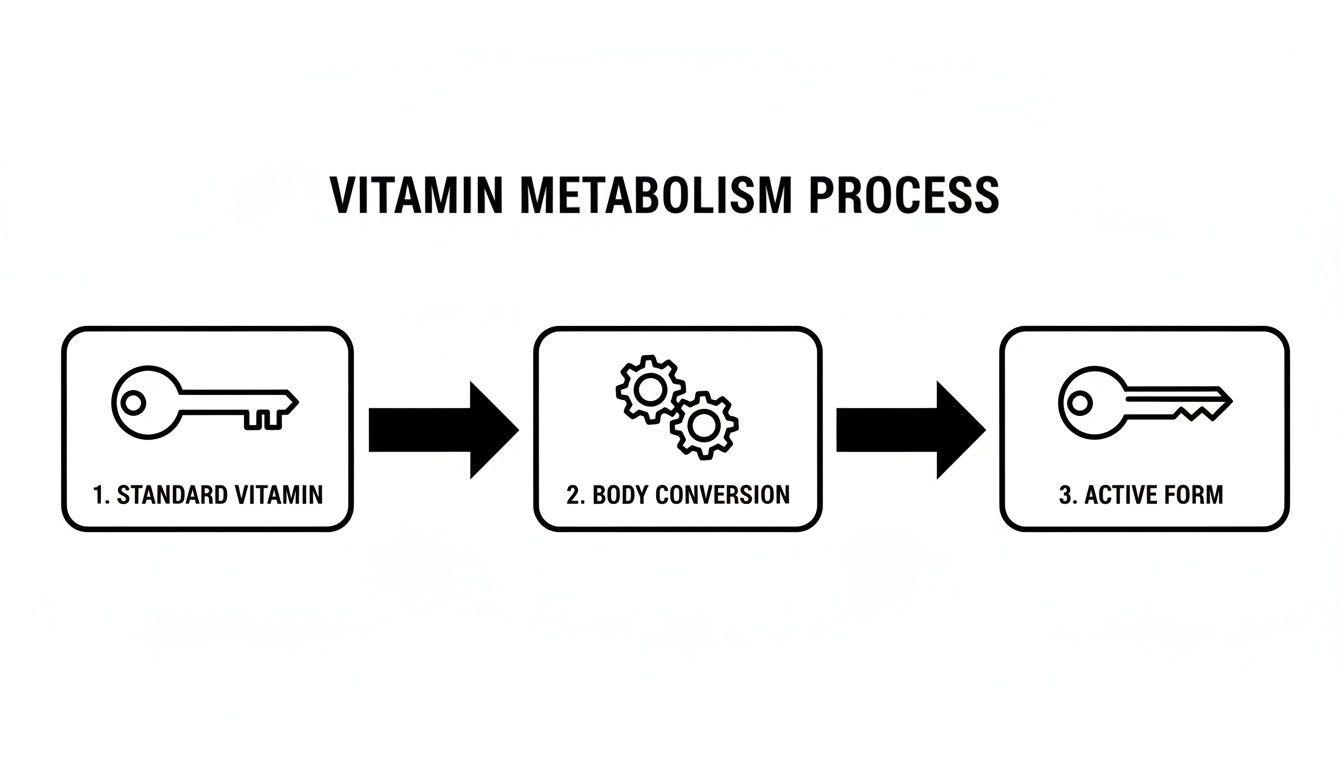
As you can see, this conversion demands extra metabolic effort—a step that methylated vitamins bypass entirely, delivering the nutrient in its ready-to-go state.
The Role of B Vitamins in Methylation
So, where do vitamins fit into all of this? Certain B vitamins—specifically folate (B9), vitamin B12, and vitamin B6—are the essential co-factors, or 'helpers', that keep the whole methylation cycle spinning. Without enough of them in their correct, active forms, the entire process grinds to a halt.
Methylation isn’t just a passive background process; it’s an active, dynamic system that dictates how well you handle stress, how much energy you have, and how sharp you feel. Giving it the right fuel isn't just a good idea—it's non-negotiable for feeling your best.
This is precisely why understanding methylated vitamins is such a game-changer. They provide these crucial B vitamins in their pre-activated, "body-ready" state. This means the methylation cycle gets the raw materials it needs to do its thousands of jobs without any delay, supporting everything from your mood to your immune system right away.
Understanding The MTHFR Gene Variant
Now that we've seen just how crucial methylation is, let's dig into a very common reason why this process might not be running as smoothly as it should be for so many of us. It often boils down to a tiny variation in a single gene: MTHFR.
Having an MTHFR gene variant isn’t a disease or some kind of defect. It's much better to think of it as a common genetic 'typo'. In fact, it’s incredibly widespread, with estimates suggesting that up to 60% of people have at least one variant of this gene, which tells the body how to make the MTHFR enzyme.

This enzyme has one of the most important jobs in the whole methylation cycle. It's responsible for converting folate (vitamin B9) from food and standard supplements (like folic acid) into its biologically active form, methylfolate. This is the 'ready-to-use' fuel that powers the entire process.
How The MTHFR Variant Creates a Bottleneck
If you carry this genetic typo, your MTHFR enzyme might work much less efficiently—in some cases, its function can be reduced by as much as 40-70%. Think of a factory assembly line where one of the main machines is running at half-speed. It doesn't take long for everything to grind to a halt.
In your body, this MTHFR slowdown creates a major bottleneck, preventing you from producing enough active methylfolate. This shortage then causes a ripple effect across all the systems that rely on healthy methylation.
Some of the most common consequences include:
- Persistent Fatigue: Your body can't produce energy efficiently at a cellular level, leading to that deep-seated fatigue that no amount of rest seems to fix.
- Brain Fog: Methylation is vital for producing neurotransmitters like dopamine and serotonin. A slowdown can directly impact focus, memory, and cognitive performance.
- Mood Imbalances: When your body can't properly synthesise the chemicals that regulate your mood and stress response, it can leave you feeling anxious or low.
Think of it this way: Your body has the raw materials (folic acid from your diet), but the tool needed to process them is faulty. The result is a system-wide shortage of the final, usable product.
For anyone with an MTHFR variant, taking standard B vitamins is a bit like pouring petrol into a car with a clogged fuel line. Not much of it actually gets through to the engine. This is a huge reason why so many people take a regular B-complex supplement and feel absolutely no different.
This is where understanding what are methylated vitamins becomes a game-changer. They provide a simple, direct workaround to this genetic bottleneck. By supplying your body with the pre-activated, 'finished' form of the vitamin (like methylfolate), you bypass the need for that sluggish MTHFR enzyme entirely. You’re essentially giving the factory the finished part it needs, letting the whole assembly line get back up to full speed.
Bioactive vs Synthetic Forms: A Clear Comparison
Not all vitamins are created equal, and understanding the difference is crucial to making sure your supplements are actually doing their job. When you grab a bottle off the shelf, you’ll often find synthetic forms that force your body to do a lot of heavy lifting. Bioactive, methylated vitamins, on the other hand, are delivered in their ready-to-use state.
Let’s put the most common B vitamins head-to-head to really see why choosing the active form has such a direct impact on absorption and effectiveness. This comparison will show you exactly what your body gets from each type.
To make things a bit clearer, here’s a quick breakdown of the most popular B vitamins you'll find on supplement labels.
Key Vitamin Forms Compared: Methylated Vs Synthetic
| Vitamin | Methylated (Active) Form | Standard (Synthetic) Form | Key Difference |
|---|---|---|---|
| Folate (B9) | L-5-Methyltetrahydrofolate (L-5-MTHF) | Folic Acid | L-5-MTHF is ready for immediate use. Folic acid needs a multi-step conversion that can be blocked by MTHFR gene variants. |
| Vitamin B12 | Methylcobalamin | Cyanocobalamin | Methylcobalamin is a natural, active form with a methyl group. Cyanocobalamin is synthetic and contains a cyanide molecule that the body must remove and detoxify first. |
| Vitamin B6 | Pyridoxal-5-Phosphate (P-5-P) | Pyridoxine Hydrochloride | P-5-P is the body's active coenzyme form. Pyridoxine is inactive and requires conversion in the liver, which can be inefficient for some people. |
As you can see, the difference isn't just in the name—it’s about giving your body what it can use right away, without the extra work.
Folate (B9): Methylfolate vs Folic Acid
This is probably the most critical comparison of them all, especially for anyone with an MTHFR gene variant.
Folic acid is the synthetic, oxidised form of folate you’ll find in fortified foods and most standard supplements. For your body to use it, it has to go through a complicated, multi-step conversion process that leans heavily on the MTHFR enzyme.
Methylfolate, often listed on labels as L-5-MTHF, is the finished product. It’s the fully active form that requires zero conversion.
By taking methylfolate, you are effectively bypassing the entire conversion pathway, including the potential MTHFR bottleneck. This ensures the nutrient gets delivered directly to your cells, ready for immediate use in methylation.
Vitamin B12: Methylcobalamin vs Cyanocobalamin
The difference here is pretty stark. Cyanocobalamin is a synthetic form of B12 made in a lab. Its molecular structure contains a cyanide molecule—yes, that cyanide. While the amount is tiny and generally considered safe, your body still has to identify, detach, and detoxify this cyanide before it can get to work converting the remaining cobalamin into a usable form.
Methylcobalamin, on the other hand, is a naturally occurring, active form of B12. It arrives with a methyl group already attached, which it can donate straight into the methylation cycle. It’s a cleaner, more efficient form that doesn’t add an unnecessary detoxification burden to your system.
Vitamin B6: P-5-P vs Pyridoxine
Finally, let’s look at vitamin B6. The common synthetic form is pyridoxine hydrochloride. Just like the others, it's inactive and needs to be converted in the liver to become useful. For some of us, this conversion process can be slow or inefficient, limiting how much active B6 is actually available.
The bioactive form is Pyridoxal-5-Phosphate (P-5-P). This is the exact form of vitamin B6 your body uses as a coenzyme in over 100 crucial reactions, including making neurotransmitters and managing homocysteine levels. Choosing P-5-P means you're supplying the active compound directly, avoiding any conversion holdups.
Ultimately, choosing bioactive forms isn't about taking higher doses; it’s about choosing smarter, more efficient ingredients. By selecting methylated vitamins, you are giving your body the exact nutrients it needs, in the form it can use instantly. And that’s the real foundation of an effective supplement strategy.
Who Should Consider Methylated Vitamins?
While anyone can benefit from using the most bioavailable form of a nutrient, some people will find that switching to methylated vitamins makes a massive difference to how they feel day-to-day. If you fall into one of the following groups, a bioactive supplement could be exactly what you need to hit your health goals.
It's clear that more of us are taking an active role in our health. The UK's vitamins and minerals market shows just how much we're investing in preventive wellness. As people look for more effective solutions, the demand for high-quality, easily absorbed supplements is only going up. You can discover more insights about the UK's growing supplement market on statista.com.
Individuals With MTHFR Gene Variants
This is probably the most clear-cut case. If you know you have an MTHFR gene variant, your body's ability to convert standard folic acid into its active form is naturally limited.
Taking pre-activated methylfolate completely sidesteps this genetic hurdle. It ensures your body gets the crucial B9 it needs for energy, mood, and detoxification without any extra metabolic work.
Those Experiencing Unexplained Fatigue or Brain Fog
Do you often feel wiped out despite getting enough sleep? Or maybe you're struggling with a persistent mental haze that you just can't shake? These are classic signs that your methylation cycle might be running on fumes.
Because methylation is so fundamental to both energy production and making neurotransmitters, giving your body active B vitamins like methylcobalamin and P-5-P can help bring back that mental clarity and vitality. Sometimes, these symptoms are tied to absorption issues, so it's always a good first step to check for common deficiencies. You can learn more in our guide on the subtle signs of vitamin B12 deficiency.
Specific Needs for Men and Women
Targeted nutrition can offer some real advantages depending on your biology and lifestyle.
- For Men’s Health: Methylated vitamins are fantastic for supporting energy metabolism, which is essential for fitness and cognitive performance. They also help with muscle recovery after a workout and assist in managing homocysteine levels—a big plus for long-term longevity and cardiovascular health.
- For Women’s Health: These vitamins play a huge part in hormone balance and mood regulation by supporting key neurotransmitters like serotonin. For women in their reproductive years, active methylfolate is especially important for prenatal health and foetal development.
Ultimately, choosing methylated vitamins is about optimisation. It’s for anyone who wants to ensure their body is getting the absolute most from their supplements, turning good nutrition into tangible results you can actually feel.
For those looking into different ways to optimise their wellbeing and find more health-related information, resources like GrabGains might offer some useful insights.
How To Choose High-Quality Methylated Supplements
Walking down the supplement aisle can feel a bit overwhelming, especially when you're trying to find methylated vitamins that actually work. But knowing a few key details to look for on the label can make all the difference. Honestly, focusing on the quality of the formulation rather than just the dosage numbers is the smartest way to make sure you're getting real, noticeable benefits.
When you pick up a bottle, flip it over and get familiar with the ingredients list. You're on the hunt for specific, bioactive names that signal you're getting the 'ready-to-use' form of a nutrient.
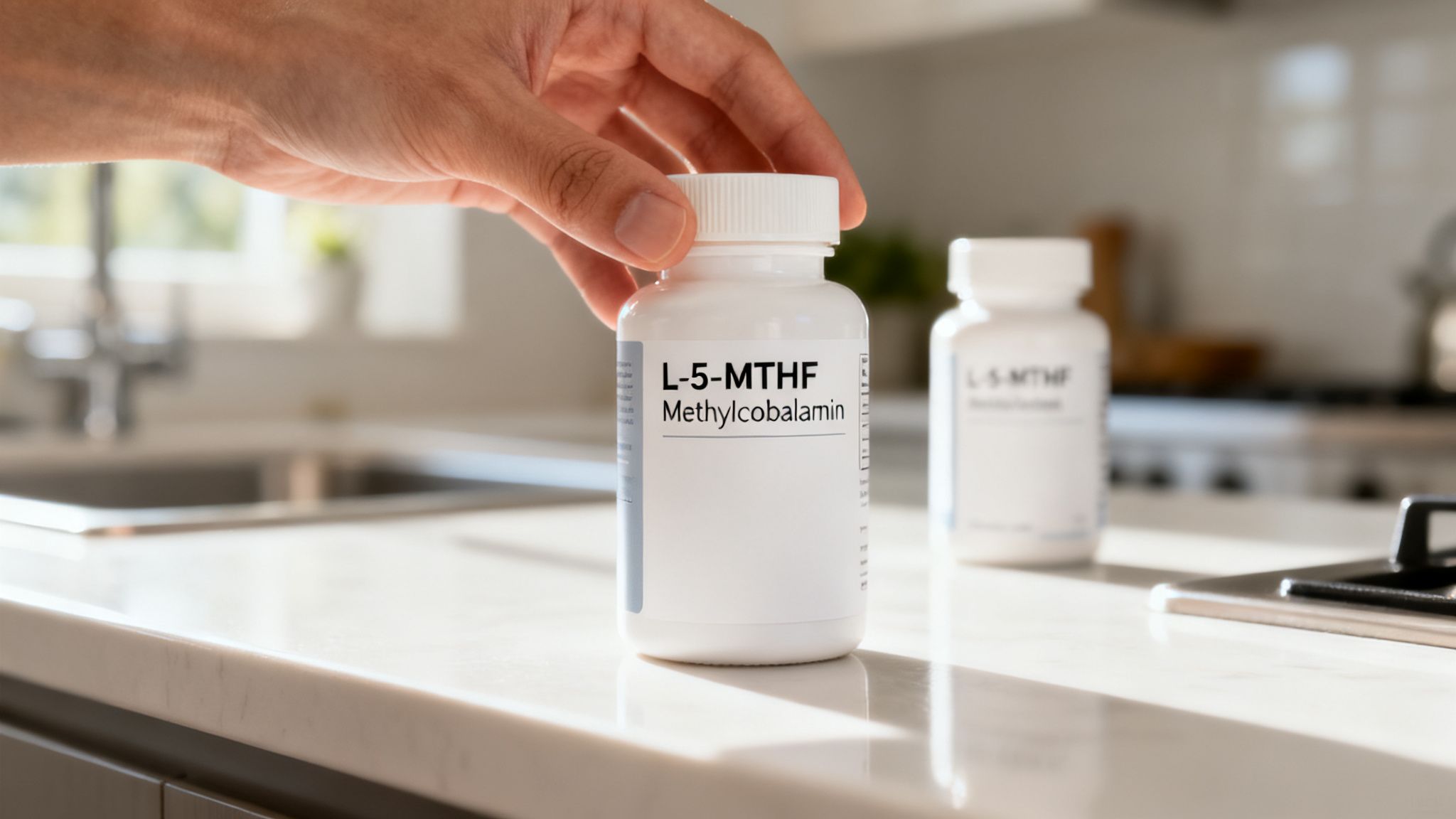
What To Look For On The Label
To pick out the best methylated supplements, my advice is to ignore the flashy marketing on the front and head straight for the supplement facts on the back. These are the names you want to see:
- For Folate (B9): Look for L-5-methyltetrahydrofolate or L-5-MTHF. Steer clear of products that only list "folic acid."
- For Vitamin B12: You want to see methylcobalamin. Try to avoid "cyanocobalamin," which is the synthetic version.
- For Vitamin B6: The active, methylated form is pyridoxal-5-phosphate, often abbreviated to P-5-P.
Finding these specific names is your confirmation that the product contains the bioavailable versions your body can put to work straight away. On a related note, many people find that learning about the best time to take a vitamin B complex helps them get even more out of their routine.
True quality isn't about having the highest milligram count. It's about formulation, bioavailability, and the synergy between nutrients that allows your body to absorb and use them efficiently.
Consumer demand for higher quality is definitely on the rise. The UK vitamin supplements market is projected to grow at a rate of 5.1% each year through 2033, and a lot of that is driven by people wanting more natural, chemical-free ingredients.
When you're choosing your supplements, it's also a good idea to find reputable sources that offer a wide array of health and wellness supplements. This helps ensure you're getting quality and transparency across the board. By simply learning to read the label, you can confidently choose supplements that deliver genuine benefits.
Got Questions? We've Got Answers
Stepping into the world of methylated vitamins can bring up a few queries. Let's tackle some of the most common ones we hear.
Can I Take Methylated Vitamins Every Day?
Absolutely. For most of us, taking methylated vitamins daily is a great part of a regular wellness routine. Think of them as the upgraded, active forms of the essential B vitamins your body is crying out for to manage countless daily jobs.
Like with any supplement, the golden rule is to stick to the recommended dose on the label, unless your health professional has given you different advice. This way, you’re getting consistent, helpful support without going overboard.
How Do I Know If I Need Methylated Vitamins?
While getting a genetic test that flags an MTHFR variant is a pretty clear sign, you definitely don't need one to see the benefits. Many people make the switch to methylated forms simply because they're more bioavailable and efficient.
If you're dealing with stubborn fatigue, persistent brain fog, or feel like your standard B-complex just isn't cutting it, it could be a clue. Your body might be finding it tough to convert those inactive nutrients. In that case, swapping to an active, methylated form could give you the direct support you've been missing.
Are Methylated Vitamins Better Than Regular Multivitamins?
This really comes down to what's inside your multi. A top-notch multivitamin should, ideally, already use methylated forms of B vitamins to give you the best absorption and bang for your buck.
If you check the label and see synthetic forms like folic acid, then adding a dedicated methylated B-complex could offer a significant upgrade. This is especially true if you're looking for a real boost in energy and mental clarity.
Ready to feel the difference that superior bioavailability can make? At VitzAI, we create personalised supplement recommendations using active, methylated ingredients to ensure your body gets the support it needs, right away.
Discover your personalised supplement stack today at VitzAI.com
This article is for informational purposes only and is not medical advice. Always consult a qualified health professional before starting any new supplement or major lifestyle change.