

What Is the Best Time to Take Vitamins for Maximum Absorption?
Let's get straight to it: the best time to take your vitamins comes down to what kind of vitamin it is. Think of it like this: some are early birds, and others are night owls.
Water-soluble vitamins, like your B-complex and vitamin C, are best taken first thing on an empty stomach. They dissolve in water, get to work quickly, and help fuel your day. On the flip side, fat-soluble vitamins—that’s your A, D, E, and K—need a meal with a bit of fat to help them get absorbed properly.
Your Quick Guide to Perfect Vitamin Timing
So, you’ve invested in supplements to boost your health, which is a great first step. But are you actually getting the full benefit from them? It turns out that when you take your vitamins can be just as crucial as what you’re taking. Nailing the timing helps your body absorb and use every last drop of those essential nutrients, turning a good habit into a brilliant one.
It helps to imagine some vitamins as your morning coffee, ready to kick-start your metabolism and get you going. Others prefer to work their magic while you're asleep, helping with rest and repair. Getting this basic principle right is the key to optimising your routine for better energy, deeper sleep, and overall wellness.
Why Timing Is Everything
The main difference is all about absorption. Some vitamins dissolve in water and can be taken on an empty stomach, while others need fat to be properly processed by your body. If you take them at the wrong time or without the right companion (like a meal), they might just pass right through your system without doing much good.
This guide is your simple, scannable overview to help you master the timing. No more guesswork.
Below, I’ve put together a quick reference table to serve as your daily cheat sheet. It breaks down the essentials for the most common vitamins and supplements, helping you build a simple yet incredibly effective schedule.
Timing isn't about chasing perfection; it's about unlocking potential. A well-timed supplement schedule ensures your body gets the right nutrients exactly when it's most ready to use them. This can make a real difference, enhancing everything from your energy in the morning to how well you recover at night.
Making this small adjustment can have a massive impact on how you feel day-to-day, making sure you’re truly getting your money’s worth from every capsule. By syncing your vitamin intake with your body’s natural rhythm, you give your health goals a serious leg up.
Quick Reference Guide for Vitamin Timing
Here's a straightforward table to help you schedule your supplements for the best results. Pin it, screenshot it, or just commit it to memory—it's designed to make your routine effortless.
| Vitamin or Supplement Type | Best Time to Take | Take With Food? | Reason for Timing |
|---|---|---|---|
| Water-Soluble (B-Vitamins, C) | Morning | No (or with breakfast) | Supports energy metabolism and is best absorbed on an empty stomach. |
| Fat-Soluble (A, D, E, K) | Evening | Yes (with a fatty meal) | Requires dietary fat for optimal absorption and utilisation. |
| Multivitamin | Morning | Yes (with breakfast) | Contains both types; food prevents nausea and aids fat-soluble absorption. |
| Magnesium | Evening | With or without food | Promotes relaxation and can improve sleep quality by calming the nervous system. |
| Omega-3 Fish Oil | Anytime | Yes (with a meal) | Fat-based supplement; food enhances absorption and prevents indigestion. |
| Probiotics | Morning | No (empty stomach) | Allows bacteria to reach the gut with less interference from stomach acid. |
Understanding Fat-Soluble vs Water-Soluble Vitamins
To really get your supplement routine dialled in, you first need to grasp a fundamental concept: not all vitamins are created equal. The most crucial difference is how they dissolve and get processed by your body. This one factor dictates the best time to take your vitamins and whether you’re actually getting your money’s worth.
Think of it like tending to a plant. Some nutrients are like a quick spritz of water for the leaves, easily absorbed. Others need to be mixed into the soil to be taken up by the roots over time. Vitamins are much the same, falling into two main camps: water-soluble and fat-soluble.
The Fast-Paced World of Water-Soluble Vitamins
Water-soluble vitamins, which include Vitamin C and the entire B-vitamin family (like B12 and folate), dissolve in water. This means they get into your bloodstream quickly and are often best taken on an empty stomach.
Because they dissolve so easily, your body takes what it needs right away and flushes out any excess through your urine. They aren't stored for later, which is why a consistent, daily top-up is so important. They are the sprinters of the vitamin world—quick, effective, and then they're gone.
Water-soluble vitamins are like daily commuters. They arrive, do their job supporting energy and cellular function, and then they head home. Your body doesn't keep a reserve, so you need to provide a fresh supply every single day to keep things running smoothly.
This is exactly why taking them in the morning is such a popular recommendation. A morning dose gives your body the tools it needs for energy production and mental clarity right at the start of your day, just when you need them most.
The Slow-Burn of Fat-Soluble Vitamins
On the other hand, fat-soluble vitamins—Vitamins A, D, E, and K—are the marathon runners. They need fat to dissolve and be absorbed properly. These vitamins hitch a ride through your small intestine with dietary fats before being stored in your body's fatty tissues and liver.
Since your body can stash them away, they don’t need to be replenished quite as often as their water-soluble cousins. However, this also makes it absolutely vital to pair them with a meal containing some healthy fats—think avocado, nuts, or oily fish. Taking them on an empty stomach is like sending a parcel without any postage; it simply won’t get where it needs to go.
This visual guide can help simplify the decision-making process.
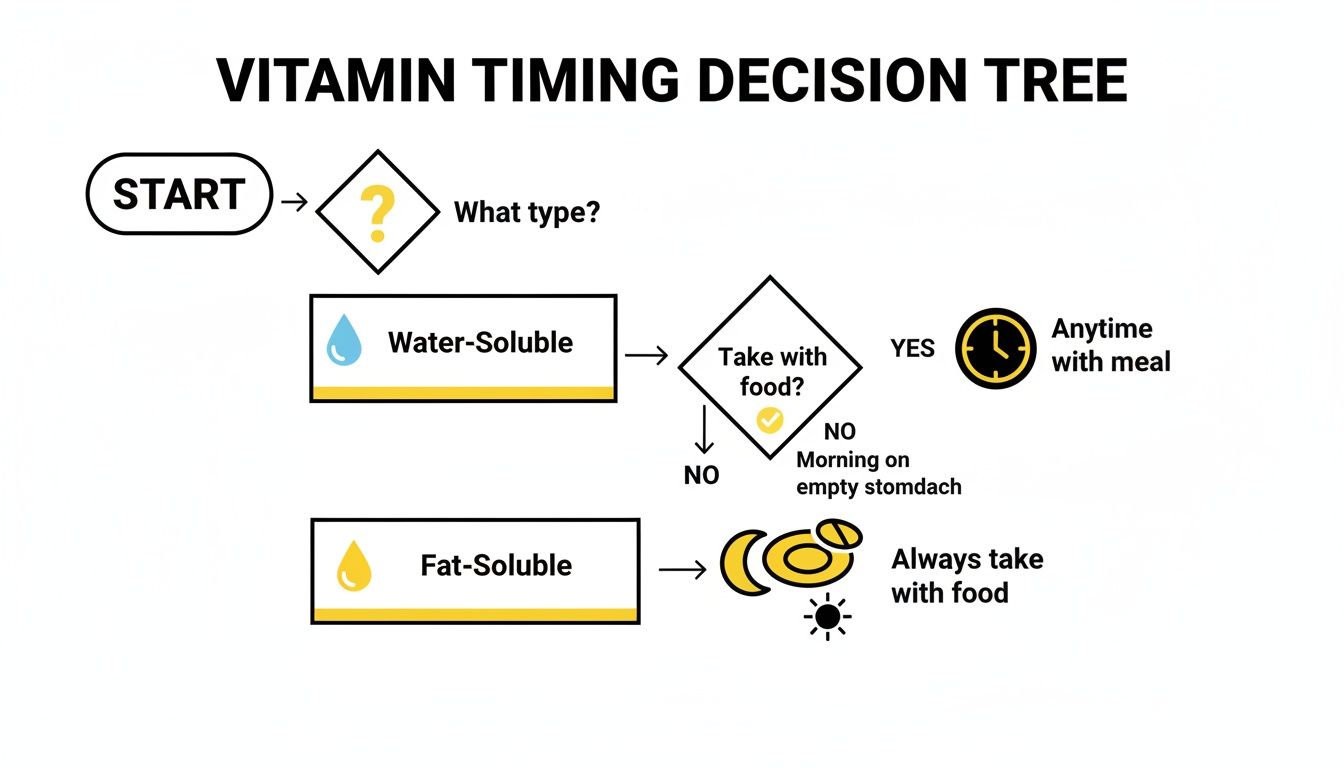
The key takeaway here is that your first question should always be about the vitamin's type. That single piece of information tells you almost everything you need to know about the ideal timing and conditions for absorption.
Getting your head around this core difference is the first and most critical step in building a supplement schedule that actually works. It isn’t about complicated science; it’s about working with your body’s natural processes. By lining up your intake with how these nutrients are absorbed, you ensure nothing goes to waste.
Energise Your Morning with Water-Soluble Vitamins
If you want to truly maximise your energy and focus, the secret lies in timing. You need to align your supplement routine with your body's natural daily rhythm, and the morning is your golden window of opportunity. Think of it as giving your body the essential raw materials it needs to build a productive, vibrant day, right from the get-go.
This is where water-soluble vitamins really shine. Nutrients like Vitamin C and the entire B-complex family act as your body’s spark plugs, essential for converting the food you eat into real, usable energy at a cellular level. Taking them first thing sets the tone for your whole day.

Why Morning Is Prime Time for B-Vitamins and Vitamin C
Water-soluble vitamins are absorbed quickly, but your body doesn't hang onto them for long. Taking them in the morning ensures they're ready and available to support your metabolism when it's firing on all cylinders.
For most people, the ideal approach is to take them on an empty stomach with a glass of water, about 30 minutes before breakfast. This simple timing trick helps your body absorb them without any interference from other nutrients. That said, if you have a sensitive stomach, taking them with a light breakfast is perfectly fine and still incredibly effective. The real goal is consistency.
The secret to a successful supplement routine isn't just what you take, but how you integrate it. By making water-soluble vitamins a non-negotiable part of your morning, you create a powerful ritual that fuels both body and mind for the hours ahead.
This one small act can make a noticeable difference in your ability to maintain focus and vitality, helping you conquer your day instead of just surviving it.
Your Morning Power Duo: Vitamin B-Complex and Vitamin C
Let's take a closer look at the two main players in your morning supplement line-up.
-
Vitamin B-Complex: This group of eight different vitamins is the very engine of your energy production system. They’re crucial for everything from neurological function to the creation of red blood cells. A morning dose can lead to sharper cognitive performance and a steady release of energy throughout the day. To really dial this in, you can learn more about the best time to take Vitamin B-complex in our detailed guide.
-
Vitamin C: Famous for its immune-boosting properties, Vitamin C is also a potent antioxidant that helps protect your cells from stress. Taking it in the morning helps arm your body against daily environmental challenges and supports collagen production for healthy skin.
While the best time for these is generally consistent, individual needs can vary. For instance, Vitamin B12, a popular supplement especially among vegans, shows 30-50% better uptake when taken in the morning on an empty stomach. With veganism on the rise and a reported 76% of UK adults using supplements to address nutrient gaps, smart timing has become more important than ever.
How to Build Your Morning Routine
To make this habit stick, try pairing it with an existing one. Place your vitamin bottles right next to your kettle or coffee machine. This simple visual cue will remind you to take them before you even pour your first cup.
For those focused on peak performance, it's worth considering highly bioavailable forms like methylated B vitamins. These are already in their active state, meaning your body can use them immediately without needing to convert them first—a huge benefit for anyone with certain genetic variations that can impair this conversion process.
By kick-starting your day with these essential nutrients, you are not just taking a supplement; you are actively investing in a more energetic, focused, and resilient version of yourself.
Why Your Evening Meal Is Prime Time for Certain Vitamins
As your day winds down and your body shifts gears from go-go-go to rest and repair, your supplement strategy should follow suit. While mornings are often about fast-acting, energy-boosting nutrients, the evening is the perfect window to focus on vitamins that support long-term structure and overnight recovery.
This is where fat-soluble vitamins—namely A, D, E, and K—really shine.
Unlike their water-soluble cousins that dissolve easily and get to work quickly, these four need a little help. They require dietary fat to be properly absorbed and transported into your system. Taking them with your evening meal, which typically contains some healthy fats, is the single most effective change you can make to ensure you're getting their full benefit.

Dinner: The Perfect Partner for A, D, E, and K
Think of fat-soluble vitamins like a key that can’t turn on its own. The fats in your food act as the lock, allowing these nutrients to be "unlocked" and carried through the intestinal wall into your bloodstream. Without that fat, the key has no door to open—the vitamins just pass through your system largely unused.
This is exactly why dinner is the ideal time. A meal with olive oil, avocado, oily fish, or nuts creates the perfect environment for these vitamins to do their jobs, supporting everything from your immune system to your bone health while you sleep.
Your evening meal is more than just the final refuel of the day; it's a critical opportunity for absorption. Pairing fat-soluble vitamins with dinner leverages your body’s natural digestive processes, turning your meal into a powerful delivery system for essential nutrients that work overnight.
It's a simple tweak, but it can dramatically improve how effective your supplements are, making it a cornerstone strategy for anyone focused on longevity, recovery, and overall wellness.
Why This Matters in the UK: The Vitamin D Spotlight
For those of us living in the UK, getting enough Vitamin D from the sun is a well-known struggle, especially during the darker autumn and winter months. Supplementing becomes a must for many, but just popping a pill isn't the whole story. Because Vitamin D is fat-soluble, its powerful benefits for mood, immunity, and bone health are only truly available when it's taken with fat.
Pairing your daily Vitamin D with an evening meal is a game-changer. It’s particularly important because another fat-soluble nutrient, Vitamin K2, works in tandem with Vitamin D to direct calcium to your bones—where you want it—and away from your arteries.
This strategy is crucial here at home, where nearly 49.5% of the UK population has suboptimal Vitamin D levels. Adding a source of fat can boost absorption by up to four times, taking full advantage of the digestive enzymes that are most active in the evening. As more people catch on, it’s no surprise that the UK dietary supplements market is growing.
Optimizing Key Fat-Soluble Vitamins
To make it even clearer, here’s a quick guide to pairing these essential vitamins with your evening meal. This is especially useful for those of us in the UK looking to make the most of our supplements.
| Vitamin | Best Time | Ideal Food Pairing | Key Benefit of Timing |
|---|---|---|---|
| Vitamin D | Evening | Salmon, avocado, olive oil | Maximises absorption for bone and immune support, crucial in low-sunlight regions. |
| Vitamin K | Evening | Leafy greens, cheese, eggs | Works with Vitamin D to support bone and cardiovascular health. |
| Vitamin A | Evening | Carrots, sweet potatoes, butter | Essential for vision, immune function, and cellular repair overnight. |
| Vitamin E | Evening | Nuts, seeds, spinach | A powerful antioxidant that helps protect cells from damage as you recover. |
By simply shifting your fat-soluble vitamins to your evening meal, you align your supplement routine with your body’s biology. This small but significant change ensures you get the maximum return on your investment in your health, turning a good habit into a great one.
Timing Minerals and Specialty Supplements
Once you've got your core vitamins dialled in, the next level of optimisation is figuring out the best time to take minerals and other specialty supplements. This is where things get really interesting. We're moving beyond just covering the basics and into actively fine-tuning your body's systems for sleep, stress, and physical performance.
Think of it as the advanced course in supplement scheduling. Just like some vitamins work best with breakfast and others are better before bed, minerals and adaptogens have their own preferred windows. Getting this right means you’re not just taking good stuff, but taking it in the smartest way possible to get the results you're after.
Optimising Your Minerals for Maximum Impact
Minerals are the unsung heroes of our health, vital for everything from steady nerve function to strong bones. The catch? They can be a bit competitive, often fighting for the same absorption pathways in your gut. Timing them correctly is all about preventing these little turf wars so they can get to work.
A classic example is the rivalry between calcium and iron. If you take them together, calcium can seriously get in the way of iron absorption. The simple fix is to separate them by at least a few hours. Maybe take your iron mid-morning and your calcium supplement (if you need one) with your evening meal.
The golden rule with minerals is separation. Think of them as solo artists who need their own time in the spotlight. Staggering them throughout the day prevents them from competing for absorption, ensuring each one performs at its peak.
This principle of strategic separation is the cornerstone of a truly effective mineral strategy.
Specialty Supplements for Sleep, Stress, and Performance
Now for the really targeted stuff. Specialty supplements like adaptogens and performance aids are designed for specific jobs, and their timing is directly tied to how well they do them. Taking them at the right moment is what makes them so effective.
Here’s a look at some of the most popular players:
- Magnesium for Sleep: This mineral is an absolute superstar when it comes to relaxation. Taking it 1-2 hours before bed can help calm your nervous system, easing your body into a state that’s ready for deep, restorative sleep. If you want to learn more, we've got a whole guide on the best time to take magnesium.
- Ashwagandha for Stress: As a powerful adaptogen, ashwagandha helps your body build resilience to stress. While you can take it during the day, many people find an evening dose helps wind things down by lowering cortisol before bed, which can lead to a more peaceful night.
- Creatine for Muscle Performance: The debate around when to take creatine has been raging for years, but the science points to one clear winner: shortly before or after your workout. This timing helps saturate your muscles with the energy they need for those heavy lifts and explosive movements, while also kick-starting the recovery process afterwards.
- Energy Powders for a Pre-Workout Boost: These are all about immediate impact. The sweet spot is 30-60 minutes before you start training. This gives active ingredients like caffeine and beta-alanine enough time to get into your system, sharpening your focus and boosting your endurance when you need it most.
By syncing these powerful supplements with your daily rhythm—your workouts, your bedtime, your moments of stress—you can unlock their true potential and take a much more precise approach to your health goals.
How to Build Your Personalised Supplement Schedule
Generic advice is a decent place to start, but the real magic happens when you move from simply knowing the rules to applying them to your own life. This is where building a personalised supplement schedule comes in—it’s where theory meets reality. It’s all about creating a routine that feels effortless because it’s built around *your* goals, your lifestyle, and your daily rhythm.The aim isn't to follow some rigid, one-size-fits-all plan. It's about intelligently stacking your supplements to create synergy, avoid clashing, and support what you're actually trying to achieve, whether that's peak physical performance or long-term wellness. Let’s look at how this works in the real world with a couple of practical examples.
Sample Schedule One: The Performance-Focused Athlete
For an athlete, timing is everything. Supplements are tools used to squeeze every last drop out of training and speed up recovery. Their schedule is built around their workout sessions to make sure key nutrients are available precisely when their body needs them most.
An ideal schedule might look something like this:
- Morning (7 AM): A solid multivitamin and omega-3s with breakfast. This covers foundational health and gives some anti-inflammatory support for hard-working joints.
- Pre-Workout (4 PM): An energy powder with caffeine and beta-alanine, taken about 30-45 minutes before hitting the gym. This primes the body for intense physical effort, boosting focus and endurance.
- Post-Workout (6 PM): Creatine monohydrate mixed into a protein shake. Taking it after training helps replenish muscle stores and kick-starts the recovery and growth process.
This approach makes sure energy is high when it’s needed for performance, while the foundational nutrients support the body's overall resilience.
Sample Schedule Two: The Longevity-Focused Professional
For a busy professional focused on long-term health and managing stress, the schedule looks quite different. The goal isn't immediate physical output but sustained brainpower, stress resilience, and deep, restorative sleep. Their timing is geared towards supporting their body and mind through a demanding day and promoting nightly repair.
A typical day might be structured like this:
- Morning (8 AM): A multivitamin and a mushroom blend (like Lion’s Mane and Cordyceps) with a morning smoothie. This supports cognitive performance and sustained energy without the jitters.
- Afternoon (1 PM): Omega-3s with lunch. Splitting the dose from the morning multi can improve absorption and sidestep any potential digestive issues.
- Evening (9 PM): Magnesium and ashwagandha an hour before bed. This is a powerful combination for lowering cortisol, calming the nervous system, and prepping the body for a night of proper rest.
Your ideal supplement schedule shouldn't feel like another chore. It should seamlessly integrate into your day, supporting your goals in the background. Think of it as your personal health blueprint—designed by you, for you.
This strategic timing supports mental clarity during work hours and actively pushes back against the effects of daily stress, setting the stage for optimal overnight recovery.
Stacking for Synergy, Not Conflict
As these examples show, building a schedule is about more than just remembering to take your pills. It involves smart stacking—combining supplements in a way that enhances their effects or, at the very least, avoids conflict. You wouldn't take calcium with your iron, and in the same way, you wouldn't down a stimulating energy powder right before trying to sleep.
To really build a holistic approach to your health, think beyond just when to take vitamins. Consider how to best manage your overall diet, including optimizing nutrient timing around exercise. All these principles work together, creating a powerful system that supports your body from every angle.
The key is to start with your main goals and work backwards. Figure out what you want to achieve, select the right supplements for the job, and then schedule them at the times they can do the most good. This thoughtful approach transforms your supplement routine from a simple daily task into a precise and effective tool for better health.
Common Questions About Vitamin Timing
Even with a solid plan in place, a few nagging questions about the finer points of vitamin timing always seem to pop up. It's easy to feel a bit lost in the world of supplements, but getting a few straightforward answers can clear up the confusion and help you fine-tune your routine with confidence.
Let’s get into some of the most common questions and give you the practical clarity you need.
Can I Take All My Vitamins at Once?
While tossing back all your supplements in one go seems like the ultimate time-saver, it’s not always the best move. The main issue comes down to a simple traffic jam in your body – we're talking about absorption conflicts. Think of it like a busy motorway; certain nutrients compete for the same absorption pathways, meaning one can easily cut in front of another, blocking it from being used properly.
A classic example is taking high doses of zinc, which can interfere with how your body absorbs copper. Similarly, calcium can get in the way of iron uptake. To sidestep this, it's smart to space out competing minerals by a few hours. To get the full picture, check out our guide on what vitamins should not be taken together for some expert-level stacking advice.
What Should I Do If I Miss a Dose?
Life happens, and missing a dose is inevitable. If you forget a water-soluble vitamin like B or C, don't sweat it. Your body doesn't store these, so you can usually just take it when you remember or simply get back on track with your next scheduled dose. Whatever you do, there’s no need to double up.
For fat-soluble vitamins (that’s A, D, E, and K), your body stores them, so while consistency is important, missing a single dose isn't a disaster. Just resume your normal schedule the next day. The real goal is to avoid making a habit of it, because it’s those consistent levels that deliver the long-term benefits you’re after.
Does the Time of Year Matter for Certain Vitamins?
Absolutely, and this is a big one for those of us in the UK. Vitamin D is the perfect example of where seasonal timing really matters. With our famously scarce sunlight during the long winter months, daily supplementation from October through March becomes essential. This isn't just a "nice to have" – nearly 50% of UK adults have suboptimal Vitamin D levels, and a staggering 56% deficiency rate has been found among young adults.
Think of your supplement schedule as a dynamic plan, not a rigid set of rules. It should adapt to your body's changing needs, your daily routine, and even the season to ensure you're always giving your body exactly what it needs to thrive.
By understanding these nuances, you can move beyond generic advice and build a supplement plan that’s genuinely personalised and effective for you.
Ready to stop guessing and start optimising? Take the free health quiz from VitzAi.com and get a personalised supplement report designed for your specific goals and lifestyle in under three minutes. https://vitzai.com
This article is for informational purposes only and is not medical advice. Always consult a qualified health professional before starting any new supplement or major lifestyle change.