

Fat Soluble vs Water Soluble Vitamins Explained
Do you really need to know whether a vitamin is fat soluble or water soluble if your only goal is to feel healthier? Yes, but not because the labels are academic. The distinction can change whether you take a supplement with a meal, how consistently you need it, and how carefully you should check for duplicate doses across a multivitamin, fortified food, and standalone product.
The simplest version is familiar. Fat-soluble vitamins are A, D, E, and K, while the water-soluble group includes the B-complex vitamins and vitamin C. But “stored versus excreted” is only the starting point. Absorption, transport, body reserves, food pairing, dose, diet pattern, and individual health all affect what the difference means in practice.
Why the Two Vitamin Groups Matter
Fat-soluble vitamins dissolve in dietary fat. In the small intestine, bile salts help them form micelles, which allow the vitamins to move toward the intestinal surface and enter the body. After absorption, they can travel through the lymphatic system and remain available in the liver and fatty tissues. This storage is useful when intake varies, but it also means excess can build over time rather than disappearing quickly in urine. The physiology of fat-soluble vitamins explains why absorption and storage are closely connected.
Water-soluble vitamins dissolve in watery fluids. The group includes thiamine, riboflavin, niacin, pantothenic acid, B6, biotin, folate, B12, and vitamin C. They're generally absorbed through carrier-mediated pathways in the small intestine, circulate in the bloodstream, and leave the body mainly through the kidneys when the body has more than it immediately needs. This clinical overview of water-soluble vitamins describes the group's generally limited storage and the importance of regular intake.
The everyday decisions behind the chemistry
The difference matters at the kitchen counter:
- Food pairing: A, D, E, and K usually make more sense with a meal containing dietary fat. B vitamins and C don't require fat in the same way.
- Consistency: Water-soluble vitamins generally need more regular replenishment because the body keeps smaller reserves.
- Stacking: Fat-soluble nutrients deserve particular attention when several supplements or fortified foods overlap.
- Individual context: A restricted diet, digestive condition, age-related change, medication, or surgery can alter deficiency risk.
Think of the groups as two delivery systems. Fat-soluble vitamins travel with fat and can settle into storage, while water-soluble vitamins move through a more short-cycle system. Neither group is automatically safe or dangerous. The useful question is how that delivery system changes absorption, deficiency risk, toxicity risk, and timing for your own routine.
Fat Soluble vs Water Soluble at a Glance
The table below is designed as a reference card. It simplifies some biology, but it captures the practical contrast without treating either group as completely uniform.
| Property | Fat-Soluble Vitamins | Water-Soluble Vitamins |
|---|---|---|
| Vitamins included | A, D, E, K | Thiamine B1, riboflavin B2, niacin B3, pantothenic acid B5, B6, biotin B7, folate B9, B12, and C |
| Chemical affinity | Lipid-based, dissolves in fat | Aqueous, dissolves in water |
| Main absorption pathway | Dietary fat, bile salts, and micelles in the small intestine | Intestinal transport, including carrier-mediated pathways |
| Transport after uptake | Packaged into chylomicrons, then handled with lipoproteins | Generally travels in blood plasma |
| Storage | Liver and adipose tissue reserves | Minimal storage for most, with important exceptions |
| Excretion | Slower elimination through bile and renal routes | Usually faster renal clearance through urine |
| Food pairing | Dietary fat supports normal uptake | No dietary fat requirement of the same kind |
| Daily dosing need | A missed dose may be less consequential because reserves can exist | Regular intake is generally more important |
| General deficiency pattern | Can develop more slowly, but risk rises with poor absorption or restricted intake | Can appear with inconsistent intake, restricted diets, or impaired absorption |
| General excess pattern | Accumulation is a meaningful concern with chronic high-dose supplementation | Excess is often cleared, but high-dose products can still cause harm |
| Toxicity ceiling | Real, especially for some concentrated supplements | Less common at ordinary dietary doses, not absent |
The foundational difference is supported by clinical references describing fat-soluble vitamins as stored in the liver and adipose tissue, while water-soluble vitamins are generally cleared through urine. This medical reference on fat-soluble vitamins also highlights why accumulation changes the risk profile.
For a wider look at the role of vitamins and minerals in everyday health, readers may find how micronutrients support wellness useful. It's a helpful reminder that vitamin status is only one part of nutrition, alongside food quality, digestion, energy intake, sleep, movement, and overall health.
One caveat matters immediately: “water soluble” doesn't mean every nutrient leaves the body at the same speed, and “fat soluble” doesn't mean every supplement behaves identically. Form, dose, meal composition, storage, and a person's health all influence the result.
How Fat Soluble Vitamins Behave in the Body
The absorption journey begins when you eat A, D, E, or K alongside food that contains fat. Bile acids released into the small intestine help disperse dietary lipids. The vitamins then join structures called micelles, which carry fat-soluble compounds close to the intestinal lining.
Intestinal cells, known as enterocytes, take up the vitamins and package them into chylomicrons, specialised particles that transport dietary fat. Chylomicrons enter the lymphatic circulation before reaching the bloodstream. This route means the newly absorbed vitamins don't go straight through the liver on their first pass.
From the intestine to storage
In circulation, lipoprotein lipase helps release lipid-associated material to tissues. The liver captures the remaining particles and becomes an important storage and processing site. Vitamin A is stored substantially in hepatic stellate cells, while vitamins D, E, and K can be retained in adipose tissue and other body compartments.
That reservoir works like a pantry. It can soften the effect of a short period of lower intake, but it can also become a liability if someone repeatedly adds high-dose supplements without checking the total. Absorption is not complete or fixed. One review reports vitamin E absorption ranging from 20% to 80%, depending partly on fat intake and the food matrix. The review of fat-soluble vitamin absorption and availability places that variability in context.
Practical rule: A single accidental extra capsule is usually a different situation from sustained high intake. The concern grows when a person repeatedly combines concentrated products.
Why stacking deserves attention
Chronic excess is more relevant than chasing the largest label number. Examples of clinically important toxicity include hypervitaminosis A, which can damage the liver and raise intracranial pressure; excess vitamin D, which can produce hypercalcaemia; and high-dose vitamin E, which can interfere with vitamin K-dependent clotting.
Those examples don't mean food sources should be feared. They do mean supplement users should examine overlapping products, especially a multivitamin combined with standalone D3, a “bone” formula, fortified drinks, or another product containing A, D, E, or K. The safest routine is usually the one that matches a clear need, uses a sensible dose, and avoids unnecessary duplication.
How Water Soluble Vitamins Behave in the Body
Water-soluble vitamins follow a more direct route. After ingestion, B vitamins and vitamin C reach the small intestine, where some cross the intestinal wall through passive movement and others rely on carrier-mediated transport. Carrier systems can become saturable, so taking more at once doesn't guarantee that the body will absorb proportionally more.
Once absorbed, these vitamins circulate in the blood and support processes such as energy metabolism, red blood cell production, connective tissue formation, and immune function. The kidneys filter the blood and usually excrete excess into urine as tissues approach their immediate needs. This overview of water-soluble vitamin handling describes the group's limited long-term storage and regular replenishment needs.
Why consistency matters
Most water-soluble vitamins don't create a large liver or fat reserve. That makes regular dietary intake useful, especially for people whose diets are restricted, appetite is poor, or meals are inconsistent. Missing one day isn't automatically dangerous, but a repeated pattern of low intake can matter more quickly than it would for a nutrient with substantial storage.
Vitamin B12 is the major exception. Although it's water soluble, the body can maintain a meaningful hepatic reserve, so B12 deficiency may develop slowly. Absorption can also be unusually dependent on transport factors. Without intrinsic factor, one clinical reference notes that B12 absorption can be as low as 1% to 2%. The clinical discussion of B12 absorption helps explain why apparently adequate intake doesn't always equal adequate status.
| Vitamin | Absorption method | Body storage | Deficiency onset | Excess route |
|---|---|---|---|---|
| B1, thiamine | Intestinal transport | Limited reserve | Can become relevant with sustained low intake | Primarily urine |
| B2, riboflavin | Carrier-mediated intestinal uptake | Limited reserve | Linked to ongoing inadequate intake or absorption | Primarily urine |
| B3, niacin | Intestinal absorption and transport | Limited reserve | Depends on intake, form, and health context | Primarily urine, with toxicity possible at high supplemental doses |
| B6 | Intestinal absorption and circulation | Some tissue handling, not a large general reserve | Can follow prolonged inadequate intake | Primarily urine, with high-dose risks |
| B9, folate | Intestinal transport after digestion | Limited compared with B12 | Can matter when intake or absorption remains low | Primarily urine |
| B12 | Transport-dependent uptake, including intrinsic factor | Large hepatic reserve | Often slow to emerge | Primarily urine, with storage exception |
| C | Intestinal absorption that becomes less efficient at higher intakes | Limited reserve | Can follow sustained low intake | Primarily urine |
For a plain-language guide to the B group, see what the vitamin B complex is good for. The practical lesson is not that every water-soluble vitamin must be taken at the same frequency or dose. It's that the group contains important differences, and B12 proves the textbook rule has exceptions.
Practical Timing, Food Pairing, and Stacking
A supplement schedule should fit the meal, not force your day to revolve around a bottle. Fat-soluble vitamins generally pair better with a meal that contains dietary fat. A fat-free breakfast of fruit and black coffee may be convenient, but it isn't the same setting as breakfast with eggs, yoghurt, nuts, avocado, or olive oil.
The supplied timing rule is to take A, D, E, and K with a meal containing at least 5 to 10 grams of fat. That specific target should be treated as practical guidance rather than a universal prescription, because absorption also depends on the vitamin form, the food matrix, digestion, and the person's health.
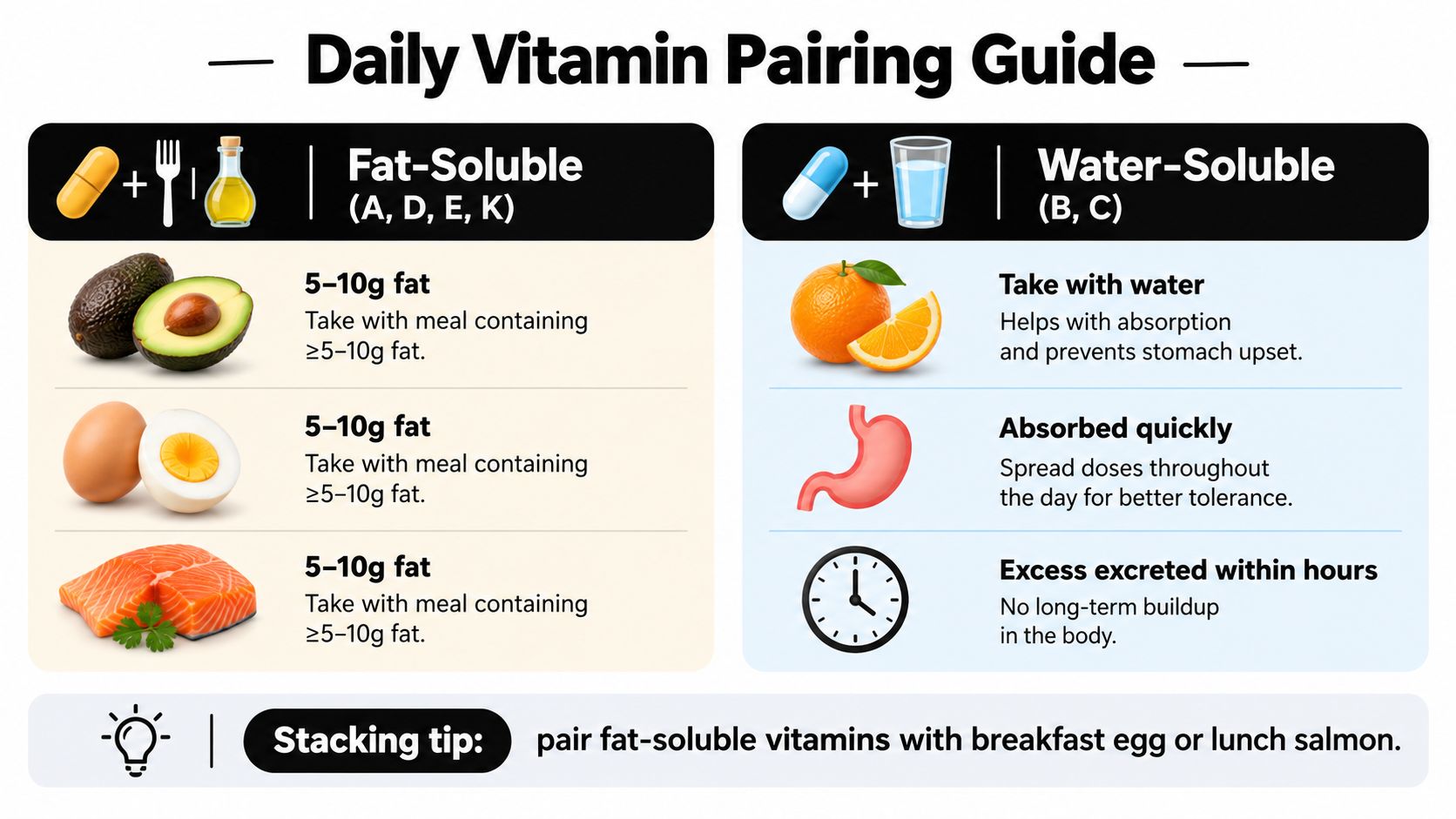
Making water-soluble vitamins easier to tolerate
B-complex products and vitamin C offer more timing flexibility. Some people tolerate them on an empty stomach, while others feel nauseated and do better with a small snack. A snack is usually more useful than a perfect schedule that causes discomfort and leads you to skip doses.
Label review matters more than elaborate timing. Check for overlap across:
- A multivitamin: May already contain several fat-soluble and B vitamins.
- Standalone D3: Can duplicate vitamin D in a multivitamin or bone formula.
- B-complex: May add substantial B6, niacin, folate, or B12.
- Fortified foods: Plant milks, cereals, drinks, and nutrition bars can contribute additional vitamins.
Minerals introduce separate timing issues. Calcium can reduce iron absorption when taken together, while prolonged zinc use can compete with copper. A pharmacist or clinician can help arrange a schedule when these nutrients are medically indicated.
A simple routine might place a multivitamin or fat-soluble supplement with breakfast containing eggs or yoghurt, then use water-soluble products with breakfast or lunch according to tolerance. If iron and calcium are both needed, separate them rather than taking both automatically in the same serving. For information about combining D3 and K2 products, see vitamin D3 and K2 benefits, then check the label and your medication list before adding anything.
Where the Simple Story Breaks Down
The popular shortcut says fat soluble equals dangerous and water soluble equals harmless. That's too neat. Water-soluble vitamins can cause problems when concentrated supplements are used for long periods or at high doses.
High-dose niacin can cause toxicity, including liver damage. Long-term vitamin B6 exposure above 100 mg per day has been associated with neuropathy concerns in the guidance described for this topic. Folate can also mask signs of B12 deficiency in older adults, allowing the underlying problem to continue unnoticed. These examples show why the word “excreted” shouldn't be treated as a safety guarantee.
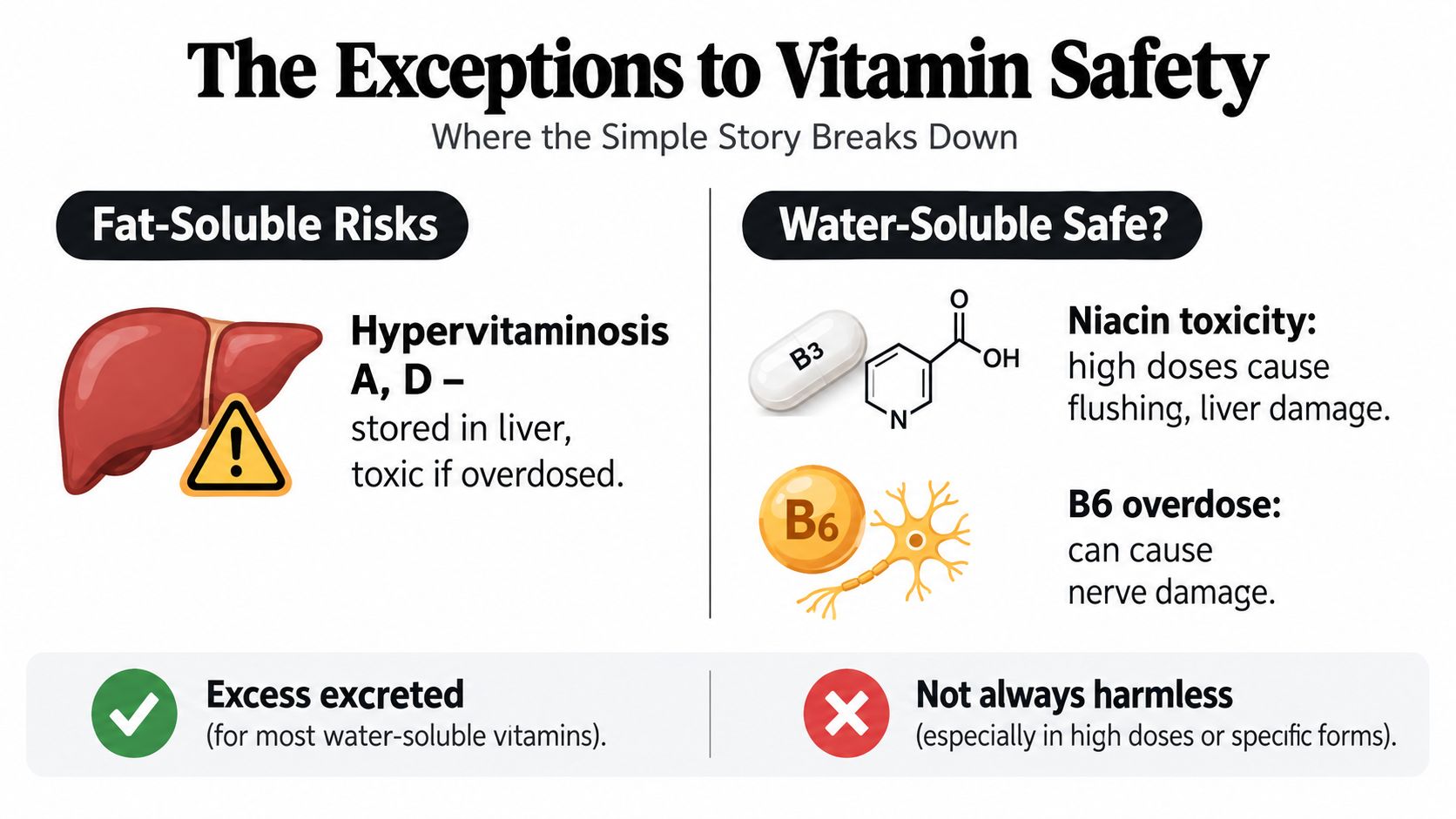
Fat-soluble vitamins need nuance too. Vitamin D insufficiency is widespread, and toxicity from ordinary dietary intake is unreported, while true hypervitaminosis A is associated mainly with excessive preformed vitamin A supplements or topical retinoid overuse, not with eating carrots. High-dose beta-carotene has also shown harm in smokers, illustrating that the chemical form and population can matter as much as the solubility category.
The better safety questions
Ask four questions before judging a product:
- What form is present? Retinol and beta-carotene aren't interchangeable in every context.
- How much is the total exposure? Add every product and fortified food that contributes the nutrient.
- How long will you take it? Storage and cumulative exposure change the risk calculation.
- Who is taking it? Age, smoking status, pregnancy, medication, digestion, and medical history can alter the balance.
If symptoms or a suspected deficiency are driving supplement use, learning what nutritional deficiency testing involves can help you discuss appropriate evaluation with a qualified professional. You can also review potential combinations in what vitamins should not be taken together before adding another product.
The useful conclusion is dose-, form-, duration-, and population-dependent. Solubility helps predict behaviour, but it doesn't replace label reading or individual assessment.
Guidance by Diet, Age, and Routine
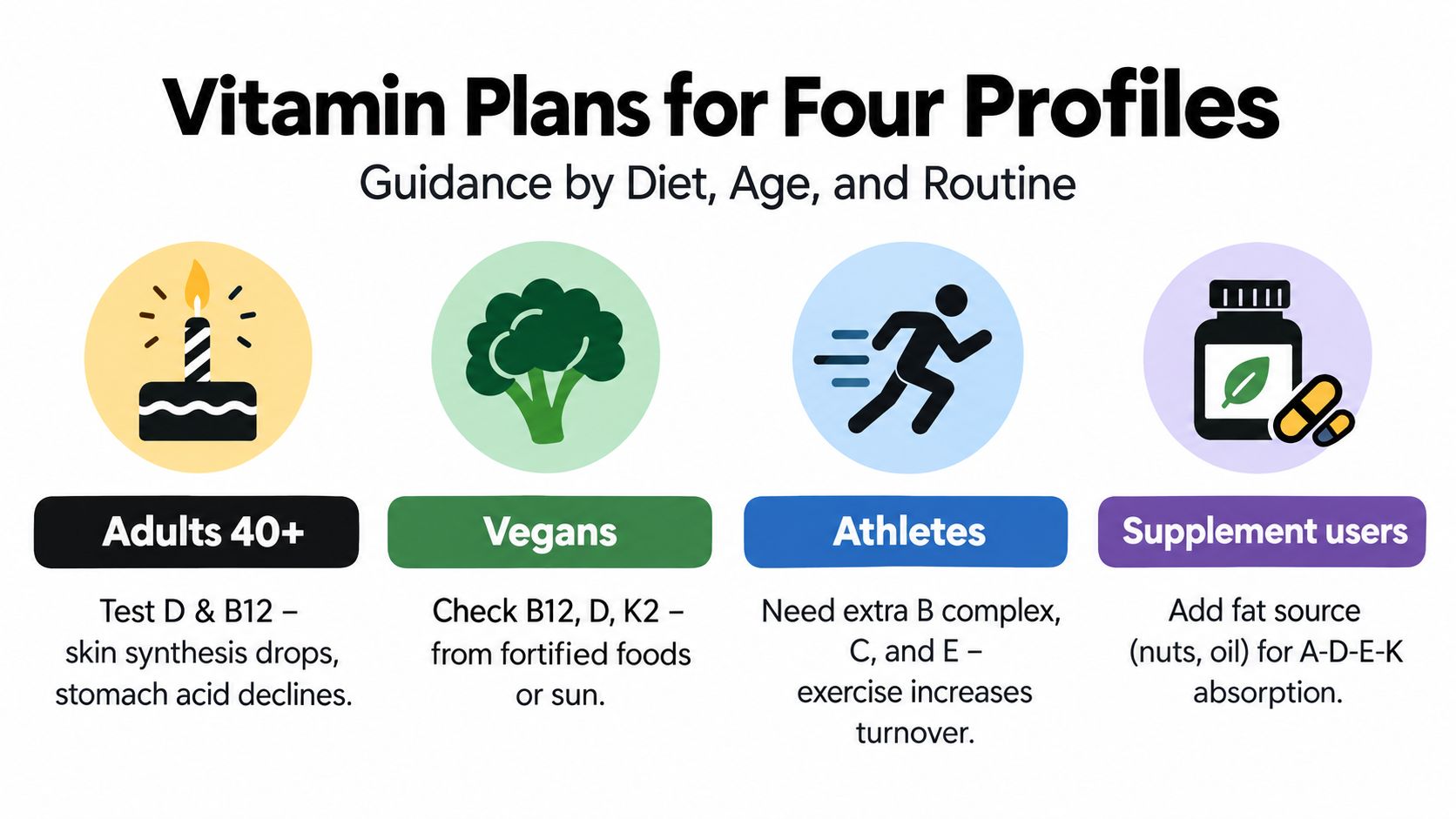
The same supplement plan won't suit every adult. A person over 40, someone eating very little fat, a plant-based eater, and a person taking several products may face completely different issues even if they're all searching for the best multivitamin.
Adults over 40
Vitamin D and B12 deserve particular attention in this group. Skin synthesis of vitamin D can decline with age, while reduced stomach acid can make it harder to release B12 from food proteins. Testing may be sensible when symptoms, diet, medication use, or medical history suggest a concern, rather than assuming every adult needs the same supplement.
Low-fat diets and post-surgery digestion
A very low-fat eating pattern can make food pairing relevant for A, D, E, and K. Include a tolerated source of fat with the meal, or ask a clinician whether an emulsified form is appropriate. Anyone who has had weight-loss surgery or has a condition affecting fat digestion should seek personalized guidance, because bile-dependent absorption may not work normally.
Plant-based diets and supplement stacks
Plant-based eaters should pay attention to B12, iodine, and riboflavin. Fortified foods can help, but relying on them without checking frequency, portion, and label content may leave gaps. Vitamin D and other nutrients also depend on sun exposure, food choices, location, and individual status.
People who stack supplements should run a short audit:
- List every product: Include multivitamins, energy powders, sleep formulas, omega-3 products, and fortified drinks.
- Mark duplicates: Look especially for A, D, E, K, B6, niacin, folate, iron, calcium, zinc, and copper.
- Check the form: Note whether vitamin A appears as preformed retinol or provitamin A carotenoids.
- Separate competing minerals: Ask a pharmacist about calcium, iron, zinc, and medication timing.
- Match the plan to evidence: Use testing or professional advice when deficiency is suspected.
Athletes may focus on energy, recovery, and performance, but more products don't automatically mean better nutrition. A varied diet, adequate energy, sleep, hydration, and training structure still shape outcomes, while supplements should address a defined need rather than fill every space on the shelf.
A Simple Rule of Thumb to Remember
Treat fat-soluble vitamins like a dinner guest who needs fat at the door. A, D, E, and K belong with a meal that includes a few grams of fat, while B-complex vitamins and C are more like daily visitors who value consistency and water.
That doesn't mean water-soluble vitamins are risk-free or that fat-soluble supplements are always inappropriate. It means the practical emphasis differs: pair the fat-soluble group with food, and avoid chronic high-dose stacking; take the water-soluble group regularly, but don't assume a larger dose is automatically useful.

Your next step is practical: review your current supplement stack for duplicate A, D, E, or K doses, then check whether your B12 and vitamin D intake fits your age, diet, digestion, and medical context.
If you're unsure which supplements fit your goals, diet, sleep, stress, exercise, or digestion, visit VitzAi.com to complete its personalised supplement quiz and review a curated plan. Use the results as a starting point for a clearer conversation with a qualified health professional, especially if you take medication or have a suspected deficiency.
This article is for informational purposes only and is not medical advice. Always consult a qualified health professional before starting any new supplement or major lifestyle change.