

How to Choose the Right Vitamins for Your Goals
Most advice on how to choose the right vitamins starts with a product list. That's backwards. The smarter approach is to audit your goal, diet, life stage, medicines and existing supplement stack before you buy anything. A larger routine isn't automatically a healthier routine, and a personalised recommendation should narrow your choices, not encourage you to collect capsules.
Why More Vitamins Is Often the Wrong Goal
A bigger supplement stack is not a better health strategy. UK dietary guidance states that a healthy, balanced diet supplies most vitamins and minerals for the average person, with vitamin D as the main common exception. Low intake across a population also does not prove that every individual has a clinical deficiency. (British Nutrition Foundation guidance)
Use that distinction to audit your stack. A multivitamin can make sense when your diet is consistently uneven, but tiredness, poor concentration, stressful work or a demanding training block do not automatically justify one. Each symptom has several possible causes, and a supplement can delay the search for the underlying problem.
Practical rule: Buy a supplement for a defined nutritional problem, not to express general anxiety about your health.
Vitamin D is the routine exception in UK guidance. Adults and children aged 5 years and older are advised to consider a daily 10 microgram supplement during autumn and winter, when seasonal sunlight exposure makes vitamin D production harder and food alone may not provide enough. (NHS vitamin D guidance)
Life stage changes the risk calculation. Pregnancy, restrictive diets, older age, absorption problems and certain medical conditions can create needs that do not apply to a healthy adult eating broadly. Anyone planning pregnancy should make prenatal selection a separate decision and seek professional guidance rather than defaulting to a general adult multivitamin. This guide on how to choose a prenatal vitamin explains why pregnancy requires its own product criteria.
The evidence also argues against buying vitamins for broad disease-prevention promises. The U.S. Preventive Services Task Force reviewed 84 randomised controlled trials and 6 cohort studies involving healthy adults without known nutritional deficiencies. It found that most vitamin and mineral supplements produced no clinically important protective effects against cardiovascular disease, cancer or all-cause mortality in that population. Evidence was insufficient to determine the overall benefits and harms of multivitamins for preventing cardiovascular disease or cancer. (USPSTF recommendation)
A personalised quiz such as VitzAI can help organise goals, diet, life stage and current products into a cleaner shortlist. It should support a stack audit, not diagnose a deficiency or replace clinical advice.
Sometimes the right choice is no supplement. Identify the gap, gate out avoidable risks, then choose the smallest useful intervention.
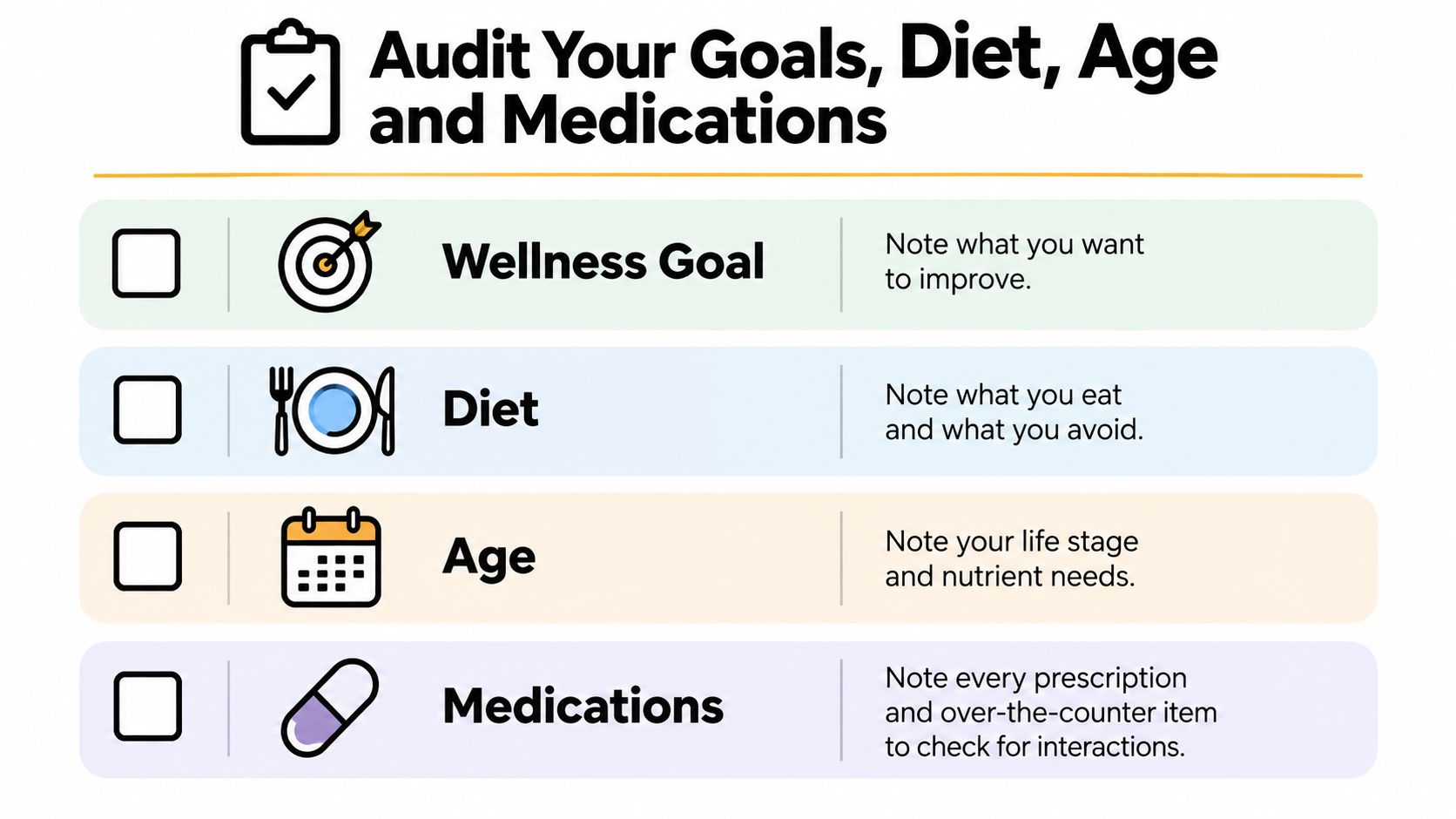
Audit Your Goals, Diet, Age and Medications
Before opening a supplement website, write a short profile. The profile should answer four questions: What are you trying to improve? What do you eat? What life stage are you in? What medicines and supplements do you already use?
Start with a concrete goal
“Better health” is too vague to guide a safe choice. Choose a specific outcome such as supporting exercise recovery, improving sleep quality, covering a restricted diet, or addressing a confirmed deficiency. Creatine monohydrate belongs in a strength or performance conversation, not automatically in a general vitamin routine. Magnesium may be relevant to dietary intake or a particular clinician-supported plan, while ashwagandha requires a different discussion about medicines, pregnancy and medical history.
A 40-year-old runner who eats little fish and avoids dairy has a different audit from a 52-year-old office worker whose main problem is poor sleep. Neither should treat low energy as proof that an “energy powder” or high-dose B-vitamin product is needed.
Examine the actual diet
Record several ordinary days, including fortified foods, protein shakes, energy powders and convenience meals. A vegan office worker may need to discuss nutrients commonly affected by food exclusion with a clinician or dietitian. A lower-carbohydrate strength trainee may eat plenty of protein while consistently missing legumes, whole grains or a broad variety of vegetables.
A multivitamin can cover several modest gaps, but it can also duplicate ingredients already supplied by fortified foods and other products. The label matters less than the combined intake.
Add age and life stage
Age, sex, pregnancy status, menopause, training load and sun exposure can change relevance. Don't use an “over 40” or “women's health” label as a substitute for personal information. The useful question is whether your current circumstances create a predictable dietary gap or a reason to seek assessment.
List every medicine
Include prescriptions, over-the-counter medicines and supplements. Proton pump inhibitors, anticoagulants, thyroid medicines and treatments for kidney or liver conditions can affect the safety of a supplement plan. Someone taking warfarin shouldn't add vitamin K or an omega-3 product casually, and someone with a medical condition affecting absorption may need clinical assessment rather than a larger over-the-counter stack.
Use this profile as your filter. If a product doesn't connect to a goal, a dietary gap, a life-stage need or professional advice, it doesn't earn a place in the basket.
Identify Gaps Versus Symptoms That Need a Clinician
Fatigue, brain fog and low mood are symptoms, not diagnoses. They may follow poor sleep, stress, inadequate food intake, infection, medication effects or a medical condition. Taking a multivitamin because you feel tired can be harmless in some cases, but it can also delay a useful review.
The right sequence is simple:
- Review the diet. Look for restricted food groups, low overall intake, limited fortified foods and patterns that make a nutrient gap plausible.
- Check risk factors. Consider pregnancy, malabsorption, relevant medicines, kidney disease, liver disease and limited sun exposure.
- Test selectively. Use laboratory testing when symptoms, history or risk factors justify it, not as a routine shopping exercise.
- Treat confirmed problems properly. A documented deficiency may require a clinician-directed dose, duration and follow-up rather than a standard multivitamin.
Routine vitamin D screening isn't recommended for healthy, asymptomatic adults because evidence is insufficient. The Endocrine Society also doesn't recommend routine 25-hydroxyvitamin-D testing in this population. When vitamin D deficiency is suspected, serum 25(OH)D is the appropriate marker. One UK clinical guideline considers below 30 nmol/L generally deficient and above 50 nmol/L generally sufficient, while recommending testing mainly for clinical signs, malabsorption, selected biochemical abnormalities or advanced kidney disease. (NIH vitamin D professional fact sheet)
A result still needs context. “Normal” doesn't automatically mean a supplement will improve your symptoms, and a low result doesn't tell you to copy somebody else's treatment dose. The appropriate response depends on the result, the suspected cause, absorption and your wider health profile.
For a useful explanation of the limits of online testing and symptom-based assumptions, see this guide to an online vitamin deficiency test. A digital quiz can identify questions to raise and risks to review. It cannot diagnose deficiency.
Seek medical input before using high-dose single nutrients, especially if you're pregnant, have kidney or liver disease, take interacting medicines or have symptoms that are new, severe or persistent.
Prioritise a Short List of Evidence-Backed Options
A good shortlist is deliberately boring. It contains only products with a stated purpose, a sensible dose, a clear duration and a reason to review or stop.
Consider three different readers. The vegan office worker in their 30s may begin with a diet review, fortified foods and clinician-supported testing where appropriate. Their shortlist might include a suitable multivitamin or specific nutrient only if the label and diet justify it, plus omega-3 if fish intake is absent and the product fits their medication profile. The point isn't to reproduce a standard vegan stack. It's to close a documented gap.
The 45-year-old strength trainee may prioritise creatine monohydrate for a clearly defined training goal, magnesium only after checking dietary intake and the supplemental dose, and omega-3 if their diet contains little oily fish. Ashwagandha may be inappropriate if the person is pregnant, has relevant medical concerns or takes interacting medicines. Mushroom blends and energy powders should face the same test as every other product. A stimulating formula doesn't become necessary because training feels difficult.
An adult over 60 focused on healthy ageing may need a medication and diet review before choosing anything. Vitamin D may be relevant according to country, season and risk profile. A multivitamin may help when food intake is consistently limited, but it isn't a treatment for an unconfirmed deficiency. Omega-3 should be judged by its actual EPA and DHA content and checked against anticoagulant use.
| Reader profile | Audit takeaways | Shortlist with dose and review |
|---|---|---|
| Vegan office worker in their 30s | Restricted diet, little or no fish, variable meal quality | Consider a targeted product only for a plausible gap. Review fortified foods and medicines first. Add omega-3 only after checking actual EPA and DHA content and interaction risk. |
| 45-year-old strength trainee | High training demand, potentially narrow food variety, performance goal | Creatine monohydrate may fit the training objective. Consider magnesium only after separating food intake from supplemental intake. Review after a defined trial rather than adding multiple recovery products. |
| Adult over 60 focused on healthy ageing | Age-related changes, possible medication use, seasonal sun exposure | Consider vitamin D according to UK guidance and personal context. A multivitamin may fit an uneven diet. Seek professional advice for suspected deficiency or absorption concerns. |
Omega-3 has no officially established recommended daily intake for EPA and DHA. The FDA advises no more than 5 grams per day of combined EPA and DHA from dietary supplements, and NIH guidance notes bleeding concerns with warfarin or other anticoagulants. Compare the actual EPA-plus-DHA amount, not merely the total fish oil. (NIH omega-3 consumer fact sheet)
For every item, write four lines: goal, dose rationale, duration and review trigger. If you can't complete all four, don't buy it yet.
Check Quality, Dose and Interactions Before You Buy
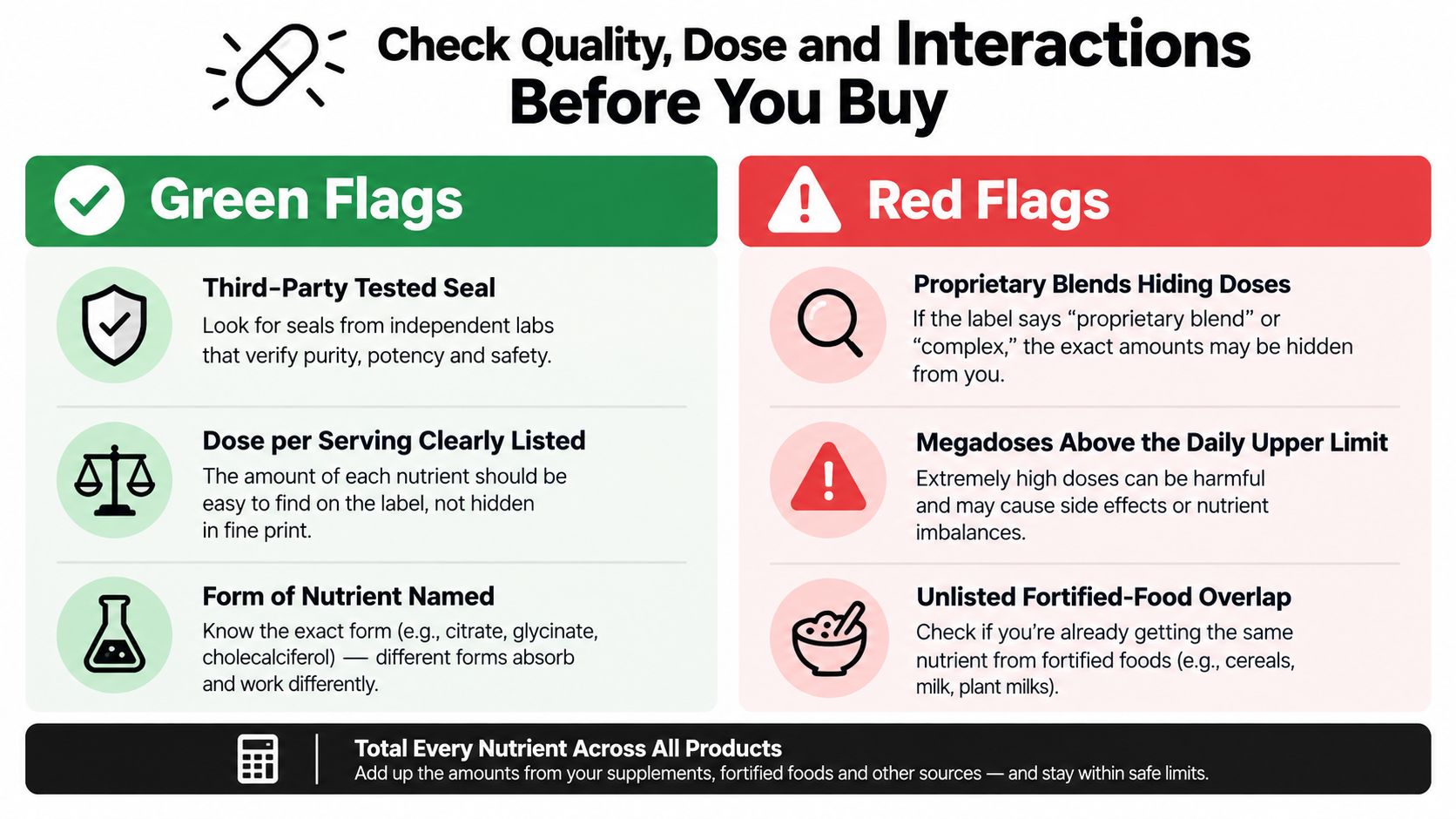
The label audit is where most supplement plans fail. People count the capsule they just purchased, but forget the multivitamin, fortified cereal, protein powder, energy drink and medicine already contributing to the same nutrient total.
Read the whole label
Write down the amount of each relevant nutrient from every product. Check the serving size, form, directions and whether a proprietary blend hides individual doses. Prefer products that clearly name the nutrient and disclose the amount supplied per serving. Third-party testing can provide an additional quality signal, but it doesn't make an unnecessary dose appropriate.
Magnesium shows why the arithmetic matters. Adult requirements generally range from 310 to 420 mg per day, varying by age, sex and life stage, while the NIH tolerable upper intake level is 350 mg per day from supplements and medicines only. Magnesium naturally present in food doesn't count toward that specific upper limit. (NIH magnesium professional fact sheet)
That doesn't mean a high supplemental dose is automatically suitable. It means you must distinguish food magnesium from supplemental magnesium and consider adverse effects, medical conditions and other products.
Screen the red flags
Before buying, check pregnancy, planned surgery, kidney disease, liver disease, smoking status, anticoagulants and other medicines. High-dose beta-carotene deserves particular caution in smokers and people at high risk of lung cancer. The USPSTF recommends against beta-carotene for cardiovascular-disease or cancer prevention because potential harm outweighs any established benefit in that context. (USPSTF evidence summary)
Check omega-3 labels for EPA plus DHA, not just fish oil weight. Check magnesium labels for supplemental magnesium. Check vitamin D labels against every other product that contains vitamin D.
A useful product-research habit is to apply the same scrutiny to supplement documentation that you'd apply when learning how to read CBD lab reports. Look for transparent ingredients, clear quantities and traceable quality information.
For combinations that may create overlap or interactions, use this practical guide to what vitamins should not be taken together. The answer isn't always “never combine them.” It's “understand the total exposure and the reason for combining them.”
A shorter, lower-dose plan is usually more rational than a broad stack. High supplement spending doesn't compensate for poor sleep, inconsistent meals or an unaddressed medical issue.
Use Personalised Guidance Without Overpromising
Personalisation is useful when it makes the decision narrower and more transparent. It becomes dangerous when it pretends to diagnose a deficiency or turns a questionnaire into permission for high doses.
A tool such as VitzAI can match a curated supplement plan to information such as age, sex, goals, diet, fish intake, exercise, sleep, stress and digestion. Treat the result as a draft, not a prescription. It should explain why a product appears, identify what information influenced the match and leave room to remove products you already take.
Run the audit before accepting the recommendation. Add your full medicine list, compare every suggested ingredient with your existing products and remove duplicates. Reassess pregnancy status, kidney or liver conditions, smoking status and any planned procedure. If your answers suggest a possible deficiency, the correct next step is a clinician or pharmacist, not a stronger product.
Personalised guidance differs from generic “one pill for everything” marketing. A useful system should help you decide what not to take, explain uncertainty and refer you away from self-treatment when the situation falls outside routine nutritional support. For broader healthy-ageing questions, a Longevity Clinics directory can help you understand what specialist medical services may be available, but a clinic assessment remains separate from a supplement quiz.
You can also explore personalised vitamins as a way to organise product choices around context rather than a generic stack. The standard remains the same: every recommendation needs a reason, a dose rationale and a safety boundary.
Track Results, Reassess and Know When to Stop
A supplement plan is a working hypothesis, not a permanent identity. Track it for 4 to 6 weeks, unless a clinician gives you a different schedule, and record enough detail to tell routine effects from coincidence.

Use a simple daily entry:
- Date and product: Record what you took and the serving size.
- Timing: Note whether you took it with food, before training or near bedtime.
- Side effects: Record stomach upset, headaches, unusual changes or anything new.
- Sleep and energy: Use consistent personal descriptions rather than chasing a perfect score.
- Weekly review: Ask whether the original goal changed, stayed the same or became less relevant.
Stop and seek clinical advice for new bleeding, jaundice, severe gastrointestinal upset, palpitations or an unexpected pregnancy. Contact a clinician before continuing any product that could interact with a medicine or worsen an existing condition.
At the review point, keep only products with a clear purpose and acceptable tolerance. Recheck the full stack every few months, especially when your diet, medicines, training or life stage changes. Escalating the dose because you haven't noticed an immediate effect is usually poor reasoning.
VitzAi.com offers a personalised supplement quiz that uses goals, diet and lifestyle information to create a curated starting plan. Visit VitzAi.com to complete an audit-first questionnaire, then review the result against your medicines, existing products and any advice from a qualified professional.
This article is for informational purposes only and is not medical advice. Always consult a qualified health professional before starting any new supplement or major lifestyle change