

Nootropic Stack UK Guide: Build One That Works
You've finished a demanding workday, but your attention is scattered, your coffee has stopped feeling effective, and a shelf of supplement bottles offers more confusion than clarity. One label promises focus, another memory, a third calm energy. The sensible question isn't “What can I add?” It's “What problem am I trying to solve, and which ingredients have earned a place?”
A well-designed nootropic stack is a small, deliberate system, not a kitchen-sink collection of capsules. UK guidance and research make that distinction especially important. Some nutrients matter when a deficiency exists, while several popular ingredients can alter brain markers without producing a meaningful improvement in everyday performance. The practical approach is to start with the foundations, choose one clear goal, and test a simple combination carefully.
What a Nootropic Stack Actually Is
A nootropic stack is a selected combination of compounds taken on a repeating schedule to support a defined mental goal. The word stack means that ingredients are layered together. It doesn't mean the combination is automatically stronger, safer, or more scientific than a single supplement.
Think of a football team. One player drives forward, another creates opportunities, and a defender prevents the whole team from becoming exposed. A useful stack works in a similar way. Caffeine may provide alertness, L-theanine may make that alertness feel smoother, and citicoline may support attention-related signalling. Each ingredient has a different job.
The beginner's mistake is choosing eleven players who all want to be the striker. Combining several stimulants, multiple choline sources, and overlapping pre-workout products can create side effects without creating better concentration. A starter protocol is usually more sensible when it contains three to five ingredients, with every addition linked to a specific outcome.
Start with the outcome
Choose the problem before you choose the product:
- Deep work: You need sustained attention and fewer distractions.
- Learning: You want support for recall, revision, or mentally demanding study.
- Calm energy: You need to stay productive without making stress or sleep worse.
Single ingredients rarely cover every part of a mental task. Attention, motivation, memory, stress tolerance, and sleep all influence one another. That's why complementary compounds can make sense, but only when the combination remains easy to understand and monitor.
Brain fog can also reflect an underlying health issue rather than a need for more supplements. If persistent symptoms are affecting work or daily life, it's sensible to review brain fog treatment options with a qualified healthcare professional.
The three useful starting points are a focus stack, a memory and learning stack, and a calm energy stack. They're templates, not fixed prescriptions. Your sleep, diet, medicines, training schedule, and response should determine what stays.
The Core Ingredients and How They Work
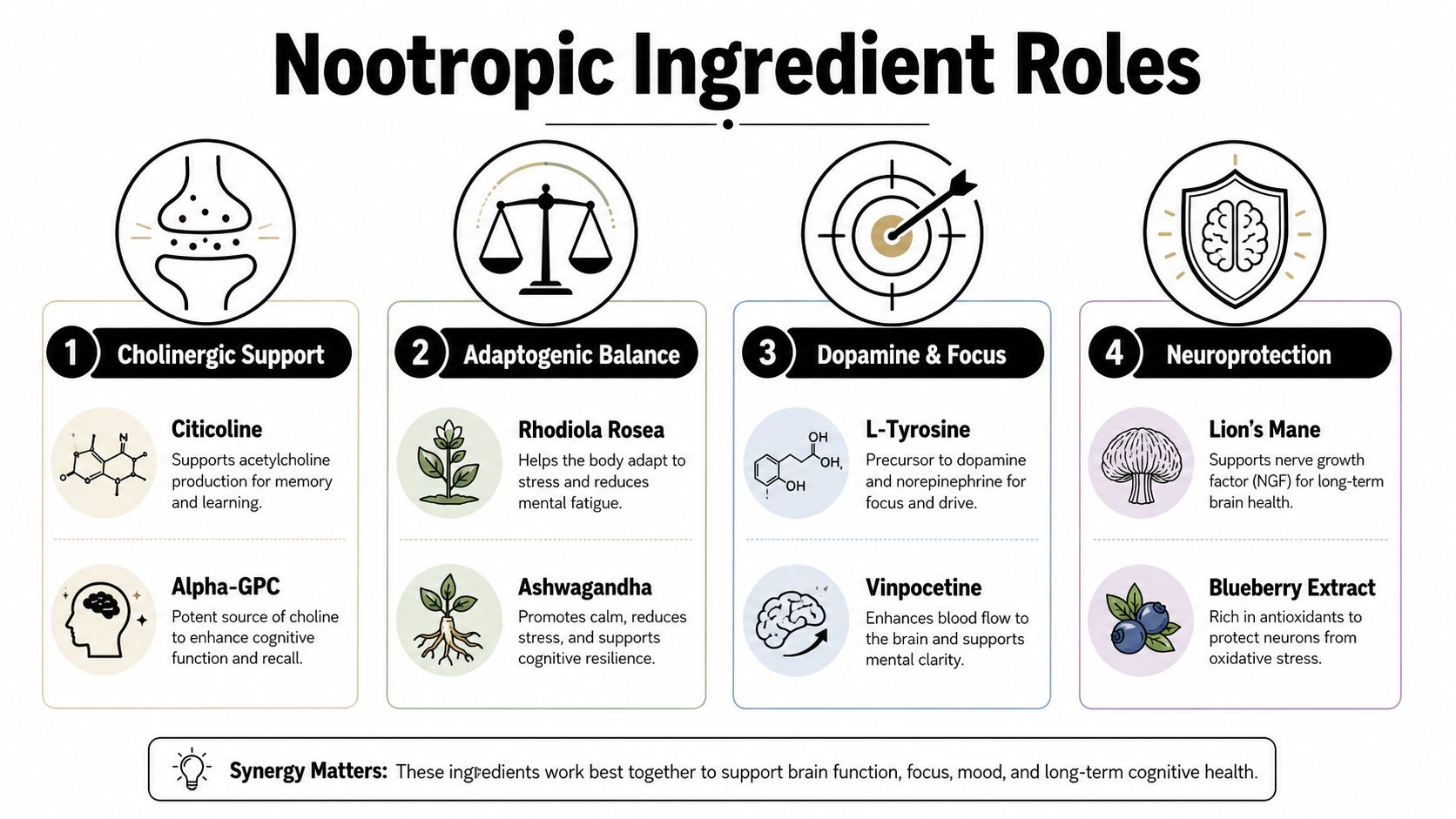
Ingredients make more sense when you group them by role rather than memorising a long shopping list. A nootropic stack usually draws from four broad categories, although the evidence within each category varies.
Cholinergic support
Citicoline and alpha-GPC provide choline-related support for acetylcholine, a chemical messenger involved in attention, learning, and memory. A simple analogy is fuel for the brain's signalling system. More fuel isn't always better, though. Using multiple choline products at once can make it difficult to identify what's helping and may increase the chance of headaches or an unsettled mood.
For a clear explanation of how choline relates to another commonly marketed nutrient, see this guide to choline and inositol. Choose one principal choline source first, rather than combining every product that lists it.
Stimulant and focus ingredients
Caffeine is the accelerator. L-theanine acts more like the brake and steering system, helping some people experience alertness with less tension. The pair is useful for a focused work block, but it still counts as a stimulant strategy, so timing matters.
L-tyrosine is often used in products aimed at mental performance under pressure. Its role is different from caffeine, but that doesn't mean every person needs both. Start with the simplest option that matches your day.
Adaptogenic balance
Adaptogens such as ashwagandha, rhodiola rosea, and Panax ginseng are generally used for stress resilience rather than instant stimulation. Treat them as training support for a system under pressure, not as an emergency replacement for sleep.
Some people find these ingredients calming, while others find particular products activating. That individual variation is one reason to introduce them separately.
Neuroprotection and long-term support
Lion's mane mushroom, omega-3 DHA, and B vitamins are usually positioned as long-game maintenance ingredients. They're less like an espresso shot and more like maintaining the machinery that supports normal function.
Evidence is uneven. The NHS advises treating confirmed B12 deficiency with hydroxocobalamin, while UK clinical guidance warns against using B12 to improve mood, memory, or energy when deficiency isn't present. If symptoms or diet raise the question, check your vitamin B12 levels through appropriate clinical support rather than guessing with a high-dose product.
Racetams deserve extra caution. Piracetam is unlicensed as a medicine in the UK, and compounds such as aniracetam may be sold as unregulated research chemicals. They shouldn't be treated like ordinary wellness supplements.
Sample Stacks for Focus Memory and Energy
The right stack depends on the kind of day you're trying to handle. A software designer facing a long writing session has a different need from someone revising a language course or managing a stressful workload.
The templates below use the amounts specified for each goal. They're starting points for discussion and self-observation, not personal medical instructions.
Three goal-led nootropic stacks compared
| Ingredient | Deep Focus | Memory & Learning | Calm Energy |
|---|---|---|---|
| Caffeine | 100 mg before the hardest work block | Not required | 50 to 100 mg before 2pm |
| L-theanine | 200 mg with caffeine | Not required | Optional only if caffeine feels edgy |
| Citicoline | 250 mg | 250 mg, or use alpha-GPC instead | Not required |
| Alpha-GPC | Not required | 300 mg alternative to citicoline | Not required |
| B-complex | One serving, if appropriate | Not required | Not required |
| Lion's mane | Not required | 1000 mg | Not required |
| Bacopa monnieri | Not required | 300 mg, standardised to 50 percent bacosides | Not required |
| Omega-3 DHA | Not required | 1000 mg from fish or algae oil | Not required |
| Rhodiola rosea | Not required | Not required | 200 mg |
| Magnesium glycinate | Not required | Not required | 200 to 400 mg in the evening |
| Ashwagandha KSM-66 | Not required | Not required | 300 mg |
For deep focus, take the caffeine and L-theanine before the most demanding block, with citicoline and a B-complex only if they fit your broader nutritional needs. This is the most acute, workday-oriented option.
The memory and learning template contains ingredients intended for consistent use rather than an immediate sensation. Bacopa, lion's mane, and omega-3 DHA should be judged by longer-term function and tolerability, not by whether you feel a dramatic change after one capsule.
The calm energy version suits a tired professional who wants support without turning the whole day into a stimulant cycle. Keep caffeine earlier, use magnesium in the evening, and remember that ashwagandha and rhodiola won't compensate for chronic sleep loss or excessive workload.
Selection rule: If two ingredients appear to do the same job, remove one before adding a third.
Dosing Timing and a Realistic Daily Routine
A practical routine should fit around breakfast, meetings, commuting, training, and bedtime. Timing also helps you identify cause and effect. If you take five new ingredients at once, a good or bad day tells you very little.
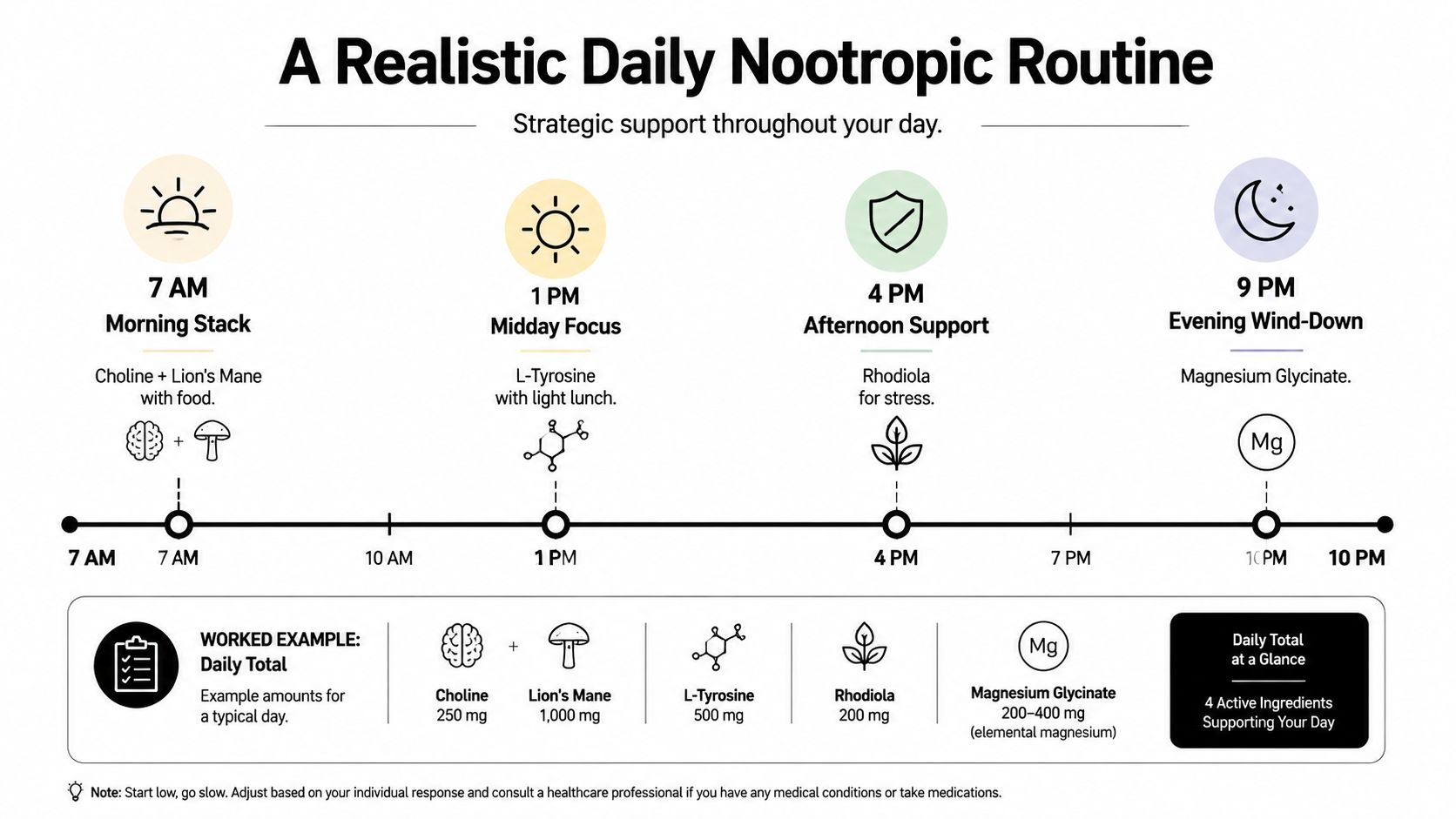
A worked example
A busy professional might organise a trial day like this:
- Morning with breakfast: Take a chosen choline source and lion's mane if they're part of the plan. Taking food-based supplements with a meal can make the routine easier to maintain.
- Before the hardest work block: Pair caffeine with L-theanine if the focus template suits you. Keep the dose modest enough that you can still work without feeling wired.
- Midday: Avoid automatically adding another stimulant. Check whether the morning dose is still active and whether tiredness reflects poor sleep, inadequate food, or a genuine need for support.
- Early afternoon: If rhodiola or L-tyrosine is being tested, place it early enough to observe whether it affects evening relaxation.
- Evening: Magnesium glycinate belongs in the wind-down portion of a calm-energy routine. You can find broader guidance on the best time to take vitamins, although individual products and medicines may require different advice.
The NHS recommends that most healthy adults sleep around 7 to 9 hours per night and advises avoiding smoking, alcohol, tea, and coffee for at least 6 hours before bedtime. See the NHS insomnia guidance for the full sleep recommendations.
Introduce one new ingredient at a time. Begin at the low end of the product's suggested amount, wait 5 to 7 days before increasing, and record focus, anxiety, digestion, and sleep. If sleep quality drops, reduce the stimulant burden or stop the newest addition before changing everything else.
What the Evidence Actually Supports
Marketing often treats “cognitive benefit” as one category. It isn't. A supplement can change a blood marker, alter an electrical brain measurement, or influence a laboratory task without improving the thing you care about, such as finishing a report, remembering names, or staying accurate during revision.
Recent UK-linked evidence highlights that gap. A plant-based nootropic study reported pronounced neurophysiological changes but no significant improvement in reaction time or choice accuracy. A UCL study of lion's mane found no significant overall improvement in cognition or mood compared with placebo. Those findings don't prove that every person will experience nothing, but they do argue against treating biomarker movement as proof of better everyday performance.
A more useful evidence filter
Ask two questions before buying:
- Were humans tested? Laboratory findings and animal research can guide hypotheses, but they don't establish a useful personal outcome.
- Was the outcome relevant? A task measuring attention or verbal recall is more informative for a knowledge worker than an isolated blood marker.
| Ingredient | Evidence type | Outcome measured | Practical verdict |
|---|---|---|---|
| Citicoline | Human research and formulation evidence | Attention and cognitive performance outcomes | Consider as a targeted option, not a compulsory foundation |
| Caffeine with L-theanine | Human acute-use research | Alertness and attention-related tasks | A logical focus pairing for some adults |
| Lion's mane | Human trials with mixed findings | Cognition, mood, and neurophysiological measures | Don't assume biomarker changes equal better performance |
| Bacopa monnieri | Human research | Memory-related outcomes over sustained use | More suitable for a patient trial than a quick fix |
| Omega-3 | Dietary and supplement research | Outcomes vary by population and baseline intake | Food intake and personal need should guide use |
| Racetams | Uneven and legally sensitive evidence | Variable cognitive outcomes | Avoid unregulated self-experimentation |
Creatine also deserves an ingredient-specific assessment rather than automatic inclusion. UK policy discussion has included a scientific opinion on creatine and improved cognitive function, showing that claims need to be judged by the exact ingredient and outcome, not by the general label “nootropic”.
Interactions What Not to Stack Together
The most common stacking error is duplication. A person may drink coffee, use an energy powder, take a pre-workout, add green tea extract, and then swallow a stimulant capsule without counting the total effect.
Do not combine these patterns casually
- Cumulative caffeine: Add up coffee, energy drinks, pre-workouts, green tea, yerba mate, and stimulant nootropics. A high combined load can worsen anxiety, palpitations, tolerance, and sleep.
- Repeated choline sources: Don't combine citicoline, alpha-GPC, choline bitartrate, and several multi-ingredient products without checking labels. Headaches or a low mood may signal that the stack is too crowded.
- Late activating ingredients: Stimulant nootropics, high-dose B vitamins, and some adaptogens may interfere with winding down when taken too late.
- Unsupervised medication combinations: Racetams alongside anticholinergic medicines require medical input. St John's wort, 5-HTP, and prescription antidepressants also need GP or pharmacist guidance.
- Overlapping blood-thinning effects: Fish oil, ginkgo biloba, and garlic supplements may be relevant around medicines or surgery. Review the combination with a clinician rather than relying on an infographic or product label.
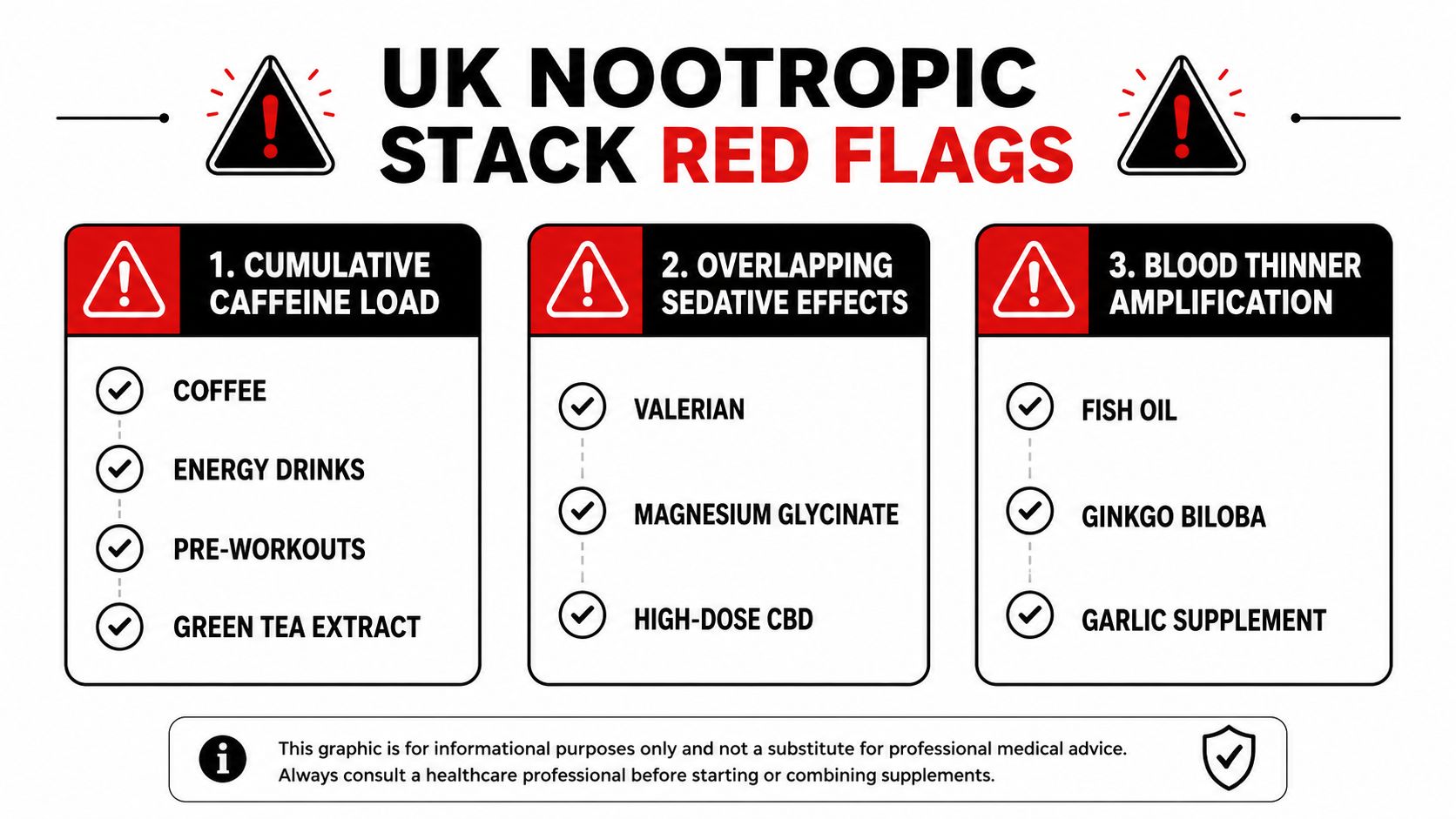
A useful label audit takes only a few minutes. Write down every coffee, powder, capsule, and fortified drink you use in a normal week, then highlight repeated ingredients. The guide to what vitamins should not be taken together can help you identify further overlap, but medicines and diagnosed conditions still require professional review.
Personalising Your Stack by Age Sex and Lifestyle
A nootropic stack should reflect your actual week, not an ideal routine. Age, sex, diet, training load, stress, medication, and sleep can all change which gaps deserve attention first.
Magnesium is a useful UK-specific example. A UK-wide analysis found that 15% of males and 12% of females had magnesium intakes below the Lower Reference Nutrient Intake, with the shortfall rising to about 19% among people in their twenties. The figures come from analysis of British adults, and they support checking food intake before treating magnesium as a universal cognitive enhancer.
Use life stage as a starting filter
- Adults over 35: Review magnesium-rich foods, sleep, alcohol, and training recovery before adding several focus products.
- Plant-heavy diets: Arrange appropriate B12 assessment, particularly if brain fog, fatigue, or altered sensation is present. Don't use B12 as a memory booster when deficiency isn't established.
- Women who may have iron deficiency: Check iron status through suitable clinical advice before treating tiredness with stimulants.
- Men over 50: Consider the wider role of creatine, diet, exercise, and cardiovascular health rather than building a supplement plan around alertness alone.
- Women over 40: Hormonal changes, sleep disruption, stress, and iron or B12 status may matter more than another stimulant capsule.
Run a weekly self-audit
Ask yourself:
- Did I sleep within the NHS-recommended 7 to 9 hour range?
- Is my caffeine helping, or am I using it to hide exhaustion?
- Does my diet provide oily fish or suitable plant alternatives?
- Am I taking a prescription medicine, preparing for surgery, pregnant, or breastfeeding?
- Can I name the specific outcome each supplement is meant to support?
The British Dietetic Association advises UK adults to eat two portions of fish per week, including one oily portion, and doesn't recommend omega-3 supplements for the general population. Its guidance also limits certain higher-mercury fish to one portion per week for other adults, including those who are breastfeeding. Read the BDA omega-3 guidance before treating fish oil as an automatic part of a stack.
Building a Smarter Stack That Lasts
The most useful stack is usually the one you can explain, measure, and maintain. Start with one ingredient, record your response for at least two weeks, and remove anything that fails the test. A supplement that produces no meaningful benefit, or regularly damages sleep, hasn't earned a permanent place.
Review the plan every few months. Work deadlines, training volume, diet, stress, and daylight exposure change, especially through a long UK winter. A simple routine built around sleep, food, movement, and one targeted addition will usually be easier to manage than a complicated formula with overlapping ingredients.
Personalisation can also reduce duplication across coffees, energy powders, mushroom blends, multivitamins, creatine, magnesium, ashwagandha, and omega-3 products. VitzAI's questionnaire generates a personalised supplement report based on factors such as age, sex, lifestyle, goals, and current supplement use, giving you a structured way to review those choices.
Visit VitzAi.com to complete the questionnaire and receive a personalised supplement report that connects your goals with a more organised stack. Use it to review possible nutrient gaps, identify overlapping products, and decide what deserves a careful trial with professional guidance.
This article is for informational purposes only and is not medical advice. Always consult a qualified health professional before starting any new supplement or major lifestyle change